


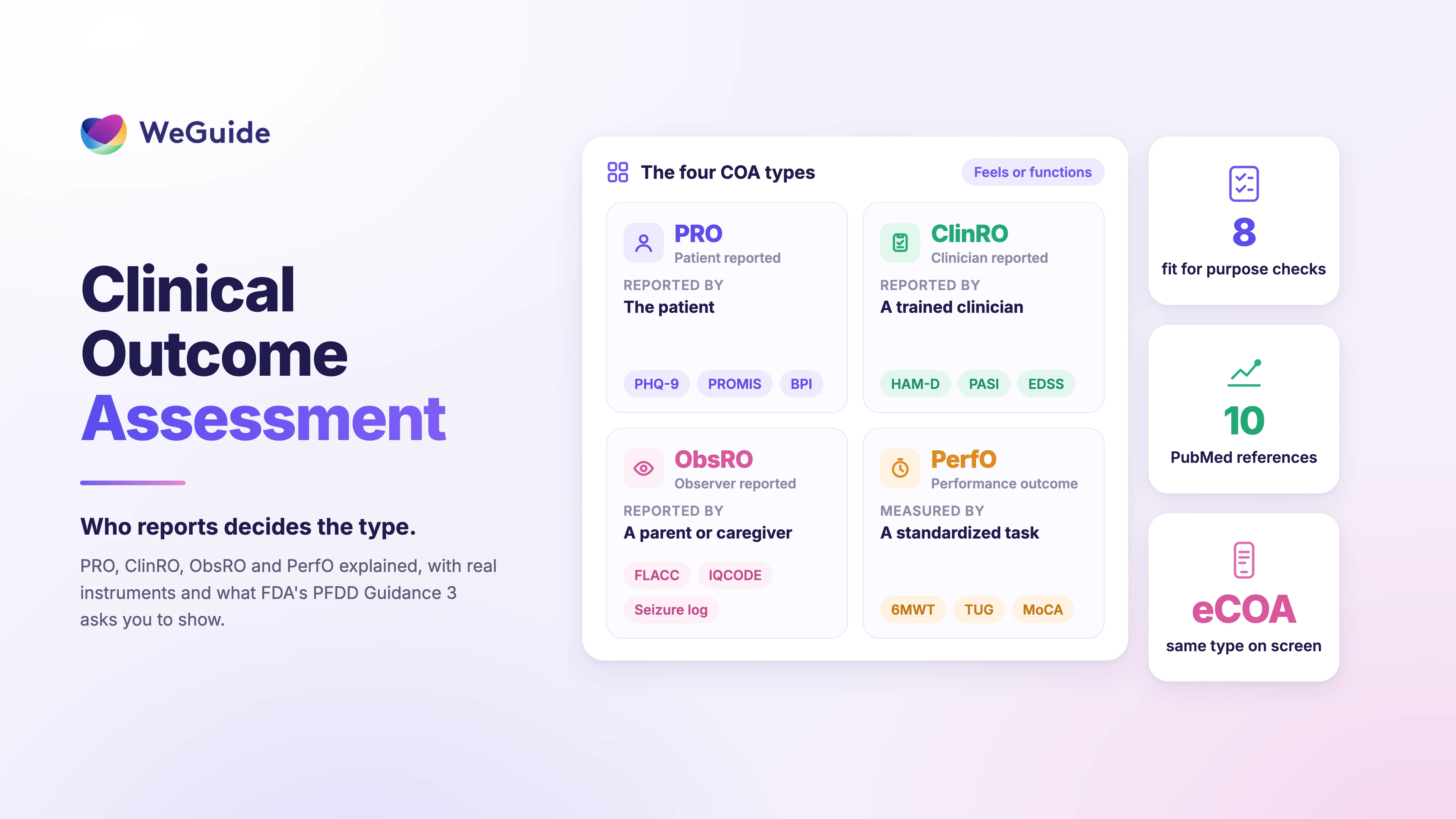


A clinical outcome assessment (COA) is a measure of how a patient feels, functions or survives that can be influenced by human choices, judgment or motivation. COAs come in four types, patient reported, clinician reported, observer reported and performance outcomes, and most efficacy endpoints are built on assessments of this kind. That is the clinical outcome assessment definition COA clinical trials work from: a measure shaped by a person's report, rating or effort, not a lab value.
What separates the four types is who reports the result and whose judgment shapes the score. That single question decides whether a measure is a PRO, a ClinRO, an ObsRO or a PerfO, and it drives most of the design choices that follow.
This guide covers each type with real instrument examples, how to choose a type for a concept you want to measure, what FDA's final PFDD Guidance 3 asks a sponsor to show, how a COA turns into an endpoint, and what changes when you collect COAs as electronic clinical outcome assessment (eCOA).
Key Takeaways
- Four types, one question: who reports the result and whose judgment shapes it decides whether a COA is a PRO, ClinRO, ObsRO or PerfO.
- Only the patient can report symptoms: pain, fatigue and nausea need a PRO, because a clinician or observer can only rate what they can see.
- Electronic capture doesn't change the type: a diary on a phone is still a PRO, but a measure taken by a sensor falls under FDA's digital health technology guidance.
- Fit for purpose is about evidence: FDA's final PFDD Guidance 3 (October 2025) asks for a clear concept of interest, a context of use and evidence that scores mean what you claim.
- Endpoints need more than an instrument: timing, missing data and what counts as a meaningful change are planned before the first participant (PFDD Guidance 4, still a draft).
What is a clinical outcome assessment?
A clinical outcome assessment is a standardized way of measuring a clinical outcome, meaning an outcome that describes how a person feels, functions or survives. The FDA and NIH BEST glossary says that assessment can come from a clinician, the patient, a non clinician observer or a performance based task, which gives the four COA types. FDA's COA FAQ uses the same "feels, functions, or survives" framing.
The ISPOR task force report by Walton and colleagues (2015) adds the practical point: when clinical assessments are used as trial outcomes, they are called COAs. The same report explains what makes them different from other measures. A COA can be influenced by human choices, judgment or motivation.
COA vs biomarker. A biomarker, such as a blood glucose value or a hemoglobin level, is subject to little if any patient motivation or rater judgment. A pain rating, a depression interview score or a walking distance depends on how the patient answers, how the rater judges or how hard the patient tries on the day. That is why COAs need their own evidence about what the scores mean.
COA vs eCOA. eCOA is how you collect a COA (on a phone, tablet or web portal), not a fifth type. Our guide to eCOA vs ePRO covers where the collection terms overlap.
In practice, a COA is usually a full instrument: the items or tasks, the instructions, the recall period and the scoring rules. That is why most teams start by searching an instrument library before they consider writing anything new.
The four types of COA at a glance
The four types differ by who provides the report: the patient, a trained clinician, a non clinician observer, or the patient's performance on a standardized task. The table below gives clinical outcome assessment examples for each type, with instruments you can look up in our library.
| Type | Who reports | Judgment involved | Best for | Examples in our library |
|---|---|---|---|---|
| Patient reported outcome (PRO) | The patient, without interpretation by anyone else | The patient's own | Symptoms and experiences only the patient knows | PROMIS, PHQ-9, Brief Pain Inventory |
| Clinician reported outcome (ClinRO) | A trained health care professional | Clinical judgment | Signs a clinician can observe and interpret | HAM-D, PASI, EASI, CGI |
| Observer reported outcome (ObsRO) | A parent, caregiver or other non clinician who sees the patient in daily life | None beyond observation | People who can't reliably self report, such as infants or people with cognitive impairment | FLACC, IQCODE, an observer completed seizure log |
| Performance outcome (PerfO) | The result of a standardized task the patient performs | Standardized administration | Function, when recall of daily function is unreliable | 6 minute walk test, Timed Up and Go, SPPB, Trail Making Test |
Sources: BEST glossary, which itself lists PASI and HAM-D as ClinRO examples and FLACC as an ObsRO example, and FDA's PFDD Guidance 3.
The four types in detail
Each type answers a different measurement problem. The sections below define each one, show where it fits and flag the mistakes that come up most often in protocols.
Patient reported outcomes (PRO)
A patient reported outcome is a report that comes directly from the patient about their health, without amendment or interpretation by a clinician or anyone else. BEST is explicit that symptoms and other concepts known only to the patient can only be measured by a PRO. Pain intensity, fatigue, nausea, itch and mood all belong here.
A PRO doesn't have to be self completed on paper or a screen. An interviewer can read the questions aloud and record the answers, as long as they record only what the patient says. PFDD Guidance 3 also notes that help from another person to accommodate a disability, such as reading items aloud or marking a form for the patient, still counts as a PRO when the assistant adds no interpretation.
Typical examples are generic and domain measures like PROMIS, the PHQ-9 for depressive symptoms and the Brief Pain Inventory. In oncology, symptomatic adverse events are increasingly collected as PROs too. Our guide to PRO-CTCAE in oncology trials covers that case. Outside trials, the same instruments are used as PROMs in routine care.
Interpreting a change in a PRO score is its own question. If you need a starting point for what size of change matters, try the MCID calculator, but the threshold you use in a trial still has to be justified for your population.
Clinician reported outcomes (ClinRO)
A clinician reported outcome (ClinRO) is a measurement made by a trained health care professional after observing a patient's health condition. Clinician reported outcome measures range from imaging reads to structured rating scales. It involves clinical judgment or interpretation, and BEST notes that a ClinRO can't directly assess symptoms known only to the patient.
The ISPOR good practices report by Powers and colleagues (2017) describes three kinds of ClinRO:
- Readings: a clinician reads and interprets a test result, such as an imaging read.
- Ratings: a clinician rates signs or behaviors against a scale, such as the HAM-D or the MADRS for depression, PASI for psoriasis or EASI for eczema.
- Clinician global assessments: an overall judgment of severity or change, such as the CGI.
Neurology relies heavily on ClinROs, for example the NIHSS in stroke and the EDSS in multiple sclerosis.
One clarification for searchers: "ClinRO" is the measurement concept. It is not the same thing as the dermatology "CLINRO score" that appears in some search results.
Observer reported outcomes (ObsRO)
An observer reported outcome is a report from someone other than the patient or a health professional, usually a parent or caregiver who sees the patient in daily life. It involves no medical judgment. BEST describes ObsROs as particularly useful for patients who can't report for themselves, such as infants or people who are cognitively impaired. Examples include the FLACC pain behavior scale, the IQCODE for cognitive decline reported by an informant, and an observer completed seizure log.
ObsRO vs proxy report. This distinction matters for regulators. A proxy reported measure asks someone to report on the patient's experience as if they were the patient, and PFDD Guidance 3 says proxy measures are discouraged by FDA. When valid self report isn't possible, FDA recommends an ObsRO of the patient's observable behavior instead. A parent rating how much pain a child feels is a proxy report. A parent counting crying episodes, or rating observable pain behaviors with FLACC, is an ObsRO.
ObsROs carry extra weight in rare disease research. The ISPOR rare disease report by Benjamin and colleagues (2017) notes that approximately 75% of rare diseases affect children, and it recommends strategies such as adapting existing instruments and using more than one COA type to measure the same construct.
Performance outcomes (PerfO)
The performance outcome definition is short: a PerfO is a measurement based on a standardized task that the patient actively performs according to a set of instructions. Performance outcome measures therefore score what a person does, not what they report. A trained administrator can run the task, or the patient can complete it independently, for example on a device. The ISPOR PerfO report by Edgar and colleagues (2023) says PerfOs reflect physical, cognitive, sensory and other functional skills, and are valuable when the concept suits task performance or when patients are limited in their capacity for self report.
Physical PerfOs include the 6 minute walk test, Timed Up and Go, the SPPB and the Nine Hole Peg Test. Cognitive PerfOs include the MoCA, the Trail Making Test and word recall tests. To put a single result in context, our physical performance norms tool gives published reference values to compare against.
Timed tasks in an app, such as reaction time or word list recall, are performance style measures you can schedule between clinic visits. WeGuide's remote cognitive testing runs tasks like these at home, next to questionnaires. They complement established instruments rather than replace them, and clinic tests stay the reference point.
Is a wearable measure a PerfO?
Usually not. PFDD Guidance 3 says that when an app or web tool collects a PRO, ObsRO, ClinRO or PerfO, the source of measurement is still the patient, observer, rater or standardized task. When the source of measurement is a digital health technology itself, such as a mobile sensor, FDA points to its Digital Health Technologies for Remote Data Acquisition guidance (December 2023) instead.
So a supervised 6 minute walk test is a PerfO, while free living step count from a wrist sensor is a digital measure. The evidence work for those measures is covered in our guides to digital endpoints and digital health technologies.
Looking for a COA for your protocol?
Search our library of clinical outcome assessments by clinical area, with scoring notes and links to the original sources.
How to choose the right COA type for your endpoint
Start from what matters to patients and who can observe it, then pick the type that measures it most directly. PFDD Guidance 3 sets out a roadmap that works as a sequence:
- Name the meaningful aspect of health. This is the part of the patient's experience the treatment should change, such as lower limb function.
- Define the concept of interest. This is what the COA actually measures. FDA's own example: for lower limb function, a PerfO such as the 6 minute walk test might measure functional walking capacity, which is only one aspect of that function.
- Write the context of use. BEST defines it as a statement that fully describes how a tool is used and for what purpose. In practice, state the population, trial design, endpoint role and setting.
- Pick the type. A symptom only the patient knows needs a PRO. An observable sign that needs expertise needs a ClinRO. A patient who can't self report needs an ObsRO, not a proxy. Function that patients can't recall accurately suits a PerfO.
- Search before you build. Check the instrument library, FDA's Clinical Outcome Assessment Compendium of COAs seen in specific contexts of use, and licensors such as Mapi Research Trust. Building a new COA means concept elicitation and cognitive interviews, as set out in the ISPOR content validity reports, part 1 and part 2.
- Plan for children and accessibility. PFDD Guidance 3 covers pediatric populations and accessibility explicitly. For pediatric trials, FDA's own example pairs a caregiver ObsRO that records scratching behavior with a PRO for itch intensity in children who can self report.
The table below applies that logic to common concepts.
| Concept example | Best first choice | Why | Example instrument |
|---|---|---|---|
| Pain intensity in adults | PRO | Only the patient knows how much it hurts | Brief Pain Inventory |
| Depression severity rated at visits | ClinRO | Needs a structured clinical interview and judgment | HAM-D, MADRS |
| Pain in nonverbal children | ObsRO | Caregivers can see pain behaviors; the child can't report | FLACC |
| Walking capacity | PerfO | A standardized task gives a direct measure | 6 minute walk test |
| Cognitive decline noticed by family | ObsRO | Family members see change in daily life over time | IQCODE |
| Daily function in older adults | PerfO plus PRO | Task performance and the patient's own view answer different questions | SPPB plus a PRO measure |
What makes a COA fit for purpose? (FDA PFDD Guidance 3)
For any FDA clinical outcome assessment decision, the test is fit for purpose: the concept of interest and context of use are clearly described and there is enough evidence to support how you interpret and use the scores. That is the core of PFDD Guidance 3, which FDA finalized in October 2025.
It is the third of four guidances in FDA's patient focused drug development series. Guidances 1 to 3 are final, and Guidance 4, on endpoints, is still a draft. Guidance 3 also limits its scope to how patients feel or function, not how they survive.
Section IV of the guidance lists the evidence a sponsor should assemble. As a checklist in plain language:
- The type suits the concept: you can explain why this concept is best measured by a PRO, ClinRO, ObsRO or PerfO.
- Coverage: the COA captures all the important parts of the concept of interest.
- Administration: the COA is administered appropriately.
- Understanding: respondents understand the instructions and items or tasks as intended.
- Scoring: the scoring method suits the concept, including rules for missing items.
- No unrelated influence: scores aren't driven by things outside the concept, such as culture and language, recall, fatigue and burden, or how the COA was implemented.
- Measurement error: error is small enough for the intended use.
- Meaning: scores correspond to the meaningful aspect of health you named at the start.
Do you have to use an FDA qualified COA?
No. FDA's COA FAQ answers this directly: sponsors aren't required to use only qualified COAs. The COA Qualification Program is voluntary, and a qualification applies only within a specific context of use.
Modifying an existing COA
Translating an instrument, shortening it or changing its mode of administration are all modifications, and each needs evidence that the scores still mean the same thing. Plan that work early. For translations, see our guide to linguistic validation. For moving a paper instrument onto a screen, see paper to electronic migration.
Where COA translation differs by type
Translation needs differ by type. The good practices paper by McKown and colleagues (2020) recommends a translation process that follows the PRO standard closely, but with targeted cognitive interviewing, for example patients for patient facing text in ClinRO measures and the intended observers for ObsRO measures.
From COA to endpoint
A COA is the instrument, and the endpoint is the precise variable you analyze, such as change from baseline at week 12 in a total score. FDA's PFDD Guidance 4 (draft, April 2023) covers that step, and its topics give a useful structure for planning.
Choosing what you analyze
Define the endpoint exactly: which score, at which time point, compared how. The draft Guidance 4 covers selecting and justifying endpoints, constructing a COA based endpoint, trial duration and the timing of assessments. Powers and colleagues add that ClinRO endpoints should sit in a clear endpoint hierarchy, so it is obvious which result supports which claim.
Missing data and burden
Every missed questionnaire or skipped visit is missing data, and the analysis plan has to say how it will be handled. The draft Guidance 4 pairs estimation and missing data with minimizing participant burden, because burden drives missingness. Fewer, shorter and better timed assessments help. Our guide to patient burden covers the practical levers.
What counts as a meaningful change?
A statistically significant difference isn't enough on its own. The draft Guidance 4 asks sponsors to interpret meaningful score differences and meaningful score regions, ideally anchored in what patients say matters to them. Plan that evidence during development, not after unblinding.
Keeping clinician ratings reliable
ClinRO scores are only as consistent as the raters. Powers and colleagues list eight good measurement practices for ClinROs, including clear context of use, content validity and intra and inter rater reliability. Rater training and calibration are standard good practice, and some sponsors use central or blinded raters to reduce site differences.
Rater training, certification and central rating are usually specialist services, so check what each vendor includes. If you are comparing systems, our list of questions to ask eCOA vendors about rater support helps separate software from services.
Running PerfO tasks consistently
PerfO scores depend on how the task is run. The 2026 ISPOR implementation report by Bush and colleagues (online ahead of print) names risks such as disease progression, learning effects, encouragement effects and sensory or cognitive limitations. It recommends administrator training, standardized documentation and, where useful, digital tools for reliable collection, and it warns that no analytic technique can compensate for inconsistent implementation. Practice rounds before the first scored session and alternate forms across sessions are common ways to limit learning effects.
Collecting COAs electronically
Moving a COA onto a phone, tablet or web portal changes how it is collected, not what type it is, but it is a modification you need to plan and document. PFDD Guidance 3 is clear that the source of measurement stays the patient, observer, rater or task.
What changes on screen
Electronic collection adds a timestamp at entry, scheduled reminders, scoring at the source and one dataset instead of transcribed paper. The evidence on how ePRO compares with paper is in our guide to eCOA vs paper.
Equivalence when you migrate from paper
The ISPOR report by O'Donohoe and colleagues (2023) sets out the evidence needed to support comparability across modes of data collection for PROs, and Mowlem and colleagues (2024) describe best practices for electronic implementation and migration. Our guide to eCOA validation explains how that plays out in a study. Device choice matters too. See BYOD or provisioned devices.
Questions to ask an eCOA platform about each COA type
Each COA type puts different demands on a system. Use these questions when you assess any platform:
| COA type | Ask |
|---|---|
| PRO | Is the validated text imported exactly as supplied? Does the item layout match the licensed version? Is the recall period shown? Can reminders be scheduled? |
| ClinRO | Can clinicians enter ratings in the same system? Is the rater recorded with each score? Is there an audit trail for changes? |
| ObsRO | Does the observer have a separate login? Is the reporter recorded with each entry, so observer and patient data aren't mixed? |
| PerfO | Is timing precise on real devices? Are there practice rounds and alternate forms? Is the device model stored with each result? |
Records also need to be attributable to the person who made them, which is where 21 CFR Part 11 and the ALCOA+ principles come in.
How WeGuide supports clinical outcome assessments
WeGuide is the participant facing layer: it delivers the COAs your protocol specifies in one app, next to eConsent and wearable data. It is a patient engagement and data collection platform for clinical research and care, covering screening, eConsent, ePRO and PROMs, wearable data and patient registries on participants' own phones.
- Questionnaires and scoring: the form builder offers over 15 types of questions, conditional logic, calculated fields or scoring systems, preview and testing before go live, and multilingual forms from uploaded translations.
- An instrument library: more than 300 clinical outcome assessments grouped by clinical area, each with scoring notes and links to the original source.
- Remote cognitive tasks: nine memory and reaction time tasks of two to five minutes each, with a practice round before the first scored session, alternate word lists across sessions, and raw trials, device model and time of day stored next to the summary scores.
- Wearable data: a native Garmin integration collects raw accelerometer and gyroscope data at 25 Hz on supported models, and WeGuide reads Apple Health and Health Connect. See wearable data.
- Daily PRO diaries at scale: the BRACE trial had over 6,800 participants and over 90% participant adherence, and participants logged daily symptoms in the WeGuide app.
WeGuide is TGA registered Class I medical device software (ARTG 355337), is ISO/IEC 27001:2022 certified and supports HIPAA, GDPR and 21 CFR Part 11 aligned workflows.
Questions we frequently get asked about clinical outcome assessments
What is an example of a clinical outcome assessment?
Each COA type has well known examples. The PHQ-9 depression questionnaire is a PRO. The Hamilton Depression Rating Scale, scored by a trained clinician, is a ClinRO. The FLACC pain scale, completed by someone watching a child's behavior, is an ObsRO. The 6 minute walk test is a PerfO. Each one measures how a patient feels or functions.
What are the four types of COA?
The four types are patient reported outcomes (PRO), clinician reported outcomes (ClinRO), observer reported outcomes (ObsRO) and performance outcomes (PerfO). They differ by who reports the result and whose judgment influences it: the patient, a trained clinician, a non clinician observer, or the patient's performance on a standardized task.
What is the difference between a ClinRO and an ObsRO?
A ClinRO is completed by a trained health care professional and involves clinical judgment, such as rating psoriasis with PASI. An ObsRO is completed by a parent, caregiver or other non clinician who sees the patient in daily life, and it records observable signs or behaviors without medical judgment, such as a seizure log.
What does ClinRO stand for?
ClinRO stands for clinician reported outcome: a measurement made by a trained health care professional who observes the patient and applies clinical judgment, such as rating psoriasis severity with PASI. It is not the same thing as the dermatology "CLINRO score" that appears in some search results.
Is a patient reported outcome the same as a COA?
No. A patient reported outcome is one of the four types of COA. Every PRO is a COA, but a COA can also be a clinician rating, an observer report or a performance task. PROs are the only type that can measure symptoms known only to the patient, such as pain or fatigue.
What is the difference between eCOA and ePRO?
eCOA is the electronic collection of any COA type, including clinician, observer and performance outcomes. ePRO is the electronic collection of patient reported outcomes only, so ePRO is one part of eCOA. Our guide to eCOA vs ePRO covers where the terms overlap.
Is a proxy report an ObsRO?
No. A proxy report asks someone to answer as if they were the patient, for example rating how much pain a child feels. FDA discourages proxy measures in PFDD Guidance 3. An ObsRO records what the observer can actually see, such as crying episodes or pain behaviors, and FDA recommends it when the patient can't self report.
Is a wearable or sensor measure a clinical outcome assessment?
Usually not. When a sensor itself is the source of measurement, such as step count from a wrist device, FDA treats it under its digital health technology guidance rather than as a COA. An app that delivers a questionnaire or a timed task keeps the COA type. Our guide to digital endpoints covers sensor measures.
What is the difference between a COA and a biomarker?
A COA can be influenced by human judgment, choice or motivation: how the patient answers, how the rater judges or how hard the patient tries. A biomarker, such as a lab value or an imaging measure, is subject to little if any of that influence. Both can support endpoints, but they need different evidence.
Can COAs support labeling claims?
They can, when they are fit for purpose in their context of use. FDA's PFDD Guidance 3 describes the evidence a sponsor needs so that COA scores can support endpoints FDA reviews. Qualification through FDA's voluntary COA Qualification Program is not required, and the strength of the evidence for your context of use is what counts.
How can an eCOA platform tell patient entries from caregiver entries?
The usual design is a separate login for each reporter, or a recorded reporter field saved with every entry, backed by an audit trail. That keeps ObsRO data apart from PRO data and shows who reported what. Decide this in the protocol, because mixing patient and caregiver answers in one record makes the data hard to interpret.
What is the PFDD guidance series?
FDA's patient focused drug development series has four methodological guidances. Guidance 1 covers collecting comprehensive and representative input from patients, Guidance 2 covers methods to identify what is important to patients, Guidance 3 (final, October 2025) covers selecting, developing or modifying fit for purpose COAs, and Guidance 4 (still a draft) covers turning COAs into endpoints.
Plan the COAs for your next study with WeGuide
Tell us your endpoints and instruments, and we will show you how questionnaires, tasks, consent and wearable data run in one participant app.
Book a demoNo pressure, just a conversation.

