

.svg)


Halfway through a global Phase III trial, a sponsor gets a regulator's query. Show us the evidence that the electronic clinical outcome assessment (eCOA) participants completed on their own phones produces the same data as the validated paper version. The team realises no one documented equivalence testing for the BYOD app. Recruitment pauses. The dataset for an interim analysis sits in limbo.
That scenario plays out more often than the industry admits. The reason isn't carelessness. It's that "eCOA validation" gets used to describe four genuinely different activities, and confusion between them creates regulatory risk later in the trial.
This guide breaks down what eCOA validation actually means, the four work streams it covers, who's responsible for each, and what FDA, EMA, ICH and TGA expect to see. If your team is starting an electronic clinical outcome assessment programme, planning a paper to digital migration, or preparing for an audit, this is the primer to share around the table. We've built medical form builder tools and run multilingual eCOA across studies like the BRACE Trial, so we'll share what works in practice, not just what the guidelines say.
A quick note before we go further. "ECOA" is also the abbreviation for the US Equal Credit Opportunity Act, a consumer finance regulation. We're not talking about that. Throughout this article, eCOA refers to electronic clinical outcome assessment in clinical trials.
Key Takeaways
- Validation is four jobs, not one eCOA validation bundles four genuinely different activities: linguistic validation of translations, equivalence between paper and digital versions, system validation of the software, and psychometric validation of the instrument. Treating them as one is the most common mistake and the source of validation gaps at audit time.
- Match the role to the activity. Responsibility is shared. The sponsor owns the overall strategy and is accountable to regulators, the CRO often runs execution, the platform vendor handles system validation and migration support, and the instrument copyright holder owns the underlying scale and its translations. A platform can validate its system but not the instrument running on it.
- Regulators want evidence, not assertions. FDA, EMA, ICH and TGA publish guidance rather than a single rule book, and "we use a validated platform" does not pass muster on its own. The validation file must show what was done, by whom, against which standard, and how it ties back to the protocol.
- Faithful migration first. Most paper-to-digital work doesn't need a full equivalence study if you keep the instrument design unchanged and run cognitive debriefing. Minor changes need debriefing only; moderate changes may need a small comparison study; major changes need a full equivalence study. Confirm licensing before you start.
- BYOD is the default for most PROs. Bring-your-own-device and provisioned devices are both acceptable, but they need different equivalence evidence. For most validated PROs, BYOD now has enough evidence to be the default, with provisioned hardware reserved for performance-based tasks where screen size genuinely changes the test.
- Know who owns the instrument. Psychometric validation is almost always the instrument developer's job. If you use validated tools like PROMIS, EQ-5D, SF-36 or PHQ-9, that work is already published; your job is to use the instrument as licensed, not to revalidate it. Novel trial-specific instruments are the exception.
What is eCOA validation in clinical trials?
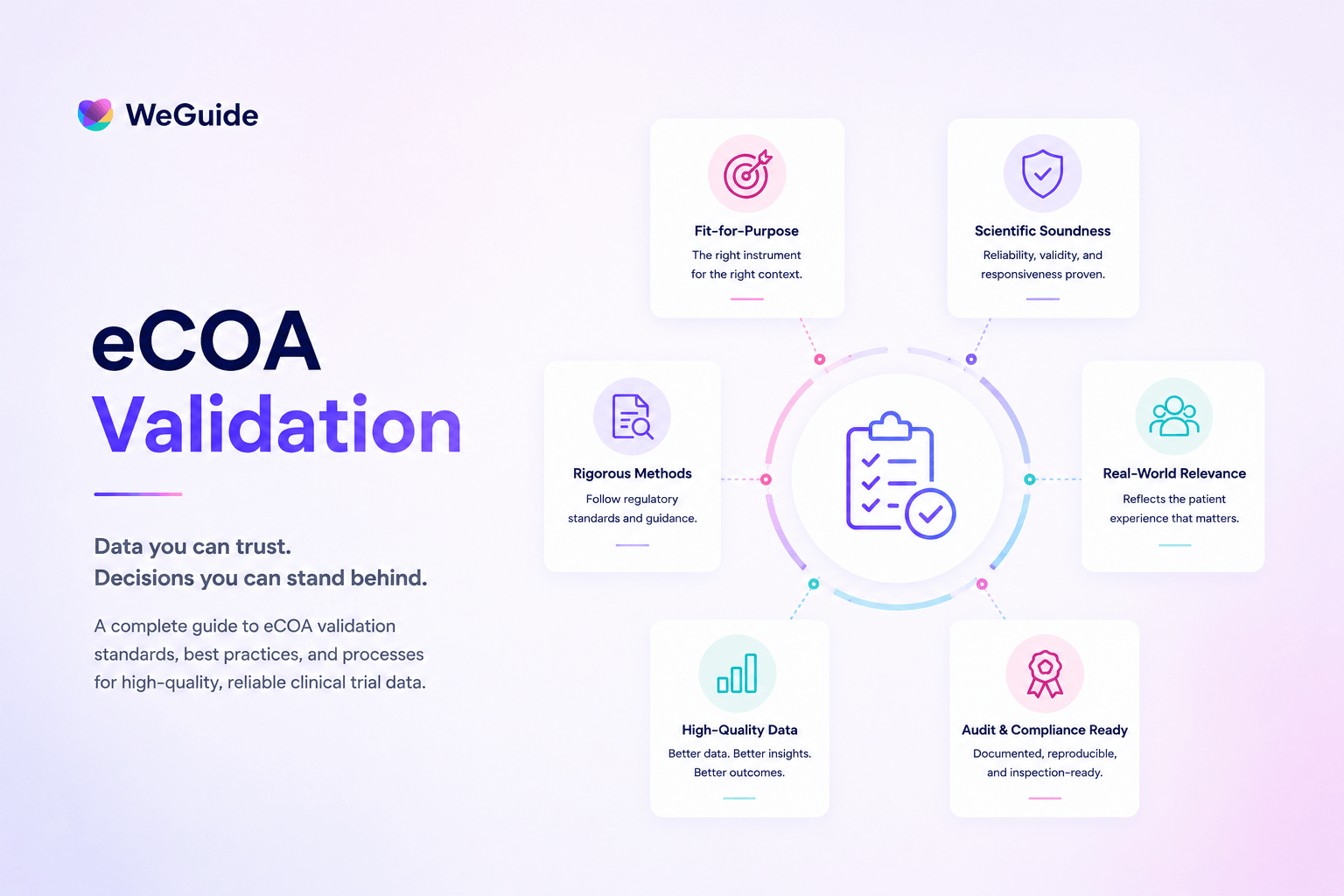
eCOA validation is the body of evidence that proves an electronic clinical outcome assessment collects data that's accurate, fit for purpose, and equivalent to the original paper or validated source. It covers four areas: linguistic validation of translations, equivalence between paper and digital versions, system validation of the software, and psychometric validation of the underlying instrument.
Each area answers a different question. Linguistic validation asks whether a Spanish version of a depression scale measures the same construct as the English original. Equivalence asks whether the digital form behaves like the paper form participants completed in the published validation studies. System validation asks whether the software handling the data is reliable, secure and audit ready. Psychometric validation asks whether the instrument itself is a good measure of what it claims.
Mixing these up is the most common mistake. A platform vendor can validate its system. It can't validate the depression scale running on it.
The four types of eCOA validation
Treating validation as one job hides the work. Here's how the four streams differ in scope, ownership and the evidence regulators expect.
Linguistic validation
Linguistic validation is the first stream of eCOA validation, and it makes sure a translated instrument measures the same thing as the original. The standard process includes two independent forward translations into the target language, reconciliation, back translation into the source language, expert review, and cognitive debriefing with native speakers in the target country. The MAPI Research Trust's ePROVIDE platform holds many of the gold standard instruments and licenses translations under copyright.
At scale, inconsistent translation creates measurement error. If "feeling blue" gets rendered literally in Mandarin, it won't pick up depressive symptoms. A fit for purpose multilingual platform lets you run the linguistic validation work alongside a study build rather than as a parallel project.
When the BRACE Trial enrolled 6,000 participants across five countries during the COVID-19 pandemic, multilingual surveys had to work for clinicians and families in Australia, the UK, Spain, the Netherlands and Brazil. WeGuide partnered with Murdoch Children's Research Institute to deploy translated forms participants understood in their own language, contributing to over 90% adherence. That's linguistic validation paying off in retention, not just compliance.
Equivalence and migration validation
eCOA equivalence proves a digital version of a paper instrument produces the same scores as the original. It matters most during eCOA migration, when you're moving an instrument that was psychometrically validated on paper to a phone, tablet or web form. The ISPOR ePRO Good Research Practices Task Force sets the de facto standard. Their recommendations distinguish between minor changes (font, navigation), moderate changes (response option layout) and major changes (different mode, like interview to self report). Each level needs more evidence.
For minor changes, cognitive debriefing with five to ten participants is usually enough. For major changes, you might need a full equivalence study comparing paper and electronic versions in the same population. Screen size equivalence sits inside this work too, especially for BYOD studies where participants use phones of different dimensions.
Skipping this step is the source of most "we got pulled up by the regulator" stories.
System validation
eCOA system validation covers the software collecting the data. The relevant frameworks are 21 CFR Part 11 (US), Annex 11 (EU), ICH E6(R2) Good Clinical Practice, and GAMP 5 for risk based computerised system validation. Together they require:
- A documented audit trail of every change to a record
- Electronic signatures with attribution
- Secure access controls and user management
- Data integrity across the full record lifecycle
- Validated processes for system updates
The same controls apply to any electronic informed consent module running on the platform, since regulators treat eConsent and eCOA as parts of the same computerised system. System validation is the platform vendor's responsibility. Sponsors should ask for the validation summary, the IQ/OQ/PQ documentation, and evidence of ongoing change control. If the vendor can't produce these on request, that's a red flag before signing the contract.
Psychometric validation
Psychometric validation, sometimes written up as patient reported outcome validation, is about the instrument itself. It covers content validity (whether the instrument measures the construct it claims), reliability (whether it produces consistent results), and responsiveness (whether it detects change when something changes). The FDA's PRO Guidance for Industry and the broader Patient Focused Drug Development (FDA PFDD) series set the expectations for instruments supporting labeling claims, which is why ePRO validation evidence often gets bundled with COA evidence in regulatory submissions.
Psychometric validation is almost always the instrument developer's job, not the sponsor's or the platform's. If you're using validated assessment tools like PROMIS, EQ-5D, SF-36, PHQ-9 or similar, the psychometric work is already done and published. Your job is to use the instrument as licensed for patient reported outcomes collection, not to revalidate it.
The exception is a novel instrument developed for a specific trial. That work belongs to the sponsor, often with academic partners, and takes years.
Want to see how validated digital forms work in practice? WeGuide's Form Builder lets research teams build, translate and version control electronic clinical outcome assessments without writing code.
Who is responsible for eCOA validation?
eCOA validation is a shared responsibility between four parties. The sponsor owns the overall validation strategy and is accountable to regulators. The CRO often runs the day to day execution. The eCOA platform vendor handles system validation and supports migration. The instrument copyright holder owns the underlying scale and provides validated translations through services like ePROVIDE.
Mixing the roles up is where things go wrong. The most common confusion is assuming the platform validated the instrument because it validated the system. Those are separate jobs. A clear responsibility matrix early in protocol planning saves rework at audit time.
Validation typeSponsorCROPlatformInstrument ownerLinguisticApproves strategyCoordinatesHosts contentProvides translationsEquivalenceOwns evidenceRuns studiesBuilds digital versionReviews if requiredSystemAudits vendorVerifies setupPerforms validationNot involvedPsychometricConfirms instrument fitNot involvedNot involvedOwns evidence
What regulators expect from eCOA validation
Regulators don't run a single eCOA validation rule book. They publish guidance, and sponsors are expected to translate it into a fit for purpose eCOA validation plan. The big four to know:
- FDA: The 2009 Patient-Reported Outcome Measures: Use in Medical Product Development to Support Labeling Claims guidance is still the anchor FDA eCOA guidance document. The Patient Focused Drug Development (PFDD) series adds detail on instrument selection and qualification.
- EMA: The reflection paper on health related quality of life measures sets European expectations.
- ICH: E6(R2) Good Clinical Practice is the global GCP baseline, including computerised systems.
- TGA: For Australian trials, the Therapeutic Goods Administration aligns broadly with ICH GCP and expects sponsors to apply equivalent rigour locally.
- ISPOR ePRO Task Force: Not a regulator, but the ePRO Systems Validation Good Practices Task Force is the practical reference most teams cite for eCOA validation evidence.
What they share is one expectation: evidence, not assertions. "We use a validated platform" doesn't pass muster on its own. The eCOA validation file needs to show what was done, by whom, against which standard, and how it ties back to the protocol.
Build and version eCOA forms
See how teams build, translate and version-control electronic outcome assessments on WeGuide's no-code form builder.
eCOA validation for paper to digital migration
Most eCOA validation work in practice is migration work, also known as paper to electronic migration. You're taking an instrument that was validated on paper and moving it to a phone, tablet or web form. The order matters.
- Confirm licensing. Many gold standard PROs are copyrighted. Check whether your intended use needs a paid licence and whether the copyright holder has approved digital migration. ePROVIDE is the main hub.
- Choose your migration scope. Faithful migration keeps every element identical: same wording, same response options, same recall period. Adaptation changes something. Faithful migration needs less equivalence evidence.
- Build the digital version. Match font, layout and navigation as closely as the device allows. Design for the smallest screen size you'll deploy on.
- Run cognitive debriefing. Show the digital form to five to fifteen participants from the target population. Watch where they hesitate, ask them to explain their answers, document any confusion.
- Decide on equivalence evidence. Minor changes need cognitive debriefing only. Moderate changes might need a small comparison study. Major changes need a full equivalence study.
- Finalise documentation. Write up the migration report, sign off, and file it before first patient first visit.
Mid-study eCOA migration is allowed but harder. Regulators will want to see why you couldn't wait, what additional eCOA validation evidence you generated, and how the change affects the study endpoints. If you can avoid mid-study migration, do.
Planning a paper to digital migration? WeGuide handles instrument licensing, multilingual rollouts, and equivalence testing for global trials. We share a working example at the end of this guide.
BYOD vs provisioned device eCOA validation
BYOD ePRO validation is the part of eCOA validation that trips up the most teams, so it deserves its own section. Bring your own device (BYOD) means participants complete the eCOA on their own phone. Provisioned device means the sponsor ships a tablet. Both are acceptable. The validation evidence differs.
Provisioned devices are predictable. You know the screen size, the OS version, the input method. Equivalence testing is simpler.
BYOD is messier. Participants have iPhones, Android phones, different screen sizes, different OS versions, different accessibility settings. The ISPOR ePRO Task Force position is that BYOD is acceptable when:
- The instrument has been tested across a representative range of devices
- The digital design adapts to different screen sizes
- A fallback (web version, provisioned device) exists for participants without a suitable phone
- Equivalence has been demonstrated for at least the major device categories
For most validated PROs, BYOD now has enough evidence behind it to be the default. The exception is performance based assessments where screen size genuinely changes the test, like timed visual response or cognitive tasks with images. Those usually still need provisioned hardware.
The cost benefit is clear. BYOD removes the logistics of shipping, charging and tracking devices. It's why most decentralised trials have moved to it.
How WeGuide approaches eCOA validation
WeGuide's role in eCOA validation is the platform side: system validation, equivalence support, and the technical infrastructure for multilingual deployment. We don't validate the instruments themselves. That's the copyright holder's job, and we don't pretend otherwise.
What we bring:
- Multilingual track record at scale. The BRACE Trial spanned five countries and multiple languages. The INHERIT multilingual COVID-19 study engaged CALD communities across Australia. Building translated forms is in our daily workflow, not a special project.
- Documented system validation. We're TGA Class I certified medical device software, ISO 27001:2022 compliant, and the platform supports GCP aligned data collection with audit trails, electronic signatures and 21 CFR Part 11 friendly controls.
- Versioning that survives mid-study changes. When protocols evolve, our clinical trial technology keeps each consent and form version traceable, with the audit trail regulators expect.
- Partnership with linguistic validation providers. We don't do forward and back translation in house. We work with specialist providers and ePROVIDE licensed content to bring translations into the platform cleanly.
Honestly, eCOA validation done well takes a sponsor, a CRO, a platform and an instrument owner working from a shared plan. We're one piece of that. If your team needs help mapping out the plan, we're happy to compare notes.
Conclusion
eCOA validation covers four jobs, not one. Linguistic, equivalence, system, and psychometric. Treating them as one is how validation gaps appear at audit time. Three things to take away:
- Roles before activities. Decide who owns each validation type before kick off. Sponsor, CRO, platform, and instrument copyright holder all have different jobs.
- Evidence over assertion. Regulators want documented validation, not "we use a validated platform." Build the file as you go.
- Faithful migration first. Most paper to digital work doesn't need a full equivalence study if you keep the instrument design unchanged and run cognitive debriefing.
If you're planning a global trial, a registry, or any study where eCOA validation needs to hold up to FDA, EMA, ICH or TGA scrutiny, the WeGuide team has been doing this across paediatric trials, vaccine studies and population cohorts for over a decade. Have a chat with us about your protocol. We'll be honest about what we can validate and where you'll need other partners.
For more on the underlying methods, our eCOA vs ePRO comparison covers when each applies and how the validation requirements differ.
Planning a global eCOA rollout?
Talk through your protocol with the WeGuide team. We'll be honest about what we can validate and where you'll need other partners.
Book a demoNo pressure, just a conversation.

