Home
Solutions
for Research
Randomised Controlled Trial (RCT)
Decentralised Clinical Trial (DCT)
Real World Evidence (RWE)
Observational Research
Patient Registry
Population Health / Cohort Study
Movement Study
Wearable Device Study
Genetic Research
Citizen Science
for Healthcare
PREMs/PROMs
Telehealth
Clinical Interventions
Patient Engagement
Employee Wellbeing
Sleep Apnoea Testing
Our Platform
Our Platform
From Protocol to Patient Engagement Program in Minutes.
Form Builder
Effortless form creation for your health program.
Patient Education
Educational material that matters, when it matters.
Multi-language
Engage with every participant, no matter the language.
Screening
Clinical trial screening made easy.
eConsent
Simplify Consent for Clinical Trials.
Wearables
Wearable data collection without the hassles.
Analytics
Actionable Analytics for your collected health data.
Integration Engine
Healthcare Integrations made easy, using our Integration Engine.
Program Builder
From Protocol to Patient Engagement Program in Minutes.
Garmin Integration
Collect health data from Garmin devices, without extra build work.
Portfolio
Blog
About Us
Our Vision and Beliefs
View of Vision and Beliefs
View Our Vision
Our team
Meet the team of digital health experts behind WeGuide
View Our Team
Contact us
Organise a Demo
WeGuide Health Blog
The WeGuide mission is to constantly be creating, challenging and inspiring - on this page you'll find out latest industry trends, announcements and product updates.
Patient Registries and Real World Evidence
A focused guide to how patient registries work as a real world evidence source, where regulators accept registry evidence, and what makes registry data fit for RWE.
Read post
eConsent for Patient Registries: A Practical Guide
A practical guide to eConsent for patient registries, covering dynamic and broad consent, reconsent, withdrawals, the features that matter, and the compliance and ethics behind long term registry consent.
Read post
Disease Registry: Types, Examples, and How They Work
A clear guide to disease registries: what they are, how they differ from patient registries, the main types with examples, and how they support research and drug development.
Read post
Patient Registry vs Clinical Trial: Key Differences
A clear comparison of patient registry vs clinical trial, covering design, intervention, data, duration, and regulatory role, with guidance on when to run a registry study and how the two work together.
Read post
Rare Disease Registries: Why They Matter and How to Run One
A practical guide to rare disease registries: what they are, why they matter for natural history and drug development, the challenges of small dispersed populations, and how to run one well.
Read post
How to Build a Patient Registry: A Step-by-Step Guide
A practical, step by step guide to building a patient registry, covering objectives, governance and consent, the data model, technology, recruitment, and long term sustainability.
Read post
How to Choose Patient Registry Software: A Buyer's Guide
A practical buyer's guide to choosing patient registry software, covering the features that matter, build vs buy, compliance, and the questions to ask a vendor.
Read post
What Is a Patient Registry? A Complete Guide
A practical guide to patient registries for sponsors, advocacy groups, and research teams, covering the definition, why they matter, the main types, how they differ from trials, how one works, and how to choose registry software.
Read post
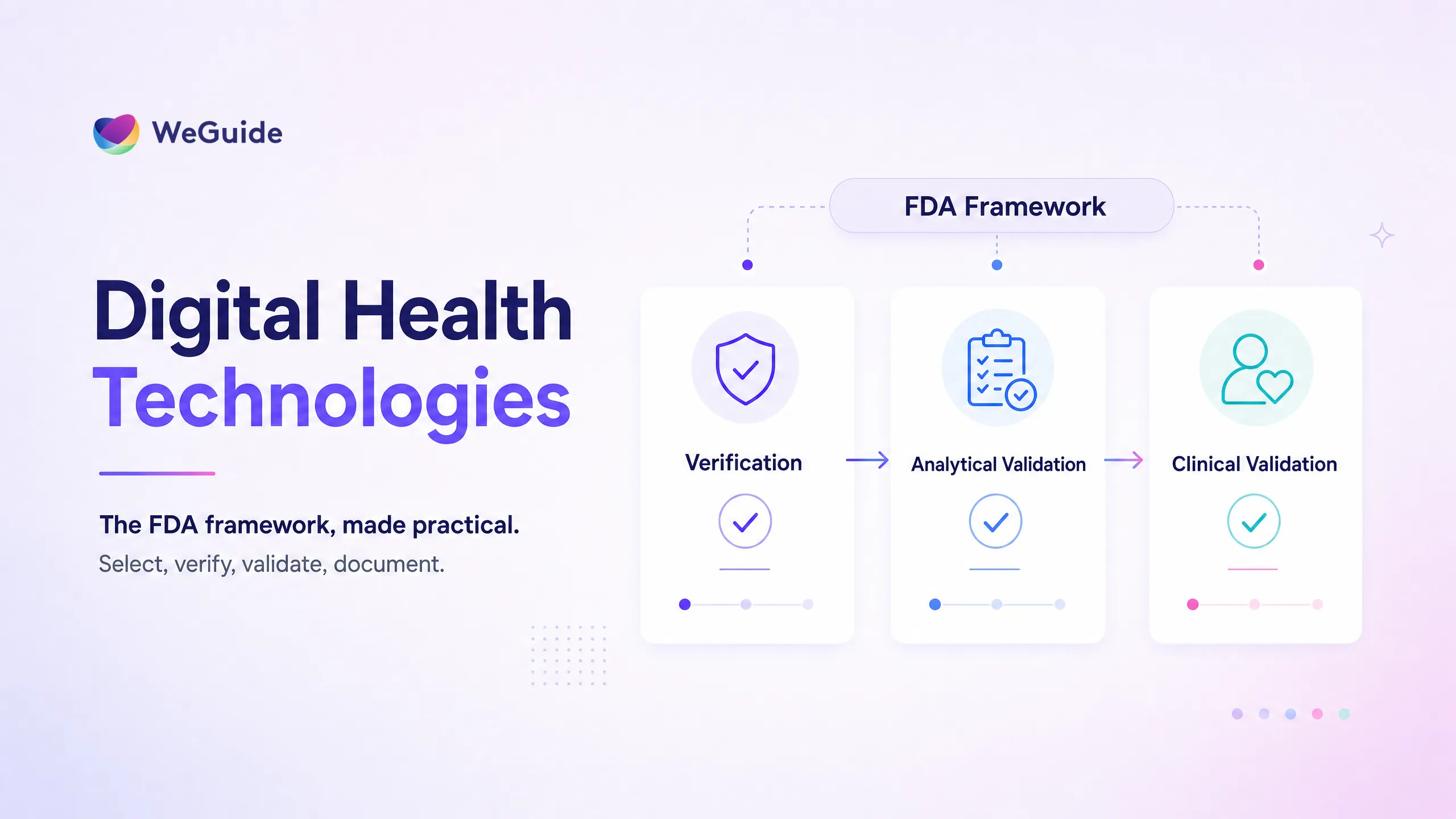
Digital Health Technologies (DHTs) in Clinical Trials: The FDA Framework
A practitioner's guide to digital health technologies in clinical trials, covering the FDA's 2023 DHT framework, fit for purpose device selection, V3 validation, and the sponsor responsibilities that protect data integrity.
Read post
Wearables in Decentralized Clinical Trials: The Remote Data Bridge
A focused guide to wearables in decentralised clinical trials: how remote sensors bridge data capture to the home, what they replace, where they sit in the DCT stack, and the data and logistics rules that decide whether the data holds up.
Read post
Patient Generated Health Data (PGHD) in Clinical Research
A practical guide to patient generated health data in clinical research: what PGHD is, its sources and examples, how it differs from clinician collected data, and how trials capture and govern it.
Read post
Consumer Wearables in Clinical Research: Fitbit vs Apple Watch vs Garmin
A practical comparison of Fitbit, Apple Watch, and Garmin for clinical research, weighing data access, validation, battery life, cost, and ecosystem so study teams can match the device to the measure and the population.
Read post
Is Wearable Data Trustworthy? Data Quality and Validation in Clinical Trials
Wearable data is trustworthy in clinical trials when it is captured and validated well. A practical guide to wearable data quality, the V3 framework, wear time, missing data, and BYOD consistency.
Read post
Digital Endpoints in Clinical Trials: From Sensor Data to Trial Outcomes
A practical guide to digital endpoints in clinical trials: what they are, how they differ from digital biomarkers, how a measure becomes a validated and prespecified endpoint, what the FDA expects, and real examples across therapeutic areas.
Read post
Digital Biomarkers in Clinical Trials: A Practical Guide
A practitioner's guide to digital biomarkers in clinical trials, covering what a digital biomarker is, how they differ from digital endpoints, the main types by sensor and therapeutic area, the V3 validation framework, and how sponsors capture them.
Read post
BYOD vs Provisioned Devices in Clinical Trials
A decision guide to BYOD vs provisioned devices in clinical trials, weighing cost, data quality, equity, and compliance, with clear advice on when to choose each model or a hybrid of both.
Read post
Wearables in Clinical Trials: A Complete Guide
A practitioner's guide to wearables in clinical trials, covering device types, the data they capture, validation, BYOD vs provisioned models, and how sponsors turn sensor data into trusted endpoints.
Read post
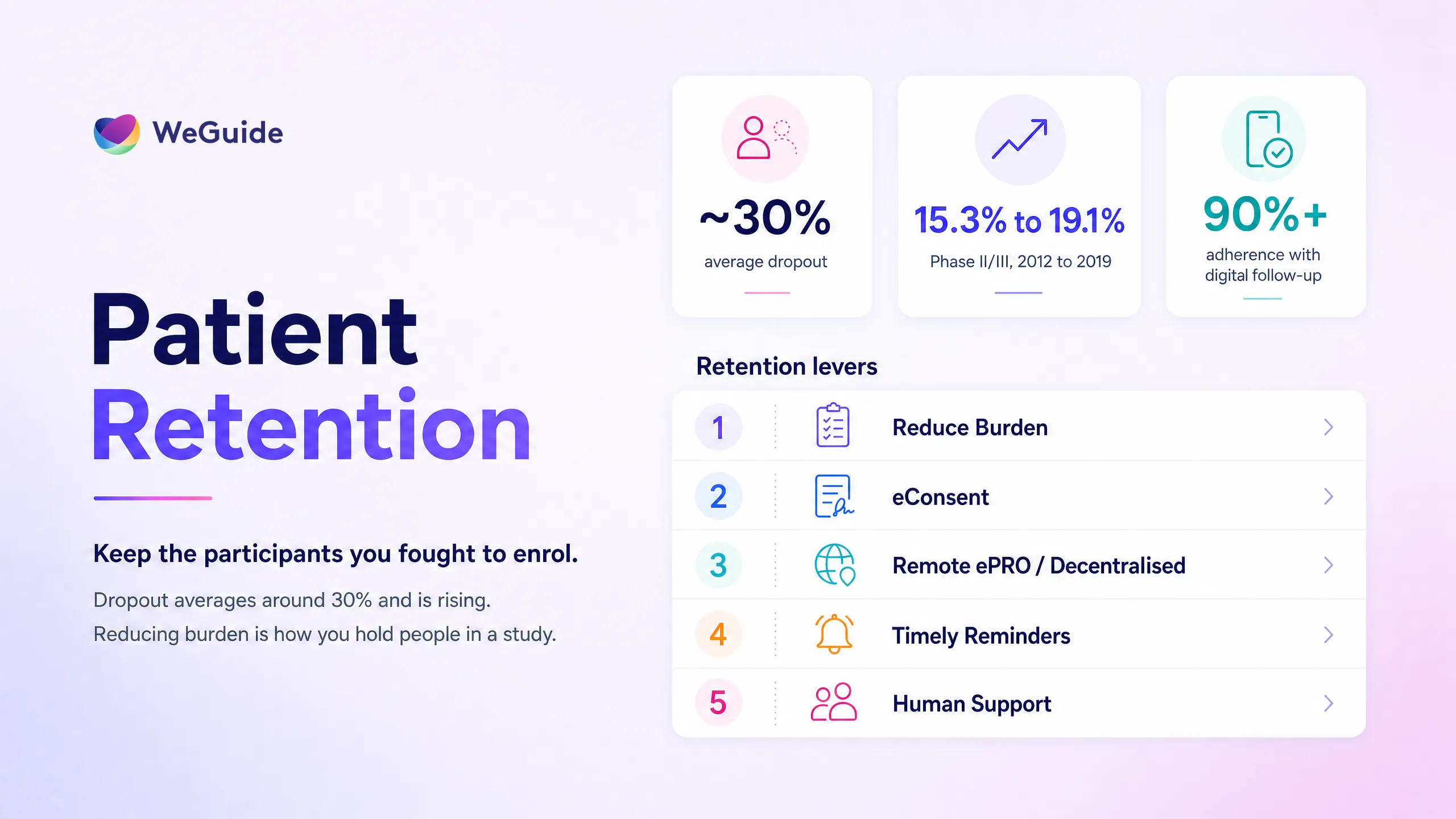
Patient Retention in Clinical Trials: Dropout Rates, Causes, and How to Reduce Them
Clinical trial dropout averages around 30% and is rising. Here are the benchmarks, the real reasons participants leave, and 12 ways to improve patient retention.
Read post
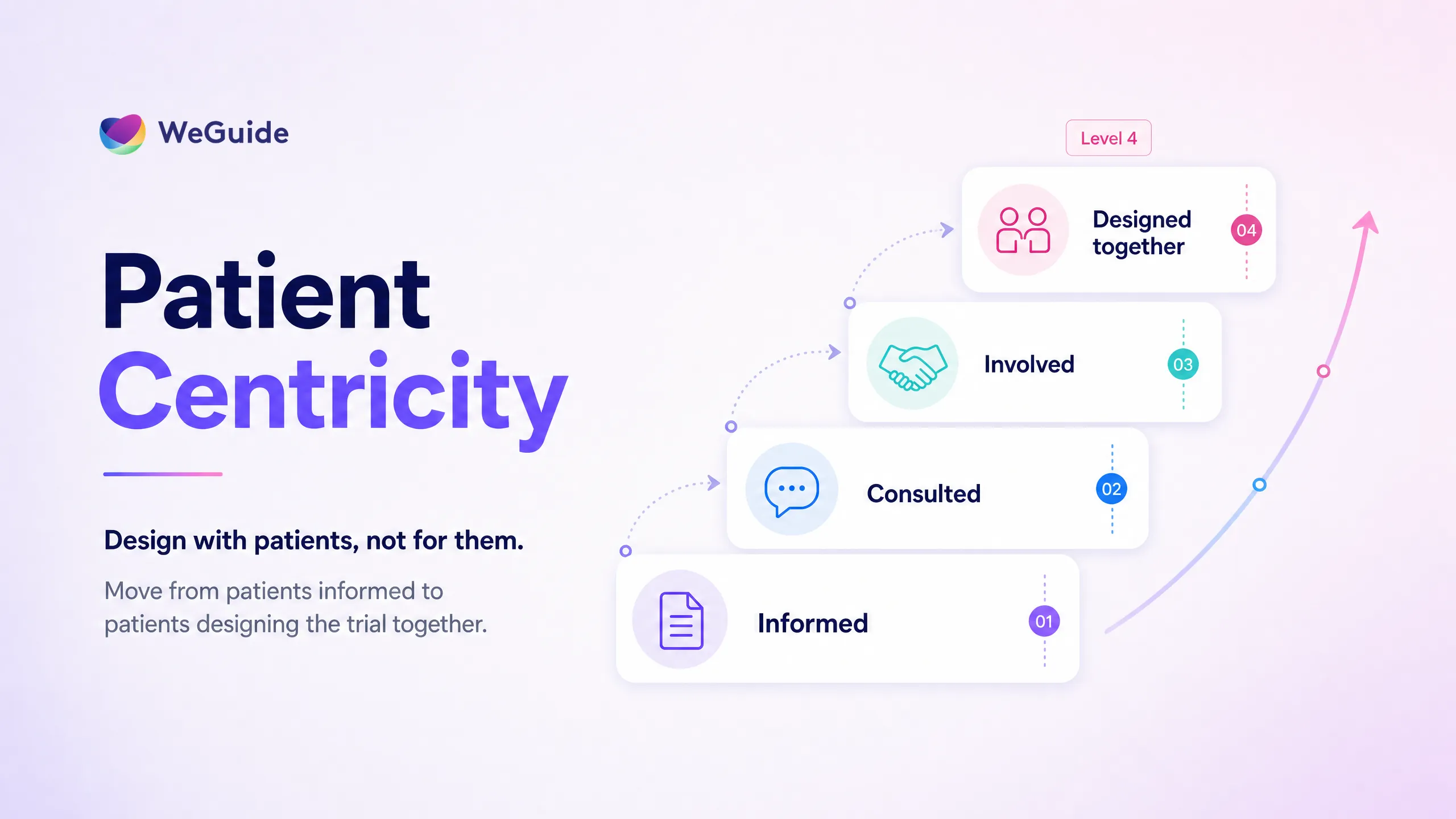
Patient Centricity in Clinical Trials: What It Means and How to Operationalize It
A practical guide to patient centricity in clinical trials: a clear definition, the disambiguation from related terms, the ROI evidence, and a lifecycle operating model plus maturity checklist to move from buzzword to a trial you can actually build.
Read post
How Decentralized Clinical Trials Improve Patient Engagement and Retention
A retention-framed look at decentralized clinical trials: the cited evidence by trial model, the burden-reducing mechanisms behind lower dropout, and where decentralisation does and does not help.
Read post
Reducing Patient Burden in Clinical Trials: A Practical Framework
A practical framework for reducing patient burden in clinical trials, covering the five burden types, how to measure them, and the digital levers that cut each one.
Read post
Clinical Trial Patient Engagement Software: A Buyer's Guide
A vendor neutral guide to choosing clinical trial patient engagement software, with a 9 point capability checklist, a build vs buy framework, and the CTMS and EDC distinction.
Read post
The Clinical Trial Patient Journey: Every Stage and Where Participants Disengage
A stage by stage map of the clinical trial patient journey, with the engagement risk and the digital lever at each of the eight touchpoints where participants quietly fall away.
Read post
What Is Patient Engagement in Clinical Trials? Involvement vs Participation
Patient engagement in clinical trials has two meanings: involving patients in trial design, and keeping enrolled participants active. Here is how both work.
Read post
CTMS vs EDC: Differences, Overlap, and How They Work Together
A CTMS runs the operations of a trial and an EDC system captures the clinical data. Here is how they differ, where they overlap, and how they work together.
Read post
What Is a Clinical Trial Management System (CTMS)?
A clinical trial management system (CTMS) is the software that runs the operations of a trial: sites, timelines, budgets, and oversight. Here is what it does, how it differs from EDC and eTMF, and how to choose one.
Read post
Real World Data vs Real World Evidence: The Difference
Real world data is what you collect. Real world evidence is what you conclude. Here is the difference, a side by side comparison, and how RWD becomes RWE.
Read post
Google Fitbit Air for Clinical Research: A New Option for Wearable Studies
Teams running wearable studies finally have a sub-$100, screenless, all-day tracker option, and here is what the new Google Fitbit Air means for clinical research, from its sensors and accuracy to data export via the Google Health API.
Read post
What Is eCOA Validation? A Practical Guide for Sponsors and CROs
eCOA validation actually covers four separate jobs: linguistic, equivalence, system, and psychometric. Here is what each one means, who owns it, and what FDA, EMA, ICH and TGA expect to see.
Read post
How To Improve Patient Recruitment in Clinical Trials
Read post
Clinical Trial Recruitment Strategies That Work
Most recruitment plans fail because they treat enrolment as a marketing problem, when it is really a design, experience, and retention problem rolled into one. Here are nine clinical trial recruitment strategies that work in the real world, with lessons from BRACE, GenV, and INHERIT on how to enrol faster and keep participants in the study.
Read post
4 Principles of Informed Consent: Complete Guide
Informed consent is more than the signature on the form, it has to hold up ethically, legally, and practically. We unpack the four principles every clinician and researcher needs to get right, with clear examples from clinical trials and the eConsent tools that support them.
Read post
What Is Real World Evidence? A Guide to RWE in Clinical Research
Learn what real world evidence is, how it differs from real world data, where RWD comes from, and how regulators and research teams use RWE in practice.
Read post
Real World Data in Clinical Trials: Practical Guide
Real world data in clinical trials explained: sources, regulatory context, use cases, and a practical guide to capturing RWD in your next study.
Read post
ePRO vs Paper PRO: Evidence Based Comparison
ePRO vs paper PRO compared. Peer reviewed evidence on cost, compliance and data quality, plus when paper still fits and how to choose for your next trial.
Read post
eConsent in Clinical Trials: How It Works and FDA Rules
Learn how eConsent works in clinical trials, FDA and 21 CFR Part 11 requirements, benefits over paper, and how to roll out electronic informed consent.
Read post
eConsent Best Practices: Designing for Comprehension and Compliance
A signed consent form isn't the same as informed consent, and most eConsent platforms miss that distinction. Here are 10 best practices for designing eConsent.
Read post
What Is eCOA in Clinical Trials? A Complete Guide
Learn what eCOA means in clinical trials, the four outcome types, benefits over paper, regulatory fit, and how to choose a platform that works.
Read post
eCOA vs ePRO: Key Differences and When To Use Each
What's the difference between eCOA and ePRO? Learn the key differences, when to use each in clinical trials, and practical tips from 100+ deployments.
Read post
FindAir and WeGuide partner for respiratory research data
Real time smart inhaler data integration helps researchers and clinicians improve asthma and COPD care. Track adherence, adjust treatments, and run better trials.
Read post
WeGuide’s Product Update | File Upload Question Type for Easier Data Entry
WeGuide’s new File Upload Question Type lets participants easily upload PDFs and images directly within forms, simplifying data entry and reducing errors.
Read post
WeGuide Product Update: Simplifying Patient Recruitment
WeGuide QR Code Login streamlines patient recruitment and enrollment, eliminating passwords and verification codes. Participants log in instantly with a quick scan: secure, fast, and effortless.
Read post
Using Open Ended Questions in Qualitative Research For Better Understanding
Discover how open ended questions enhance qualitative research. Learn how WeGuide's integrated approach, including the GenV case study, captures rich patient experiences that lead to discoveries.
Read post
Accelerate Your Research: Innovate with Our Exclusive Grant for Digital Health and Wellbeing with Garmin Health.
WeGuide and Garmin Health announce a grant opportunity tailored for pioneering medical and wellbeing researchers and innovative digital health startups.
Read post
Product Update March 2024
We are excited to bring you some fantastic additions to the WeGuide experience! Let us explain to you what that means...
Read post
Apple Features WeGuide on The Apple Newsroom: Using Apple Watch to Study Impacts of Cancer Treatment on Heart Rhythm
Researchers can now collect ECG data remotely using Apple Watch and the WeGuide platform.
Read post
Patient Centric: How to build an app that solves global issues
A look into how WeGuide, MCRI and philanthropic support empowers digital technology during COVID-19
Read post
The advantages of mobile data collection for your research study data
Mobile data collection for your research study helps to reduce missing and bad data and opens up new
Read post
Why data quality + security are the keys to enabling digital health care
The pandemic has pushed healthcare providers to address two of the biggest challenges associated wit
Read post