

.svg)
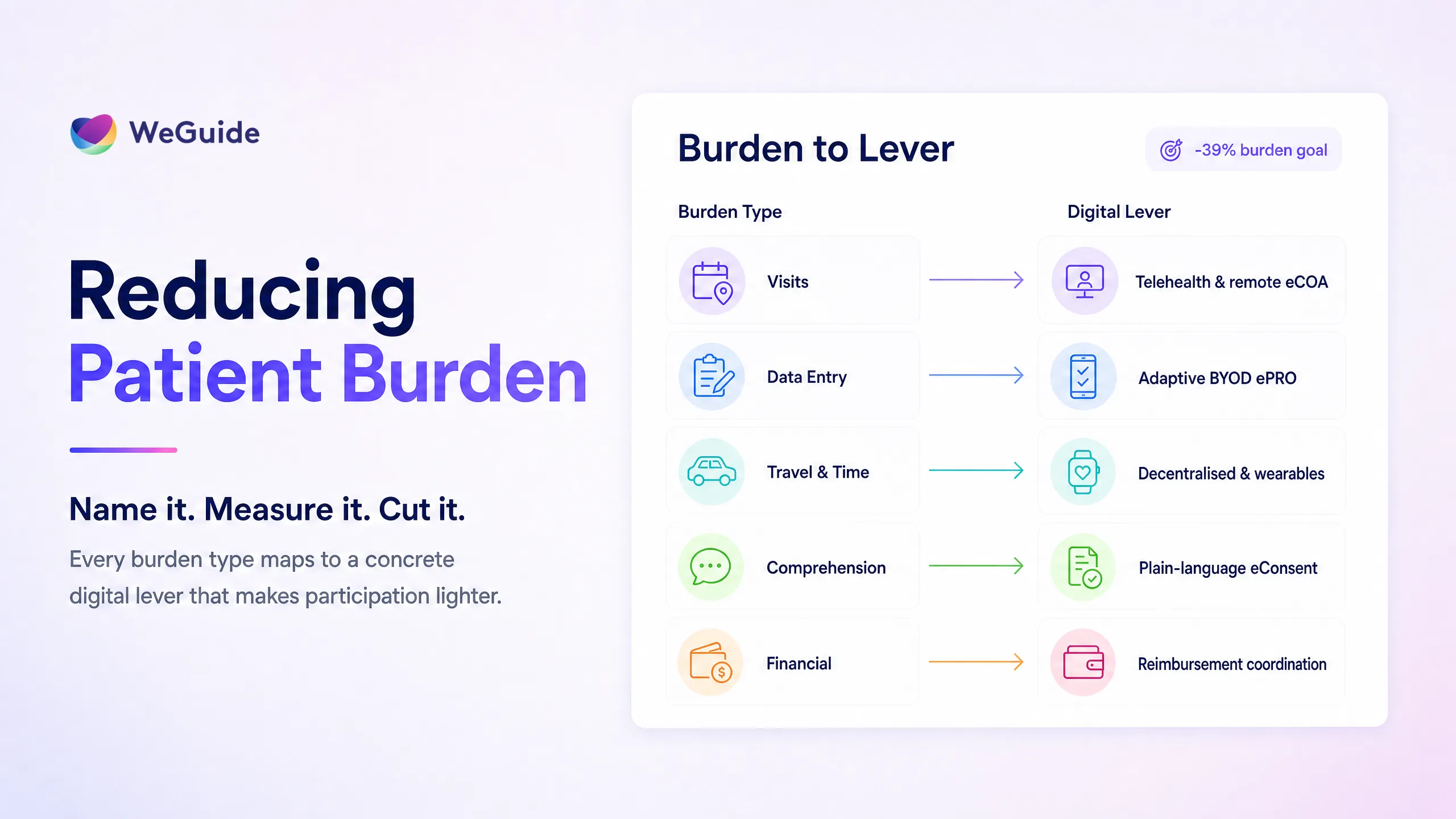


Patient burden in clinical trials is the total physical, logistical, cognitive, and financial cost a study imposes on participants. It covers site visits, procedures, diary and questionnaire completion, travel and time, comprehension demands, and out of pocket spend. It's the leading driver of dropout, and it has risen sharply. Burden in Phase II and III trials is up roughly 39% since 2011.
That rise matters because every protocol you design asks real people to give up real time, money, and effort. When the ask gets too heavy, participants leave, data goes missing, and timelines slip. This article gives clinical operations and protocol design teams a clear way to name burden, measure it, and reduce each type with concrete levers. If retention is your worry, burden is the upstream cause, and tools like patient engagement software attack it directly.
Key Takeaways
- Burden is the top dropout driver. Patient burden is the participant's lived cost of taking part, and it's the number one reason people drop out of trials.
- Five distinct burden types. There are five distinct burden types: visit, data entry, travel and time, comprehension, and financial.
- Measurable before launch. Burden can be measured before launch using the Tufts CSDD and ZS participation burden algorithm, which scores a protocol against its endpoints.
- A third of procedures are waste. Roughly one third of procedures collected in trials don't support a primary or key secondary endpoint.
- Reimbursement isn't coercion. Reimbursing travel, parking, and time is supported by FDA and OHRP guidance and is not coercion, as long as it's coordinated transparently.
What Is Patient Burden in Clinical Trials?
Patient burden in clinical trials is the sum of physical, logistical, cognitive, and financial costs a study places on the people who take part. It includes the procedures they undergo, the data they enter, the distance they travel, the time they lose, and the money they spend. It's the cause that sits behind most dropout.
This is a useful distinction. Burden is the cause, and dropout and poor retention are the effects. A heavy protocol pushes participants toward the exit, and patching retention afterward with reminders treats the symptom rather than the source.
If you want to reduce attrition, lowering burden is the cheaper, earlier move. For the retention side of that equation, see our guide to patient retention in clinical trials.
The trend line is moving the wrong way. According to Tufts Center for the Study of Drug Development, overall participation burden in Phase II and III trials has climbed by about 39% since 2011, driven by more questionnaires, more blood draws, and longer visits. As protocols grow more complex, the people you most need to keep are the ones feeling the weight.
Patient Burden vs Site Burden, and Why This Article Is About the Participant
Patient burden is the participant's lived cost. Site burden is the workload that falls on coordinators and research staff. They're related, but they're not the same, and a good design reduces one without quietly shifting load onto the other.
It's easy to confuse the two in an operations meeting. A team might "simplify" a protocol by asking participants to self report more at home, which lightens the site but adds diary fatigue for the patient. The reverse happens too.
The aim is to cut total burden, not move it around. This article keeps the lens firmly on the participant, because the participant is the one who decides whether to stay.
When you lower patient burden with the right digital tools, you often lower site burden at the same time. Remote data capture, automated reminders, and passive wearable collection reduce manual chasing for staff while making participation easier for patients. That's the win you're aiming for.
The 5 Types of Patient Burden
Most advice jumps straight to tips. A taxonomy helps you find the burden before you fix it. There are five types, and each has its own driver and its own lever.
Visit and procedural burden
This is the cost of showing up and being assessed. According to Tufts CSDD, just over 45% of Phase II and III trials now have average visit durations longer than two hours, compared with 17% a decade ago. Long, frequent, procedure heavy visits are the most visible burden, and often the first reason a participant decides the trade isn't worth it.
Data entry, ePRO, and diary burden
Electronic patient reported outcome (ePRO) tools and daily diaries are valuable, but they pile up. Tufts CSDD reports that the share of participants rating diaries and questionnaires "somewhat" or "very" burdensome rose from 18% in 2021 to 32% in 2025. When forms are long, repetitive, or poorly timed, completion drops and data quality suffers.
Travel and time burden
Getting to site costs hours, money, and energy. Drawing on the CISCRP Perceptions and Insights study, a majority of participants travel 30 minutes or more one way to reach a study site, and travel routinely ranks among the top burdens patients name. For anyone managing a chronic condition or a job, that time adds up fast.
Comprehension and health literacy burden
If a participant can't understand the consent form, the schedule, or the instructions, every other burden gets heavier. Dense consent documents, clinical jargon, and materials offered only in a participant's non native language create a quiet but real cognitive load. This burden falls hardest on the diverse populations trials most need to reach.
Financial burden
Taking part can cost real money. A 2024 Cancer Medicine study found that around half of early phase oncology participants spent $1,000 or more per month out of pocket, with roughly $600 a month in added non medical costs. Lower income participants and those travelling further faced worse financial toxicity, and many receive no reimbursement at all.
Lighten the participant ask
WeGuide is the patient-facing layer that attacks each burden type directly, from remote ePRO to multilingual education.
How to Measure Patient Burden
You can measure patient burden before a trial launches, not just after participants start leaving. The Tufts CSDD and ZS participation burden algorithm scores a protocol at the design stage, weighing the procedures and data collection against the endpoints they're meant to support.
The findings are sobering. Work from TransCelerate and Tufts CSDD, based on 105 Phase II and III protocols across 14 companies, found that roughly one third of procedures and data collected don't support a primary or key secondary endpoint. That's burden with no scientific payoff, and it's the first place to cut.
The practical move is an audit of your schedule of assessments. For each procedure, ask a plain question. Does this support a primary or key secondary endpoint? If the answer is no, that visit, blood draw, or questionnaire is a candidate for removal.
Measuring burden this way turns a vague worry into a defensible list you can take into a protocol review.
A Framework to Reduce Patient Burden (Burden to Lever)
Once you've named and measured burden, each type maps to a concrete lever. The table below pairs every burden with what drives it, the digital or operational fix, and where WeGuide attacks it honestly. The most important row is the last one. The cheapest way to cut burden is to design less of it upstream.
| Burden type | What drives it | Digital or operational lever | Where it shows up in WeGuide |
|---|---|---|---|
| Visit and procedural | Long, frequent, procedure heavy visits | Move assessments remote, use telehealth for check ins | Integrated telehealth and remote eCOA replace some in person visits |
| Data entry and ePRO | Long, repetitive, poorly timed forms | Shorter adaptive forms with conditional logic | Form Builder supports BYOD ePRO with branching logic |
| Travel and time | Distance to site, time off work | Decentralised and hybrid design, BYOD passive capture | Garmin and wearable data collected passively from the participant's own device |
| Comprehension | Dense consent, jargon, language gaps | Plain language education, multilingual delivery | In app patient education and multi language support |
| Financial | Out of pocket travel, parking, time | Coordinate reimbursement transparently | WeGuide coordinates and captures reimbursement workflows, it does not disburse funds |
| Design upstream | Procedures that don't support endpoints | Protocol de bloat, audit the schedule of assessments | Program Builder makes a leaner protocol fast to deploy |
This is WeGuide's role stated plainly. WeGuide is the patient facing engagement and data capture layer that attacks burden directly. It isn't a CTMS or a traditional EDC, and it doesn't run recruitment. It makes participation lighter for the person living through the study. Cutting burden is also how you put patient centricity in clinical trials into practice rather than leaving it as a slogan.
Reducing Burden Without Breaking Compliance: the Reimbursement Line
Covering a participant's travel, parking, and time is supported, not suspect. Both FDA and OHRP guidance treat reimbursement for trial related costs as separate from undue inducement, because you're offsetting a cost rather than paying someone to take a risk. Removing the financial barrier to participation is widely seen as an equity measure, not coercion.
The line to hold is transparency and proportionality. Reimbursement should reflect real costs and be applied consistently across participants, and your IRB or ethics committee should sign off on the approach. The HHS and ASPE issue brief on empowering patients frames cost and logistics as barriers worth removing for access reasons.
Here's the honest WeGuide boundary. WeGuide coordinates and captures reimbursement workflows so the right costs are tracked and processed. WeGuide does not disburse funds itself. The platform supports a compliant process, it doesn't replace your finance or ethics oversight, and you should always confirm your approach with a regulatory adviser.
Burden Is Upstream of Engagement and Retention
Lowering burden is the cheapest retention lever you have. Engagement programs, reminders, and re enrolment efforts all work better when the underlying ask is lighter. Reduce the cost of taking part, and retention tends to follow without much extra spend.
WeGuide's BRACE Trial shows what a low burden remote design can do. The study ran across 6,000 participants in five countries, deployed in around six weeks during COVID-19, and held adherence above 90%, as detailed in the BRACE Trial case study. Participants stayed because participation was built to fit their lives, not the other way around. Mapping burden against each stage of the clinical trial patient journey shows exactly where the heaviest costs land, from screening through to the final visit.
Burden, in other words, is fundamentally a trial design problem, which is why a decentralised clinical trial model is often the most effective starting point. For the wider picture, this article sits under our pillar on patient engagement in clinical trials.
Frequently Asked Questions
What is patient burden in clinical trials?
Patient burden in clinical trials is the total physical, logistical, cognitive, and financial cost a study places on participants. It includes site visits, procedures, diary and questionnaire completion, travel, time, comprehension demands, and out of pocket spending. It's the leading driver of dropout, and Tufts CSDD reports it has risen roughly 39% since 2011.
What are the main types of patient burden?
There are five main types. Visit and procedural burden covers long, frequent appointments. Data entry burden covers diaries and ePRO forms. Travel and time burden covers the journey to site. Comprehension burden covers consent and language demands. Financial burden covers out of pocket costs. Naming each one helps you target the right fix.
How is patient burden measured?
Patient burden can be measured before launch using the Tufts CSDD and ZS participation burden algorithm, which scores a protocol against its endpoints. Research from TransCelerate and Tufts CSDD found roughly one third of procedures don't support a primary or key secondary endpoint. Auditing the schedule of assessments is the practical first step.
How can decentralised trials reduce patient burden?
Decentralised and hybrid trials cut burden by moving activity off site. Remote ePRO, telehealth visits, and passive wearable data capture from a participant's own device reduce travel, time, and visit burden at once. WeGuide's BRACE Trial held adherence above 90% across 6,000 participants in five countries using this kind of low burden remote design. For the detail on how this model lifts retention, see our guide to patient engagement and retention in decentralised trials.
Can sponsors reimburse participants without it being coercion?
Yes. FDA and OHRP guidance treat reimbursement for trial related costs, such as travel, parking, and time, as separate from undue inducement. The key is transparency and proportionality, with reimbursement reflecting real costs and approved by your IRB. WeGuide coordinates and captures these workflows but does not disburse funds itself.
Conclusion
Patient burden in clinical trials is the participant's lived cost, and it's the clearest place to look when dropout climbs. Name the five types, measure them against your endpoints, and map each to a concrete lever. Cut what doesn't serve a primary or key secondary endpoint, move what you can off site, and coordinate reimbursement transparently. Burden reduction is the cheapest retention strategy you have, and it starts at the protocol, not the patient.
See burden reduction in action
Walk through how WeGuide's patient-facing platform lowers burden across remote ePRO, multilingual education, wearables, and reimbursement coordination.
Book a demoNo pressure, just a conversation.

