

.svg)
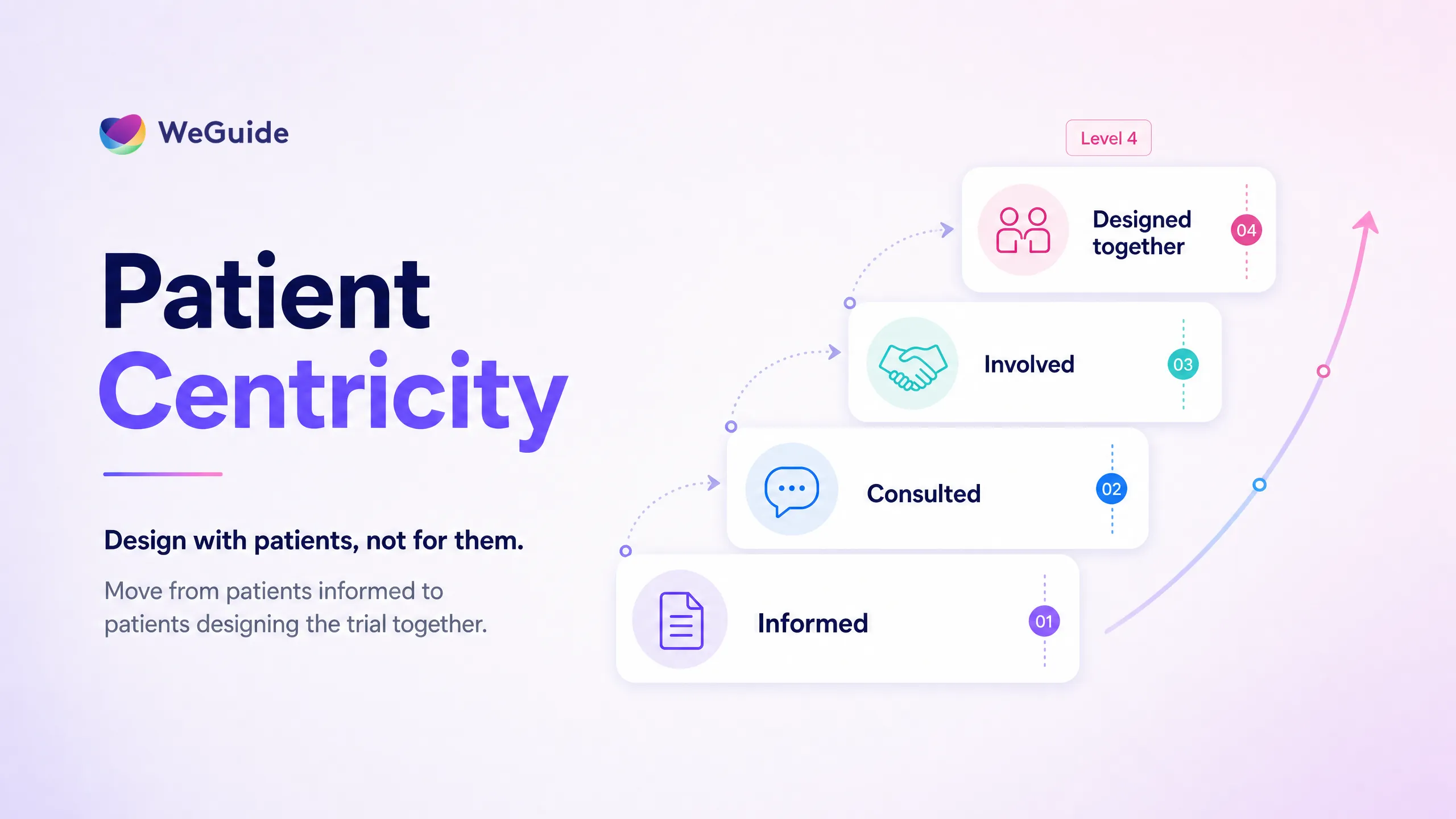


Patient centricity in clinical trials means designing and running studies with patients rather than for them, building the patient's needs, preferences, and lived experience into every decision from protocol design to results sharing. In practice it shows up as reduced participant burden, plain language consent, flexible visits, and patient input on endpoints.
Most sponsors and CROs already accept that patient centricity matters. The problem is that the term has become a slogan. Few sources tell you what to actually change in a protocol, how to measure it, or how to know whether your trial is genuinely centric or just says so on a slide.
This guide fixes that. You'll get a defensible definition, a clean disambiguation of the neighbouring terms, the evidence that it pays off, and the part nobody else hands you: a lifecycle operating model plus a self scoring maturity checklist. Many of the digital levers below run on dedicated clinical trial patient engagement software, which is where the abstract principle becomes a working trial.
Key Takeaways
- Centricity is the operating principle of designing trials with patients, not the activity set of keeping them enrolled (that's engagement).
- Patient centric trials succeed more. Patient centric Phase II and III trials are around 20% more likely to succeed and recruit roughly twice as fast, according to the Economist Intelligence Unit (2019).
- FDA's PFDD makes it an expectation. The FDA's four part Patient-Focused Drug Development (PFDD) guidance series turns the patient voice into a regulatory expectation, not a nice to have.
- Operationalise it across the lifecycle burden mapping, plain language eConsent, flexible and remote visits, multilingual access, patient input on endpoints, and returning results.
- Self assess with the maturity checklist. Use the maturity checklist below to self assess from Level 1 (patients informed) to Level 4 (patients design together and receive results).
What Does Patient Centricity in Clinical Trials Actually Mean?
Patient centricity in clinical trials is the practice of building studies around the people who join them, treating their burden, comprehension, and priorities as design inputs rather than afterthoughts. The defining test is simple. A centric trial is designed with patients, not merely for them.
That distinction has teeth. Designing for patients means a sponsor decides what's good for participants and builds it. Designing with patients means real patient input shapes the protocol, the visit schedule, the consent language, and the endpoints that get measured. It spans the whole lifecycle, not just the recruitment poster at the top of the funnel.
This matters because the trial is where most of the friction lives. A protocol that asks for 14 site visits, a 40 page consent form, and a paper diary every evening is not centric, however warmly it's described. Centricity is what you remove and what you hand back, measured against the participant's real life.
Patient Centric vs Patient Centered vs Patient Engagement: What's the Difference?
These terms get used interchangeably, which causes confusion in protocols and proposals. Here's the clean version.
Patient centric (or the American spelling patient centered) is the philosophy. Patient engagement is the set of activities that keep enrolled participants active and informed. Patient and public involvement (PPI) is the governance mechanism that puts patients in the room where decisions are made.
The table below separates them. The short summary: centricity is the principle, engagement is the practice, and PPI is the structure that makes the principle accountable. If you want the full picture of the second column, our patient engagement in clinical trials pillar guide covers the activity set in depth.
| Term | What it means | Who or what it centres on | Example in practice |
|---|---|---|---|
| Patient-centric | The operating principle of designing trials with patients | The participant's needs across the whole study | Patients help set the visit schedule before the protocol is locked |
| Patient-centered | The same principle, American spelling, common in FDA and US literature | The participant's preferences and outcomes | A US sponsor cites "patient-centered" design in an FDA submission |
| Patient engagement | The activities that keep enrolled participants active and informed | Behaviour during the study | Reminders, education, and two way messaging that reduce dropout |
| Patient and public involvement (PPI) | The governance mechanism for patient input into decisions | Decision making and study design | Patients sit on an advisory board and review the protocol |
Read it left to right and the relationship becomes clear. PPI is how you operationalise centricity at the governance level. Engagement is how it shows up day to day for an enrolled participant. WeGuide sits in that engagement column as the patient facing layer, while PPI and advisory boards remain organisational processes that software supports but does not replace.
Why Patient Centricity Matters (the Evidence)
The business case is no longer soft. According to the Economist Intelligence Unit's 2019 analysis, patient centric Phase II and III trials were around 20% more likely to succeed than traditional trials, and they recruited roughly twice as fast, taking about four months to enrol 100 participants against about seven months for conventional designs. In neurology the gap was wider still, and in rare disease the centric approach recruited in roughly one fifth of the time.
Those numbers connect to a known cost driver. Research from the Tufts Center for the Study of Drug Development has long shown that a large share of trial procedures don't support the primary or secondary endpoints, which adds burden without adding evidence. Trimming that burden through patient input improves feasibility, recruitment, and retention at once. The economic payoff of early patient input is widely described as outsized, and by industry estimates the return on a modest patient engagement investment is large, though the exact figures vary by source and should be treated as directional.
Centricity is also where retention starts. Burden is the leading reason participants drop out, so a trial designed around real lives loses fewer people. That thread runs straight into patient retention in clinical trials, where the operational tactics for keeping participants enrolled live.
What the FDA Says: Patient-Focused Drug Development (PFDD)
If you need to defend a centricity budget internally, point to the regulator. The FDA's Patient-Focused Drug Development guidance series is a four part framework that turns "the patient voice" from a value statement into a method.
The series moves in a logical sequence. First, collect comprehensive patient input. Second, identify what's most important to patients about their condition and treatment. Third, select, develop, or modify clinical outcome assessments (COAs) that fit their purpose so you measure what matters.
Fourth, build those COAs into trial endpoints. The FDA's COA final guidance completes that arc, tying patient input directly to the data a submission rests on.
Regulatory note: PFDD is guidance, not a single binding rule, and expectations vary by programme and region. Consult your regulatory adviser on how the patient voice should be documented for your specific submission.
The point for an operations lead is concrete. Patient centricity is no longer just good practice. The FDA expects patient input to inform what you measure, which means centric design and regulatory strategy now point in the same direction.
Run the digital levers
WeGuide is the patient-facing engagement layer that operationalises the digital levers of centric design, from eConsent to burden-light data capture.
How to Operationalize Patient Centricity (the Operating Model)
This is where most guides stop and where the real work begins. Patient centricity becomes real when you apply specific levers across the trial lifecycle. Each one below is concrete, measurable, and maps to a capability you either build, buy, or run as a process. To see where these levers land stage by stage, map them against the clinical trial patient journey.
Map and reduce participant burden
Start by counting the burden you're asking for: site visits, hours, travel, data entry, and procedures that don't feed an endpoint. Cut what you can. Every visit removed and every redundant assessment dropped lowers the dropout risk that burden creates. Our guide to reducing patient burden in clinical trials walks through how to map and trim each of these load points.
Use plain language eConsent with comprehension checks
A consent form the participant can't follow is a centricity failure on day one. Plain language eConsent with built in comprehension checks confirms understanding before enrolment, supports informed participation, and gives you an auditable record of who understood what.
Build in scheduling and visit flexibility
Rigid schedules punish people with jobs, carers, and distance. Flexible windows, remote visits, and a decentralised trial design that protects engagement and retention let participation fit around real life. Adding telehealth for suitable visits removes travel without removing oversight.
Make access multilingual and accessible
A trial that only speaks English excludes a large share of the people a medicine will eventually treat. Multilingual support and health literacy aware materials widen access for culturally and linguistically diverse participants, which strengthens both centricity and the generalisability of your data.
Invite patient input on endpoints and protocol
This is the governance layer. Patient advisory boards and PPI bring participants into protocol and endpoint decisions before the design locks. Software doesn't replace that conversation, though clear patient education materials make patient input better informed when it happens.
Give data back to participants
Returning results, where appropriate and ethically cleared, signals that the relationship runs two ways. It respects the contribution participants made and supports trust for future studies.
A practical note on positioning. WeGuide operationalises the digital levers above, the consent comprehension, burden light data capture, remote participation, and multilingual access. The governance levers like advisory boards stay organisational processes WeGuide supports, not replaces. Track all of it through an analytics dashboard so centricity becomes a set of KPIs, not a claim.
A Patient Centricity Maturity Checklist
Use this to self assess. Read down each dimension and find the level that honestly describes your current trial. The goal isn't to hit Level 4 everywhere on day one. It's to know where you sit and where to move next.
| Dimension | Level 1: Informed | Level 2: Consulted | Level 3: Involved | Level 4: Designed together |
|---|---|---|---|---|
| Consent | Standard form provided | Plain language version offered | eConsent with comprehension checks | Participants helped shape consent wording |
| Burden | Burden not measured | Burden noted in design review | Burden mapped and actively reduced | Participants set acceptable burden limits |
| Endpoints | Sponsor sets all endpoints | Patient input reviewed late | Patient input shapes COAs | Patients help design endpoints that fit their purpose |
| Access and language | Single language, on site only | Some translation offered | Multilingual plus remote options | Access designed together with diverse participants |
| Data return | No results shared | Aggregate results promised | Individual results offered where appropriate | Results format chosen with participants |
| Governance | No patient input forum | Ad hoc patient feedback | Standing advisory input | Patients on the governing board (PPI) |
If most of your rows sit at Level 1 or 2, you have a patient centric ambition. If they sit at Level 3 or 4, you have a patient centric trial.
How Centricity Drives Engagement and Retention
Centricity is the upstream driver. It reduces burden, and burden reduction is the single biggest lever on dropout, which is why centric trials retain better. Engagement activities like reminders and education then keep enrolled participants active, but they work far better on a foundation that was centric by design.
The sequence reads like this. Centric design lowers burden. Lower burden raises retention. Sustained engagement protects that retention over time.
Skip the centric foundation and you're using engagement tactics to paper over a protocol that asks too much. That's the honest reason centricity belongs upstream of every retention plan, not beside it.
A Real Example: a Patient Centric Decentralised Trial
Patient centric design holds up under real conditions, not just in theory. WeGuide's work on a patient centric app for a decentralised COVID-19 trial shows the levers above running together in a live study.
The BRACE Trial is the clearest proof point. Across more than 6,000 participants in five countries, a remote first, burden light design held adherence above 90%. That's what centricity produces in practice.
When you reduce burden, support comprehension, and let people participate from home, more participants stay. The principle and the retention numbers move together.
Frequently Asked Questions
What is patient centricity in clinical trials?
Patient centricity in clinical trials means designing and running studies with patients rather than for them, building participants' needs, preferences, and lived experience into decisions from protocol design through to results sharing. In practice it shows up as reduced burden, plain language consent, flexible or remote visits, and patient input on endpoints.
What is the difference between patient centric and patient centered?
There's no meaningful difference in concept. Patient centric and patient centered describe the same principle of designing trials around participants. Patient centered is the American spelling, common in FDA and US literature, while patient centric is more common internationally. Both contrast with patient engagement, which is the activity set that keeps enrolled participants active.
Why is patient centricity important in clinical trials?
Patient centricity improves outcomes that matter to sponsors. According to the Economist Intelligence Unit (2019), patient centric Phase II and III trials were around 20% more likely to succeed and recruited roughly twice as fast. Lower participant burden also reduces dropout, so centric trials tend to retain participants better and generate cleaner data.
How do you operationalize patient centricity?
You apply specific levers across the trial lifecycle: map and reduce participant burden, use plain language eConsent with comprehension checks, build in scheduling and remote visit flexibility, make materials multilingual and accessible, invite patient input on endpoints through advisory boards, and return results where appropriate. A maturity checklist helps you self assess each dimension from informed to designed together with patients.
What does the FDA say about patient-focused drug development?
The FDA's Patient-Focused Drug Development (PFDD) guidance series is a four part framework for incorporating the patient voice into drug development. It moves from collecting patient input, to identifying what matters most to patients, to selecting clinical outcome assessments that fit their purpose, to building those assessments into trial endpoints, making patient input part of regulatory decision making.
What are examples of patient centric clinical trials?
Decentralised and remote first trials are common examples, where flexible visits, eConsent, and multilingual access reduce burden. WeGuide's BRACE Trial held adherence above 90% across more than 6,000 participants in five countries using a burden light, remote first design, showing how centric levels lift retention in a real study.
Turning the Buzzword Into a Trial You Can Build
Patient centricity stops being a slogan the moment you treat it as an operating model. Define it clearly, defend it with the EIU and FDA evidence, apply the lifecycle levers, and score yourself against the maturity checklist. The trials that do this recruit faster, retain better, and produce data that holds up.
See centric design in a live trial
Walk through how WeGuide's patient-facing layer puts the digital levers of centricity, from eConsent to burden-light data capture, to work in a real study.
Book a demoNo pressure, just a conversation.

