

.svg)
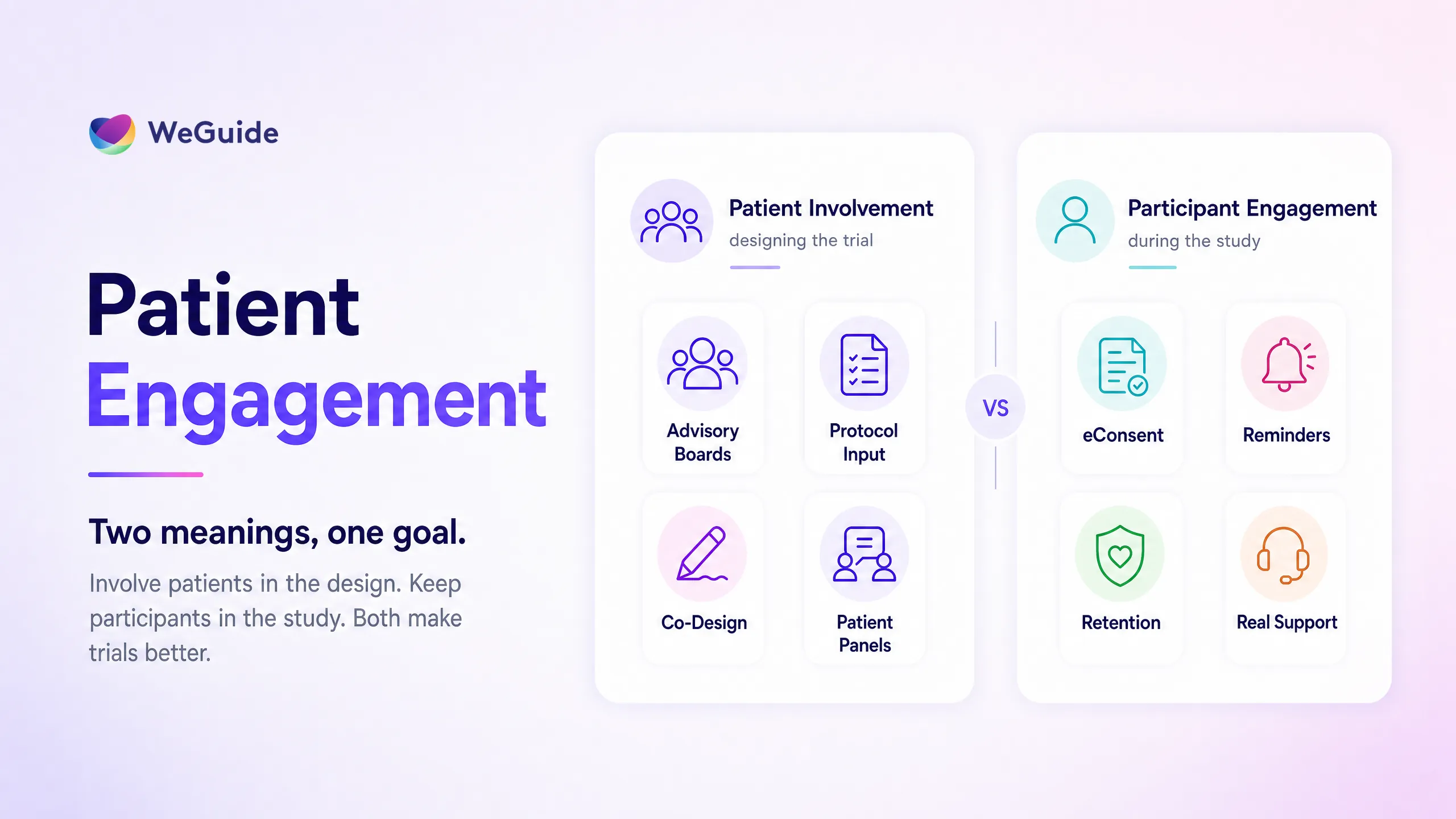


Patient engagement in clinical trials has two meanings, and people use the phrase for both. One is patient involvement: bringing patients into how a trial is designed and run. The other is participant engagement: keeping enrolled participants informed, supported, and active throughout the study. Both improve trials, and they get confused all the time.
That confusion has a cost. Teams often plan for one and neglect the other, and the half that usually gets neglected is participation. That's the half where people quietly drop out, data goes missing, and timelines slip.
This guide separates the two clearly, explains why each matters, and points you to the deeper resource for each. We've spent more than 7 years building patient engagement software for studies like the BRACE Trial, so the practical side is grounded in what actually holds people in a study.
Key Takeaways
- Two meanings, often confused. Patient engagement in clinical trials means two different things: patient involvement (designing the trial with patients) and participant engagement (keeping enrolled participants active).
- Each protects something different. Patient involvement shapes better protocols and more relevant endpoints. Participant engagement protects retention, data quality, and timelines.
- A third drop out. Around a third of participants drop out of trials on average, so participant engagement is where most studies lose ground.
- Engagement and retention differ. Engagement is the experience during the trial. Retention is the outcome of that experience, which is why the two are linked but not the same.
- A layer, not a feature. Participant engagement is a separate participant facing layer that runs alongside your CTMS and EDC, not a feature of either.
What Is Patient Engagement in Clinical Trials?
Patient engagement in clinical trials is the practice of involving patients in research and keeping participants active in it. It spans two things: patient involvement, where patients help shape how a trial is designed, and participant engagement, where enrolled participants stay informed and supported so they complete the study and provide full data.
Most teams need both. Involvement makes the trial worth doing well. Participation makes sure it finishes with usable data. The rest of this guide treats them separately, because the tactics for each are different.
The Two Meanings: Patient Involvement vs Participant Engagement
The two meanings sit at different points in a trial's life. Patient involvement happens mostly before and around the design. Participant engagement happens once people are enrolled and the study is running.
| Patient involvement | Participant engagement | |
|---|---|---|
| When | Design and planning | During the running study |
| Who | Patient advisers, advocacy groups | Enrolled participants |
| Goal | Better, more relevant trial design | Retention, adherence, complete data |
| Examples | Advisory boards, protocol input, co-design | Reminders, education, support, easy data capture |
| Owned by | Sponsors, ethics, patient groups | Study teams, coordinators, the engagement layer |
Patient involvement: designing the trial with patients
Patient involvement brings lived experience into trial design. Patient advisory boards review protocols, advocacy groups weigh in on what outcomes matter, and patients help judge whether the visit schedule is realistic. In practice it can be as simple as a patient panel reading a draft consent form, or as formal as patients sitting on the study team. The aim is a trial that answers questions patients care about and asks less of them along the way.
This is well supported by regulators and research bodies. The FDA's Patient Engagement Collaborative gives patients a formal voice in how research is shaped, and the Clinical Trials Transformation Initiative has published practical recommendations for working with patient groups. A 2025 review in the National Library of Medicine describes patient involvement as a shift in how trials are designed, not a tick box.
Participant engagement: keeping people in the study
Participant engagement is about the people already enrolled. It covers everything that helps them understand the study, complete their tasks, and stay until the end: clear onboarding, timely reminders, useful education, easy ways to report data, and real support when something goes wrong. This is where dropout is won or lost, and it's the half WeGuide is built for.
Patient Engagement vs Patient Retention: What's the Difference?
Patient engagement is the experience participants have during the trial. Patient retention is the outcome of that experience, the share of participants who complete the study. Good engagement is how you earn retention. The two get used interchangeably, but the work and the metric are different.
This guide covers engagement. For dropout rates, the real causes of attrition, and a journey mapped playbook to reduce it, see our full guide to patient retention in clinical trials.
Why Patient Engagement Matters
Both meanings change trial outcomes, just in different ways.
On the involvement side, patient input leads to protocols that fit real lives. That means fewer amendments, visit schedules people can actually keep, and endpoints that matter to patients and regulators. Trials designed with patients tend to recruit and retain better, because the study asks for things participants are willing to give. Regulators have noticed too, and patient input is now a standard part of how many trials are reviewed and funded.
On the participation side, the stakes are retention and data. By widely reported estimates, roughly a third of participants drop out of clinical trials, and the industry average has been rising, from 15.3% in 2012 to 19.1% in 2019 across Phase II and III trials. Every dropout is missing data, weaker statistical power, and a longer, costlier study.
Strong participant engagement is the most direct way to protect against that. It's also closely tied to good clinical trial recruitment strategies, since the work of keeping people engaged starts the moment they enrol.
Built for participant engagement
WeGuide is the participant facing layer that keeps enrolled participants informed, supported, and active throughout your study.
How to Improve Participant Engagement
A handful of practical moves hold participants in a study. Make consent and onboarding simple with clear electronic informed consent. Keep people informed with timely reminders and in app education. Reduce burden with mobile and wearable data capture and home based visits. Design for diverse and multilingual populations. And back the technology with real human support, because people stay for people.
Each of these is one lever against dropout, and the full playbook lives in the retention guide linked above.
The proof that this works is in the numbers. In the BRACE Trial with the Murdoch Children's Research Institute, WeGuide supported 6,000+ participants across five countries. The study held adherence above 90%, launched in 6 weeks, and ran entirely remotely. In GenV, one of Australia's largest studies, more than 100,000 families have stayed engaged over the long term, which is the kind of clean data that only arrives when participants find a study easy to stay in.
Where Participant Engagement Fits in Your Trial Systems
Participant engagement is a separate layer, not a feature of your operations or data systems. A clinical trial management system (CTMS) runs the operations of a trial, and an electronic data capture (EDC) system holds the clinical data. Neither one talks to participants. They track and store, but they don't engage.
The participant facing layer sits alongside them. It handles eConsent, symptom and outcome capture through eCOA and ePRO, reminders, education, and remote visits, then feeds clean data into the EDC while the CTMS tracks progress. If you're mapping out your eClinical setup, our guide to how a CTMS fits in the eClinical stack shows where each system belongs. This separation matters most in decentralised clinical trials, where almost all participant contact happens through that engagement layer rather than a site visit. Our guide to remote and hybrid trial designs covers which elements move.
How to Measure Patient Engagement in Clinical Trials
You can't improve what you don't track. Useful engagement and retention measures include:
- Completion rates: the share of scheduled tasks, surveys, or visits participants actually finish.
- Adherence: how closely participants follow the protocol schedule over time.
- Retention and dropout: how many participants stay enrolled, and when and why people leave.
- Time to response: how quickly participants act on reminders or requests.
- At risk flags: early signals, like a run of missed tasks, that mark someone likely to drop out.
There's no single benchmark that fits every study, so the most useful comparison is your own trend over time, arm by arm and site by site. Watch the direction of travel, not just the headline number. Tracking these in real time lets a study team step in before a quiet disengagement becomes a dropout.
Explore the Cluster
This guide is the hub. For the deep dive on each part of participant engagement, follow the links below.
- Patient engagement software: a buyer's guide covers the capabilities to look for when you choose a participant facing platform.
- Patient centricity in clinical trials turns a buzzword into a concrete operating model.
- The clinical trial patient journey maps every stage from awareness to close-out, and where participants disengage.
- How decentralised trials improve retention sets out the evidence that remote designs hold participants better.
- Reducing patient burden in clinical trials explains the root cause of disengagement and the levers that ease it.
Frequently Asked Questions
What is the difference between patient involvement and patient engagement?
Patient involvement means including patients in how a trial is designed and run, such as through advisory boards or protocol input. Participant engagement means keeping enrolled participants active and supported during the study. Involvement shapes the trial, and engagement keeps people in it. The broader phrase "patient engagement in clinical trials" covers both.
What is the difference between patient engagement and patient retention?
Patient engagement is the experience participants have during a trial. Patient retention is the result, the share who complete the study. Engagement is how you earn retention, so the two are linked, but engagement describes the work and retention describes the outcome you measure.
How do you improve patient engagement in clinical trials?
Improve participant engagement by simplifying consent and onboarding, sending timely and clear communication, reducing participant burden with mobile and wearable data capture, and designing for diverse and multilingual populations. Track completion and retention in real time so you can support participants at risk before they drop out.
How is patient engagement measured in clinical trials?
Patient engagement is measured through completion rates, protocol adherence, retention and dropout rates, response times to reminders, and flags for participants showing early signs of disengagement. Tracking these together gives study teams an early warning system and a clear picture of how well participants are staying involved.
Why is patient engagement important in clinical trials?
Patient engagement protects the things a trial depends on. Involving patients in design produces protocols that fit real lives and recruit better. Keeping enrolled participants engaged protects retention, data quality, and timelines, since around a third of participants drop out of trials on average. Both reduce risk and cost.
Conclusion
Patient engagement in clinical trials is really two jobs. Patient involvement brings patients into the design so the trial is worth running well. Participant engagement keeps enrolled people informed and supported so the trial finishes with complete data. Confusing the two, or planning for only one, is how studies end up with great protocols and poor retention, or the reverse.
Three things to carry forward:
- Treat involvement and participation as separate jobs with separate tactics.
- Put real effort into participation, since that's where dropout happens.
- Remember that engagement is its own layer beside your CTMS and EDC, not a feature of either.
Lift engagement in your study
We can help you build the participant facing layer that keeps people enrolled and your data complete, alongside your existing CTMS and EDC.
Book a demoNo pressure, just a conversation.

