

.svg)
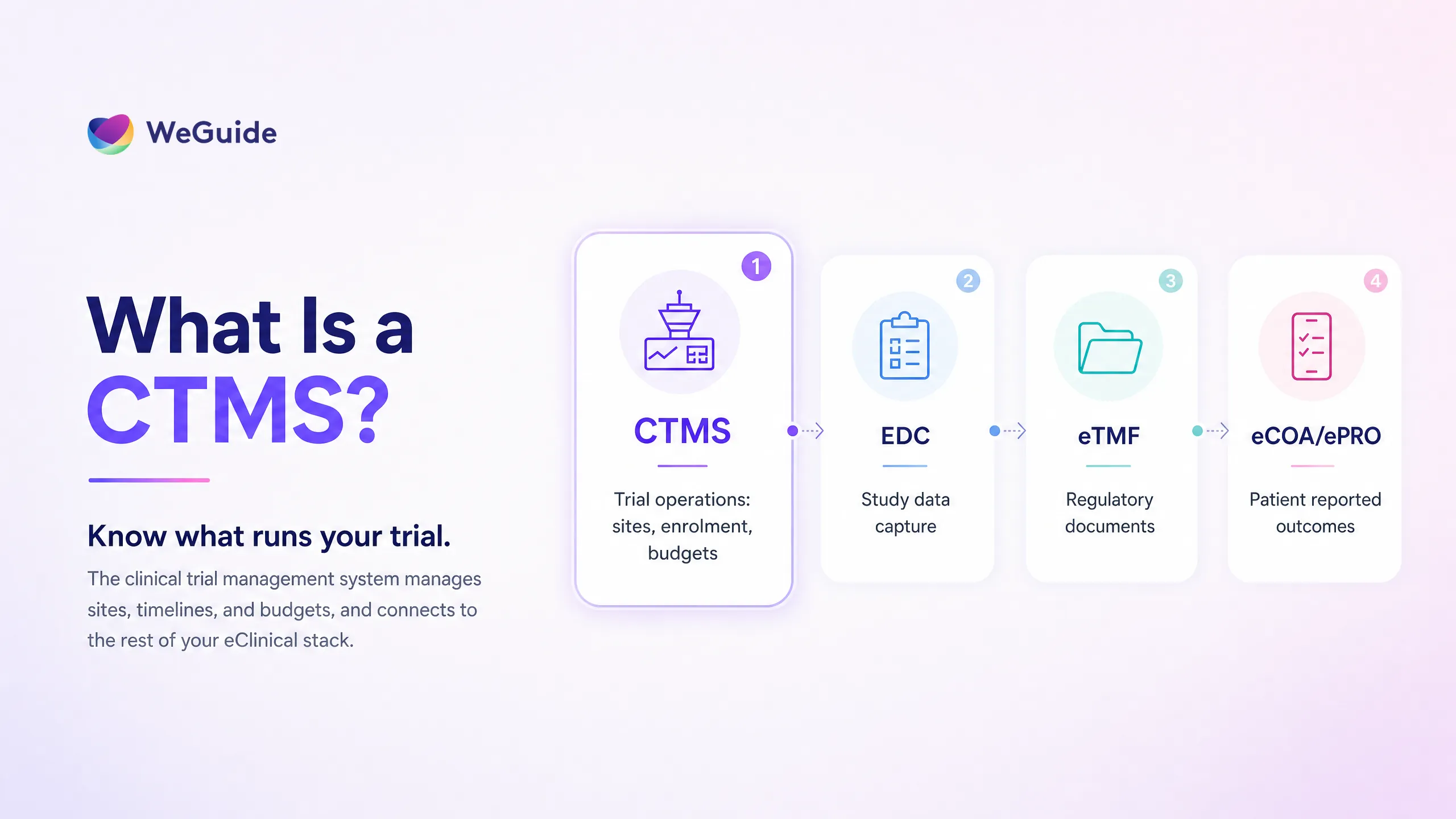


A clinical trial management system (CTMS) is software that runs the operational side of a clinical trial. It tracks sites, participants, timelines, monitoring visits, and budgets in one place, giving sponsors and research sites a single, real time view of how a study is progressing. Think of it as the control tower for trial operations, not the system that captures patient data.
If you have ever tried to run a multisite study from spreadsheets and email, you already know the problem a CTMS solves. Enrolment numbers live in one file, the monitoring schedule in another, site payments somewhere else, and nobody has a clean view of the whole study. A clinical trial management system pulls that together.
This guide explains what a CTMS does, how it differs from related tools like EDC and eTMF, who actually needs one, and how to choose the right system. We'll also be honest about what a CTMS doesn't do, because that gap matters as much as the features. WeGuide has supported more than 200,000 participants across 50+ research institutions, so we will draw on what works in real studies.
Key Takeaways
- A clinical trial management system (CTMS) manages trial operations: site and investigator tracking, enrolment, monitoring visits, milestones, and study budgets. It is the operational backbone, not a data capture tool.
- A CTMS is different from EDC (which captures study data), eTMF (which stores regulatory documents), and eCOA/ePRO (which collects patient reported outcomes). Most trials run several of these systems together.
- Sponsors, contract research organisations (CROs), and larger research sites get the most from a CTMS. Small or single site studies often manage with lighter tools.
- The main benefits are real time oversight, fewer manual errors, faster study start up, audit readiness, and tighter budget control.
- A CTMS does not collect patient reported data or run remote visits. That is where patient engagement platforms like WeGuide sit, integrating alongside your CTMS and EDC.
What Is a Clinical Trial Management System?
A clinical trial management system (CTMS) is a software platform that plans, tracks, and manages the operational and administrative work of a clinical trial. It centralises study information such as site details, participant enrolment status, monitoring visit schedules, milestones, and finance, so research teams can manage a trial from one place instead of scattered documents.
CTMS meaning: CTMS stands for clinical trial management system, so the terms CTMS, CTMS software, and clinical trial management system software all describe the same kind of platform. You will sometimes see the same idea called a clinical research management system, which usually describes a CTMS built for an academic centre or a whole research department rather than a single trial.
The job of a CTMS is coordination. It answers the operational questions a study team asks every day. How many participants have we enrolled against target? Which sites are behind? When is the next monitoring visit due? Have we paid this site for the last milestone? A good CTMS keeps those answers current and visible to everyone who needs them.
For a neutral baseline definition, the Wikipedia entry on clinical trial management systems is a reasonable starting point. The detail that matters for buyers, though, is what a CTMS actually does day to day, and how it sits next to the other systems in a modern trial.
If you are mapping out the technology for an upcoming study, our clinical trial solutions overview shows how the operational layer connects to the participant facing tools.
What a CTMS Does: Core Features and Functions
A clinical trial management system brings the moving parts of a trial into one system. The exact modules vary by vendor, but most clinical trial management system software covers the same core areas.
Site and investigator management
The CTMS holds a record for every site and investigator in the study: contact details, contracts, regulatory approvals, training status, and performance. This gives the study team a clear picture of which sites are ready to activate and which are holding things up. For multisite and multi country trials, this single source of truth is the main reason teams adopt a CTMS in the first place.
Enrolment and milestone tracking
A CTMS tracks recruitment against target in real time, site by site. It flags slow enrolling sites early, when you can still do something about it, and links progress to study milestones. This visibility is one of the biggest practical wins, because recruitment problems are far cheaper to fix early than late.
Monitoring and CRA workflows
Clinical research associates (CRAs) plan and record their monitoring visits in the CTMS. The system schedules visits, tracks what was reviewed, captures follow up actions, and keeps a record of site contact. That history matters for oversight and for showing a sponsor met its monitoring obligations.
Study finance and budgets
A CTMS connects study activity to money. It tracks site budgets, payment milestones, and study spend, so finance is tied to real progress rather than guesswork. For sponsors and CROs managing many sites, automated payment tracking removes a large and error prone manual job.
Reporting and real time oversight
Most clinical trial management systems include dashboards that pull all of this into live reports. Leadership can see study health at a glance, spot risks, and make decisions based on current data. Connecting these operational metrics to your study data is where WeGuide's analytics dashboard adds a participant level view on top of the operational picture.
CTMS vs EDC vs eTMF vs eCOA: The eClinical Stack
This is where most confusion lives. A clinical trial management system is one part of a wider set of clinical technology, often called the eClinical stack. Each system has a clear job, and most trials run several together.
| System | What it manages | Primary data | Who uses it most |
|---|---|---|---|
| CTMS | Trial operations: sites, enrolment, monitoring, budgets | Operational and administrative data | Sponsors, CROs, study managers |
| EDC | Study data capture and case report forms | Clinical study data | Data managers, site coordinators |
| eTMF | Regulatory and essential documents | Trial documents and records | Regulatory and quality teams |
| eCOA / ePRO | Patient reported and clinician reported outcomes | Participant outcome data | Participants, clinicians, sites |
The simplest way to remember it: a CTMS manages the trial, EDC captures the data, eTMF stores the documents, and eCOA collects what participants report.
CTMS vs EDC
A CTMS manages the operations of the study, while electronic data capture (EDC) collects the actual clinical data from each participant, such as case report forms, lab values, and visit data. The CTMS tells you a site has enrolled 20 participants and is two visits behind. The EDC holds what those participants' data actually says. They're most useful when they talk to each other, so enrolment and visit data flow between them without rekeying.
CTMS vs eTMF
An electronic trial master file (eTMF) is the regulated home for a study's essential documents: protocols, approvals, contracts, and the records an inspector will ask to see. If the CTMS is the operational control tower, the eTMF is the filing cabinet that proves the trial was run properly. A CTMS tracks activity as it happens. An eTMF preserves the documented evidence of it. If you are comparing document platforms for sponsors or sites, our Florence Healthcare alternatives comparison sets out the main options.
CTMS vs eCOA and ePRO
Electronic clinical outcome assessment (eCOA) and electronic patient reported outcomes (ePRO) collect data directly from participants and clinicians, often on a phone or tablet. This is the one a CTMS genuinely doesn't cover. A CTMS will tell you a participant is enrolled and on schedule, but it won't capture their daily symptom diary or quality of life survey. That participant facing data comes from eCOA and ePRO tools, covered in our complete guide to eCOA in clinical trials, a point we return to below.
Who Uses a CTMS, and Do You Actually Need One?
Not every study needs a dedicated clinical trial management system. The honest answer depends on scale and complexity.
Sponsors and CROs get the most value. When you are running trials across many sites, countries, and timelines, the coordination problem is real and a CTMS pays for itself in oversight and fewer mistakes. Managing dozens of sites and payment schedules without one is slow and risky.
Larger research sites and academic centres often run a clinical research management system to manage their whole portfolio of studies in one place, track staff and finances across trials, and report to their institution.
Small or single site studies are a different story. If you are running one study at one site with a small team, a full CTMS can be more system than you need. Many smaller teams manage operations with lighter tools and put their budget into data capture and participant engagement instead, where it has more direct impact on data quality and retention.
The useful question is not "should we buy a CTMS" but "where is our coordination actually breaking down". If the answer is operations across many sites, a CTMS helps. If the answer is participant data and retention, your money is better spent elsewhere.
Planning a remote or hybrid study changes this calculation too. Our decentralised clinical trials page covers how operational and participant facing needs shift when sites are not the centre of the study, and our blog guide explains how decentralized trials are actually run.
Key Benefits of a Clinical Trial Management System
When a clinical trial management system fits the study, the benefits are practical and measurable.
- Real time oversight: One live view of every site, enrolment number, and milestone, so problems surface early.
- Fewer manual errors: Operational data lives in one system instead of duplicated spreadsheets that drift out of sync.
- Faster study start up: Reusable templates, site records, and workflows speed up activation.
- Audit readiness: Monitoring visits, contacts, and actions are recorded, which supports good clinical practice (GCP) expectations and inspection readiness.
- Tighter budget control: Site payments and study spend are tied to real milestones, not estimates.
- Better collaboration: Sponsors, CROs, and sites work from the same current information.
A CTMS supports compliance work, but it does not replace it. Standards like ICH E6 Good Clinical Practice and electronic records rules such as 21 CFR Part 11 still sit with your team and your regulatory adviser. Good software makes meeting them easier, not automatic.
How to Choose a CTMS, and What It Won't Do
Once you have decided a clinical trial management system makes sense, the selection comes down to fit. A few criteria matter more than feature lists.
- Integration: Your CTMS should connect to your EDC, eTMF, and participant facing tools. Data that has to be rekeyed between systems is where errors and delays creep in. Interoperability between your CTMS software and the rest of the stack matters here, and a strong integration engine is often the difference between a connected stack and a set of silos.
- Compliance support: Look for audit trails, access controls, and electronic records features that align with 21 CFR Part 11 and your regulatory setting. Data standards bodies like CDISC are worth knowing when you assess how a system handles data.
- Usability: A CTMS only helps if your team actually keeps it current. If it is painful to use, the data goes stale and the oversight benefit disappears.
- Scalability: The system should handle your next study, not just this one.
Well known CTMS options include platforms from Medidata, Veeva, IQVIA, Oracle, and several site focused vendors. The right choice depends on whether you are a sponsor, a CRO, or a site, and on the systems you already run.
Here is the honest limit, and it is an important one. A CTMS manages operations. It does not collect patient reported data, run remote visits, or keep participants engaged between visits. Those jobs belong to electronic data capture and patient engagement tools. A CTMS will tell you a participant is enrolled and on schedule. It will not tell you how they are actually doing, because it was never built to ask them.
Engagement runs alongside your CTMS
A CTMS tracks the trial; it doesn't engage participants. WeGuide is the patient-facing layer that protects retention and feeds clean data in.
Where Patient Engagement Fits Alongside Your CTMS
Modern trials, especially decentralised and hybrid studies, generate a lot of data that never touches the CTMS: eConsent, symptom diaries, quality of life surveys, wearable readings, and remote check ins. A clinical trial management system was not designed to collect any of it. That is the gap WeGuide fills.
WeGuide isn't a CTMS, and we won't pretend to be one. We are the patient engagement and data capture layer that sits alongside your CTMS and EDC. Participants use a branded app to consent, complete eCOA and ePRO assessments, connect a wearable, and stay in contact with the research team, while that data flows into your wider study systems through integration.
This is where engagement turns into data quality. In the BRACE trial with the Murdoch Children's Research Institute, WeGuide supported remote follow up for more than 6,000 participants across five countries and sustained participant adherence above 90 percent, with the study launched in around six weeks. A CTMS would have tracked the operations of a trial that size. Holding retention above 90 percent without routine site visits came from the participant facing layer.
Want to see how the participant layer fits with your trial operations?Book a demo and we'll show you how WeGuide works alongside your existing CTMS and EDC.
The point is not that one system replaces another. A complete trial usually runs a CTMS for operations, an EDC for data, an eTMF for documents, and a patient engagement platform for the participant experience. Each does its job. The teams that get this right are the ones who match the tool to the problem instead of stretching one system to cover everything.
Conclusion
A clinical trial management system is the operational backbone of a trial. It tracks sites, enrolment, monitoring, milestones, and budgets, and gives sponsors and CROs the real time oversight that spreadsheets cannot. Used well, a CTMS speeds up study start up, reduces manual errors, and keeps a study audit ready.
The key points to carry forward:
- A CTMS manages trial operations, not study data, documents, or patient reported outcomes.
- It is most valuable for sponsors, CROs, and larger sites. Smaller studies often need lighter tools.
- A clinical trial management system works best as part of a connected eClinical stack alongside EDC, eTMF, and eCOA.
- Choose for integration, compliance support, usability, and scalability, and be clear about what a CTMS will not do.
- Patient engagement and remote data capture sit outside the CTMS, which is exactly where WeGuide adds value.
If your trial runs across many sites and you need to keep participants engaged and reporting reliable data between visits, the operational system is only half the picture. WeGuide complements your CTMS with a participant engagement layer built around the people in your study, capturing eConsent, eCOA, and remote data while your operational systems track the trial. Book a demo to talk through how it fits with your existing setup.
Frequently Asked Questions About CTMS
Is a CTMS the same as EDC?
No. A clinical trial management system (CTMS) manages trial operations such as sites, enrolment, monitoring, and budgets. Electronic data capture (EDC) collects the actual study data from participants, like case report forms and lab values. Most trials run both, and connect them so data flows between the two.
What does CTMS stand for?
CTMS stands for clinical trial management system. It is the software that plans, tracks, and coordinates the operational and administrative side of a clinical trial in one place. You may also see it called a clinical research management system when it manages a whole research department rather than a single study.
Who needs a CTMS?
Sponsors, contract research organisations (CROs), and larger research sites get the most from a CTMS, because they coordinate many sites, timelines, and budgets at once. Small or single site studies often manage well with lighter tools and put their budget into data capture and participant engagement instead.
What are examples of clinical trial management systems?
Well known CTMS platforms include systems from Medidata, Veeva, IQVIA, and Oracle, plus site focused tools built for research centres. The right choice depends on whether you are a sponsor, a CRO, or a site, and on the EDC, eTMF, and participant facing systems you already run.
Add the participant layer to your stack
See how WeGuide's patient-facing engagement layer sits beside your CTMS, EDC, and eTMF, without adding operational overhead.
Book a demoNo pressure, just a conversation.

