

.svg)
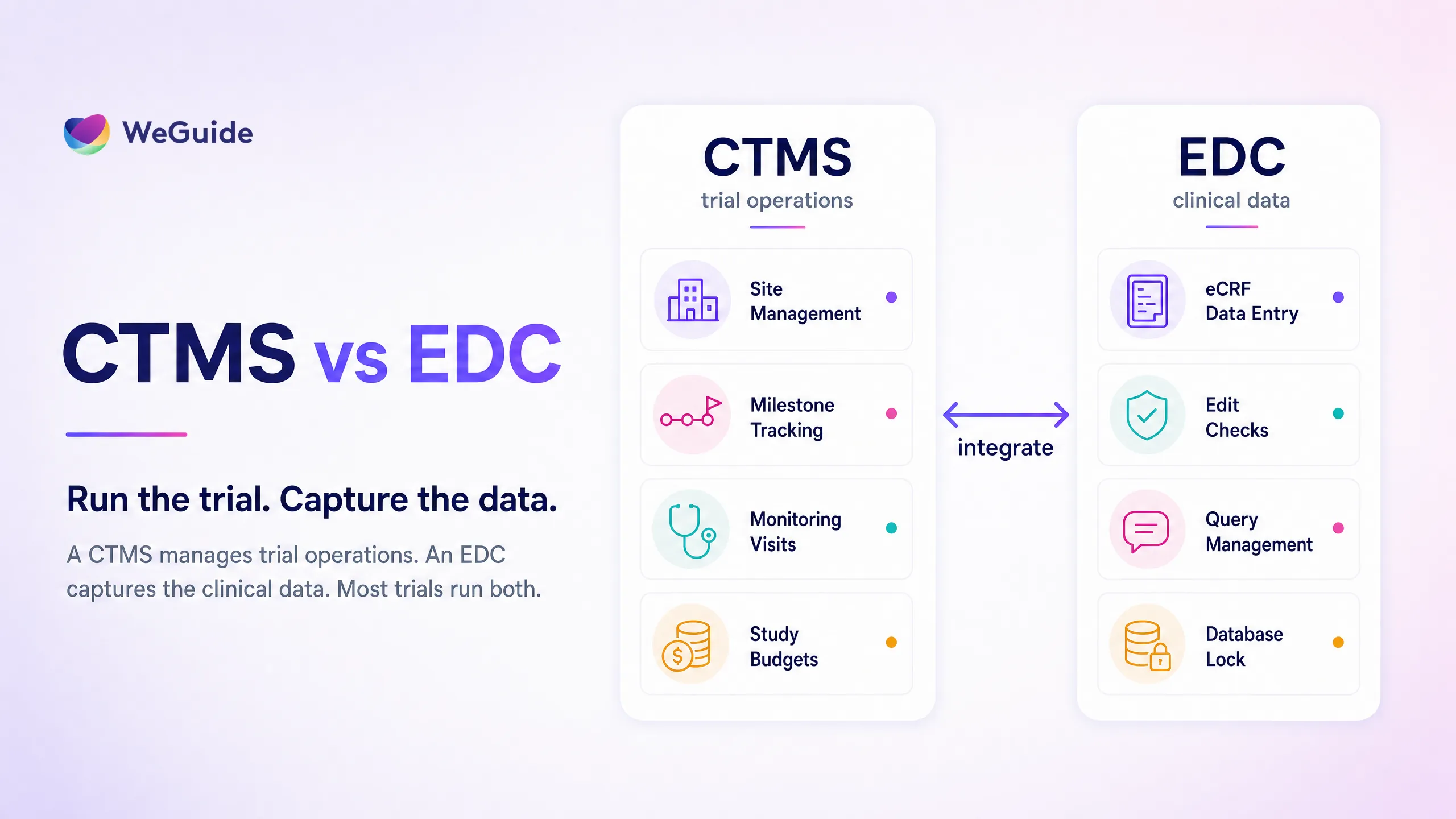


A clinical trial management system (CTMS) runs the operations of a study, while an electronic data capture (EDC) system collects and stores the clinical data. That is the heart of the CTMS vs EDC question. They solve different problems, and most trials run both.
The two get confused often, especially by sites and smaller sponsors weighing up their first eClinical tools. Some teams assume one system replaces the other. It doesn't. A CTMS tracks sites, milestones, monitoring visits, and budgets. An EDC system holds the case report form data your statisticians will analyse.
This guide explains what each system does, how they differ, whether you actually need both, and how they connect during a live trial. We have spent more than 7 years building the participant facing layer that feeds these systems, so we will also show where your patient data comes from before it ever reaches an EDC.
Key Takeaways
- A CTMS manages trial operations (sites, enrolment, monitoring, finance); an EDC system captures and stores clinical study data in electronic case report forms.
- They are not the same system, and an EDC is not a module inside a CTMS. They are separate functions that integrate.
- Most sponsors and CROs run both and connect them, often using CDISC ODM or an API so milestone and metric data stay in sync.
- Sites and small studies sometimes start with an EDC alone, then add a CTMS as the operation grows.
- The patient engagement layer (eConsent, eCOA, ePRO) sits upstream of the EDC and feeds it the source data, while the CTMS oversees the work.
CTMS vs EDC: What's the Difference?
A CTMS manages the operational side of a clinical trial, including site and investigator management, enrolment tracking, monitoring visits, and study budgets. An EDC system manages the clinical data itself, collecting participant level information in electronic case report forms (eCRFs) with built in checks and an audit trail. One runs the trial. The other holds the data.
The table below sums up the difference between CTMS and EDC, with eTMF and eCOA added for context within the wider stack.
| System | What it manages | Primary data | Primary users |
|---|---|---|---|
| CTMS | Trial operations: sites, milestones, monitoring, finance | Operational and metadata (status, dates, visits, payments) | Study managers, CRAs, operations teams |
| EDC | Clinical data collection and storage | Participant eCRF data (endpoints, labs, adverse events) | Data managers, site coordinators, statisticians |
| eTMF | Trial master file documents | Regulatory and essential documents | Regulatory, quality, document teams |
| eCOA and ePRO | Outcome data from clinicians and participants | Patient and clinician reported outcomes | Participants, clinicians, data managers |
If you only remember one thing, make it this. CTMS answers "how is the trial running". EDC answers "what did we measure". For the full picture of how these pieces fit, our guide to what a CTMS does and when you need one maps the whole eClinical stack.
Sorting out which system owns which job early saves a lot of rework later. If you are scoping your first eClinical setup, our team can talk you through where each tool fits with our digital clinical trial platform.
What a CTMS Does
A CTMS is the operational command centre of a trial. It gives study managers and clinical research associates (CRAs) one place to plan, track, and report on how the study is progressing across every site. The data it holds is mostly status and metadata, not participant measurements.
Core CTMS functions include:
- Site and investigator management: contacts, contracts, site activation status, and document tracking.
- Enrolment and milestone tracking: screening, randomisation, and visit milestones against the planned timeline.
- Monitoring and CRA workflows: visit scheduling, trip reports, and action item follow up.
- Study finance: site payments, budgets, and invoicing tied to completed milestones.
- Reporting and oversight: real time dashboards on recruitment, deviations, and study health.
A CTMS does not collect endpoint data. It will not hold a participant's blood pressure reading or a quality of life score. It tells you that a visit happened, when, and whether the data is in. The clinical values themselves live in the EDC.
What an EDC System Does
An EDC system is where clinical study data is captured, validated, and stored. It replaces paper case report forms with electronic ones, so site coordinators enter participant data directly and data managers can clean it as the trial runs. This is the system that produces the dataset for analysis.
Core EDC functions include:
- eCRF design and data entry: structured forms for endpoints, labs, vitals, and adverse events.
- Edit checks and validation: range checks and logic rules that flag errors at the point of entry.
- Query management: raising and resolving data queries between data managers and sites.
- Database lock and export: cleaning, locking, and exporting the final dataset, often in CDISC formats.
EDC platforms are built to support data integrity and regulatory expectations, including the electronic records and signatures requirements in FDA 21 CFR Part 11. Data standards bodies like CDISC shape how the data is structured for exchange and submission. The capture layer that feeds an EDC, including digital forms and questionnaires, is exactly the kind of work our electronic data capture tool is designed for.
Are CTMS and EDC the Same?
No. A CTMS and an EDC aren't the same system. A CTMS manages how the trial is run, and an EDC manages the clinical data the trial produces. They cover different jobs, hold different data, and serve different users, even though they work side by side throughout a study.
The confusion is understandable. Both are core eClinical systems, both appear in the same trials, and some vendors sell suites that bundle modules together. That bundling is where most of the "are they the same" questions come from.
Is EDC part of CTMS?
No, EDC is not a module inside a CTMS. They are distinct functions. Some platform vendors offer both a CTMS and an EDC under one brand, and a few market combined suites, but the data capture function and the operational management function remain separate. When you see them sold together, you are looking at two systems that integrate, not one system doing both jobs.
Is Medidata Rave a CTMS or an EDC?
Medidata Rave is best known as an EDC system, and the broader Medidata platform also offers a separate CTMS product. So "Rave" usually points to data capture, not trial operations. The naming trips people up because large vendors package several eClinical products under one umbrella. The lesson holds across vendors: check whether you are buying the operations system, the data system, or a suite that bundles both.
What's the difference between EDC and a CRF?
A CRF (case report form) is the form itself, the structured template that defines what data to collect at each visit. An EDC is the software that holds and validates those forms electronically as eCRFs. So the CRF is the document, and the EDC is the system that runs it. Both sit firmly on the data side of the CTMS vs EDC split.
How CTMS and EDC Work Together
In a running trial, the CTMS and EDC pass information back and forth so the operational picture matches the data picture. The EDC captures participant data at each visit. The CTMS reads metrics from that activity, such as how many eCRFs are complete or how many queries are open, and reflects them in its tracking and reporting.
Data flow between the two systems
The integration usually runs on a shared standard or an API. Many teams use the CDISC Operational Data Model (ODM) to move metadata between systems, so visit status, enrolment counts, and query metrics stay aligned without manual re entry. When the two systems are connected well, a CRA can see in the CTMS that a site is behind on data entry, then act on it, without logging into the EDC to count forms by hand.
CTMS and EDC integration removes a common source of error: two systems showing different numbers. Connecting your eClinical tools so they share one source of truth is the job of our integration engine, which links to existing EDC and CTMS systems rather than replacing them.
Where eCOA, ePRO, and eConsent fit
There is a third layer most CTMS vs EDC explainers skip: where the participant data actually comes from. eConsent captures consent, and electronic clinical outcome assessment (eCOA) and ePRO tools capture outcomes from clinicians and participants. That source data flows into the EDC, often as eSource, which the FDA's guidance on electronic source data addresses directly. The CTMS then tracks that the work happened.
This is where WeGuide sits. We are the participant facing capture and engagement layer that feeds your EDC and runs alongside your CTMS, not a replacement for either. In the BRACE Trial with the Murdoch Children's Research Institute, we supported remote data capture and engagement for 6,000+ participants across five countries, holding adherence above 90% over the study, launched in 6 weeks and run entirely remotely. Clean source data at that scale only reaches an EDC if participants stay engaged enough to provide it.
The third layer: your participants
A CTMS runs operations and an EDC stores data. Neither talks to participants. WeGuide is the patient-facing layer that does.
Do You Need Both a CTMS and an EDC?
It depends on the size and complexity of your trial. A single site study or an early phase trial might run with an EDC plus spreadsheets for operations, then add a CTMS once the coordination load grows. Larger sponsors and CROs almost always run both, because manual operational tracking breaks down across many sites.
If you're weighing up the spend, think about where the pain is now. A team drowning in messy data and queries needs the EDC sorted first. A team losing track of site payments, monitoring visits, and timelines across a dozen locations needs the CTMS. The honest answer for most growing studies is that you'll end up with both, so the real CTMS vs EDC question is rarely which to pick, it's how to connect them cleanly from the start.
A few simple guides help:
- Small site or single study: an EDC may be enough at first. Add a CTMS when tracking sites and finance by hand becomes the bottleneck.
- Multi site sponsor or CRO: run both. The CTMS keeps operations visible across sites while the EDC holds the clinical data.
- Decentralised or hybrid trial: you also need a strong participant engagement layer feeding the EDC, since most data arrives remotely rather than from a site visit.
The decision is rarely "one or the other". It is usually "when do we add the CTMS", and "how do we connect everything so the data only gets entered once".
CTMS vs EDC vs eTMF: The Wider eClinical Stack
CTMS and EDC are two parts of a larger eClinical stack that also includes the eTMF, eCOA and ePRO, and randomisation and trial supply management (RTSM). The CTMS handles operations, the EDC handles clinical data, the eTMF handles regulatory documents, and eCOA and ePRO handle outcome data from participants and clinicians. The CTMS vs eTMF distinction matters too: the eTMF is your document of record, not your operations tracker. For the document side of that stack, our Florence Healthcare alternatives comparison sets out the main eTMF and site document options.
Each system has a clear job, and the real work is making them share data cleanly. The CTMS guide linked earlier maps the whole stack from end to end if you want the operational, data, and document layers in one place.
Conclusion
The CTMS vs EDC question has a clear answer once you separate the two jobs. A CTMS runs the operations of your trial: sites, milestones, monitoring, and money. An EDC system captures and holds the clinical data your study is built to produce. They are different systems, an EDC is not a module inside a CTMS, and most trials run both and connect them.
Three things worth holding onto:
- Use a CTMS for operational oversight and an EDC for clinical data capture.
- Plan the integration early so the two systems share one set of numbers.
- Remember the upstream layer, since eConsent, eCOA, and ePRO feed the source data that ends up in your EDC.
If you are mapping out how these systems fit your study, we can help you connect the participant layer to your existing EDC and CTMS. Book a demo to see how the pieces work together for your trial.
See where the participant layer fits
We'll show how WeGuide's patient-facing layer runs alongside your CTMS and EDC, feeding clean data in without adding to your stack.
Book a demoNo pressure, just a conversation.

