

.svg)
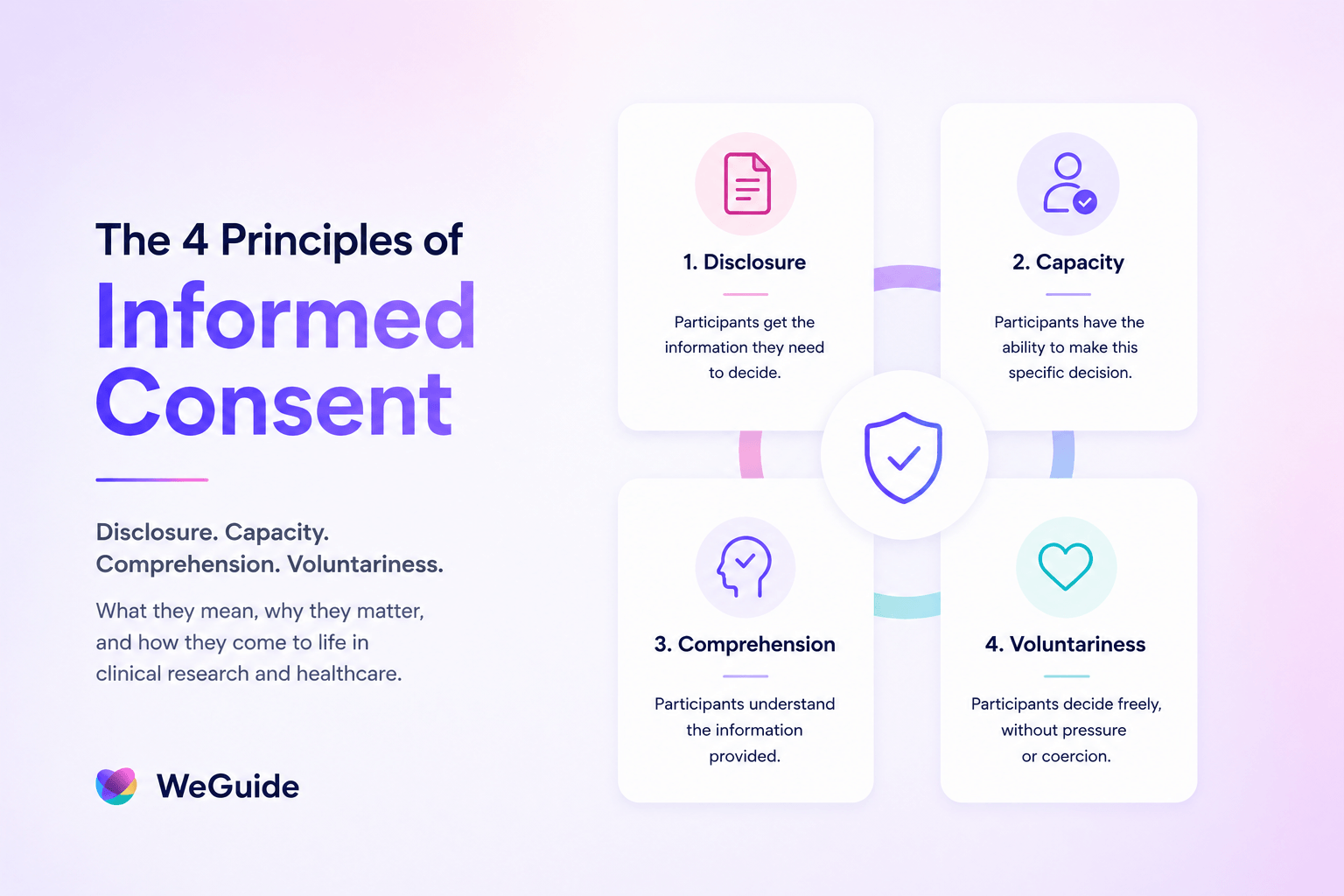


The 4 principles of informed consent are disclosure, capacity, comprehension, and voluntariness. Together they are what turn a signature into a meaningful, ethically valid decision, in everyday clinical care and in research. If you’re a clinician, a researcher, or a study coordinator, you already know consent is more than paperwork. It has to hold up ethically, legally, and practically when your participant is sitting at home re-reading the form at 10 pm. This guide gives you a clear answer to the four principles, shows how each applies in clinical practice and clinical trials, and then connects the dots to how teams support those principles with electronic informed consent.
Key Takeaways
- Four principles, not a signature. Valid informed consent rests on disclosure, capacity, comprehension, and voluntariness. A signed form alone is just consent; going through all four is what makes it informed.
- Comprehension is where consent fails. Participants often leave consent conversations with gaps about randomisation, placebo arms, and data use. Plain-language summaries, multimedia explainers, teach-back questions, and non-penalising knowledge checks close that gap.
- Disclosure means the right information. Share the diagnosis or research question, procedures, realistic risks and benefits, and alternatives in plain language, written for roughly a Year 8 reading level rather than legalese.
- Capacity is specific and can change. Capacity is judged for this decision, now, by whether the person can understand, appreciate, reason, and express a stable choice; special populations may need assent or a substitute decision maker, and re-assessment if circumstances change.
- Voluntariness extends past the signature. Consent must be free of coercion, manipulation, and undue inducement, and participants can withdraw at any time without penalty. Surfacing the right to withdraw early and making it easy is part of voluntary design.
- Documentation proves the process. The so-called fifth element is documentation: dated signatures, consent version records, an audit trail of what the participant saw, and evidence of comprehension checks that hold up at FDA or ICH E6(R2) audit.
The 4 principles of informed consent at a glance
The four principles of informed consent are disclosure, capacity, comprehension, and voluntariness. Together they protect a person’s right to make an informed decision about their own medical care or research participation. Every reputable framework, from the Belmont Report to the WMA Declaration of Helsinki and the NHMRC National Statement, points back to the same four ideas.
| Principle | What it means | What it looks like in practice |
|---|---|---|
| Disclosure | The participant is given the information they need to decide | Plain language summary of risks, benefits, alternatives, and study procedures |
| Capacity | The participant can understand and weigh the decision | Mental capacity check, age appropriate consent, surrogate decision making where needed |
| Comprehension | The participant actually understands what was disclosed | Teach back questions, multimedia explainers, comprehension quizzes |
| Voluntariness | The participant decides freely, without pressure | No coercion, no undue financial inducement, clear right to withdraw |
These four sit on a foundation of patient autonomy. Take any one away and consent stops being meaningful.
Disclosure without comprehension is a wall of text. Comprehension without voluntariness is compliance under pressure. Capacity without disclosure is guesswork. The four principles only work as a set.
Principle 1: Disclosure (sharing the right information)
Disclosure is the first job of any consent conversation. Before someone can agree, they need to know what they’re agreeing to. That includes the diagnosis or research question, the proposed treatment or study procedure, the realistic risks and benefits, the alternatives (including doing nothing), and what the experience will look like day to day.
In a clinical research setting, the FDA’s informed consent guidance and 21 CFR 50.25 set out the informed consent requirements every study must meet, including the eight basic elements that every consent form must cover. ICH E6(R2) Good Clinical Practice does the same internationally. These are the legal floor for disclosure, and a well written consent document moves through them in plain language rather than legalese.
Standards of disclosure
Two standards govern how much to share. The professional standard asks what a reasonable practitioner in the field would tell a patient. The reasonable patient standard asks what a reasonable person in the patient’s position would want to know. Most modern guidance leans toward the patient standard because it recognises that the person taking the risk should drive the conversation.
Practice tip: If you can’t explain the study or treatment to a friend at a barbecue without slipping into jargon, your consent document probably can’t either. Rewrite for a Year 8 reading level, then ask a non clinical colleague to read it back to you.
Principle 2: Capacity (the ability to make the decision)
Capacity is the question of whether the person in front of you can make this decision, right now, for this matter. It’s not a global judgement about intelligence. It’s specific, situational, and can change over time.
Four abilities are usually checked: the participant can understand the information, appreciate how it applies to their own situation, reason through the trade offs, and express a stable choice. A clinician or researcher who’s worried about capacity should document what they observed, what they tried, and what the outcome was.
Capacity in special situations
Some populations need extra care. Children participate through parental or guardian consent plus age appropriate assent. Adults with cognitive impairment, severe mental illness, or acute intoxication may lose capacity temporarily, in which case a substitute decision maker steps in. People in vulnerable circumstances, such as prisoners, employees, or students, deserve careful checks because the relationship itself can pressure their decision.
Regulatory note: Capacity assessment isn’t a tick box exercise. If a participant’s situation changes mid study, you may need to re-assess and, if needed, re-consent through a legally authorised representative. Always check your local ethics committee or HREC requirements.
Principle 3: Comprehension (understanding what was disclosed)
Disclosure tells the participant. Comprehension makes sure the message landed. A WHO systematic review of trial consent comprehension found that participants leave consent conversations with substantial gaps about randomisation, placebo arms, and what data will be collected. That’s a comprehension problem, not a disclosure one.
Comprehension is where most consent processes fall down, and it’s where digital tools have made the biggest difference. Effective approaches include:
- Plain language summaries at the front of the consent document, with the dense regulatory text behind it
- Multimedia explainers, short videos or animations that walk through randomisation, blinding, and key procedures
- Teach back questions, where the participant explains the study back to the coordinator in their own words
- Knowledge quizzes with non penalising feedback, so a wrong answer becomes a learning moment instead of a barrier
- Time to think, especially for non urgent decisions, with a follow up call rather than an on the spot signature
Comprehension also depends on language and culture. A participant who speaks English as a second language, or who comes from a community where research is unfamiliar, needs the consent in their first language and in a culturally appropriate frame. That’s why multi-language consent is now a baseline expectation, not a bonus feature. WeGuide’s work on the INHERIT multilingual COVID-19 study showed how delivering consent in multiple languages, with audio and video support, improved understanding for CALD participants who would otherwise have been excluded.
Principle 4: Voluntariness (a free, uncoerced decision)
Voluntariness means the decision is the participant’s, made without coercion, manipulation, or undue inducement. Coercion is the obvious one, threats or punishment for refusing. Manipulation is subtler, framing information in ways that distort the choice. Undue inducement is offering rewards so large that they override a person’s normal judgement of risk.
In clinical care, the line is usually clear. In research, it can blur.
A patient enrolled by their treating clinician may worry that refusing will affect their ongoing care. A trial that pays $2,000 for a low risk study may pull in participants who wouldn’t otherwise consider it. The HHS Common Rule (45 CFR 46.116) and equivalent regulators expect researchers to think carefully about both.
The right to withdraw
Voluntariness doesn’t end at the signature. Participants can withdraw at any time, for any reason, without penalty or loss of standard care. A consent process that buries the withdrawal clause on page 14, or that makes withdrawal feel awkward, is not really voluntary. Strong consent design surfaces the right to withdraw early, repeats it during the study, and gives participants a simple way to act on it.
Paper processes can make withdrawal harder than it should be, forcing a participant to print, sign, and post a letter just to step out of a long term study. Digital consent with a simple in-app withdrawal flow removes that friction and puts the decision back in the participant’s hands. That sense of control is what makes voluntariness work.
Where the fifth element fits: documentation and signatures
You’ll see plenty of articles online that list five components of informed consent, or eight elements, or ten. They’re not contradicting the four principles, they’re going deeper. The four principles are the ethical foundation. The eight basic elements under 21 CFR 50.25 are the regulatory translation of those principles into a checklist your consent form has to cover.
Documentation is sometimes called the “fifth element” because, in practice, you have to be able to prove that the four principles were satisfied. That means a dated signature, a record of which version of the consent form was signed, an audit trail of what the participant saw, and evidence of any comprehension checks. In FDA regulated and ICH E6(R2) regulated trials, all of this has to be defensible at audit. Good consent design treats documentation as the receipt for an ethical process, not the process itself.
See eConsent in practice
WeGuide's eConsent supports disclosure, comprehension, and voluntariness with plain-language modules, knowledge checks, and remote enrolment.
How the 4 principles of informed consent apply to clinical trials
Informed consent in clinical trials meets the operational reality of multi site, multi language, long running studies with protocol amendments. That’s where electronic informed consent (eIC) earns its place. Done well, eConsent supports each principle directly:
- Disclosure is delivered through structured, plain language modules with embedded video, so participants get the same complete information whether they’re-consenting in clinic or at home
- Capacity is supported by allowing the right amount of time, surrogate decision flows where needed, and accessibility features for participants with sensory or cognitive needs
- Comprehension is checked through inline knowledge questions, with non penalising feedback that turns a wrong answer into a teaching moment
- Voluntariness is reinforced by offering the choice to consent from home, away from the clinical environment, with a one tap withdrawal pathway throughout the study
eConsent also handles the administrative side that traditional paper consent struggles with. Version control, audit trails, automated re-consent on protocol amendments, multilingual delivery, and integration with your EDC or registry. WeGuide’s work on the BRACE Trial, where the team enrolled more than 6,000 participants across five countries during the COVID-19 pandemic, only worked because consent could be delivered remotely, in multiple languages, with full audit trail. You can read the operational view in our eConsent best practices guide and our deeper eConsent in clinical trials explainer.
For decentralised clinical trials the four principles aren’t a constraint on going digital, they’re the design brief for it. That design brief sits inside a wider set of choices, which we set out in our guide to decentralized clinical trials.
Common exceptions and special situations
A few situations let clinicians or researchers act without the full informed consent process. They’re narrow, time limited, and usually require ethics or IRB approval afterwards.
- Emergency exception: Treatment can begin without consent when delay would cause serious harm and the patient cannot consent. The patient or their representative is informed as soon as possible
- Therapeutic privilege: A clinician may withhold information if disclosure would cause serious psychological harm. This is rare, contested, and very narrow. Most jurisdictions are tightening the standard
- Public health and minimal risk waivers: Ethics committees can waive or modify consent for certain low risk studies, including some retrospective record reviews
- Re-consent on amendments: When a protocol changes in a way that affects risk, benefit, or procedures, participants must be offered the chance to consent again under the updated terms
Even in these exceptions, the four principles remain the lens. The question is always whether disclosure, capacity, comprehension, and voluntariness are being respected as fully as the situation allows.
Frequently asked questions
What are the 4 parts of informed consent?
The four parts of informed consent are disclosure, capacity, comprehension, and voluntariness. Disclosure is the information shared with the participant. Capacity is their ability to make the decision. Comprehension is whether they actually understood what was disclosed. Voluntariness is the freedom to decide without pressure.
What are the 4 criteria for informed consent?
The four criteria are the same as the four principles: the participant must be given relevant information, must have the mental capacity to make the decision, must understand what was disclosed, and must give consent freely and voluntarily. Documentation captures that all four were met.
What are the 5 elements of informed consent?
Lists of “five elements” usually add documentation or a competence check to the four principles. The most common framing is: disclosure of information, decision making capacity, comprehension, voluntary decision, and documentation of consent. They’re a more granular version of the same four ideas.
What’s the difference between consent and informed consent?
Consent is agreement to a procedure or activity. Informed consent is consent given with the information, capacity, comprehension, and freedom needed to make a meaningful decision. Signing a form is consent. Going through the four principles first is what makes it informed.
Bringing the 4 principles of informed consent into your study
The four principles of informed consent (disclosure, capacity, comprehension, and voluntariness) are the ethical core of every clinical care moment and every clinical research enrolment. They sit underneath every regulatory requirement, from the HHS Common Rule to ICH E6(R2) GCP, and they translate directly into the eight basic elements your consent form has to cover.
The principles haven’t changed. The way we deliver them has. Multimedia explainers, comprehension checks, multilingual consent, and one tap withdrawal aren’t extras, they’re how the four principles look in 2026. If you’re designing a new study, or refreshing the consent flow on an existing one, treat the four principles as your design brief.
Ready to see how the 4 principles of informed consent translate into a working eConsent flow? Have a look at WeGuide’s eConsent solution, or book a chat with our team about your study.
Build the four principles into your consent flow
See how WeGuide's eConsent turns disclosure, capacity, comprehension, and voluntariness into a working, auditable consent experience for your study.
Book a demoNo pressure, just a conversation.

