


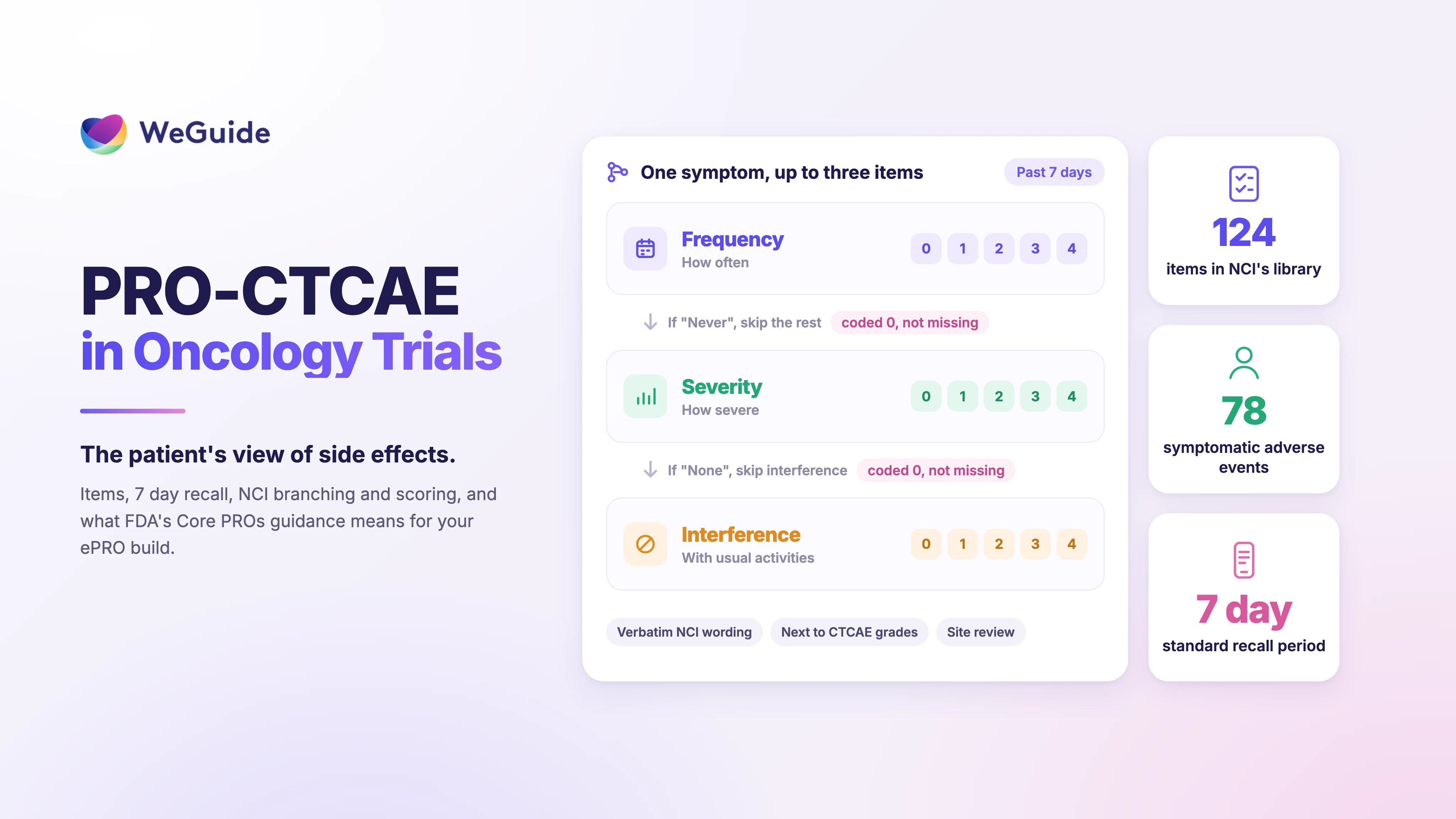


PRO-CTCAE® (Patient-Reported Outcomes version of the Common Terminology Criteria for Adverse Events) is the National Cancer Institute's library of 124 patient reported items covering 78 symptomatic adverse events. Patients rate how often, how severe and how much a symptom interferes over the past 7 days, as a companion to clinician graded CTCAE.
NCI built it because clinicians miss symptoms. In a 37 patient phase II prostate cancer trial, physicians' adverse event logs had a sensitivity of 47% against the patients' own questionnaire reports, and the NCI development team wrote that investigator reporting "underdetects symptomatic AEs".
This guide is for sponsors, CROs and academic cancer trials units that want to run PRO-CTCAE as ePRO next to their other patient reported outcomes in oncology. It covers the item library, FDA's final Core PROs guidance, NCI's branching and coding rules, recall and scheduling, alerts, scoring, the Terms of Use and a 12 point checklist. The rules come from NCI, FDA and peer reviewed papers, we mark our own practical suggestions as suggestions, and we don't reprint any item text.
Key Takeaways
- A companion, not a replacement: PRO-CTCAE adds the patient's view to clinician CTCAE grading, and NCI and FDA both say it complements safety data.
- 124 items, 78 symptoms, 7 days: each symptom gets 1 to 3 items on frequency, severity or interference, scored 0 to 4, over the past 7 days.
- FDA names it as one acceptable library: the final Core PROs guidance (October 2024) lists symptomatic adverse events among five core PROs and gives PRO-CTCAE as an example item library.
- Branching and coding are fixed: "Never" or "None" skips the follow up items, which are then coded 0, not missing.
- The wording is locked: NCI's Terms of Use forbid rewording, shortening or self translating items, and items should not be reprinted in publications.
What Is PRO-CTCAE?
PRO-CTCAE is a patient reported outcome measurement system that NCI describes as "developed to evaluate symptomatic toxicity in patients on cancer clinical trials." It's designed as a companion to the Common Terminology Criteria for Adverse Events, the clinician grading system used for safety reporting in cancer trials. Because patients answer it themselves, it's a patient reported outcome (PRO), one of the four types in our clinical outcome assessment overview. You can look up any clinician term and grade in our CTCAE lookup tool.
As the 2014 development paper explains, NCI's team reviewed all 790 adverse events listed in the CTCAE and found 78 that patients can reasonably report themselves: symptoms such as nausea, fatigue, numbness or hand and foot skin reactions. Each of those symptoms became one to three items written in plain language, for 124 items in total.
Three facts shape everything else:
- It's free, but licensed. NCI says PRO-CTCAE is "freely available for all to use," under Terms of Use that require study registration and forbid changing the items.
- It's an item library, not a fixed questionnaire. You select the symptoms relevant to your regimen.
- It's for describing tolerability. NCI intends it "to describe in aggregate the safety and tolerability of a therapeutic compound, regimen, or device," not to diagnose or to measure efficacy.
People also write it as PRO CTCAE or search for the NCI PRO CTCAE form, but the official name is PRO-CTCAE. A pediatric module, Ped-PRO-CTCAE, covers ages 7 to 17 (see below).
PRO-CTCAE vs CTCAE: How Patient and Clinician Reports Differ
CTCAE is a clinician's grade of an adverse event. PRO-CTCAE is the patient's own rating of a symptom. They measure related but different things, and both NCI and FDA expect them to be reported side by side rather than one replacing the other. An NCI authored review describes them as "two distinct and complementary perspectives."
| CTCAE | PRO-CTCAE | |
|---|---|---|
| Who reports | Investigator or clinician | Patient (or caregiver in the pediatric module) |
| What is rated | One grade from 1 to 5 that combines severity, effect on daily activities and intervention | Up to three attribute scores per symptom (frequency, severity, interference), each 0 to 4 |
| Scope | About 850 terms, including lab values, signs and symptoms | 78 symptomatic adverse events only |
| Time frame | Clinical assessment at the visit | Past 7 days (standard recall) |
| Main purpose | Individual adverse event reporting for safety | Describing tolerability in aggregate |
| Maintained by | NCI Cancer Therapy Evaluation Program | NCI Healthcare Delivery Research Program |
Clinicians also disagree with each other. When two clinicians rated the same patients, agreement was moderate, and a systematic review of 28 studies found agreement between CTCAE and patient reports was "moderate at best."
NCI warns against reading too much into the gap. Its FAQ says there's no perfect correspondence between the two systems "nor should there be." A patient's "severe" or "very severe" rating doesn't equal a CTCAE grade 4 or 5, which are reserved for life threatening events and death. NCI's example: two episodes of vomiting a day may meet CTCAE grade 1, yet feel severe to the patient.
The terms also differ. NCI publishes a correspondence table that maps plain language PRO-CTCAE terms to CTCAE terms: "Numbness and tingling" maps to Peripheral sensory neuropathy, and "Difficulty swallowing" maps to Dysphagia. That table still lists CTCAE v5.0 terms, while CTCAE v6.0 was released in 2025, so check each mapped term in our CTCAE lookup if your protocol grades in v6.0.
How the PRO-CTCAE Item Library Is Built
Each PRO-CTCAE symptom is assessed by up to three items, one per attribute, on 5 point scales over the past 7 days. The structure is what you configure in an ePRO system, and the exact wording comes only from NCI.
Attributes and response scales
NCI's overview lists five attributes: frequency, severity, interference with usual activities, amount, and presence or absence. Most symptoms use one, two or three of the first three. A few use "amount" or a simple present or absent item.
Frequency, severity, interference and amount responses are scored 0 to 4, and presence or absence is scored 0 or 1. So a symptom such as fatigue produces up to three numbers per assessment, not one grade.
We don't reproduce item stems or response options here. NCI's FAQ says "PRO-CTCAE items should not be reprinted in a publication," and the official versions are free to download from NCI.
Validation evidence and mode equivalence
The main validation study, published in JAMA Oncology in 2015, enrolled 975 adults at 9 US cancer centers and community practices. 119 of the 124 items met at least one construct validity criterion, and the median test retest intraclass correlation for prespecified items was 0.76. The authors reported favorable validity, reliability and responsiveness.
A 2016 study of 112 patients compared tablet, interactive voice response (IVRS) and paper administration and found median intraclass correlations of 0.78 to 0.81 between modes. That supports pooling data across those modes. Smartphones weren't studied, which we come back to below.
Languages and the pediatric module
NCI states that PRO-CTCAE has been "linguistically validated in more than 60 languages." Those translations belong to NCI, and the Terms of Use forbid making your own. For a multinational trial, that's good news: the linguistic validation work is already done, as long as your languages are on NCI's list.
Ped-PRO-CTCAE has 130 items covering 62 symptomatic toxicities for ages 7 to 17. Children can self report, and a caregiver version exists for children who can't. Responses are scored 0 to 3 (or 0 and 1 for presence). Its core items showed construct validity and reliability in a 2020 JNCI study. NCI notes the module isn't validated for children under 7.
Where to find the PRO-CTCAE item library and questionnaire
The PRO-CTCAE questionnaire is not one fixed form: NCI publishes the full item library, and each study builds its own PRO CTCAE questionnaire from the symptoms it selects. The item library lives on NCI's instrument page, with full libraries downloadable per language. For a study, use the NCI Form Builder. It's available to users who accept the Terms of Use, asks for the principal investigator, study design and sponsorship, and produces a study specific form in any available language. Check NCI's release notes before you build and again before each protocol amendment.
What FDA's Core PROs Guidance Says About PRO-CTCAE
FDA's Core Patient-Reported Outcomes in Cancer Clinical Trials guidance, final since October 2024, recommends that sponsors collect five core PROs and names PRO-CTCAE as one acceptable item library for symptomatic adverse events. The guidance covers FDA regulated trials of anticancer therapies intended to show an effect on survival, tumor response or delay in progression. It replaced the June 2021 draft, and builds on the core PRO concept that FDA authors set out in a 2016 paper.
FDA recommends "collecting and separately analyzing" five concepts:
| Core PRO | What it captures | Example measures named in the guidance |
|---|---|---|
| Disease related symptoms | Symptoms of the cancer itself | A disease specific measure suited to the cancer type |
| Symptomatic adverse events | Side effects of treatment | PRO-CTCAE, as "one acceptable item library" |
| Overall side effect impact | The patient's overall bother from side effects | A single global item, such as FACIT GP5 or EORTC Q168 |
| Physical function | Ability to carry out physical activities | PROMIS physical function or the physical function scale of the EORTC QLQ-C30 |
| Role function | Ability to work and carry out usual activities | The role function scale of the EORTC QLQ-C30 |
For symptomatic adverse events, the guidance sets four practical rules:
- Keep it concise. Select "a concise set of the most important symptomatic AEs," not every term in the library.
- Assess both arms. In active controlled trials, assess the adverse events expected from both regimens in all patients in both arms. FDA uses neuropathy as the example: if one regimen is known to cause it, ask about it in both arms.
- Justify the selection. Base it on the mechanism of action, early phase data and input from patients and clinicians.
- Add a free text question. FDA suggests considering one to capture symptoms the selected items miss. In a study of 1,760 participants, 58% added supplemental symptom information at least once, either by picking a dropdown term or by typing free text. Afterwards, 32% of the typed entries could be mapped to a PRO-CTCAE term and 68% to a MedDRA term.
Two lines in the guidance set the limits. "Symptomatic AEs assessed by PROs are intended to complement, not replace, standard CTCAE safety data." And "FDA does not endorse any specific PRO measure." PRO-CTCAE is an example, not a requirement.
Choosing PRO-CTCAE Items for Your Protocol
Pick the symptoms your regimen is expected to cause, the same way you build the adverse event surveillance plan. NCI's FAQ says item selection should draw on published data, earlier trials and the drug's mechanism of action. In practice that looks like this:
- Start from the evidence you already have. Preclinical findings, earlier phase data and the known profile of agents in the same class point to the likely symptoms.
- Apply the both arms rule. With an active comparator, include the comparator's expected symptoms too.
- Watch the burden. NCI estimates a 20 item PRO-CTCAE survey takes on average 3.4 minutes on paper, 3.7 minutes on the web and 5.4 minutes by IVRS. That's short, but it repeats every week in the early cycles, alongside other questionnaires.
- Add a free text item for unexpected symptoms, as FDA suggests.
- Collect a baseline before the first dose. Without it, you can't separate treatment effects from disease symptoms.
- Schedule the other core PROs separately. Physical function, role function and disease symptoms usually need a different cadence from adverse events. Our list of cancer and palliative care instruments shows common options.
Write the rationale into the protocol. It keeps the item set from growing with every amendment.
Recall Period and Assessment Schedule
Use the standard 7 day recall with weekly surveys in the first cycles, then widen the interval. Use 24 hour recall only with daily surveys.
Why 7 days
The 7 day recall is part of the validated instrument. A 2017 study of 127 patients found "a 1-week recall corresponds best to daily reporting," with small but growing differences at 2, 3 and 4 week recall. NCI's FAQ says it can't recommend longer or shorter recall periods.
A schedule that follows the toxicity curve
NCI suggests a baseline, then more frequent assessment early (for example weekly in the first several months), then monthly or quarterly. FDA's guidance includes an example (Figure 1) for an advanced cancer trial: weekly symptomatic adverse event assessment from baseline to week 8, then at months 3, 4, 5, 6, 9 and 12.
FDA also asks you to align assessments with how the drug is given, because cyclic IV and continuous oral regimens produce different symptom patterns. Use a visit window calculator to check how survey windows sit against clinic visits.
When 24 hour recall makes sense
Some designs need daily data: symptoms around infusions, after surgery or after cell therapy. NCI's FAQ says a 24 hour recall should be paired with daily reporting, because symptoms such as vomiting, diarrhea and insomnia vary a lot from day to day. In a 2023 study, 21 of 27 items reached an intraclass correlation of at least 0.70 under that design.
Using 24 hour recall on a weekly schedule is a different matter. In a 2024 interrupted time series analysis of an electronic symptom management program in routine care (1,692 patients at 6 institutions, 12 common symptoms), switching to 24 hour recall with weekly surveys lowered the odds of reporting severe symptoms after surgery (odds ratio 0.65) and of moderate or severe symptoms during chemotherapy (odds ratio 0.83). NCI's FAQ summarizes this as a 17% to 35% reduction.
If you change the recall period, NCI asks that the protocol and any publication state the change, the interval and the rationale. For registration trials, NCI suggests consulting FDA or EMA first.
Treatment interruptions and holds
Neither NCI nor FDA sets a specific rule for dose holds. One reasonable default is to keep surveys running on calendar time during an interruption, because the symptoms that cause a hold are exactly what you want to capture. That is our suggestion, not an NCI or FDA rule. Whatever you choose, define it in the protocol and record the reason for every missed survey, which FDA's missing data advice asks for anyway.
Building a PRO-CTCAE schedule?
See how WeGuide runs scheduled ePRO surveys on participants' own phones.
Building PRO-CTCAE Into an ePRO System: Branching, Coding and Layout
An ePRO build must follow NCI's branching rule, code skipped items as 0, keep each symptom's items together and leave the wording untouched. These rules come from NCI's FAQ and Terms of Use.
| Rule | What to configure | Source |
|---|---|---|
| Frequency answered "Never" | Skip the severity and interference items for that symptom | NCI FAQ |
| Severity answered "None" | Skip the interference item | NCI FAQ |
| Items skipped by branching | Code as 0, never as missing | NCI FAQ |
| "Not applicable", "Not sexually active", "Prefer not to answer" | Store the text response as a string; don't assign a number or code as missing | NCI FAQ |
| Forced response or allowed skips | Decide with the IRB; if skips are allowed, code them as "missing, participant did not answer" | NCI FAQ |
| Item grouping | Keep one symptom's items together in sequence, on one screen where possible | NCI FAQ |
| Wording and translations | No rewording, shortening or your own translations | NCI Terms of Use |
| Submission data standard | CDISC QRS supplement for PRO-CTCAE | CDISC |
Why 0? A frequency of "Never" means the patient didn't have the symptom, so severity and interference are known to be zero. Coding them as missing would inflate missing data.
On forced response, NCI notes there's no regulatory rule. It suggests that requiring a response to every shown item, combined with branching to keep the burden low, may balance data quality and burden best.
Smartphone screens are not yet studied
NCI tested PRO-CTCAE in a "wide" layout, with response choices across the screen, on tablets, IVRS and paper. Its FAQ is explicit: equivalence using "other layouts (eg. vertical response choices) or other devices (eg. smartphone) has not been studied."
That doesn't rule out phones, but it does mean a phone build is a migration decision you should document: how the layout differs, why the change is minor, and how the team reviewed screens before go live. Our guides on eCOA validation and migration and on BYOD cover the general approach. For the wider case for electronic capture, see paper vs ePRO.
Version control
Record which NCI library version and release notes you checked at build, and keep a full audit trail of form changes. If your system holds trial data for an FDA submission, the electronic records rules in 21 CFR Part 11 apply, and the ALCOA+ principles describe what reviewers expect from the data itself.
Alerts and Safety Review: What a Patient Report Should Trigger
Alerts route a patient's severe or worsening symptom to the site team for review. They don't grade or report an adverse event. The investigator still assesses the patient and, where appropriate, records a CTCAE graded event.
The evidence for alerts comes from routine cancer care rather than drug trial endpoints. In a randomized trial of 766 patients at Memorial Sloan Kettering, nurses received email alerts when patients reported severe or worsening symptoms on 12 common symptoms. Emergency room visits were lower with symptom monitoring (34% vs 41%), and the trial later reported overall survival results.
The larger PRO-TECT trial used items from the PRO-CTCAE library. Across 52 US community practices, patients answered weekly surveys by web or automated phone, and "severe or worsening symptoms triggered care team alerts." The final results in 1,191 patients showed no survival difference (hazard ratio 0.99), a longer time to the first emergency visit (hazard ratio 0.84), delayed deterioration of physical function, symptoms and quality of life, and 91.5% completion of expected weekly surveys. If your readers are clinic teams rather than sponsors, our cancer symptom management pathway covers the routine care side.
In a trial, alert design is a protocol decision:
- Define thresholds in the protocol, for example a severity score of 3 or higher, or a rise from the patient's baseline.
- Name the reviewer and the response time, and say what happens outside site hours.
- Describe the path from alert to adverse event: the investigator reviews, assesses and grades in CTCAE, and the PRO-CTCAE score itself is never the grade.
- Tell participants the app isn't for emergencies, with the site's contact details in the patient facing text.
- Protect the analysis: alerts shouldn't unblind treatment arms or change how PRO data are analyzed.
NCI's Terms of Use say PRO-CTCAE is "not intended for diagnostic, prognostic or therapeutic purposes." Alerts are compatible with that when they support clinician review inside the protocol's safety process, rather than acting as an automated decision.
Scoring, Analysis and Reporting
Report each attribute descriptively, next to the CTCAE grades for the same period, with the share of missing data. That's NCI's standing advice.
PRO-CTCAE scoring and the composite grade
Each item is scored 0 to 4. NCI states that "there are as yet no standardized scoring rules for how to combine attributes into a single score," and presents descriptive statistics or graphs per attribute as the default.
Researchers have proposed an option. A 2021 composite grading algorithm maps all 179 possible score combinations for a symptom to a single composite grade from 0 to 3, mapped by 20 clinical investigators, with the 12 combinations that lacked 75% agreement settled by investigator committees at a National Clinical Trials Network cooperative group meeting. The authors found it performed comparably to the item scores and "can be useful in analyses and reporting." Treat it as a published method that you prespecify in the statistical analysis plan, not as an NCI standard.
Missing data
FDA's guidance asks sponsors to monitor completion (for example with reminders), collect PROs at early withdrawal, document how and where each PRO was completed, and record reasons for missing assessments.
Publishing results
The Terms of Use require publications to state that permission was obtained by registering the study and agreeing to the Terms of Use, to reference the NCI PRO-CTCAE website, and to carry NCI's trademark statement.
PRO-CTCAE Terms of Use in Plain Language
PRO-CTCAE is free, but NCI owns it: you register your study, use the items exactly as published and credit NCI. In plain words, the Terms of Use mean:
- Register first. Use the NCI Form Builder, which asks you to accept the Terms of Use and describe the study.
- Don't change anything. You may not "adapt, alter, amend, abridge, modify, condense, make derivative works, or translate" the items without NCI's written consent. NCI's FAQ applies this to symptom terms, item phrasing, response choices and the recall period.
- Use NCI's translations. NCI holds the rights to all translations.
- Keep distribution inside the study, apart from regulators and journals.
- Credit NCI. Include the trademark statement on all copies, and state registration and the NCI website in protocols and papers.
- Don't sell it. Items can't be sold or built into materials for sale, except educational books and journals.
- Don't use it for efficacy. It's "not intended to assess the efficacy of medical drugs or devices."
PRO-CTCAE® is a registered trademark of the U.S. National Cancer Institute.
PRO-CTCAE Implementation Checklist
Use this list before protocol lock and again before go live:
- Study registered with NCI and the Terms of Use accepted.
- Items chosen from the regimen's expected symptomatic adverse events, covering both arms.
- A free text item added for unexpected symptoms.
- Recall period set to 7 days, or 24 hours only with daily surveys and a written rationale.
- Schedule set: baseline before first dose, weekly in early cycles, then wider intervals.
- Branching configured ("Never" and "None" skip the follow up items) and skipped items coded 0.
- "Not applicable", "Not sexually active" and "Prefer not to answer" stored as text.
- Forced response or skip policy agreed with the IRB, with skips coded as "missing, participant did not answer."
- NCI translations used for every language, and NCI release notes checked.
- Phone layout reviewed: items bundled per symptom, wide layout where possible, migration rationale documented.
- Alert thresholds, reviewer, response time and the path to CTCAE grading written into the protocol.
- Statistical analysis plan specifies descriptive reporting, any composite grade, CTCAE grades side by side and missing data handling.
Comparing platforms? Use the full eCOA vendor RFP question list.
How WeGuide Supports PRO-CTCAE Studies
WeGuide runs the ePRO side: you build your registered PRO-CTCAE items, verbatim from NCI, into scheduled surveys on participants' own phones. WeGuide is a patient engagement and data collection platform for clinical research and care, covering screening, eConsent, ePRO and PROMs, wearable data and patient registries.
- Your data where you analyze it. WeGuide integrates with REDCap through the REDCap API and also connects to Castor and Medidata Rave.
- Own phones first. BYOD comes first, and provisioned devices are supported when a protocol needs them. Typical platform configuration takes two to four weeks.
WeGuide is TGA registered Class I medical device software (ARTG 355337), is ISO 27001 certified, and supports HIPAA, GDPR and 21 CFR Part 11 aligned workflows. In the BRACE trial led by Murdoch Children's Research Institute, a trial of the BCG vaccine against COVID-19 with over 6,800 participants, participants logged daily symptoms in the WeGuide app with over 90% adherence, and data flowed into REDCap.
To be clear about the boundary: WeGuide doesn't supply PRO-CTCAE items or translations. You obtain them from NCI under its Terms of Use, and we build what you've registered. See our clinical trial solutions for the wider platform.
Frequently Asked Questions About PRO-CTCAE
What does PRO-CTCAE stand for?
PRO-CTCAE stands for Patient-Reported Outcomes version of the Common Terminology Criteria for Adverse Events. It's NCI's library of 124 items covering 78 symptomatic adverse events, which patients answer about the past 7 days as a companion to clinician graded CTCAE.
Is PRO-CTCAE validated?
Yes. A 2015 JAMA Oncology study of 975 adults found favorable validity, reliability and responsiveness, and tablet, IVRS and paper versions were shown to be equivalent. Smartphone equivalence hasn't been studied.
Is PRO-CTCAE required by the FDA?
No. FDA's final Core Patient-Reported Outcomes in Cancer Clinical Trials guidance (October 2024) asks sponsors to assess symptomatic adverse events and calls PRO-CTCAE "one acceptable item library." FDA states it doesn't endorse any specific PRO measure, so other well justified approaches are possible.
Can I change the PRO-CTCAE wording or recall period?
Not the wording. NCI's Terms of Use forbid rewording, shortening or translating items without written consent. The recall period is part of the instrument too: if you use 24 hour recall with daily surveys, state the change and rationale in the protocol and publications, and consider consulting FDA or EMA for registration trials.
How is PRO-CTCAE scored?
Each item is scored 0 to 4 (presence items 0 or 1). NCI has no standardized rule for combining a symptom's attributes into one score, so results are reported descriptively per attribute. A published composite grading algorithm (0 to 3) can be prespecified in the analysis plan.
Can PRO-CTCAE be used in children?
Yes, through Ped-PRO-CTCAE: 130 items for ages 7 to 17, with a caregiver version for children who can't self report. It isn't validated for children under 7.
Is CTCAE version 6 available, and does PRO-CTCAE change with it?
CTCAE v6.0 was released in 2025, and our CTCAE lookup covers it. NCI's PRO-CTCAE release notes list no change to the English items since then, only translation corrections, and its PRO-CTCAE to CTCAE correspondence table still lists v5.0 terms.
How do you capture patient reported adverse events in an early phase oncology trial?
Run weekly PRO-CTCAE surveys from baseline through the first cycles (our eCOA clinical trials guide covers the wider oncology setup), using items chosen from the regimen's expected symptoms plus a free text question. Send severe or worsening reports to the site team for review, and keep investigator grading in CTCAE. Report both side by side.
What should sponsors check when PRO-CTCAE assessments fall during treatment interruptions?
Check that the protocol says whether surveys continue on calendar time during a hold, that the ePRO schedule follows that rule automatically, and that every missed assessment has a recorded reason. Neither NCI nor FDA sets a specific rule for interruptions, so the protocol must.
Can PRO-CTCAE be completed on a smartphone?
It can be built for smartphones, but NCI notes that equivalence on smartphones and with vertical response layouts hasn't been studied. Keep items bundled per symptom, use a wide layout where possible and document the migration rationale.
Plan your oncology ePRO study with WeGuide
Tell us your regimen, items and schedule, and we'll show you how PRO-CTCAE surveys run on participants' own phones.
Book a demoNo pressure, just a conversation.

