

.svg)
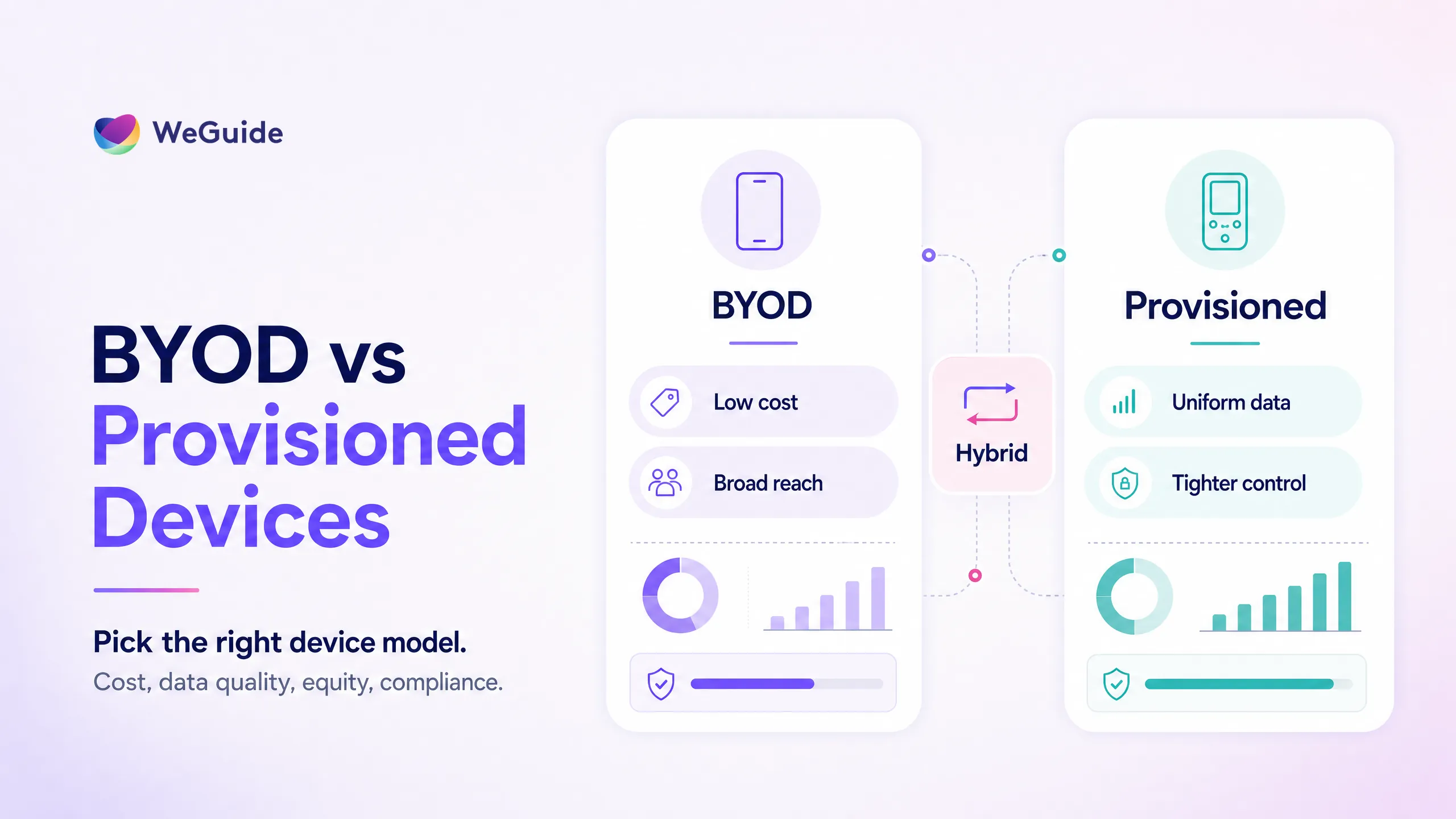


BYOD in clinical trials means participants use their own smartphone, tablet, or wearable to take part, rather than a device the study ships to them. In a BYOD clinical trials model, the phone someone already carries runs the eConsent flow, captures ePRO responses, and syncs wearable data, so there is nothing to post, configure, or recover. Provisioned devices flip that around. The study supplies identical hardware to every participant, which buys tighter control at a higher cost.
The choice shapes your budget, your data quality, who can take part, and how much your study team has to manage. This is a decision guide, not a wearables overview. It works through the trade off across cost and logistics, data quality, equity and access, and compliance, then shows when BYOD, provisioned, or a hybrid is the right call. WeGuide runs both models in the same study, so the focus here is the decision itself. For the wider picture of how sensors and apps fit a trial, start with our guide to wearables in clinical trials.
Key Takeaways
- BYOD means participants use their own device. They install a study app on a phone or wearable they already own, which removes shipping, setup, and device recovery from the study team.
- Provisioned devices buy consistency. Identical hardware and settings make data uniform and easier to validate, but the cost and logistics are real and recurring.
- Each model has a clear weak spot. BYOD can exclude people without a suitable device and varies across handsets. Provisioned costs more and adds a device people have to learn.
- Most trials run a hybrid. Offer BYOD as the default and provision a device only for participants who need one, which protects both data quality and equity.
- The model is a compliance and equity decision, not just a cost one. Validation, security, and access all change with the choice, so decide before you pick a device.
What Is BYOD in Clinical Trials?
BYOD, short for bring your own device, lets clinical trial participants use their own smartphone, tablet, or wearable to complete study tasks, instead of hardware the sponsor provides. They install a study app, give eConsent, answer ePRO questionnaires, and share sensor data from a device they already own. The model has grown because most people now carry a capable phone, which makes it practical to reach participants at scale.
In a BYOD study, the participant facing app does the heavy lifting. It guides consent, serves the right questionnaire at the right time, and pulls data from a connected wearable. WeGuide builds that layer, and our wearable device studies page shows how consumer and medical grade devices connect into one branded app. The forms themselves are built without code in the digital form builder, so the same instrument runs cleanly on a participant's own phone or a provisioned one.
Most BYOD in clinical trials today is BYOD eCOA, where electronic clinical outcome assessments run on the participant's phone, covering patient reported outcomes, daily diaries, and symptom tracking between visits. The same approach extends to wearables, where a participant's own smartwatch streams heart rate, activity, and sleep into the study.
BYOD vs Provisioned Devices: The Core Differences
The honest summary is that BYOD trades a little data consistency for big savings in cost and reach, while provisioned devices spend more to make the data uniform. Neither is better in the abstract. The right answer depends on the measure and the population.
BYOD widens reach and cuts cost. There is no hardware to buy, ship, configure, or collect, and participants use a device they already understand. The trade off is variability, because different phone models, operating systems, and screen sizes can present a questionnaire or capture a sensor reading in slightly different ways.
Provisioned devices give the opposite balance. Everyone has the same hardware, operating system, and settings, so the data is consistent and easier to validate against a known configuration. Device provisioning in a clinical trial also reaches people who do not own a suitable phone, which protects equity. The price is logistics, from procurement and shipping to support and recovery at the end.
| Decision factor | BYOD | Provisioned | Hybrid |
|---|---|---|---|
| Cost | Low, no hardware to buy or ship | High, hardware plus shipping, support, and recovery | Medium, provision only for those who need it |
| Data consistency | Varies across handsets and operating systems | Uniform, one known configuration | Mostly uniform, with a validated BYOD path |
| Equity and access | Excludes participants without a suitable device | Includes everyone, sponsor supplies the device | Includes everyone, default BYOD plus fallback hardware |
| Compliance and security | Needs clear app controls on unmanaged devices | Tighter control on managed devices | Layered, managed where it matters most |
| Participant experience | High, uses a familiar device | Lower, learns a new device to carry | High for most, supported for the rest |
| Best fit | Exploratory measures, large or spread out studies | Primary endpoints, regulated measures, mixed device access | Most real studies, balancing reach and rigour |
Provisioned setups vary too. Some sponsors lock down a managed phone for the study app only, while others ship a dedicated wearable alongside a participant's own phone, so the decision is rarely all or nothing.
Cost and Logistics
Cost is the first place the two models part company. BYOD removes the largest line items in a device programme, because there is no fleet to purchase, image, ship, track, or recover. For a study with hundreds or thousands of participants across many sites, that saving compounds quickly.
Provisioned devices carry cost across the whole study, not just at the start. Beyond the hardware, device provisioning in a clinical trial means warehousing, configuration, shipping, a help desk for setup and faults, replacement units, and a recovery process at close out. Devices go missing, break, or never come back, so the real cost is always higher than the sticker price.
Logistics also shape timelines. A BYOD study can enrol a participant the moment they consent, because the app installs on a phone they already hold. A provisioned study has to get a device into the right hands first, which can slow enrolment and add friction in remote or decentralised designs.
Capture clean device data, BYOD or provisioned
WeGuide runs both bring your own device and provisioned device studies in one participant app, so data lands consistent and ready for analysis whichever model you choose.
Data Quality and Consistency
Data quality is where provisioned devices earn their cost. When every participant uses the same hardware and settings, you remove a layer of variability and can validate the measure against one known configuration. For a primary endpoint that depends on precise timing or a specific sensor, that uniformity is often worth the logistics.
BYOD introduces variation, but it is manageable. The same ePRO instrument can render differently on a small older handset than on a large new one, and wearables differ in how they sample a signal. The fix is design and validation rather than avoidance. Good BYOD studies confirm an instrument behaves consistently across the device range they allow, set minimum operating system and hardware requirements, and validate equivalence so the data holds up. Our guide to wearable data quality in clinical trials covers the wear time, missing data, and standardisation controls that decide whether sensor data is usable.
Validation frameworks help here. The Digital Medicine Society publishes practical resources at DiMe for verifying and validating digital measures, which apply whether the data comes from a participant's own device or a provisioned one. A measure is trustworthy when it has been validated for the way it is actually captured, not because of the brand on the device. For the difference between the assessment types running on these devices, see our explainer on eCOA vs ePRO.
Equity, Access, and Inclusion
Equity is the argument that often decides the model. A pure BYOD study quietly excludes anyone without a suitable smartphone, and that group is not random. Older participants, people on lower incomes, and some rural communities are less likely to own a recent device, so a BYOD only design can skew the sample away from the people a treatment may need to reach.
Ownership is only the first barrier. The second is whether the data actually arrives, and it can fail hardest exactly where inclusion matters most. In a three week study of 148 participants in rural Burkina Faso using a wrist worn tracker, acceptability was 94 to 100 percent, yet coverage reached only 43 percent for accelerometer data and 3 percent for heart rate. The missingness was technical, driven by sync failures, rather than behavioural (PMID 36249225). A study that measured inclusion by enrolment alone would have recorded that as a success.
Provisioned devices solve this directly. When the study supplies the hardware, device ownership stops being a barrier to taking part, which supports a more representative sample. Regulators and ethics committees increasingly expect sponsors to show they have thought about digital access, so the equity case is part of a defensible enrolment plan, not just an ethical one.
This is why most teams land on a hybrid. WeGuide has run device based data capture at scale, including the BRACE trial on a WeGuide app with the Murdoch Children's Research Institute, which supported more than 6,000 participants across five countries with over 90% participant adherence and a six week deployment during COVID 19. The lesson is that a participant friendly app keeps adherence high, and a fallback device for the people who need one keeps the sample broad without forcing everyone onto provisioned hardware.
Compliance, Security, and Validation
Compliance applies to both models, but the controls differ. On a provisioned device the sponsor manages the hardware, so you can lock the configuration, restrict other apps, and standardise security. On a participant's own phone you cannot manage the whole device, so the protection has to live in the study app, through secure login, encryption, controlled data storage, and a clear audit trail. Both approaches can support GCP aligned and 21 CFR Part 11 aligned data capture when designed properly.
Validation is the part teams underestimate. If an instrument was validated on paper or on one device type, regulators expect evidence that it performs the same way on the devices participants actually use. For BYOD eCOA that usually means equivalence testing across the allowed device range, with minimum requirements set in the protocol. The FDA sets out how to select, verify, and validate technology for remote data collection in its guidance on digital health technologies for remote data acquisition in clinical investigations, which applies to both models.
WeGuide is TGA Class I certified medical device software and supports the secure, documented data capture both models need, though sponsors remain responsible for instrument validation and regulatory strategy. BYOD is not a compliance shortcut, and provisioned is not automatically compliant. Either model meets the bar when the app, the data handling, and the validation evidence are in place before the first participant enrols.
When to Choose BYOD, Provisioned, or Hybrid
The decision follows the measure, the population, and the regulatory weight of the data. As a starting rule, choose BYOD when the measure tolerates some device variation and the population is likely to own suitable phones. Choose provisioned when the measurement is a primary endpoint, demands a specific sensor, or the population has uneven device access.
Use this as a quick guide:
- Choose BYOD for exploratory or supportive measures, large or geographically spread studies, fast enrolment, and populations with high smartphone ownership, where cost and reach matter most.
- Choose provisioned for primary endpoints, regulated measures that need a validated configuration, studies that depend on a specific wearable, or populations where device access is uneven and equity is at risk.
- Choose hybrid for most real studies, offering BYOD as the default and provisioning a device only for participants who lack a suitable one, which protects data quality and equity at a controlled cost.
In practice the hybrid model wins more often than not, because it captures the savings of BYOD while closing the equity and consistency gaps with provisioned hardware where it counts. The key is to design the model into the protocol from the start, alongside the validation plan.
Frequently Asked Questions
What is BYOD in clinical trials?
BYOD, or bring your own device, means participants use their own smartphone, tablet, or wearable to take part in a trial instead of hardware the sponsor supplies. They install a study app to give eConsent, complete ePRO questionnaires, and share sensor data, which lowers cost and lets people use a device they already know.
What does a provisioned device mean in a clinical trial?
A provisioned device is hardware the study supplies to each participant, configured and managed by the sponsor or a vendor. Because everyone uses identical devices and settings, the data is consistent and easier to validate. Device provisioning in a clinical trial adds cost for procurement, shipping, support, and recovery, but it removes device ownership as a barrier to taking part.
Is BYOD or provisioned better for data quality?
Provisioned devices give more consistent data because every participant uses the same configuration, which suits primary endpoints. BYOD introduces variation across handsets, but it is manageable with minimum device requirements and equivalence validation. For many supportive measures, a well validated BYOD model produces data that holds up, so the better choice depends on the endpoint.
Does the FDA allow BYOD in clinical trials?
Yes, within a clear framework. The FDA's guidance on digital health technologies for remote data acquisition explains how sponsors select, verify, and validate technology for remote data collection, and it applies to both BYOD and provisioned models. BYOD data is accepted when the instrument is validated for the devices used and data handling is documented.
What is a hybrid device model in clinical trials?
A hybrid model offers BYOD as the default and provisions a device only for participants who do not own a suitable one. It captures most of the cost and reach benefits of BYOD while protecting equity and data consistency for the people who need a supplied device. Most real studies end up choosing this balanced approach.
Does BYOD reduce clinical trial costs?
Usually, yes. BYOD removes hardware purchase, configuration, shipping, support, and recovery from the device programme, which are the largest costs in a provisioned model. The saving grows with participant numbers and with studies spread across many sites or countries. The trade off is more design and validation work upfront to handle device variation.
Conclusion
The BYOD clinical trials question is rarely BYOD or provisioned in the abstract. BYOD wins on cost, reach, and speed, provisioned wins on consistency and control, and the weak spots of each are what the other covers. That is why the strongest answer for most studies is a hybrid that defaults to a participant's own device and provisions hardware for the people who need it.
Whatever model you choose, decide it early and pair it with a validation plan, because the data quality, equity, and compliance all flow from that choice. WeGuide is the participant facing layer that runs BYOD and provisioned studies in one branded app, bringing eConsent, ePRO, and wearable data together so the data lands clean alongside your existing CTMS and EDC.
Choose the right device model with confidence
Walk through how WeGuide supports BYOD, provisioned, and hybrid studies, from device choice to validated, analysis ready data.
Book a demoNo pressure, just a conversation.

