

.svg)
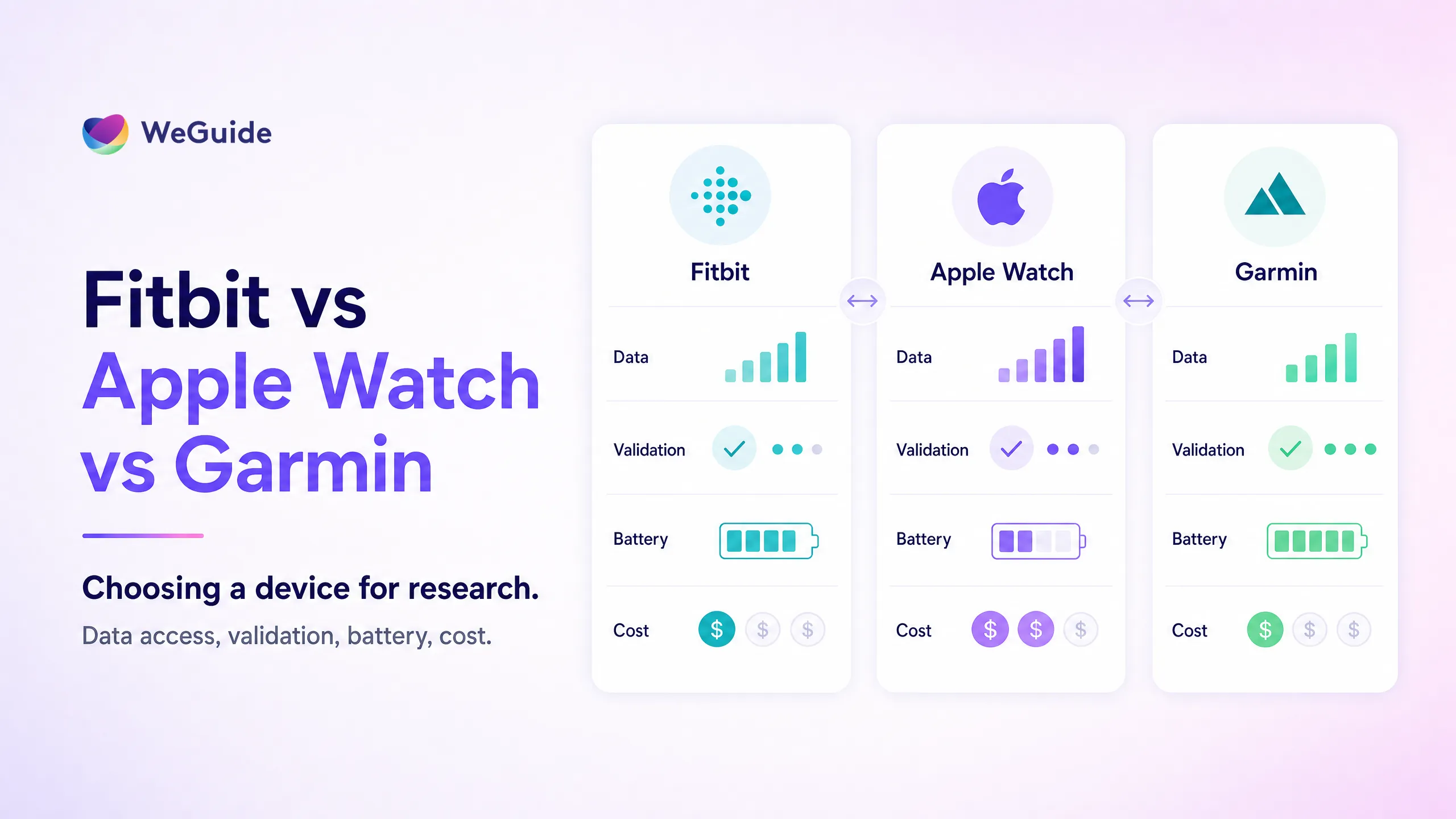


Consumer wearables can be used in clinical research, and many trials already do. Devices from Fitbit, Apple Watch, and Garmin capture heart rate, activity, and sleep continuously, which makes them a practical way to collect objective data between visits. The honest answer to which one is best is that none is best in the abstract. The right choice depends on the measure you need, the population you are studying, and how well the data has to hold up.
This guide compares Fitbit, Apple Watch, and Garmin for clinical trials across the factors that actually decide fit: data access and API, validation status, battery life, cost, and ecosystem. It then sets the three side by side and walks through how to choose by measure and population. For the wider context on sensors, endpoints, and validation, start with our guide to wearables in clinical trials. This article stays focused on the cross device choice a study team has to make.
Key Takeaways
- No device is universally best. Fitbit, Apple Watch, and Garmin each suit different measures and populations, so the choice follows the endpoint, not the brand.
- Consumer devices fit activity, sleep, and heart rate. They work well for exploratory and supportive endpoints. Primary regulatory endpoints usually need a medical grade device or careful validation.
- The five factors that matter are data access, validation, battery, cost, and ecosystem. Compare on these, not on marketing specs.
- Apple leads on cardiac, Garmin on battery, Fitbit on reach and cost. Each has a clear strength a study team can plan around.
- Data quality decides the outcome. Whichever device you pick, wear time and validation matter more than the badge on the case.
Can You Use Consumer Wearables in Clinical Research?
Yes, consumer wearables are accepted in clinical research when the device fits the question and the data is handled well. A smartwatch or fitness tracker can supply activity, sleep, and heart rate data for exploratory and supportive endpoints, and in some cases for cleared measures such as atrial fibrillation detection. What they are not is an automatic substitute for a medical grade device on a primary regulatory endpoint.
The point that matters is the role of the measure. For an exploratory endpoint, a supportive secondary measure, or participant engagement, a consumer device is often a sensible and affordable choice. For a primary endpoint that a regulator will scrutinise, you either pick a device with the right clearance for that measure or you validate the consumer measure carefully before you rely on it.
Regulators have set out how to make these calls. The FDA guidance on digital health technologies explains how to select a device that fits the population and the measure, then verify and validate it for the way you intend to use it. Consumer wearables sit comfortably inside that frame as long as the sponsor does the homework.
What to Compare Across Consumer Wearables
Before you weigh Fitbit, Apple Watch, and Garmin by name, it helps to fix the criteria. Five factors decide whether a consumer device fits a study, and they matter more than brand loyalty.
- Data access and API. How you get raw and summary data out of the device, and at what resolution.
- Validation status. Whether the measure you care about has been studied or cleared for that use.
- Battery life and wear time. How long the device runs before charging, which drives missing data.
- Cost and ecosystem. Device price, whether it ties to one phone platform, and total study cost.
- Research programmes and support. Developer access, grants, and the track record behind the device.
Data access is where teams often get surprised. Some devices expose a clean cloud feed, others keep data on the phone and need a custom app. Validation is the second gate. A measure can be accurate for steps and still be unreliable for sleep staging or energy use, so consumer wearable validation has to be specific to the measure, not the device as a whole. The accepted way to frame that work is the V3 framework from the Digital Medicine Society (DiMe), which separates verification, analytical validation, and clinical validation.
Cost and battery shape the participant experience. A cheaper device with longer battery often produces better data than a premium one that participants forget to charge. WeGuide connects consumer devices into a single participant app, including a direct Garmin integration, so the comparison below assumes the data still has to land somewhere clean and usable.
Fitbit for Clinical Research
Fitbit has the longest research track record of the three, which is why fitbit clinical trials are common in academic and large cohort work. Google now owns Fitbit, and the range spans low cost trackers to full smartwatches, so it reaches broad and cost sensitive populations that an expensive device would exclude.
Data access runs through the Fitbit Web API, with third party platforms such as Fitabase widely used to pull and manage participant data at scale. Granular intraday data is available but needs approval, which is worth planning for early rather than discovering mid study. Fitbit captures steps, heart rate, sleep, and blood oxygen, and some models add a cleared ECG app and irregular rhythm features.
For activity and sleep on a budget, Fitbit is hard to beat, and its familiarity supports wear time across mixed populations. We cover the device family, sensors, and data handling in depth in our look at Google and Fitbit for clinical research, so this comparison stays at the level a study team needs to choose between brands rather than repeating that detail.
Bring any consumer wearable into one participant app
WeGuide connects Fitbit, Apple Watch, and Garmin data with eConsent and ePRO in a single branded app, so sensor data lands clean and ready to analyse alongside your existing systems.
Apple Watch for Clinical Research
Apple Watch is the strongest choice for cardiac measures, which is what most apple watch clinical research builds on. It carries an FDA cleared ECG app and irregular rhythm notifications, and Apple has run large studies of its own on heart rhythm, hearing, and women's health, which gives the platform a deep evidence base for those measures.
Data capture uses HealthKit on the iPhone, with the ResearchKit framework available for building study apps. That offers a rich and well documented development ecosystem, but it also means you need an iPhone and usually a custom app to get data out, which raises cost and narrows reach. Apple also exposes movement related measures that have drawn interest in neurology research.
The main trade offs are battery and access. The watch needs near daily charging, which can interrupt overnight measures such as sleep unless you plan around it, and the iPhone requirement excludes participants who only use Android. WeGuide has supported Apple Watch research, including a heart rhythm study that Apple featured, so the device suits cardiac questions and iPhone owning populations well.
Garmin for Clinical Research
Garmin stands out for battery life and granular data, which makes garmin clinical research attractive for studies that need long, uninterrupted wear. Many Garmin devices run for a week or more between charges, and some considerably longer, so participants are less likely to take the device off and create gaps in the record.
Access runs through the Garmin Health API and SDK, with a server to server data feed and, on some devices, higher resolution sensor data than consumer apps usually expose. Garmin captures activity, heart rate, heart rate variability, stress, respiration, sleep, and pulse oximetry, and it works across both iOS and Android, which widens reach in mixed populations.
Garmin is positioned mainly around wellness and fitness rather than regulatory cleared diagnostic measures, so it suits activity, heart rate variability, and exploratory endpoints more than primary cardiac diagnosis. WeGuide offers a direct Garmin integration that brings heart rate, sleep, and activity into the participant app, and Garmin runs research grants that some study teams have used to help fund device costs.
Fitbit vs Apple Watch vs Garmin: Side by Side
The table below sets the three consumer wearables against the factors that decide fit. Read it as a starting point, then confirm the detail for the specific model and measure you have in mind, because capabilities differ across each maker's range.
| Factor | Fitbit | Apple Watch | Garmin |
|---|---|---|---|
| Data access and API | Fitbit Web API plus third party tools like Fitabase, granular intraday data needs approval | HealthKit and ResearchKit on the iPhone, needs a custom app to export data | Garmin Health API and SDK, server to server feed, higher resolution data on some models |
| Validation | Steps and heart rate well studied, cleared ECG and rhythm features on some models | Strong cardiac evidence, FDA cleared ECG and irregular rhythm notifications | Activity and heart rate widely used, positioned for wellness, fewer regulatory clearances |
| Battery life | Several days for trackers, less for smartwatches | About a day, needs near daily charging | A week or more, some models much longer |
| Cost and ecosystem | Low entry cost, wide range, iOS and Android | Highest cost, requires an iPhone | Wide range, strong value, iOS and Android |
| Best fit | Broad reach, activity and sleep, cost sensitive studies | Cardiac measures, iPhone owning populations, rich app integration | Long wear time, activity and HRV, mixed device groups |
Each of these device families has a dedicated deep dive on this blog, covering data access, accuracy evidence, and regulatory status in detail: the Apple Watch, the Garmin CIRQA, and the Google Fitbit Air. Two categories sit outside this three way comparison and are worth knowing about: the Oura Ring, the most validated smart ring in research, and WHOOP, a subscription only screenless band carrying one FDA cleared function.
How to Choose a Wearable for Clinical Research
Which wearable for clinical trials comes down to two questions: what are you measuring, and who is wearing it. Match the device to both and the rest of the decision falls into place.
Choose by the measure
Start with the endpoint, because that sets the floor for accuracy and clearance.
- Activity, steps, and sleep. Any of the three works. Decide on cost, battery, and how the data feed fits your study.
- Heart rhythm and cardiac screening. Apple Watch leads, with a Fitbit model that carries a cleared ECG as an alternative.
- Long continuous wear and heart rate variability. Garmin, because longer battery keeps the device on and the record complete.
- A primary regulatory endpoint. Reconsider whether a consumer device is right at all. A medical grade device or a carefully validated consumer measure is usually the safer path.
Choose by the population
The device has to suit the people in the study, not just the protocol.
- Mixed iOS and Android groups. Fitbit or Garmin, since Apple Watch needs an iPhone.
- Large or cost sensitive cohorts. Fitbit, for low device cost and broad familiarity.
- Older participants or anyone who forgets to charge. Garmin, for long battery life that protects wear time.
- Tech comfortable iPhone users in a cardiac study. Apple Watch, to make the most of its sensors and apps.
Whichever device you choose, the data quality work decides the result. Wear time, missing data, and how consistently the measure is captured matter more than the brand, which is why we treat capture and monitoring as the real lever in our guide to wearable data quality in clinical trials. Pair the right device with a participant experience that keeps it on, and consumer wearables in clinical research can produce data you can stand behind.
Frequently Asked Questions
Can you use consumer wearables in clinical research?
Yes. Consumer wearables like Fitbit, Apple Watch, and Garmin are accepted for activity, sleep, heart rate, and exploratory or supportive endpoints when the measure is fit for purpose. For a primary regulatory endpoint, teams usually choose a medical grade device or validate the consumer measure carefully before relying on it.
Which is better for clinical trials, Fitbit, Apple Watch, or Garmin?
None is best in every case. Apple Watch leads on cardiac measures, Garmin on battery life and long wear, and Fitbit on cost and broad reach. The right device depends on the endpoint you are measuring and the population wearing it, so match the device to both before deciding.
Are Fitbit and Apple Watch accurate enough for clinical trials?
For many measures, yes. Steps and heart rate are well studied across both, and Apple Watch has cleared cardiac features. Accuracy varies by measure, so sleep staging and energy use are less reliable than activity. Validate the specific measure for your use rather than assuming the whole device is accurate.
Does Apple Watch work for clinical research on Android?
No. Apple Watch needs an iPhone, because it relies on HealthKit and pairs only with iOS. For studies with mixed iOS and Android participants, Fitbit or Garmin are usually the better fit, since both work across phone platforms and avoid excluding Android only participants from the study.
Why is Garmin used in clinical research?
Garmin is used for its long battery life and granular data access. Many models run for a week or more between charges, which protects wear time, and the Garmin Health SDK exposes higher resolution data on some devices. It suits activity, heart rate variability, and exploratory endpoints across both iOS and Android.
Do consumer wearables need validation for trial endpoints?
Yes, for any measure you plan to rely on. Consumer wearable validation should follow a framework like the DiMe V3 model, which checks that the sensor measures what it claims, that the algorithm turns the signal into an accurate measure, and that the measure reflects something clinically meaningful.
Conclusion
Choosing among consumer wearables in clinical research is less about finding the best device and more about matching the device to the job. Fitbit gives you reach and low cost, Apple Watch gives you cardiac depth inside the iPhone ecosystem, and Garmin gives you battery life and granular data across both phone platforms. Decide the measure and the population first, then let those choices point to the device.
The factors that separate them are concrete: data access, validation, battery, cost, and ecosystem. Weigh those, validate the specific measure you need, and plan for wear time from the start. WeGuide is the participant facing layer that brings Fitbit, Apple Watch, and Garmin data together with eConsent and ePRO in one branded app, so your wearable data arrives clean and ready to use alongside your existing trial systems.
Choose the right wearable for your study
Walk through how WeGuide captures clean data from Fitbit, Apple Watch, and Garmin, from device choice to a single participant app.
Book a demoNo pressure, just a conversation.

