

.svg)
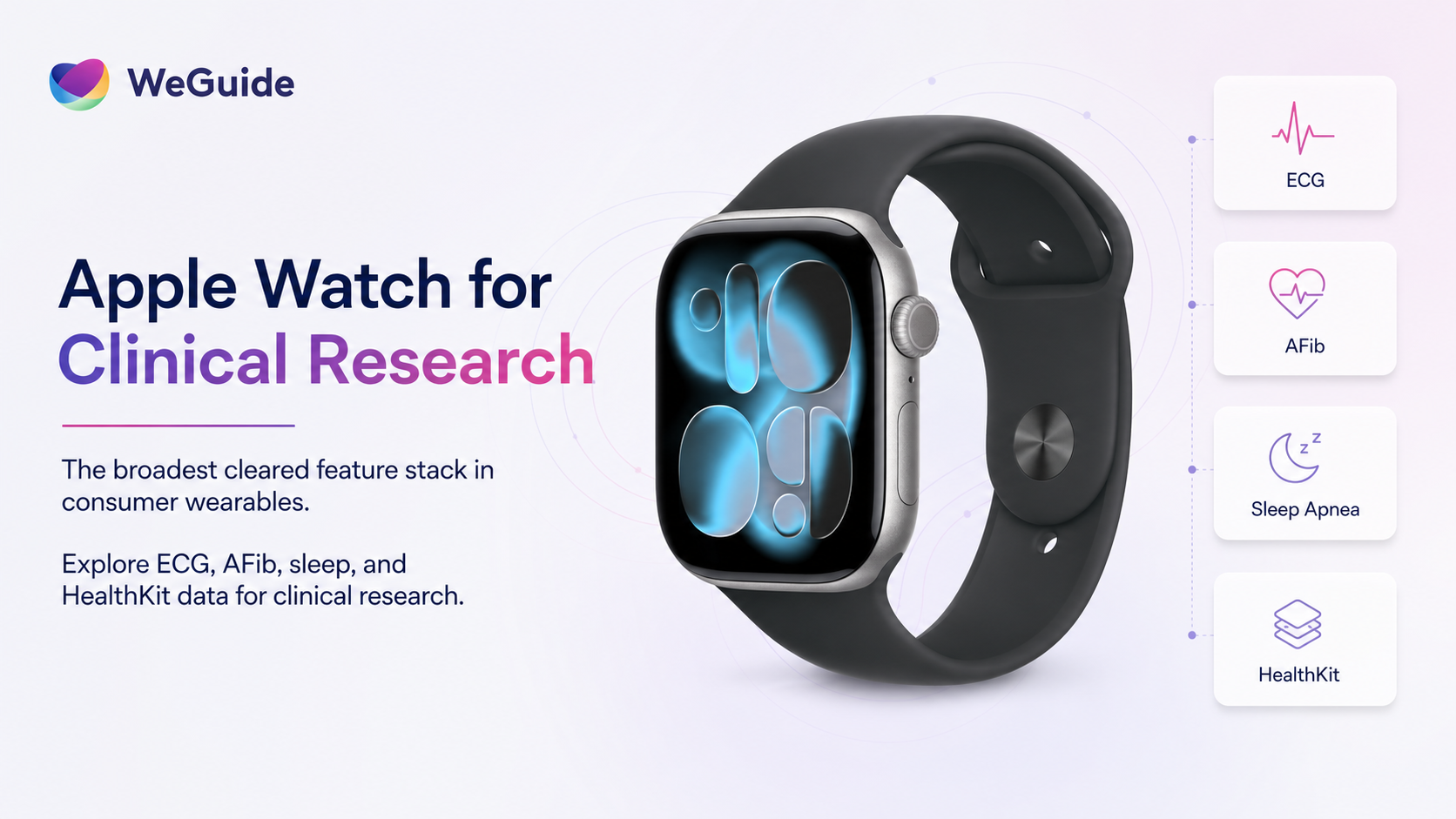


The Apple Watch can be used in clinical research as a native source of heart rate, heart rate variability (HRV), sleep, activity and mobility data, plus a stack of FDA cleared cardiac features (ECG, atrial fibrillation history, and irregular rhythm, sleep apnea and hypertension notifications). It's the most research-embedded consumer wearable there is, but two facts shape every study. There's no Apple cloud API, so data is captured on device through HealthKit, and the watch needs a paired iPhone. Used with those facts in mind, Apple Watch clinical research is one of the most capable options available.
The current line is the Series 11, Ultra 3 and SE 3, all on watchOS 26. Apple Watch stands out from other research wearables on three points. It has more separately cleared medical features than any rival, and Apple Health is a native data path rather than a third-party API. It also carries the deepest research track record, anchored by the Apple Heart Study of roughly 419,000 participants. WeGuide has run Apple Watch research directly: our Beat2Beat study, featured on the Apple Newsroom, used the Apple Watch to detect the impact of cancer treatment on heart rhythm, one of the wearable device studies we run end to end on our platform.
Wearable substudies tend to succeed or fail on three questions: whether participants keep wearing the device, whether the signal is good enough for the endpoint, and whether you can get the data out cleanly. This guide works through all three for the Apple Watch, covering what it measures, how accurate each signal is, how researchers actually access the data, its regulatory footing, and how it compares to WHOOP, the Oura Ring and other research wearables.
Key Takeaways
- The Apple Watch has more FDA cleared features than any rival, but the watch itself is not a medical device. ECG and irregular rhythm notifications were granted in 2018, AFib History and sleep apnea and hypertension notifications followed, and each is cleared or granted per feature and per model.
- There is no Apple cloud or OAuth API. Data is captured on device through HealthKit inside the participant's iPhone app, which is WeGuide's native Apple Health path. Raw sensor data needs SensorKit and an Apple granted research entitlement.
- An Apple Watch study needs an iPhone. That makes an Apple Watch arm an iPhone owner arm, a real selection bias fact that skews demographics and forecloses Android participants.
- Accuracy is signal-specific. Heart rate and sleep and wake are strong, its sleep staging topped an independent six-device study, and its HRV is reported as SDNN. ECG and hypertension features are high specificity screens, not diagnostics.
- Model mix matters. The SE 3 has no ECG and no blood oxygen sensor, so a cohort that mixes SE and flagship watches cannot uniformly collect those signals.
What Is the Apple Watch for Research?
The Apple Watch is a wrist worn smartwatch that captures heart rate, HRV, an on demand single lead ECG, respiratory rate, sleep, wrist temperature, activity and mobility metrics. All of these surface to researchers through Apple's HealthKit framework on a paired iPhone. The current models are the Series 11, the rugged Ultra 3, and the lower cost SE 3, all running watchOS 26.
For a study, "we're using Apple Watch" is under-specified, because the sensor set differs by model. The flagship Series 11 and Ultra 3 carry the electrical heart sensor for ECG, a third generation optical heart sensor, a blood oxygen sensor, and a wrist temperature sensor. The SE 3 is a different data instrument: it has a second generation optical sensor and, importantly, no ECG electrodes and no blood oxygen sensor. So a cohort that mixes SE and flagship watches cannot uniformly collect ECG or SpO2, and the model split becomes a covariate rather than a footnote.
Battery life is an adherence variable. Mainline watches run about 18 to 24 hours, so they realistically need a daytime top up to protect the overnight window used for sleep, HRV and temperature. The Ultra is a multi day device at up to 42 hours, which can run continuous overnight capture on a once daily charge. Fast charging softens the gap, with the Series 11 reaching about 80% in roughly 30 minutes.
The most consequential fact is the iPhone dependency. An Apple Watch can't be set up or fully used without a paired iPhone running a current iOS version. That isn't a minor logistics note, it's a selection bias fact. An Apple Watch arm is implicitly an iPhone owner arm. That skews higher income and by geography, and forecloses a bring your own device design for Android participants. If a sponsor provisions iPhones to level the field, that's real per participant hardware and support cost.
Why the Apple Watch Matters for Clinical Trials
The Apple Watch earns its place through reach, cleared features and a native data path. Four things make it a genuine option for Apple Watch clinical trials.
The deepest research footprint. A ClinicalTrials.gov search for the exact phrase "Apple Watch" returns around 189 registered studies, and the device anchors some of the largest digital health studies ever run, including the Apple Heart Study of roughly 419,000 participants. No consumer wearable has a longer track record as a study instrument.
A native data path, not a third-party API. Apple Health is one of WeGuide's three native integrations, so standard Apple Watch metrics land in HealthKit and can be captured next to ePRO with no custom build. That native path is what makes Apple Watch capture practical for a study.
More cleared features than any rival. ECG, atrial fibrillation history, and irregular rhythm, sleep apnea and hypertension notifications are each separately cleared or granted by the FDA. That gives a trial team a menu of regulator-reviewed cardiac and sleep measures no other consumer wearable matches.
Proven in real WeGuide research. Our Beat2Beat study used the Apple Watch to monitor heart rhythm changes during cancer treatment, work that Apple featured on its Newsroom. For studies pairing passive physiology with wearable data quality controls, and for decentralised clinical trials that lean on remote capture, that lived experience shapes how we set up the pipeline.
The honest counterweight is the iPhone lock and the daily charge on mainline models, plus the fact that most published Apple Watch work is device validation or Apple-sponsored cohort studies rather than trials using an Apple Watch metric as a pre-specified primary endpoint.
Run your Apple Watch substudy on a proven pipeline
WeGuide powers wearable device studies end to end, from eConsent through native Apple Health capture to analysis ready export, alongside your ePRO.
What the Apple Watch Measures
For trial design, the useful split is between near raw signals, which can be validated against reference instruments, and derived or cleared features built on top of them. Only the signals belong in a defensible endpoint, and the cleared features carry a defined regulatory context.
| Metric | Type | What it is | Notes for research |
|---|---|---|---|
| Heart rate | Signal | Optical PPG heart rate | Strong vs ECG at rest; degrades with motion |
| HRV | Signal | Reported as SDNN, auto recorded overnight | Apple gives SDNN, not RMSSD or frequency domain |
| ECG | Signal | On demand single lead ECG (not SE) | Cleared feature; classifies AFib and sinus rhythm |
| Respiratory rate | Signal | Overnight breaths per minute | Surfaces in HealthKit |
| Blood oxygen (SpO2) | Signal | Overnight blood oxygen % | US availability affected by the Masimo dispute (see below) |
| Wrist temperature | Signal | Overnight deviation from baseline | Relative trend, not core temperature |
| AFib History | Feature | Weekly AFib burden estimate | Cleared + FDA MDDT-qualified as a secondary endpoint |
| Sleep apnea, hypertension notifications | Feature | Retrospective risk flags | Cleared high specificity screens, not diagnostics |
| Cardio fitness (VO2max), mobility metrics, sleep stages | Derived | Estimates from motion + HR | Wellness estimates; mobility/gait used in trials |
Two points matter most. First, Apple reports HRV as SDNN, the standard deviation of the inter-beat intervals, and it doesn't expose RMSSD or frequency domain HRV. That matters when you compare against devices like WHOOP or Oura that report RMSSD. Continuous beat to beat interval data is not streamed to third-party apps, it's generated only in Mindfulness sessions. Second, wrist temperature is a nightly deviation from the wearer's own baseline, useful as a relative trend for cycle tracking, not a clinical thermometer.
One data-provenance caveat sits on blood oxygen. After a patent ruling in the Masimo dispute, Apple disabled the Blood Oxygen feature on US sold Series 9, Series 10 and Ultra 2 units from January 2024. It then restored a redesigned version in August 2025, where the sensor measures on the watch but the calculation happens on the paired iPhone. It is not a stable, uniform US research signal, so treat any SpO2 endpoint with a dated, model-specific caveat.
Is the Apple Watch Accurate Enough for Clinical Research?
Apple Watch accuracy is signal-specific: strong for heart rate and sleep and wake, genuinely leading for sleep staging, high specificity for its cardiac screens, and a wellness grade estimate for cardio fitness. Validate the metric your endpoint depends on, in your population, before you rely on it.
Apple Watch ECG accuracy is the most scrutinised of any feature. Apple's own registration study behind the 2018 De Novo grant reported 98.3% sensitivity for atrial fibrillation and 99.6% specificity for sinus rhythm. But those figures apply only to classifiable recordings in a study of about 600 subjects, and they are manufacturer reported, not independent. The share of inconclusive recordings is variable, from around 8% in Apple's newer testing to 17% or more in real-world and older-adult studies, so a screening endpoint must plan for uninterpretable tracings. The Apple Heart Study showed the same pattern at scale: a large screening tool with a modest positive predictive value that needs confirmatory monitoring, not a diagnosis on the wrist.
On sleep tracking accuracy, the Apple Watch is a genuine strength. In an independent six device polysomnography study, the Apple Watch ranked first of all six devices for sleep staging, ahead of two Fitbits, the Withings ScanWatch, a Garmin and a WHOOP. Apple Watch heart rate accuracy is strong at rest against ECG, though wrist PPG degrades during motion. On Apple Watch HRV accuracy, the value is reported as SDNN and auto recorded, but it is not a standardised short resting recording.
The newer cleared features are screens, not measurements. The hypertension notification feature was validated at about 41% sensitivity and 92% specificity against 15 to 30 days of home blood pressure monitoring, so it catches only a minority of hypertension but rarely flags people without it. Apple Watch VO2 max accuracy is wellness grade: cardio fitness is a sub maximal estimate over a 14 to 65 mL/kg/min range, not a lab measurement.
Several limits cut across every signal. Accuracy is validated mostly at rest and overnight, and degrades with motion. Green light PPG generally shows larger error in darker skin tones. The algorithms are proprietary and update with watchOS, so a metric can shift mid study, which threatens longitudinal comparability, so record the model and watchOS version per participant. And the large Apple studies (Heart, Heart and Movement, Women's Health, Hearing) are Apple-sponsored, so read them as manufacturer evidence alongside the selection bias caveat, not independent validation.
Regulatory note: The Apple Watch itself is not an FDA cleared medical device; specific features are separately cleared or granted and enabled per model. Before using any Apple Watch output as a study endpoint, validate the specific metric against an appropriate reference in your population, follow the FDA framework for digital health technologies in clinical investigations, and confirm the approach with your ethics committee or regulatory adviser.
How the Apple Watch Compares to Other Research Wearables
Study teams rarely assess a device in isolation. Here is how the Apple Watch sits alongside the wearables most often shortlisted for research in 2026, on the axes that matter for a protocol.
| Device | Form factor | Approx. cost | Battery | Cleared cardiac features | Data access | Independent validation | Research footprint |
|---|---|---|---|---|---|---|---|
| Apple Watch | Smartwatch | $250 to $800 | 18 to 42 h | ECG, AFib, sleep apnea, hypertension (most in class) | HealthKit on device, no cloud API; SensorKit for raw | Strong; topped a 6-device sleep study | ~189 studies, largest track record |
| WHOOP 5.0 / MG | Screenless band | Subscription only | 14+ days | ECG (MG only) | Cloud API, summaries only | Moderate (HR/HRV) | Small, partnership-led |
| Oura Ring 4 or 5 | Smart ring | $349+ plus subscription | 5 to 8 days | None | Cloud API, summaries only | Strong for RHR, HRV, sleep | ~121 studies |
| Fitbit | Wrist / band | From ~$100 | Days | ECG on some models | Cloud API (Google Health) | Deep | ~1,432 studies, the default |
| Garmin | Wrist / band | $150 to $800 | Days to weeks | Model dependent | Health API and SDKs | Good in exercise physiology | ~256 studies |
Prices and specifications are approximate as of July 2026 and vary by model and region.
The Apple Watch's edges for research are its cleared feature depth, its native HealthKit capture, and the biggest research footprint of any consumer wearable. Its trade-offs are the iPhone lock, the daily charge on mainline models, and, critically, the data-access model: unlike Fitbit, Garmin, WHOOP and Oura, which expose cloud APIs, Apple has no server side API, so a study reads data on device. For a broader look across devices, see our guide to consumer wearables in clinical research.
Against the two recovery wearables, the choice is clear enough. Compared with WHOOP, the Apple Watch offers far more cleared features and a native path but a much shorter battery and an iPhone requirement. Compared with the Oura Ring, it trades the ring's discreet multi day wear for a richer sensor set, an ECG and the cleared feature stack.
The other devices here have their own deep dives: the Garmin CIRQA and the Google Fitbit Air, both screenless bands that trade cleared features for battery life and cost. For the wider framing, our pillar guide to wearables in clinical trials covers how any of these fits into a protocol.
Data Access: HealthKit, SensorKit and ResearchKit
This is where the Apple Watch differs most from every other wearable, and where teams most often get it wrong. Apple provides no server side cloud or OAuth API to pull a participant's data the way the Fitbit and Garmin APIs do. Instead, watch data flows to the paired iPhone and is read through HealthKit inside a study app the participant installs, which then syncs it to the study platform. That on device path is exactly WeGuide's native Apple Health integration.
HealthKit gives you Apple's processed metrics reliably: heart rate, HRV as SDNN, sleep stages, respiratory rate, wrist temperature deviations, activity, and the ECG classification and AFib data where enabled. What it does not give you is raw waveform-level signal on demand. For that, researchers use SensorKit.
SensorKit exposes lower level, near raw streams that HealthKit does not, including accelerometer, photoplethysmography, wrist temperature and ECG samples. The catch is that it's gated. It works only inside an Apple-approved research study with a granted entitlement and explicit per participant opt-in. Apple also applies a 24 hour holdback before data is fetchable, and keeps about 7 days of prior data on the device. So raw sensor capture is possible, but it is approval-dependent, delayed and not something a general consumer app can do. ResearchKit and the Apple Research app round out the toolkit for building and enrolling studies.
The takeaway for protocol design is straightforward. If your endpoints use Apple's processed metrics, HealthKit and a native integration handle it cleanly. If you need raw waveform data, budget time for the SensorKit entitlement process, and confirm the current constraints against Apple's developer documentation before a protocol depends on them. WeGuide brings that HealthKit data into a study through its native Apple Health path and Integration Engine, alongside ePRO and eConsent, on a TGA certified (Class I), ISO 27001 platform that has supported over 200,000 participants.
Regulatory Status: The Stacked Cleared Features
The Apple Watch is unusual for having a stack of separately reviewed features, each cleared or granted for a specific model set. The watch as a whole is not a medical device. Precision matters here, so use "cleared" and "granted", never "approved".
The ECG app and the irregular rhythm notification feature were both granted through the FDA's De Novo pathway in 2018. The Atrial Fibrillation History feature was cleared in 2022 and, separately, qualified in 2024 under the FDA's Medical Device Development Tools (MDDT) programme. That qualification lets its weekly AFib burden estimate serve as a secondary effectiveness endpoint within a defined context, specifically studies of cardiac ablation devices. That MDDT qualification is not a clearance or a general endorsement, and its exact scope is worth verifying against the FDA's current qualified-tool list.
The two newest features round out the stack. The Sleep Apnea Notification feature was cleared in 2024 and the Hypertension Notification feature in 2025, and both roll out across recent Series and Ultra models via watchOS rather than to a single model.
For a trial, the implication is that these cleared features give the Apple Watch a menu of regulator-reviewed measures, but each is model and watchOS gated, so the cohort's device mix determines which cleared features can legally produce data on each wrist. Cleared status also does not make a feature a validated primary endpoint on its own, and non-US regulatory status (Australia's TGA, EU CE marking) for the newer features should be confirmed for any multi-site study.
How to Run an Apple Watch Study
At a high level, an Apple Watch integration looks like any modern consented data flow, and it can be stood up in five steps.
- Match the device to the endpoint and the platform. Confirm the signals you need are ones the Apple Watch supports well: heart rate, HRV (SDNN), sleep and wake, activity and mobility, and, on flagship models, ECG and AFib. Remember an Apple Watch study is an iOS study, so plan for the iPhone requirement.
- Handle the iPhone requirement head on. Decide whether the cohort is iPhone owners (BYOD) or whether you provision iPhones, and document the selection bias. For a mixed iOS and Android cohort, pair the Apple Watch arm with an Android-capable device for the rest.
- Choose the model and control the mix. ECG and blood oxygen need a flagship, not an SE. Record the model and watchOS version per participant, since exposed sensors, cleared features and algorithms differ across them.
- Design the consent and pipeline. Capture processed metrics through HealthKit via a native integration; if you need raw signal, start the SensorKit entitlement process early. Version tag every record because metrics drift with watchOS updates.
- Pilot, validate, then scale. Run a short pilot to check data completeness and charging adherence, validate the endpoint metric against a reference, and only then roll out to the full cohort.
The Apple Watch fits some designs far better than others. It's a good fit for cardiac and AFib screening, activity and mobility endpoints, sleep and wake, and iOS-heavy cohorts where native HealthKit capture and the cleared feature stack are the point. It's a poor fit for Android-heavy or lower-income cohorts where the iPhone lock creates selection bias, for endpoints needing raw signal without a SensorKit entitlement, and for bulk server side data pulls, which Apple's model does not support. Matched to the right endpoint and captured through a consented pipeline that also handles ePRO and device data, the Apple Watch brings a breadth of cleared, native signal that no other wearable matches.
Apple Watch Clinical Research FAQs
Can you use the Apple Watch in clinical research?
Yes. The Apple Watch captures research relevant signals including heart rate, HRV, an FDA cleared ECG, sleep, respiratory rate, wrist temperature, activity and mobility metrics, and its data flows through HealthKit into a study pipeline. Because it's a consumer device whose individual features are separately cleared, suitability depends on your protocol, the model mix and the iPhone requirement, and any metric you rely on should be validated in your population first.
Is the Apple Watch accurate enough for clinical research?
For some signals, yes. Heart rate at rest is strong, sleep and wake is reliable, and its sleep staging topped an independent six device study. Its ECG is a high specificity screen (98.3% sensitivity and 99.6% specificity on classifiable recordings in Apple's own study), and its hypertension screen is high specificity but low-sensitivity. VO2max and similar estimates are wellness grade. Validate the specific metric your endpoint depends on before relying on it.
Does the Apple Watch have an API for researchers?
Not a cloud or OAuth API. Unlike Fitbit and Garmin, Apple provides no server side API to pull watch data. Researchers capture data on device through HealthKit inside the participant's iPhone app, which then syncs to the study platform. Raw sensor streams are available through SensorKit, but only inside an Apple-approved study with a granted entitlement and participant opt-in.
How do you export Apple Watch data?
Apple Watch data is read on the paired iPhone through HealthKit inside a study app, then synced to your systems, which is WeGuide's native Apple Health path. There's no server side export API. Raw sensor data requires a SensorKit research entitlement. A research platform automates the HealthKit pipeline so study teams receive cleaned, analysis ready datasets rather than handling manual exports.
Is the Apple Watch FDA cleared?
The watch itself is not a medical device, but several features are separately cleared or granted: the ECG app and irregular rhythm notifications (granted 2018), the Atrial Fibrillation History feature (cleared 2022, and MDDT-qualified in 2024), and the Sleep Apnea (2024) and Hypertension (2025) notification features. Each is enabled per model and watchOS version, so treat non-cleared outputs as wellness grade that need sponsor side validation.
Does an Apple Watch study need an iPhone?
Yes. An Apple Watch requires a paired iPhone to set up and use, so an Apple Watch study is effectively an iPhone owner study. That is a selection bias fact worth documenting: it skews demographics and forecloses Android-owning participants unless you provision iPhones, which adds cost.
Apple Watch vs WHOOP or Oura for clinical research?
The Apple Watch offers far more cleared features and native HealthKit capture, but a shorter battery and an iPhone requirement. WHOOP offers continuous multi-day wear, a subscription model and a single cleared ECG on its MG device. The Oura Ring offers discreet multi-day wear and strong sleep and HRV validation but no cleared feature. The choice usually turns on which cleared features you need and which device your participants will keep wearing.
What is SensorKit?
SensorKit is Apple's framework for accessing lower-level, near-raw sensor streams (accelerometer, PPG, ECG, wrist temperature) that HealthKit does not expose. It is restricted to Apple-approved research studies with a granted entitlement and participant opt-in, with a 24 hour data holdback and about 7 days of on device retention, so it suits studies that genuinely need signal-level data and can plan for the approval process.
The Apple Watch Clinical Research Verdict
The Apple Watch gives clinical research teams the widest set of cleared cardiac and sleep features of any consumer wearable, a native HealthKit capture path, and the deepest research track record, from the 419,000-participant Apple Heart Study to WeGuide's own Apple Newsroom study. That earns it a place in cardiac, AFib screening, activity, mobility and sleep research. Its limits are equally clear. It's iPhone-locked, which builds selection bias into any cohort, its mainline battery needs a daily charge, and it has no server side API, so data comes on device via HealthKit or, for raw signal, a gated SensorKit entitlement.
If you're scoping a wearable substudy now, the path is short: confirm the Apple Watch measures your endpoint signal well, plan for the iPhone requirement and the model mix, design around HealthKit capture, pilot with a handful of participants, and validate before scaling. Done in that order, the Apple Watch is one of the most capable ways to bring cleared, native physiological data into a study, provided you hold it to what each feature can honestly support.
See an Apple Watch ready pipeline against your protocol
We'll walk through native Apple Health capture, from eConsent to analysis ready export, alongside the systems you already run.
Book a demoNo pressure, just a conversation.

