

.svg)
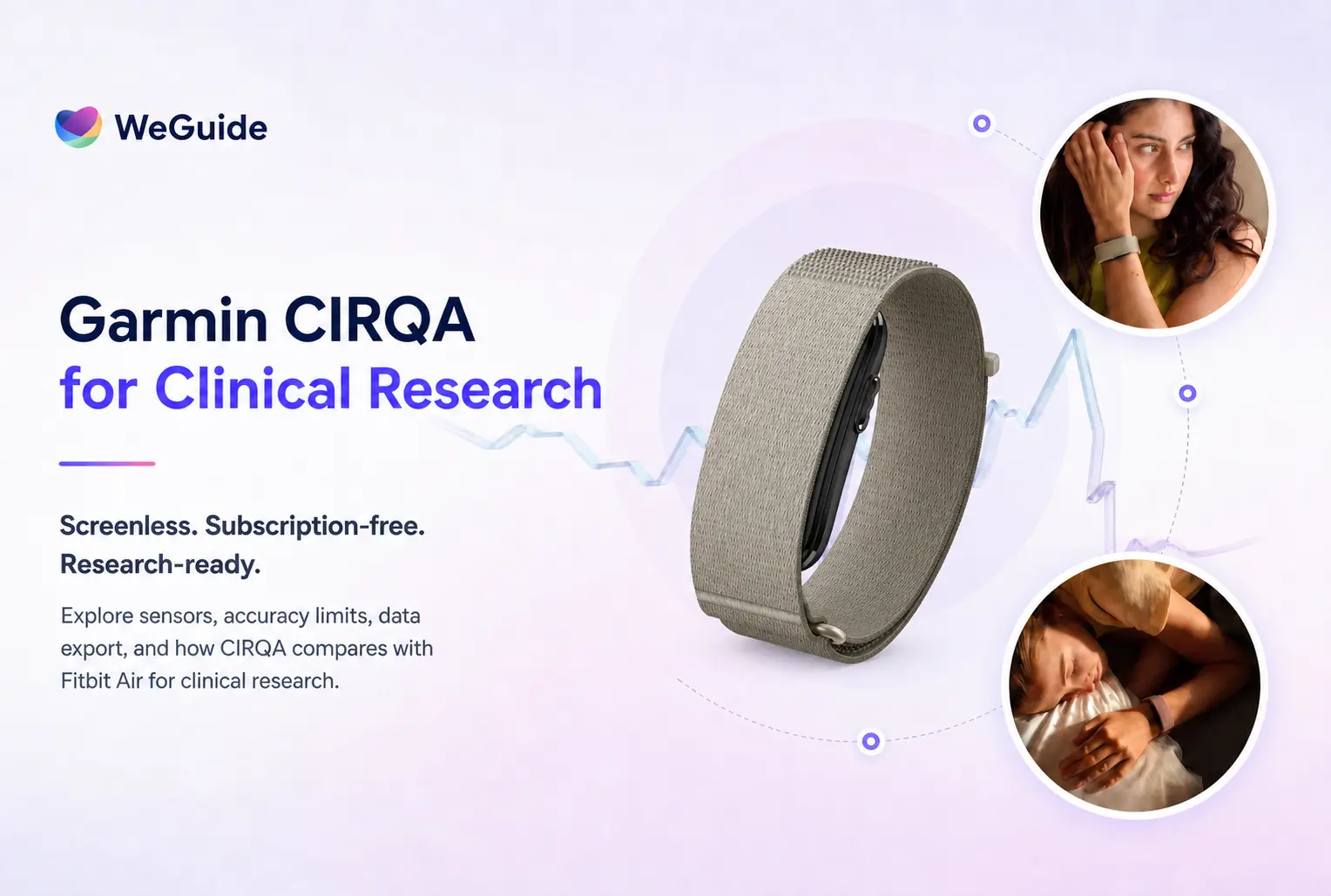


The Garmin CIRQA can be used in clinical research from launch week. It's a $199.99 screenless smart band that records continuous heart rate, heart rate variability (HRV), blood oxygen, skin temperature, respiration, stress, and sleep. Because it syncs into the Garmin ecosystem, Garmin CIRQA clinical research data lands in the same Garmin Connect pipeline that feeds the Health API and SDKs studies already use for wearable data collection.
Garmin announced the CIRQA on 21 July 2026, with orders opening three days later, positioning it against WHOOP, the Oura Ring, and Google's Fitbit Air. For most buyers it's a minimalist fitness tracker. For clinical research teams it's more interesting: a screenless wearable with no subscription attached and Garmin's research data tools behind it, which changes the economics of provisioning devices for a whole cohort.
Clinical trial wearable substudies tend to succeed or fail on three questions: whether participants keep wearing the device, whether the data is good enough for the endpoint, and whether you can get that data out cleanly. This guide works through all three for the CIRQA, covering its sensors, accuracy caveats, data export paths, and how it compares with the Fitbit Air and other research wearables. WeGuide runs consented Garmin data collection for studies through a native integration, so we have a practical view of what a new Garmin band means for a research data pipeline.
Key Takeaways
- The CIRQA is research ready at launch. It syncs into the Garmin ecosystem, whose Health API and Health SDKs studies already use for wearable data collection. Confirm CIRQA's supported device listing with Garmin before committing a protocol.
- No subscription changes cohort budgeting. At $199.99 outright, provisioning 100 participants costs about $20,000 once. WHOOP and Oura both add recurring fees on top of the hardware.
- Know the sensor limits before you commit. The CIRQA uses Garmin's previous generation Elevate Gen 4 optical module. There is no ECG, no AFib detection, and no onboard GPS.
- Researchers get two data paths. The Garmin Health API delivers JSON summaries, while the Health SDKs stream raw signals. The Standard SDK keeps data entirely in your own pipeline and is HIPAA eligible.
- Validation is still pending. The device went on sale on 24 July 2026, so no CIRQA specific accuracy studies exist yet. Validate the metric your endpoint depends on before locking in the device.
What Is the Garmin CIRQA?
The Garmin CIRQA is Garmin's first screenless smart band: a small sensor pod held in a fabric strap, worn on the wrist or upper arm, that tracks heart rate, HRV, blood oxygen, skin temperature, respiration, stress, and sleep around the clock.
It costs $199.99, runs up to 10 days per charge, and presents all data in the Garmin Connect app rather than on a display.
The hardware is deliberately minimal. The pod weighs 14.8 g on its own, about 20.7 g with the smaller strap, and carries a single side button and nothing else. The device ships in two band sizes (S/M and L/XL) and four colours, with seven swappable accessory bands and a separate upper arm band sold as accessories.
Water resistance is rated at 5 ATM, so pool swimming is fine. Charging uses Garmin's own four pin clip rather than USB C, and a full charge takes about 90 minutes. Connectivity is Bluetooth Low Energy and ANT+, syncing to the free Garmin Connect app on iOS or Android.
Knowing what the CIRQA leaves out matters as much for protocol design as what it includes:
- No screen, so participants see nothing on the wrist and all feedback lives in the app
- No ECG and no AFib detection
- No onboard GPS, with outdoor pace and distance supplied by a paired phone through connected GPS
- No wireless network syncing, NFC payments, altimeter, or gyroscope
DC Rainmaker's hands on review confirmed the optical sensor is Garmin's Elevate Gen 4 module with added skin temperature sensing, one generation behind the Gen 5 module in Garmin's current watches. That choice keeps the price down, and it also draws the line on cardiac capability, which we cover below.
For an early video look at the device, recorded ahead of launch, this preview covers the design and where the band sits in Garmin's range:
Why the Garmin CIRQA Matters for Clinical Trials
Garmin is not a newcomer to clinical trials. As of mid 2026, Garmin devices appear in roughly 71 active studies registered on ClinicalTrials.gov, Garmin Health runs a dedicated research programme, and the company's data pipeline has supported academic and commercial studies for years. The CIRQA inherits that whole ecosystem on day one, which positions it well for Garmin CIRQA clinical trials from launch. The question for study teams is what the new form factor adds. Four things stand out.
A single upfront cost. At $199.99 with no ongoing subscription, the CIRQA undercuts its subscription based screenless rivals, WHOOP and Oura, on total cost. For a 100 participant cohort over 12 months, that difference can move a wearable substudy from unaffordable to routine, and it simplifies the BYOD versus provisioned devices decision because sponsor provisioned units carry no recurring per participant fees.
Comfort that supports adherence. A screenless pod in a fabric strap is easy to forget you're wearing, and the option to move it to the upper arm helps participants who find wrist devices uncomfortable at night. Published wearable studies in cancer care have reported wear adherence anywhere from about 60% to 100%, and that spread often decides whether a dataset is publishable. A 10 day battery also means fewer charging gaps, which are one of the most common sources of missing wearable data.
Passive, naturalistic collection. With no display, the CIRQA never prompts, buzzes, or shows the participant a step count on the wrist. For studies where feedback could change behaviour, a screenless device protects the naturalistic quality of the data in a way a smartwatch cannot.
A fit for remote and hybrid designs. Continuous physiological data that syncs automatically suits decentralised clinical trials, where site visits are rare and passive signals fill the gaps between patient reported outcomes. Our guide to wearables in clinical trials covers how these signals become endpoints, and our pillar covers which elements of a study can move to the participant.
Run your CIRQA substudy on a proven pipeline
WeGuide already powers wearable device studies end to end, from eConsent through consented Garmin data collection to one click export.
Health Data You Can Capture With the Garmin CIRQA
Despite its size, the CIRQA carries a capable sensor set built around the Elevate Gen 4 optical module, an accelerometer, a pulse oximeter, and a skin temperature sensor. The metrics most relevant to research include:
- Continuous heart rate, sampled every second on the device
- HRV, including overnight HRV status trends
- Blood oxygen saturation (SpO2), available all day and during sleep, though it ships off by default to save battery and is not offered in every country
- Respiration rate, day and night
- Stress scores and Body Battery, Garmin's recovery index
- Skin temperature variation during sleep
- Sleep stages and automatic nap detection
- Steps, activity minutes, and movement from the accelerometer
- VO2 max and Training Readiness estimates
- Menstrual cycle and pregnancy tracking through Garmin Connect
That range covers a lot of research ground: sleep studies, cardiometabolic and recovery work, stress and mental health research, respiratory monitoring, and any protocol that needs objective activity data alongside patient reported outcomes. Teams that need raw signal access rather than daily summaries can go deeper through Garmin's developer tools, which we cover in the data export section.
Is the Garmin CIRQA Accurate Enough for Research?
The Garmin CIRQA has no device specific accuracy study yet, because it only went on sale on 24 July 2026, so any accuracy figure today rests on its Elevate Gen 4 sensor platform rather than the band itself. In consumer wearable research, optical heart rate from established modules like this one typically lands within about 3% of a reference measure at rest and during steady activity. Treat this section as a starting point for your own validation, not a substitute for it.
The underlying hardware is well travelled. The Elevate Gen 4 module has shipped in Garmin watches for several years, and heart rate plus its derivatives, HRV, stress, and Body Battery, are exactly what the CIRQA is built around.
The usual optical sensor caveats still apply. Accuracy drops during high intensity or high movement activity, and readings can degrade for participants with darker skin tones, higher BMI, wrist tattoos, or arrhythmias that disturb the optical signal. Sleep staging on consumer wearables remains less reliable than polysomnography, and SpO2 from a wrist or arm sensor is a screening grade signal, not a clinical oximeter.
Two absences matter most for protocol design. The CIRQA can't record an ECG and doesn't run AFib detection, because the Gen 4 module lacks the hardware for it. And without onboard GPS, distance and pace depend on a paired phone. Studies with cardiac rhythm endpoints or precise outdoor movement endpoints should shortlist a different device.
Regulatory note: The CIRQA is sold as a consumer wellness device, and no medical device clearance or classification has been published for it at launch. Before using it for a study endpoint, validate the specific metric against an appropriate reference in your population, and confirm the approach with your ethics committee or regulatory adviser.
How the Garmin CIRQA Compares to Other Research Wearables
Research teams rarely assess a device in isolation. Here is how the CIRQA sits alongside the wearables most often shortlisted for studies in 2026.
| Device | Form factor | Approx. cost | Subscription | Battery | ECG and GPS | Key research signals | Data access |
|---|---|---|---|---|---|---|---|
| Garmin CIRQA | Screenless band, wrist or upper arm | $199.99 | None | Up to 10 days | Neither | HR, HRV, SpO2, skin temp, respiration, stress, sleep | Garmin Health API and Health SDKs |
| Google Fitbit Air | Screenless tracker | ~$99 | None for core data | Up to 7 days | No ECG, AFib alerts, no GPS | HR, HRV, SpO2, skin temp, AFib alerts, sleep | Google Health API |
| WHOOP 5.0 | Screenless band | Hardware bundled | Annual membership, required | Up to 14 days | Neither | HR, HRV, SpO2, skin temp, respiratory rate, sleep | WHOOP API |
| Oura Ring 4 | Smart ring | ~$349 plus ~$6 per month | Required for full data | Up to 8 days | Neither | HR, HRV, SpO2, temperature, respiration, sleep | Oura API |
| Apple Watch | Smartwatch | $250 to $800 | None | 18 to 36 hours | Both | HR, ECG and AFib, SpO2, sleep, movement | HealthKit and SensorKit |
Prices and specifications are approximate as of July 2026 and vary by model and region.
The CIRQA's closest competitors are the other screenless options: WHOOP, Oura, and the Fitbit Air. It beats WHOOP and Oura outright on running cost, and Garmin brings a long, documented footprint in registered clinical studies behind it. The trade off against a smartwatch is the absence of ECG, GPS, and a screen for participant prompts, which matters for some protocols and not at all for others. For a broader comparison of consumer devices in study settings, see our guide to consumer wearables in clinical research.
Garmin CIRQA vs Fitbit Air for Clinical Research
The short answer. Choose the Garmin CIRQA when your study needs a longer battery or upper arm wear, or, once Garmin adds CIRQA to its Health SDK device list, beat to beat interval data and a fully controlled pipeline through Garmin's Standard SDK. Choose the Fitbit Air when unit cost decides the budget, you want AFib alerts on a screenless device, or your pipeline is already built on the Google Health API.
Both bands are screenless, both target all day passive wear, and both launched in 2026 within about nine weeks of each other. The differences that matter to a study team sit below the spec sheet.
| Decision factor | Garmin CIRQA | Google Fitbit Air |
|---|---|---|
| Unit cost | $199.99 | About $99 |
| Battery life | Up to 10 days | Up to 7 days |
| Cardiac signals | HR and HRV, no AFib detection | HR and HRV plus AFib alerts (PPG based, not ECG) |
| Raw data access | Through the Health SDKs once Garmin lists CIRQA as supported (not on the list in October 2026) | High resolution summaries through the Google Health API |
| Pipeline control | Standard SDK keeps data inside your own app, no Garmin cloud, HIPAA eligible | Data flows through the Google Health app and API |
| API outlook | Garmin Health API, unchanged by this launch | New Google Health API, with the legacy Fitbit Web API retiring in September 2026 |
| Wear options | Wrist or upper arm | Wrist |
| Device specific validation | None yet | None yet |
Cost favours the Air, and at nearly half the price that argument is real for large cohorts. Data operations favour the CIRQA. Garmin's developer stack lets a research platform take raw interbeat intervals and accelerometer streams without routing anything through a consumer cloud.
Fitbit Air data arrives through the Google Health API instead, which is still new and mid migration from the old Fitbit Web API. Teams building on the Air before September 2026 need to plan for that transition. On cardiac signals the positions reverse: the Air offers AFib alerts and the CIRQA offers none.
Before choosing between the two, run a short decision checklist:
- Which signal your endpoint depends on, and whether the band captures it well
- Whether you need raw beat to beat data or daily summaries
- Whether the protocol requires AFib alerts
- Budget per participant, hardware plus any platform costs
- Who must own the data path, your team or a vendor cloud
Neither device has published validation work of its own yet, so the honest position is the same for both: pilot first, validate the endpoint metric, then scale. We cover the Air in the same depth in our guide to using the Fitbit Air in clinical research.
Three of those comparators have their own deep dives, written in the same format as this one: the Oura Ring, WHOOP, and the Apple Watch. Whichever you shortlist, wearable data quality and validation explains how to judge whether the signal will survive as a trial endpoint.
Exporting Garmin CIRQA Clinical Research Data
This is where the CIRQA moves from a participant's wrist into a study workflow, and it's the strongest part of the Garmin story. Readings sync from the band into Garmin Connect, and from there Garmin CIRQA data export runs on two programmatic routes.
The Garmin Health API is the summary route. It delivers all day health metrics in JSON, covering steps, heart rate, sleep, stress, Body Battery, respiration, SpO2, and HRV summaries through push based callbacks. Plan around one granularity caveat: per second heart rate arrives only during logged activities. All day heart rate outside activities is summarised at coarser intervals, so a protocol that needs continuous per second data should not rely on the API alone.
The Garmin Health SDKs are the raw route, embedded in your own study app. Both stream real time signals including accelerometer data, heart rate, beat to beat (RR) intervals, SpO2, respiration, stress, and steps. The difference between the two SDKs is where the data lives:
| Standard SDK | Companion SDK | |
|---|---|---|
| Where data goes | Only to your app and platform | Your app plus Garmin Connect |
| Garmin Connect compatible | No | Yes |
| Garmin cloud involved | No | Yes |
| Compliance posture | HIPAA eligible, built for controlled research pipelines | Rides alongside Garmin's consumer ecosystem |
| Best for | Trials that must own the full data path | Faster builds that keep the participant's normal Garmin experience |
For regulated studies, the Standard SDK is the notable option: device data never touches Garmin's servers, which simplifies data governance conversations with sponsors and ethics committees.
One practical note given how new the device is: Garmin maintains supported device lists for its developer programmes, so confirm CIRQA coverage for your chosen route with Garmin before committing a protocol to it. Early hands on coverage confirms the band syncs through Garmin Connect like any other current Garmin wearable, which is the same pathway our platform collects from today.
How to Set Up a Garmin CIRQA Clinical Research Study
At a high level, a CIRQA integration looks like any modern consented data flow, and it can be stood up in five steps.
- Match the device to the endpoint. Confirm the signals you need are ones the CIRQA measures well: heart rate, HRV, sleep, respiration, activity, and skin temperature, not ECG or GPS.
- Pick the data path. Summaries through the Garmin Health API suit most observational designs. Raw streams through a Health SDK suit protocols that need interbeat intervals or high frequency movement data.
- Design the consent. Participants should see clearly what the band collects, where it flows, and how to pause it. Consent, withdrawal, and data deletion all need to work digitally.
- Provision or BYOD. At $199.99 with no subscription, sponsor provisioning is affordable, and participants who already wear a Garmin device can often connect their own.
- Pilot, validate, then scale. Run a short pilot to check data completeness and wear adherence, validate the endpoint metric against a reference, and only then roll out to the full cohort.
The build effort sits in step two and the governance sits in step three, and that's exactly the layer a research platform removes. WeGuide's native Garmin integration already collects 50 plus metrics through a consented, API based flow and turns them into analysis ready datasets alongside ePRO and eConsent, on a TGA certified (Class I), ISO 27001 platform that has supported over 200,000 participants. The CIRQA drops into that same wearable device integration pipeline without custom development. If you are comparing other Garmin based research platforms, our Labfront alternatives comparison covers the main options.
Garmin CIRQA Clinical Research FAQs
Can you use the Garmin CIRQA for clinical research?
Yes. The CIRQA captures research relevant signals including continuous heart rate, HRV, SpO2, respiration, skin temperature, stress, and sleep, and its data flows into Garmin Connect, where the Garmin Health API and Health SDKs pick it up. As with any consumer wearable, suitability depends on your protocol, endpoints, and regulatory requirements, and the metric you rely on should be validated first.
How accurate is the Garmin CIRQA?
No Garmin CIRQA accuracy study has been published yet, since the band only went on sale on 24 July 2026. Its Elevate Gen 4 optical sensor is well established though, and consumer grade optical heart rate typically lands within about 3% of a reference measure at rest and during steady activity. Accuracy drops during high intensity movement, so validate your endpoint metric first.
Does the Garmin CIRQA measure HRV?
Yes. The CIRQA records heart rate variability continuously and reports overnight HRV status trends in Garmin Connect. Through the Garmin Health SDKs, research teams can also access the underlying beat to beat (RR) intervals rather than summary values only, which is the raw signal most HRV analyses require. HRV comes from the optical sensor, not an ECG.
What is the Garmin CIRQA's sampling rate?
On the device, heart rate is sampled every second. One caveat matters for study design: through the Garmin Health API, per second heart rate is delivered only during logged activities, and all day heart rate is summarised at coarser intervals. Protocols that need continuous per second data should plan on a Health SDK raw stream instead.
Does the Garmin CIRQA have an API for research data?
There's no separate Garmin CIRQA API. The band syncs into Garmin Connect, and researchers access data through the Garmin Health API for JSON summaries or the Health SDKs for raw real time streams, subject to Garmin's supported device lists. The Standard SDK keeps data inside your own application, bypasses Garmin's cloud, and is HIPAA eligible.
Can you get raw data from the Garmin CIRQA?
Not yet confirmed. Raw data from Garmin devices comes through the Garmin Health SDKs, but CIRQA was not on the SDKs' supported device list in October 2026, so confirm support with Garmin before you plan on it. Embedded in your own study app, the SDKs stream real time signals including accelerometer data, beat to beat (RR) intervals, SpO2, respiration, and stress. The Health API delivers summarised JSON rather than raw samples. The Standard SDK keeps every sample inside your own pipeline and is HIPAA eligible.
How do you export data from the Garmin CIRQA?
Data syncs from the band over Bluetooth to the Garmin Connect app, then flows to your systems through the Garmin Health API or an SDK integration. A research platform can automate that pipeline, delivering cleaned, analysis ready exports so study teams never handle manual downloads or ask participants to upload anything.
Does the Garmin CIRQA need a subscription?
No. The CIRQA costs $199.99 outright with no subscription, and all core health metrics live in the free Garmin Connect app. That contrasts with WHOOP, which requires an ongoing membership, and the Oura Ring, which adds a monthly plan on top of the hardware, a real difference when budgeting a whole cohort.
Does the Garmin CIRQA have ECG or GPS?
No. The Elevate Gen 4 module lacks the hardware for ECG or AFib detection, and there is no onboard GPS, so outdoor pace and distance come from a paired phone through connected GPS. Studies with cardiac rhythm endpoints or precise location endpoints should shortlist a different device, such as a watch with ECG hardware.
Is the Garmin CIRQA better than the Fitbit Air for clinical trials?
It depends on the endpoint and the pipeline. The CIRQA wins on raw data access, battery life, wear options, and pipeline control through the HIPAA eligible Standard SDK. The Fitbit Air wins on unit cost and offers AFib alerts. Neither band has device specific validation studies yet, so pilot whichever fits your protocol.
The Garmin CIRQA Clinical Research Verdict
The Garmin CIRQA gives clinical research teams the most controllable screenless wearable on the market: a $199.99 band with no subscription, 10 days of battery, continuous cardio, sleep, and respiratory signals, and a developer stack that can keep Garmin CIRQA clinical research data entirely inside a study's own pipeline. Its limits are equally clear. There's no ECG, no AFib detection, no GPS, and no device specific validation evidence yet, so it earns a place in observational, remote monitoring, and behavioural protocols before it earns one in cardiac endpoint trials.
If you're scoping a wearable substudy now, the practical path is short: confirm the CIRQA measures your endpoint signal, decide between API summaries and SDK raw streams, pilot with a handful of participants, and validate before scaling. Done in that order, the CIRQA is one of the most cost effective ways yet to add continuous physiological data to a study.
See a CIRQA ready pipeline against your protocol
We'll walk through consented Garmin data collection, from eConsent to analysis ready export, alongside the systems you already run.
Book a demoNo pressure, just a conversation.

