

.svg)
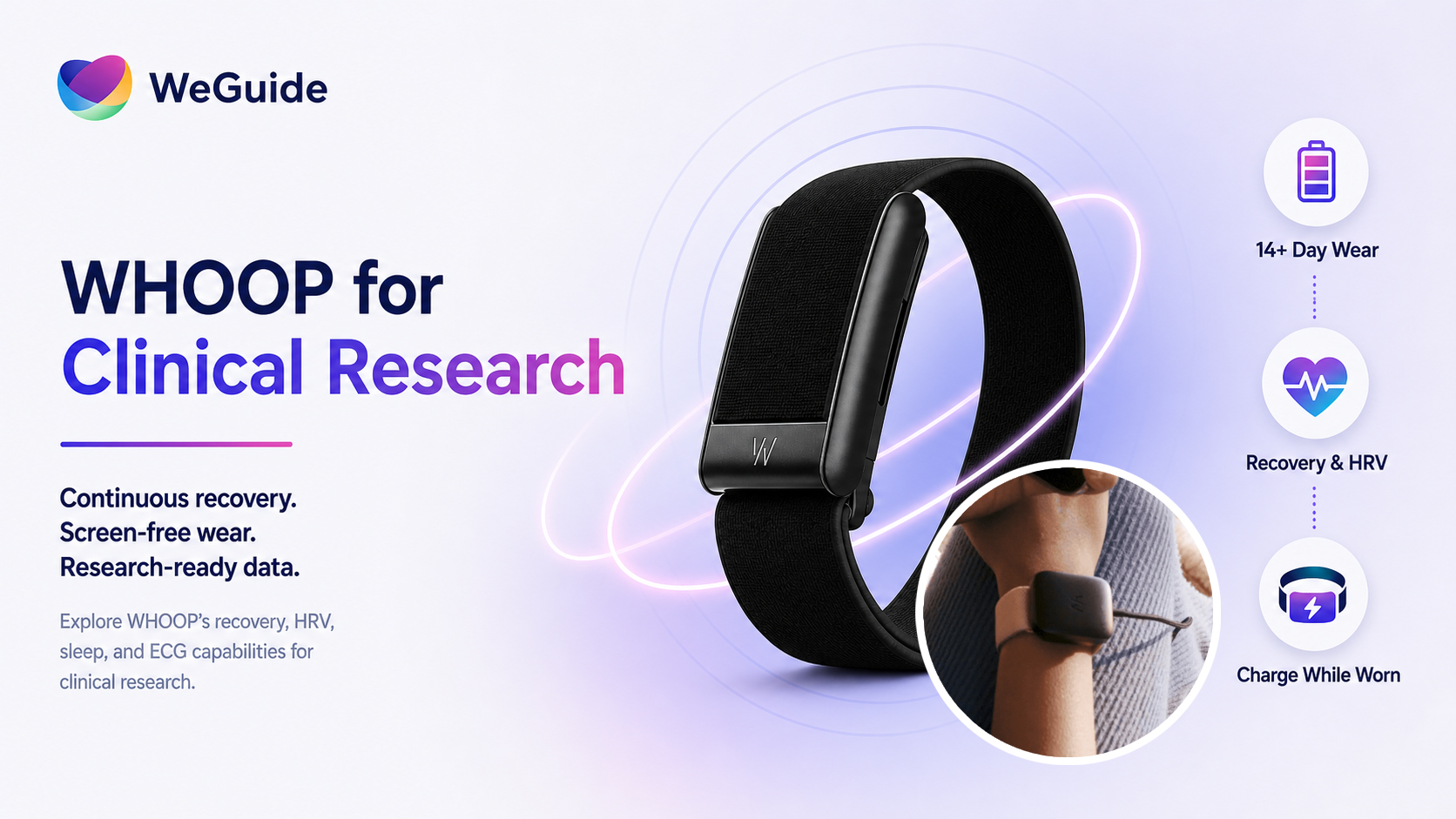


WHOOP can be used in clinical research as a wellness grade source of recovery, heart rate variability (HRV), sleep and respiratory data, plus one FDA cleared feature: the single lead ECG on WHOOP MG that screens for atrial fibrillation (AFib). It's a screenless, subscription only band rather than a medical device beyond that ECG, so most of its outputs suit exploratory and secondary endpoints, not a primary regulatory endpoint without extra validation. Used inside those limits, WHOOP clinical research is a realistic option, especially for continuous recovery and autonomic monitoring.
The current line is WHOOP 5.0 and WHOOP MG (Medical Grade), both launched on 8 May 2025. Two things set WHOOP apart from other research wearables. It uses a subscription only model, so you never buy the hardware outright, and its top tier adds an FDA cleared ECG that no ring or most bands carry. It also had a public run-in with the FDA over a blood pressure feature, which we cover honestly below. WeGuide runs consented wearable device studies end to end, so we look at any new device through the lens of a real research data pipeline.
Wearable substudies tend to succeed or fail on three questions: whether participants keep wearing the device, whether the signal is good enough for the endpoint, and whether you can get the data out cleanly. This guide works through all three for WHOOP, covering what it measures, how accurate each signal is, what the WHOOP API actually exposes, its regulatory footing, and how it compares to the Oura Ring, the Fitbit Air and other research wearables.
Key Takeaways
- WHOOP is subscription only, and one feature is cleared. You never own the hardware, and only the WHOOP MG single lead ECG for AFib is FDA cleared. Recovery, Strain, HRV, SpO2, skin temperature and Blood Pressure Insights are wellness features, not validated measurements.
- The strongest signals are nocturnal heart rate, HRV trend and respiratory rate. Sleep is reliable for total sleep time but weak at stage discrimination, and SpO2, temperature and blood pressure have no independent WHOOP-specific validation.
- The API gives you scored summaries, not raw signal. The WHOOP API returns one nightly value each for Recovery, resting heart rate, HRV (RMSSD), SpO2 and skin temperature, plus per cycle, sleep and workout aggregates. It does not expose raw PPG, beat to beat intervals or continuous intraday heart rate.
- Budget for a membership per participant. The band is bundled with a paid membership, and ECG requires the top WHOOP Life tier. A lapsed membership ends device access, a continuity risk for multi-year studies.
- Mind the whooping cough. A bare ClinicalTrials.gov search for "whoop" is inflated by pertussis trials, so any study count must be filtered before you use it.
What Is WHOOP?
WHOOP is a screenless, wrist worn (or apparel worn) optical band that tracks heart rate, HRV, respiratory rate, sleep, skin temperature and blood oxygen around the clock, with all data read through a companion app rather than an on-device display. The current models are WHOOP 5.0 and WHOOP MG, both launched in May 2025.
The commercial model is the first thing that shapes a study budget. WHOOP is subscription only: you can't buy the hardware outright, and the band is bundled with a paid membership across three tiers. WHOOP One (about $199 per year) covers core sleep, strain, recovery and HR/HRV. WHOOP Peak (about $239 per year) adds the wireless PowerPack, Healthspan and a real time stress monitor. WHOOP Life (about $359 per year) includes the WHOOP MG device with the ECG and Blood Pressure Insights. So the FDA cleared ECG sits behind the top tier and the MG hardware, and a cohort provisioned on One or Peak has no ECG.
The sensor stack combines an optical PPG array, a 3 axis accelerometer and gyroscope, a pulse oximeter (from WHOOP 4.0), a skin temperature sensor (from 4.0), and, on WHOOP MG only, ECG electrodes in the clasp. WHOOP describes the 5.0 and MG sensors as capturing data "26 times per second," which is a product marketing figure rather than a verified raw PPG sampling rate. Public teardown analysis, which is lower confidence than an official spec, reports a 5 LED and 4 photodiode optical array carried over from WHOOP 4.0. WHOOP has not published an official 5.0 sensor sheet, so treat the exact sensor counts as teardown derived.
Two hardware details matter for adherence. WHOOP 5.0 runs 14 or more days per charge, and the slide on wireless PowerPack clips over the band while it's still worn, so participants charge without removing the device and without a data gap. Wear location is also flexible: beyond the wrist, WHOOP sells bicep bands and the WHOOP Body apparel line that moves the sensor to the upper arm or torso. That flexibility can lift adherence, but the wear site changes PPG signal quality and should be fixed per protocol.
Why WHOOP Matters for Clinical Trials
WHOOP earned its place in research through wear time and recovery physiology, not raw specifications. Four things make it a genuine option for WHOOP clinical trials.
Continuous, high adherence wear. The month long battery with charge while worn design removes the charging gaps that produce missing data on other wearables, and the bicep and apparel options suit participants who find wrist wear impractical. For studies that need uninterrupted overnight and daytime physiology, that continuity is the main draw.
Naturalistic, screen free data. Because there's no display, WHOOP never shows the participant a score on the wrist or prompts them mid task. For studies where feedback could change behaviour, a screenless device protects the naturalistic quality of the data in a way a smartwatch cannot.
A genuinely cleared cardiac feature. WHOOP MG carries an FDA cleared single lead ECG that screens for AFib. Among consumer wearables in the recovery category, that's a real differentiator, and it supports an AFib screening endpoint in appropriate adults on a spot check basis. We cover the exact clearance and its limits in the regulatory section.
A fit for recovery and autonomic endpoints. WHOOP's headline outputs are Strain and Recovery, built on nocturnal heart rate, HRV and respiratory rate. For studies pairing passive autonomic signals with wearable data quality controls, that overnight physiology is the point, and it suits decentralised clinical trials where site visits are rare.
One honest caveat on scale. WHOOP's registered trial footprint is smaller than a naive search suggests, because a bare ClinicalTrials.gov search for "whoop" collides with whooping cough (pertussis) trials. Filter those out before quoting any number. Most published WHOOP research to date is device validation work rather than trials using WHOOP as a qualified endpoint device, so a study team should assume they're early adopters and budget for their own validation.
Run your WHOOP substudy on a proven pipeline
WeGuide powers wearable device studies end to end, from eConsent through consented API based data collection to analysis ready export, alongside your ePRO.
What WHOOP Measures: Signals Versus Scores
For trial design, the useful split is between near raw signals, which can be validated against reference instruments, and proprietary scores, which are closed indices that change with firmware. Only the signals belong in a defensible endpoint.
| Metric | Type | What it is | Notes for research |
|---|---|---|---|
| Resting heart rate | Signal | Overnight heart rate in bpm | Strongest signal, near perfect vs ECG at rest |
| HRV (RMSSD) | Signal | One nightly value from the last slow wave sleep window | Not a standard resting or 24 hour HRV |
| Respiratory rate | Signal | Overnight breaths per minute, from PPG | Accurate, but the headline study is WHOOP funded |
| Blood oxygen (SpO2) | Signal | Overnight blood oxygen % | Wellness feature, no independent WHOOP-specific validation |
| Skin temperature | Signal | Deviation from personal baseline | Relative trend, not calibrated temperature |
| Single lead ECG | Signal | On demand ~30 second ECG (MG only) | FDA cleared for AFib screening |
| Strain, Recovery | Score | 0 to 21 strain, 0 to 100% recovery | Proprietary indices, no external gold standard |
| Sleep Performance, stages | Score | Sleep %, light/REM/deep | Inferred from motion, HR, HRV, not EEG |
| WHOOP Age, Stress, BP Insights | Score | Derived indices | Exploratory only, BP Insights not cleared |
Two points matter most. First, WHOOP's HRV is a single nightly RMSSD value selected from the last slow wave sleep episode of the night, not a standardised short resting recording or a 24 hour figure. It's a defensible recovery trend, but it isn't interchangeable with a clinical 5 minute resting HRV protocol, and frequency domain HRV can't be derived because raw beat to beat intervals aren't exposed. Second, Strain and Recovery are WHOOP's headline outputs and both are proprietary composites with no external gold standard, so a study can correlate them but can't calibrate them.
Is WHOOP Accurate Enough for Clinical Research?
WHOOP accuracy is uneven by signal: strong for nocturnal heart rate, good for HRV and respiratory rate, weak for sleep stage discrimination, and effectively unproven (independently) for SpO2, skin temperature and blood pressure. A pervasive caveat runs through all of it: nearly all published accuracy data are for WHOOP 2.0 or 4.0, and no independent peer reviewed validation of the 5.0 or MG specifically was located. Validate the metric your endpoint depends on, in your population, before you rely on it.
Heart rate is the strongest signal, and WHOOP heart rate accuracy is well supported at rest. A controlled validation of WHOOP 2.0 against ECG during sleep reported near perfect agreement, with a Pearson correlation of 1.00, though on a very thin base of only 6 healthy young adults measured during sleep. The best independent data come from Dial et al. 2025, an Air Force Research Laboratory funded study of WHOOP 4.0 across 536 nights, which reported resting heart rate concordance of 0.91 and HRV (RMSSD) concordance of 0.94, with wider error on HRV (MAPE 8.17%). Treat these as resting and nocturnal figures: wrist PPG degrades during motion, and a placement study found WHOOP on the upper arm outperformed the wrist at higher exercise intensities.
Respiratory rate is accurate, within about one breath per minute of a reference, but the headline study was funded by a grant from WHOOP to the university that ran it, so the "independent" framing often attached to it is not quite right. Disclose the funding when you cite it.
WHOOP sleep tracking accuracy is a two part story. WHOOP is good at total sleep time: a systematic review against polysomnography found it had the least disagreement of the devices tested, within a couple of minutes. Stage discrimination is weaker. Because WHOOP infers stages from motion, heart rate, HRV and respiratory rate rather than EEG, it tends to misclassify quiet wakefulness as sleep, so wake is its weakest stage at roughly 40% to 60% specificity, not REM. In a six device head to head against polysomnography, WHOOP 4.0 ranked 4th of 6 by agreement (Cohen's kappa 0.37), behind the Apple Watch Series 8 and two Fitbits. Expect accuracy to drop further in older, comorbid or sleep disordered populations that validation samples underrepresent.
Skin temperature, SpO2 and blood pressure sit on the thinnest ground. WHOOP skin temperature is a relative deviation with no independent accuracy validation located, its SpO2 is not an FDA cleared pulse oximeter (a limitation shared across consumer wearables), and Blood Pressure Insights is not a validated measurement (see the regulatory section). Keep all three exploratory.
Several limits cut across every signal. The most cited HR and sleep validations used tiny samples (n=6). The algorithms are proprietary and update over the air, so a score can shift mid study and break longitudinal comparability. Green light PPG generally shows larger error in darker skin tones and during vigorous motion, a validity and equity concern for diverse cohorts. And because only summaries are exposed, sponsors can't independently re-derive or audit the metrics.
Regulatory note: Apart from the WHOOP MG ECG, no WHOOP output is FDA cleared. Before using any WHOOP signal as a study endpoint, validate the specific metric against an appropriate reference in your population, follow the FDA framework for digital health technologies in clinical investigations, and confirm the approach with your ethics committee or regulatory adviser.
How WHOOP Compares to Other Research Wearables
Study teams rarely assess a device in isolation. Here is how WHOOP sits alongside the wearables most often shortlisted for research in 2026, on the axes that matter for a protocol rather than for a consumer.
| Device | Form factor | Cost and model | Battery | Key research signals | Cleared ECG/AFib | Data access | Regulatory footing (US) |
|---|---|---|---|---|---|---|---|
| WHOOP 5.0 or MG | Screenless band or apparel | Subscription only, $199 to $359 per year | 14+ days, ~30 with PowerPack | HR, HRV, respiration, SpO2, skin temp, sleep | Yes, MG only | API summaries only | Wellness, MG ECG cleared |
| Oura Ring 4 or 5 | Smart ring | Buy $349 to $499 + subscription | 5 to 8 days | HR, HRV, temperature, SpO2, sleep | No | API summaries only | General wellness, no cleared feature |
| Google Fitbit Air | Screenless tracker | About $99, none for core | Up to 7 days | HR, HRV, SpO2, skin temp, AFib alerts, sleep | AFib alerts on some models | Google Health API | Some cleared features on Fitbit models |
| Apple Watch | Smartwatch | $250 to $800 | 18 to 36 hours | HR, ECG and AFib, SpO2, sleep, movement | Yes | HealthKit and SensorKit | FDA cleared ECG and AFib |
| Garmin | Wrist or band | $150 to $500 | Days to weeks | HR, HRV, SpO2, respiration, sleep, activity | Model dependent | Health API and SDKs | Largely wellness |
Prices and specifications are approximate as of July 2026 and vary by model and region.
WHOOP's genuine edges for research are wear time economics (month long battery, charge while worn, apparel wear sites) and the narrow but real cleared ECG on MG. Its trade-offs are the subscription only model (recurring per participant cost, no ownership) and a closed, summary only API that's more restrictive than some rivals for raw data. On the one head to head where devices are scored the same way against polysomnography, WHOOP sat mid pack. For a broader look across devices, see our guide to consumer wearables in clinical research.
WHOOP vs Oura for research
WHOOP and Oura are the two subscription based recovery wearables most often compared. Both deliver strong overnight heart rate and HRV, both need an ongoing membership, and both keep their raw signal closed. The practical differences come down to form factor and one cleared feature. Oura's ring wins on discreetness and tends to lead slightly on resting heart rate and HRV agreement in head to head testing, while WHOOP offers a band or apparel form with a longer battery and, on MG, an FDA cleared AFib ECG that the Oura Ring doesn't carry. For a recovery, sleep or AFib screening endpoint, the choice usually turns on whether you need the cleared ECG and which device your participants will actually keep wearing. Our companion Oura Ring for clinical research guide covers the ring side in the same depth.
The other devices in this comparison have their own deep dives: the Apple Watch for the widest set of cleared features, the Garmin CIRQA as a screenless band with no subscription, and the Google Fitbit Air for a lower cost screenless option on the Google health stack.
Data Access and the WHOOP API for Clinical Research
This is where a wearable moves from a participant's wrist into a study workflow, and it's where WHOOP has a clean developer story with one hard limit. Data syncs from the band to the WHOOP app, and researchers pull it programmatically through the WHOOP developer API, or, for larger programmes, through WHOOP Unite.
The public API v2 uses OAuth 2.0, with each participant consenting to specific scopes such as read recovery, read sleep, read cycles and read workout. Endpoints cover cycle, recovery, sleep and workout collections, and webhooks push updates as they sync. Rate limits are 100 requests per minute and 10,000 per day, applied per application rather than per user, so plan the polling pattern for your cohort size and request an increase early for large studies.
The single most important design constraint is resolution. The WHOOP API returns scored summaries, not raw signal. The recovery object gives you one nightly value each for recovery score, resting heart rate, HRV (RMSSD), blood oxygen and skin temperature; cycle and sleep objects give strain, average and max heart rate, stage summaries and respiratory rate. It does not expose raw PPG waveforms, beat to beat (RR) intervals, or continuous intraday heart rate. So the lowest level cardiac quantity you can pull is a single nightly RMSSD, and any protocol that assumes raw signal access can't be satisfied through the public API. Independent re-derivation of custom HRV windows or frequency domain HRV isn't possible from it.
For sponsored research and remote monitoring, WHOOP Unite is the more relevant channel. It adds administrative dashboards and the WHOOP Gateway, a relay that pulls data from the band and transmits it to Unite without requiring the participant's smartphone, which suits low tech or facility based cohorts. The key open question is whether Unite exposes any higher resolution or raw data beyond the public API's summaries. That's contractual and not publicly documented, so confirm it directly with WHOOP, along with Business Associate Agreement coverage and 21 CFR Part 11 support, since consumer WHOOP generally sits outside HIPAA scope. Individual members can also request a self service data export, useful for small consented cohorts where each participant exports their own file.
The upshot for a trial is simple. WHOOP is genuinely operationalisable through OAuth2, webhooks and per participant consent scoping, as long as you design endpoints around nightly summaries rather than raw waveforms. That capture, consent and pipeline layer is exactly what a platform like WeGuide provides. We bring WHOOP API data into a study through the Integration Engine and API, alongside ePRO and eConsent, on a TGA certified (Class I), ISO 27001 platform that has supported over 200,000 participants.
Regulatory Status: The FDA Cleared ECG and the Blood Pressure Saga
WHOOP is the most regulatory nuanced device in the recovery category, so it's worth being precise. Exactly one WHOOP output is FDA cleared, and one drew a warning letter.
The WHOOP MG ECG (the Heart Screener) is FDA cleared. The clearance is 510(k) K243236, granted on 4 April 2025, as a Class II over the counter device with the Apple ECG App as its predicate. It records an on demand single lead ECG over about 30 seconds and classifies atrial fibrillation and normal sinus rhythm, for adults aged 22 and over, and it isn't intended for users with pacemakers or ICDs or to replace clinical diagnosis. WHOOP's submission reported AFib sensitivity of 96.2% and normal rhythm specificity of 99.4%, and those figures hold only on classifiable recordings inside a heart rate range of 50 to 150 bpm. Two research relevant caveats: these are WHOOP's own submission figures, not independent data, and roughly 11% of recordings were inconclusive, which lowers real world AFib detection to around 87% to 88%. The validation cohort also skewed older (mean age about 60), so the numbers are extrapolated to WHOOP's younger user base. The clearance supports an AFib screening endpoint on a spot check basis, not continuous rhythm monitoring or other arrhythmias.
Blood Pressure Insights is not cleared, and its story is instructive. It's a PPG derived overnight estimate that needs calibration against a physical cuff, offered only on the top WHOOP Life tier. On 14 July 2025 the FDA issued WHOOP a warning letter arguing the feature is an uncleared medical device and objecting specifically to its "medical grade" marketing. WHOOP publicly disputed the letter and kept the feature, so it's wrong to say WHOOP removed it. The matter resolved in WHOOP's favour after the FDA issued broader general wellness guidance in early 2026 that let optical blood pressure features stay in the wellness category provided no medical grade claims are made, followed by a closeout letter around 17 June 2026 stating the FDA won't enforce device requirements against the modified feature. That's enforcement discretion, not a clearance, a validation, or an FDA endorsement. For research, treat WHOOP blood pressure output as non-validated wellness data.
One naming point that trips people up: the "MG" in WHOOP MG stands for Medical Grade, which is a brand name, not a regulatory designation. Only the discrete ECG feature carries a clearance. And non-US regulatory footing (CE marking, UK MHRA, Australian TGA) for the MG ECG was not established in this research, which matters for multi-site and Australia based trials and should be confirmed with WHOOP before any protocol relies on it.
How to Run a WHOOP Study
At a high level, a WHOOP integration looks like any modern consented data flow, and it can be stood up in five steps.
- Match the device to the endpoint. Confirm the signals you need are ones WHOOP supports well: nocturnal resting heart rate, HRV trend, respiratory rate, sleep and wake, and, on MG, AFib screening. Not fine grained sleep staging, oximetry, temperature or blood pressure as clinical endpoints.
- Choose the tier and generation. ECG requires the WHOOP MG device on the top Life tier, so a study with an AFib screening arm must provision MG. Record the generation and firmware per participant, since exposed metrics and algorithms differ across 3.0, 4.0, 5.0 and MG.
- Budget the subscription. WHOOP is subscription only, so provisioning a cohort means recurring memberships, not one time device buys. Carry the membership as a per participant line item for the full study and any follow up, and plan for the continuity risk if a membership lapses. Enterprise pricing under WHOOP Unite is negotiated, not listed.
- Design the consent and pipeline. Use the OAuth 2.0 flow with minimal scopes, subscribe to webhooks with polling as a backstop, and version tag every record because scores drift with over the air updates. Decide up front between the public API (summaries) and a negotiated WHOOP Unite agreement.
- Pilot, validate, then scale. Run a short pilot to check data completeness and wear adherence, validate the endpoint metric against a reference, and only then roll out to the full cohort.
WHOOP fits some designs far better than others. It's a good fit for recovery, autonomic and sleep and wake endpoints treated as exploratory signals, for studies needing long unobtrusive wear, and for AFib screening in adults using the MG ECG. It's a poor fit for fine grained sleep architecture, oximetry, temperature or blood pressure as clinical endpoints, for anything needing raw PPG or beat to beat intervals, and for a device participants keep with no recurring cost. Matched to the right endpoint and captured through a consented pipeline that also handles ePRO and device data, WHOOP adds continuous recovery physiology that intermittent devices miss.
WHOOP Clinical Research FAQs
Can you use WHOOP in clinical research?
Yes. WHOOP captures research relevant signals including nocturnal heart rate, HRV, respiratory rate, sleep and, on WHOOP MG, an FDA cleared single lead ECG for AFib, and its data flows through the WHOOP API into a study pipeline. Because most outputs are wellness features rather than cleared measurements, suitability depends on your protocol and endpoints, and any metric you rely on should be validated in your population first.
Is WHOOP accurate enough for clinical research?
For some signals, yes. Nocturnal resting heart rate is strong, HRV and respiratory rate are good, and total sleep time is reliable. Sleep stage discrimination is weak (wake is the weakest stage), and SpO2, skin temperature and blood pressure have no independent WHOOP-specific validation. Most published accuracy data are for older WHOOP models, not the current 5.0 or MG, so validate the specific metric your endpoint depends on before relying on it.
Does WHOOP have an API?
Yes. The WHOOP API v2 uses OAuth 2.0 and returns scored summaries: one nightly value each for recovery, resting heart rate, HRV (RMSSD), SpO2 and skin temperature, plus per cycle, sleep and workout aggregates, with webhooks for updates. It does not expose raw PPG waveforms, beat to beat intervals or continuous intraday heart rate, so protocols that need raw signal can't use the public API for it.
How do you export WHOOP data?
Data syncs from the band to the WHOOP app, then flows to your systems through the WHOOP API with webhooks, or through the enterprise WHOOP Unite programme for larger studies. Individual members can also request a self service data export file. A research platform can automate the API pipeline so study teams receive cleaned, analysis ready datasets rather than handling manual downloads.
Is WHOOP FDA cleared?
Partly. The WHOOP MG single lead ECG for atrial fibrillation is FDA cleared (510(k) K243236, April 2025). No other WHOOP output is cleared: Recovery, Strain, HRV, SpO2, skin temperature and Blood Pressure Insights are wellness features. The "Medical Grade" name is a brand, not a regulatory designation, so treat non-ECG data as wellness grade that needs sponsor side validation.
Does the WHOOP ECG detect AFib?
Yes, on WHOOP MG. It records an on demand single lead ECG over about 30 seconds and classifies atrial fibrillation or normal sinus rhythm for adults 22 and over. WHOOP's own submission reported high sensitivity and specificity, but about 11% of recordings are inconclusive and the feature is a spot check screen, not continuous monitoring or a diagnosis. It isn't intended for people with pacemakers or ICDs.
WHOOP vs Oura for clinical research?
Both are subscription based recovery wearables with strong overnight heart rate and HRV and closed raw signal. Oura's ring is more discreet and tends to lead slightly on resting HR and HRV agreement, while WHOOP offers a band or apparel form, a longer battery, and an FDA cleared AFib ECG on MG that the ring doesn't have. The decision usually turns on whether you need the cleared ECG and which device participants will keep wearing.
Does WHOOP work without a subscription?
No. WHOOP is subscription only: the hardware is bundled with a paid membership and can't be bought outright, so device access ends if the membership lapses. For a study, budget the membership as a recurring per participant cost for the full duration, and note that the ECG requires the top WHOOP Life tier with the MG device.
The WHOOP Clinical Research Verdict
WHOOP gives clinical research teams a distinctive combination: long, high adherence wear through its charge while worn design, strong nocturnal heart rate and HRV trends, and the one genuinely FDA cleared AFib ECG in the recovery wearable category. That earns it a place in recovery, autonomic, sleep and AFib screening research. Its limits are equally clear. It's subscription only with no ownership, its API gives you nightly summaries rather than raw signal, its sleep staging and non-ECG features aren't validated for clinical endpoints, and its blood pressure output is wellness data, not a measurement.
If you're scoping a wearable substudy now, the path is short: confirm WHOOP measures your endpoint signal well, decide between the MG tier and a standard tier, design around the summary only API, pilot with a handful of participants, and validate before scaling. Done in that order, WHOOP is one of the more dependable ways to add continuous recovery physiology, and an optional AFib screen, to a study, provided you hold it to what a wellness wearable can honestly support.
See a WHOOP ready pipeline against your protocol
We'll walk through consented wearable and API data collection, from eConsent to analysis ready export, alongside the systems you already run.
Book a demoNo pressure, just a conversation.

