

.svg)
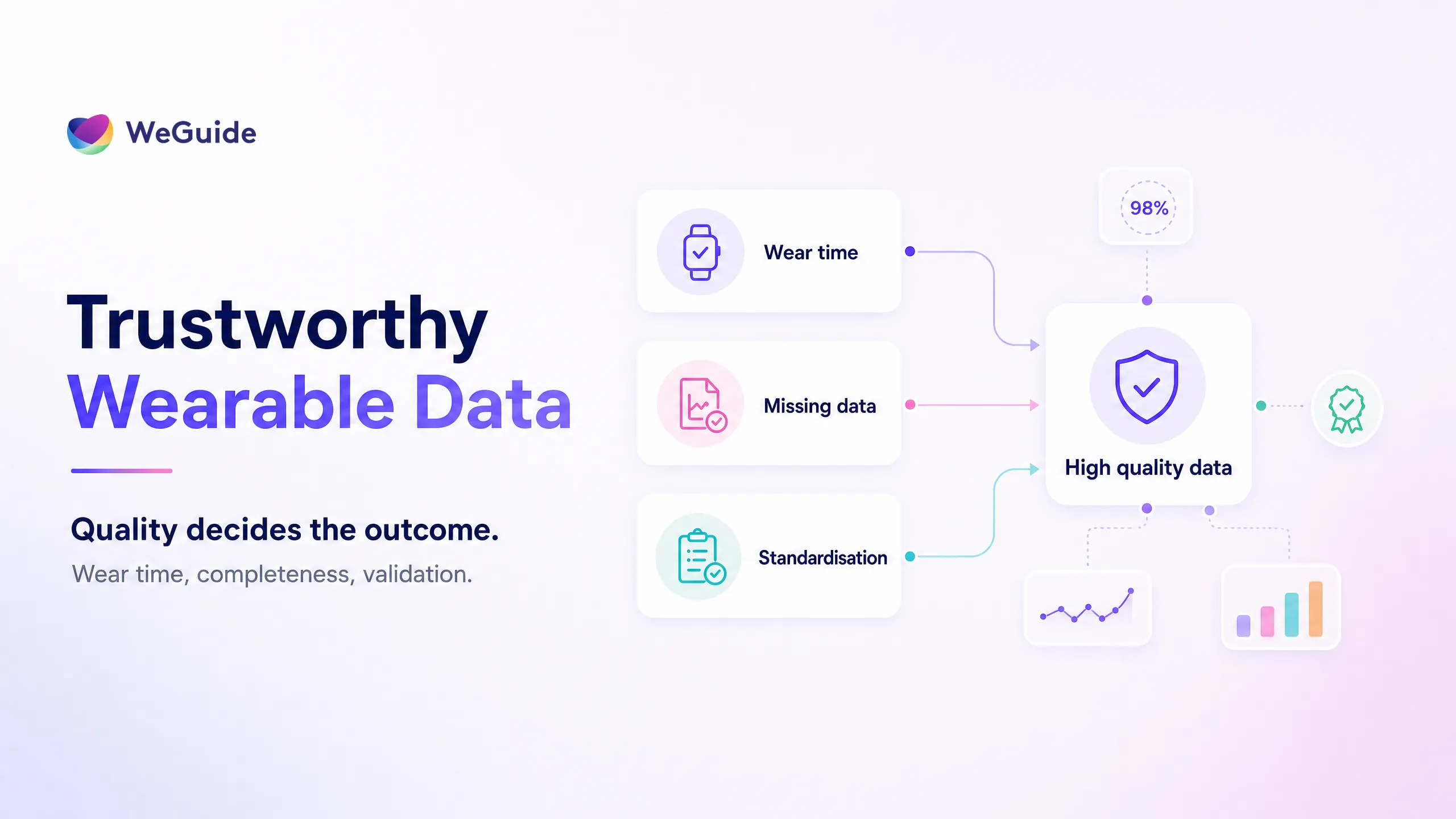


Wearable data is trustworthy in clinical trials when it is captured and validated well, and unreliable when it is not. Wearable data quality depends far less on the device brand than on wear time, completeness, and the validation work behind each measure. A validated sensor that participants stop wearing produces worse data than a humbler device worn every day.
That honest answer matters because the doubt is real. The first question most sponsors ask about a sensor is whether they can trust it for a regulatory endpoint. This guide answers that question the way a study team meets it. You will get the framework that decides whether a measure is reliable, the operational threats that quietly degrade data, the BYOD versus provisioned trade off, and a practical way to design a study for high quality wearable data. WeGuide has run wearable and mobile data capture at scale, including the BRACE trial with the Murdoch Children's Research Institute, so the focus stays practical rather than theoretical.
Key Takeaways
- Quality beats brand. Wearable data quality comes from wear time, completeness, and validation, not from which logo is on the wrist.
- The V3 framework decides reliability. Verification, analytical validation, and clinical validation turn a raw sensor stream into a measure a regulator will accept.
- Wear time and missing data are the real risks. Most trust problems trace back to gaps in capture, not faulty sensors.
- BYOD adds variability. Mixed devices and operating systems complicate analysis, so many trials provision hardware where consistency matters.
- You design quality in, not after. Reminders, real time monitoring, and clear wear time rules protect the data before analysis, not during it.
Is Wearable Data Trustworthy in Clinical Trials?
The short answer is yes, within limits that the sponsor controls. Wearable data is accepted in regulated trials when the device fits the population, the measure is validated, and the chain of capture is documented. The doubt sponsors carry is reasonable, because a sensor reading is only as good as the conditions it was collected in. Trust is earned at the study design stage, not assumed from a datasheet.
Regulators have moved past blanket caution. The FDA treats digital health technologies as acceptable sources of trial data when they are selected and validated for the specific measure. Industry bodies have built the methods that make this practical. So the live question is no longer whether sensor data can be trusted, but how you produce wearable data in clinical trials that a study team can defend later.
WeGuide sees this play out in practice. On the BRACE trial with the Murdoch Children's Research Institute, more than 6,000 participants across five countries recorded over 90% adherence in a six week deployment, with capture running through mobile and remote workflows rather than clinic visits. High adherence is what keeps wearable data complete, which is the first condition of trust. Our overview of wearable device studies shows how WeGuide brings devices into one participant app, and the broader wearables in clinical trials guide sets the wider context.
What Makes Wearable Data Reliable: The V3 Framework
Reliability is not a vibe. It has a method, and the most widely used one is the V3 framework from the Digital Medicine Society. V3 breaks the work into three questions that a measure has to pass before it can carry an endpoint.
Verification asks whether the sensor measures what it claims at the hardware level. Does the optical heart rate sensor report beats accurately against a reference under known conditions? This is bench work, and it is the floor, not the finish.
Analytical validation asks whether the algorithm turns that raw signal into an accurate measure in the people you are studying. A step counter verified on a treadmill still has to count steps correctly for older adults with a shuffling gait. This is where many consumer measures wobble, because performance shifts across populations.
Clinical validation asks whether the measure reflects something that matters to how a patient feels or functions. The clinical validation of a wearable measure is what lets you argue that a change in nocturnal activity, say, is clinically meaningful and not just a number that moved. Skip it and you have a precise measurement of something nobody can interpret.
Get all three right and you can prespecify the measure as a digital biomarker or endpoint and defend it. This is also why device brand is a weak proxy for quality. A measure rides on its validation evidence, not its packaging. We go deeper on the measures themselves in our guides to digital biomarkers and digital endpoints.
How to Read a Wearable Validation Study
Validation evidence is only useful if you can tell what it actually covers. Four questions separate a claim you can build an endpoint on from one you cannot.
Who holds the clearance? A brand on the box is not the same as a clearance in that brand's name. Withings blood pressure cuffs are a useful example. The devices are sold as Withings, but the United States clearances covering them are held by the contract manufacturer Transtek, under K240102, K202891 and K223374. If your regulatory file needs the clearance holder, read the 510(k) record rather than the product page.
What is the denominator? The same device can report very different accuracy for the same function depending on which records are counted. In one Withings clearance the atrial fibrillation function reports sensitivity and specificity of 0.73 and 0.77 under an all records analysis, and 0.989 and 0.963 once inconclusive and unclassified recordings are removed. Both are true. Only one of them describes what happens in your study. Always ask what was excluded before the percentage was calculated.
Who paid for the study? Vendor authored validation is not worthless, but it is not independent either. Several of the strongest looking wearable accuracy papers have author lists drawn largely from the manufacturer. Note it, weight it, and look for an independent replication before you rely on the number.
Which generation was tested, and what does the signal exclude? Published evidence usually trails the product on sale by a generation or two, so a figure quoted for a device you can buy today may come from hardware nobody sells any more. The signal specification matters just as much. The Polar H10 chest strap, the reference device behind a large share of consumer wearable accuracy claims, streams single lead ECG through a 0.7 to 40 Hz passband, which by design forecloses ST segment, QT interval, P wave and T wave morphology. It is an excellent heart rate and RR interval reference, and it is not a diagnostic ECG.
A device can be validated, cleared, and still wrong for your protocol. Those are three separate tests.
The Operational Threats: Wear Time, Missing Data, and Standardisation
A perfectly validated measure still fails if the data never arrives. This is where most real trust problems live, and they are operational rather than scientific. Three threats do the most damage, and a good study plans for all three from the start.
Wear time is whether participants keep the device on long enough to produce a usable signal. A sleep measure needs nights, not naps. Trials set minimum wear time rules, for example a set number of valid hours per day across a defined number of days, and treat data below that threshold with caution.
Missing data is the gaps that open when a device is not charged, a sync fails, or the person takes it off and forgets it. Wearable data completeness is the metric teams watch here, because scattered gaps can bias a result as much as outright dropout.
Standardisation is capturing the same measure the same way across participants and sites. Sensor data validation is hard to defend when one cohort wore the device on the wrist and another on the hip, or when sampling rates differed by phone model.
The table below maps the common risks to their cause and the mitigation that holds them down.
| Data quality risk | Common cause | Mitigation |
|---|---|---|
| Low wear time | Discomfort, forgetting, charging at the wrong time | Clear wear time rules, reminders, comfortable devices, charge prompts |
| Missing or patchy data | Failed syncs, flat batteries, device removed | Real time monitoring, automatic syncing, alerts when data stops arriving |
| Inconsistent measures | Different wear locations, sampling rates, or firmware | Standardised wear instructions, fixed device settings, version control |
| Device variability (BYOD) | Mixed phone models and operating systems | Provisioned devices for primary measures, validated BYOD limits |
| Poor accuracy in subgroups | Algorithm not validated for the population | Analytical validation in the study population before relying on the measure |
Completeness is the number that most often decides whether a study is powered, and it is almost never in the headline accuracy claim. The figures below come from one device family because its regulatory file and published studies happen to report completeness openly. Read them as an order of magnitude for consumer wearables in general, not as a warning about one brand.
| What was measured | Loss rate | Source |
|---|---|---|
| SpO2 data rejected in a PSG comparison | 26.5% | Manufacturer authored validation study, 97 adults |
| Overnight recording failure in an OSA cohort | 15.7% | 127 consecutive patients, PMID 36971253 |
| Inconclusive ECG tracings in cardiology populations | 17 to 19% | PMID 36858690, PMID 40536450 |
| Night level data insufficiency inside a De Novo pivotal | 16.7%, or 205 of 1,229 nights | FDA DEN230041 decision summary |
Four independent sources, including the manufacturer's own regulatory submission, converge on roughly one night or tracing in six being unusable. Power the study on that figure, and design the reminder and repeat measurement workflow around it. That second part is a participant engagement problem rather than a device problem, which is exactly why it gets missed at protocol stage.
Bring wearable data into one participant app
WeGuide connects consumer and research grade devices, eConsent, and ePRO in one branded app, so sensor data lands complete and ready to validate.
BYOD vs Provisioned and Data Consistency
One operational choice shapes data consistency more than any other: whether participants use their own phone and wearable, known as bring your own device or BYOD, or whether the study ships a provisioned device to each person.
BYOD widens reach and cuts cost, because most people already own a phone and use a device they know. The trade off is variability. Different phone models, operating systems, and wearables sample and process data in slightly different ways, which makes a single clean dataset harder to assemble and validate.
Provisioned devices give the opposite balance. Everyone has the same hardware and settings, so wearable data accuracy is easier to characterise and defend, and you can reach people who do not own a suitable device. The cost is logistics, from shipping and support to recovering devices at the end.
Most studies land on a mix, using BYOD where it is good enough and provisioning hardware where the primary measure or the population demands consistency. Our deep dive on BYOD vs provisioned devices covers the full cost, equity, and compliance decision.
How to Design a Study for High Quality Wearable Data
High quality wearable data is designed in from the protocol, not rescued at analysis. A few decisions, made in the right order, do most of the work.
Start with the endpoint and its validation evidence, then choose the device. Deciding the measure first tells you how much accuracy you need and which validation steps the FDA digital health technologies guidance expects you to document. Picking a device first and hunting for an endpoint later is how teams end up with interesting data they cannot use.
Set wear time rules and define completeness up front. State the minimum valid wear time, what counts as a valid day, and how you will handle missing data in the statistical plan. Writing this before enrolment keeps later decisions honest and supports a defensible analysis.
Monitor data in real time. The cheapest way to protect completeness is to notice gaps while you can still act. Real time monitoring lets a coordinator reach a participant whose device went quiet a week ago, rather than a month after the visit window closed.
Design for the participant. Reminders, simple syncing, comfortable devices, and a single app that people already check keep wear time high and gaps low. This is the quiet engine behind clean sensor data, and it is the same lever that lifts retention. WeGuide is the patient facing layer that brings devices, eConsent, ePRO, and reminders into one branded app, so wearable data quality is built into daily use rather than chased after the fact.
Do these four things and wearable data in clinical trials stops being a leap of faith. It becomes a measure you selected, validated, and captured on purpose, with the wear time and completeness to back it up.
Frequently Asked Questions
Is wearable data accurate enough for clinical trials?
Often yes, when the measure is validated for the specific use and population. Wearable data accuracy depends on the sensor, the algorithm, and who is wearing it. For exploratory or supportive measures, consumer devices can be fine. For a primary endpoint, teams validate the measure carefully or choose a research grade device.
What is the V3 framework for wearable data?
V3 is the Digital Medicine Society method for showing a digital measure is trustworthy. It has three steps: verification, that the sensor is accurate, analytical validation, that the algorithm produces an accurate measure, and clinical validation, that the measure reflects how a patient feels or functions. All three are needed for an endpoint.
How much wear time is needed for valid wearable data?
There is no single number, because it depends on the measure. A sleep metric needs valid nights, while an activity measure needs valid days. Trials set a minimum, often a defined number of valid hours per day across several days, and write it into the protocol before enrolment. Clear wear time rules protect completeness.
What causes missing data in wearable studies?
Missing data usually comes from flat batteries, failed syncs, or participants taking the device off and forgetting it. Less often it comes from app or connectivity faults. Real time monitoring and automatic syncing catch most gaps early, which protects wearable data completeness and keeps the dataset defensible at analysis.
Does BYOD reduce wearable data quality?
Not on its own, but it adds variability. Different phones and wearables sample and process data in slightly different ways, which complicates a clean, comparable dataset. Many trials use BYOD for supportive measures and provision identical devices for primary endpoints, where sensor data validation and consistency matter most.
Does the FDA accept wearable data in clinical trials?
Yes, within its framework. The FDA's guidance on digital health technologies explains how sponsors select, verify, and validate a device for remote data collection. Wearable data is accepted when the device fits the population, the measure is validated, and data handling is documented, so the sponsor can defend the endpoint.
Capture wearable data you can defend
See how WeGuide keeps wear time high and wearable data quality built in, from device choice to a validated endpoint.
Book a demoNo pressure, just a conversation.

