

.svg)
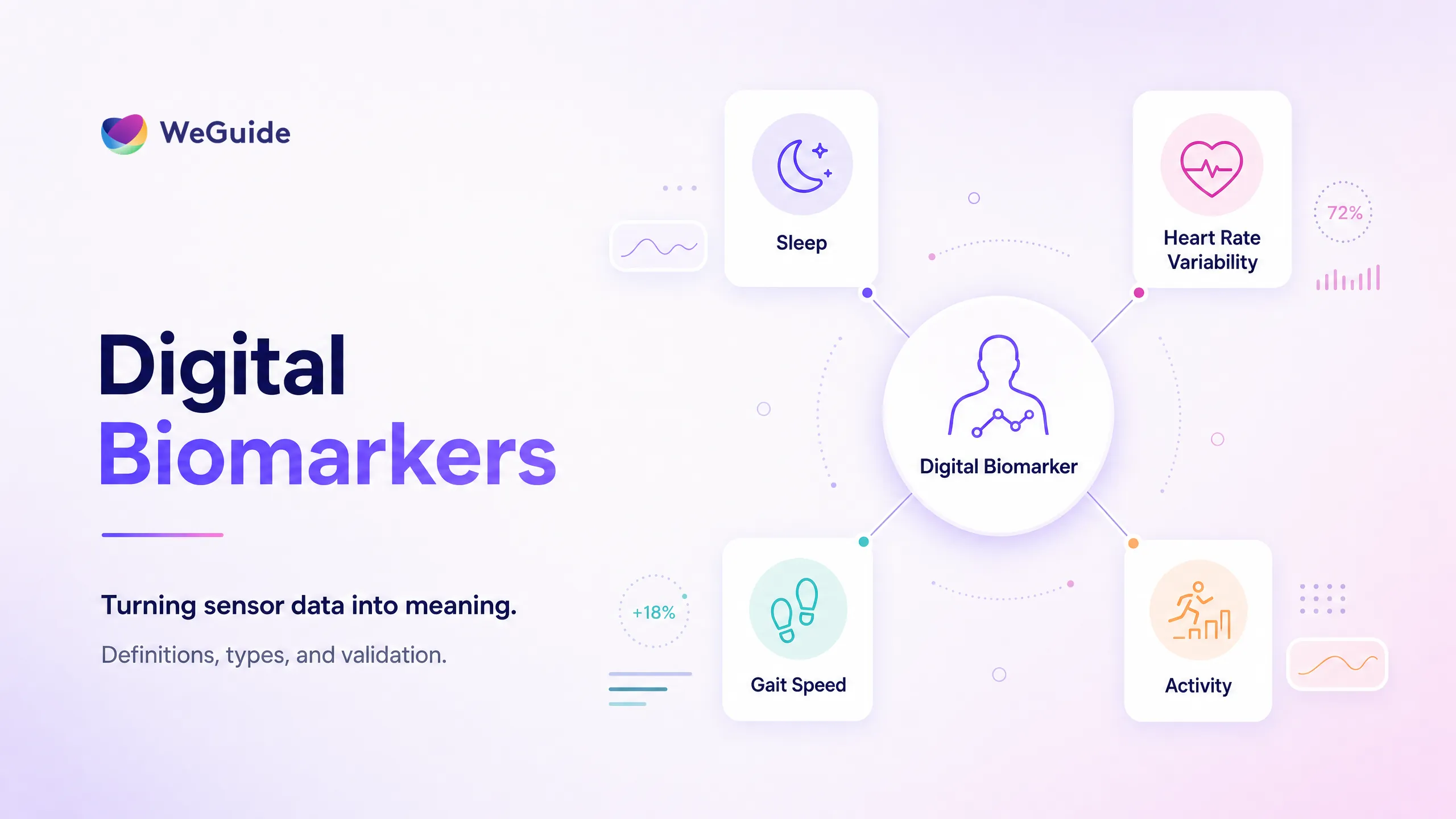


A digital biomarker is a measurable indicator of a health state collected through a digital device, such as a wearable, smartphone, or sensor, that reflects how a patient feels, functions, or survives. In clinical trials, digital biomarkers turn continuous sensor data into objective signals of disease activity, recovery, or treatment effect, recorded in daily life rather than at a clinic visit.
That shift matters because traditional trials measure a participant for a few hours every few weeks. A digital biomarker can measure them every minute at home, which removes recall bias and catches change that a clinic snapshot misses. WeGuide built its biomarker capture capability for exactly this work, and this guide is written for the study teams who have to make it real.
You will get a clear definition of what a digital biomarker is, the important distinction between a digital biomarker and a digital endpoint, the main types grouped by sensor and therapeutic area, how digital biomarker validation works under the V3 framework, real digital biomarker examples from clinical research, and how sponsors capture this data without adding burden. The aim is practical, not theoretical.
Key Takeaways
- A digital biomarker is the measure, not the device. It is a characteristic of health, captured by a sensor or app, that stands in for how a patient feels or functions.
- A biomarker is not an endpoint. A digital biomarker becomes a digital endpoint only once it is validated and prespecified as a trial outcome.
- Validation follows the V3 framework. Verification, analytical validation, and clinical validation, set out by the Digital Medicine Society, decide whether a measure can be trusted.
- Examples already span therapeutic areas. Gait speed, sleep efficiency, heart rate variability, tremor, and continuous glucose are all in active use.
- Capture quality decides the value. Wear time, completeness, and a participant experience people will stick with matter more than the brand of device.
What Is a Digital Biomarker?
A digital biomarker is an objective, quantifiable characteristic of health or disease that is collected and measured through a digital device, such as a wearable, smartphone, implant, or environmental sensor. It reflects how a person feels, functions, or survives, and it is derived from sensor data rather than from a blood sample or a clinician's reading.
The word biomarker is the key. A traditional biomarker might be blood pressure, cholesterol, or a tumour measurement. A digital biomarker is the same idea, an indicator that something is happening in the body, but the signal comes from a sensor stream and an algorithm that turns raw data into a meaningful measure. Resting heart rate read once at a visit is a clinical measure. Resting heart rate tracked continuously by a wrist sensor, then summarised into a daily value, is a digital biomarker.
Two parts make a digital biomarker work. First, the hardware that senses a signal, for example an accelerometer that detects movement. Second, the algorithm that converts that signal into a measure a clinician understands, such as gait speed in metres per second. Neither half is useful alone. A sensor with no validated algorithm produces noise, and an algorithm with no reliable sensor has nothing to read.
Digital Biomarkers vs Digital Endpoints
The distinction that trips teams up most is the difference between a digital biomarker and a digital endpoint. A digital biomarker is the measure. A digital endpoint is the specific, predefined trial outcome built from that measure and used to judge whether a treatment works.
Think of it as a promotion. Gait speed from a waist sensor is a digital biomarker. The moment a protocol prespecifies a change in gait speed over 12 weeks as the way to test a drug, that measure has become a digital endpoint. The same biomarker can sit in one trial as an exploratory signal and in another as the primary endpoint, depending on how far it has been validated and how it is written into the protocol.
Why does the line matter? Because the regulatory and statistical work lives on the endpoint side, not the biomarker side. Choosing to measure tremor is easy. Defending a tremor based endpoint to a regulator, with the validation evidence behind it, is the hard part. This article stays on the measure itself. For how a measure earns endpoint status, how regulators view novel endpoints, and how the analysis is prespecified, see our guide to digital endpoints in clinical trials.
Keep the two words separate in your own protocols. Calling everything an endpoint blurs the validation you still owe, and calling everything a biomarker hides the outcome you actually plan to test.
Types of Digital Biomarkers
Digital biomarkers are easiest to organise two ways at once, by the sensor that captures them and by the therapeutic area that uses them. The same accelerometer can produce a mobility biomarker in a Parkinson's trial and an activity biomarker in an oncology trial, so the sensor tells you what is technically possible and the therapeutic area tells you what is clinically useful.
Most digital biomarkers in clinical trials fall into a handful of families. Movement and mobility measures come from accelerometers and gyroscopes. Cardiac measures come from optical heart rate sensors and ECG patches. Sleep measures come from actigraphy. Metabolic measures come from continuous glucose monitors. Behavioural and cognitive measures come from smartphone interactions, voice, and typing. The table below maps the common ones.
| Digital biomarker | Sensor or source | Example measure | Therapeutic area |
|---|---|---|---|
| Gait and mobility | Accelerometer, gyroscope (wrist or waist) | Gait speed, stride variability, daily walking | Neurology, Parkinson's, multiple sclerosis |
| Physical activity | Accelerometer, smartwatch | Step count, active minutes, sedentary time | Cardiology, oncology, respiratory |
| Sleep | Actigraphy, wrist sensor | Total sleep time, sleep efficiency, wake after sleep onset | Sleep medicine, psychiatry, neurology |
| Heart rate | Optical sensor, ECG patch | Resting heart rate, heart rate variability | Cardiology, mental health |
| Tremor | Accelerometer, smartphone | Tremor amplitude and frequency | Parkinson's, movement disorders |
| Speech and voice | Smartphone microphone | Speech rate, pause patterns, articulation | Neurology, depression, cognition |
| Glucose | Continuous glucose monitor | Time in range, glucose variability | Diabetes, metabolic disease |
| Cognition | Smartphone app tasks | Reaction time, memory task scores | Alzheimer's, cognitive disorders |
None of these is a digital biomarker by default. A step count is raw data until it is defined, validated, and tied to something clinically meaningful for the population in the study. The grouping helps you scope what is feasible, but the validation work in the next section is what decides whether a measure belongs in your protocol. For the device side of this picture, our pillar on wearables in clinical trials covers how the hardware is chosen and managed.
Capture digital biomarkers in one participant app
WeGuide brings wearable and sensor data together with eConsent and ePRO in a single branded app, so your digital biomarkers arrive clean and ready to validate.
How Digital Biomarkers Are Validated
Digital biomarker validation is what separates a promising signal from a measure you can stand behind. The accepted approach is the V3 framework from the Digital Medicine Society, which breaks validation into three questions you answer in order: verification, analytical validation, and clinical validation.
Verification
Verification asks whether the sensor itself measures what it claims at the hardware level. Does the accelerometer record acceleration accurately against a known reference? This is a bench level check of the device and its firmware, done before any patient data is collected. Skip it and every later number inherits the error.
Analytical validation
Analytical validation asks whether the algorithm turns the raw sensor signal into an accurate, reliable measure. If the device counts steps, does the step count match a video reference count across different walking speeds and gaits? This is where many consumer measures pass for some populations and fail for others, which is why the use case has to be defined first.
Clinical validation
Clinical validation asks the question that matters most: does the measure reflect something clinically meaningful for this population? A validated gait speed is only useful if slower gait genuinely tracks with the disease or the treatment effect you care about. Clinical validation links the digital biomarker to a clinical outcome, a patient reported experience, or a known reference measure.
Getting all three right, in order, is what lets a sponsor prespecify a digital biomarker as an endpoint and defend it. This is also why experienced teams decide the measure and its evidence before they choose a device, not after. The regulatory frame around the whole chain sits in the FDA's guidance on digital health technologies for remote data acquisition in clinical investigations, finalised in December 2023.
Digital Biomarker Examples in Clinical Trials
Digital biomarker examples are no longer hypothetical. Several are well established in research, and a 2018 review in PMC set out both the promise and the early caution that still shape how teams use them today.
In neurology, gait and tremor are active areas. Smartphone and wrist sensors measure gait speed, stride variability, and tremor amplitude in Parkinson's disease and multiple sclerosis, where small motor changes are hard to capture in a short clinic visit. These movement measures can be more sensitive than an in clinic rating scale because they sample daily life.
In sleep medicine and psychiatry, actigraphy derived measures such as total sleep time, sleep efficiency, and wake after sleep onset are long standing digital biomarkers. They replace the recall problems of a paper sleep diary with a continuous record taken in the participant's own bed.
In cardiology and metabolic disease, resting heart rate, heart rate variability, and continuous glucose measures give a fuller picture than periodic readings. Time in range from a continuous glucose monitor, for example, captures glucose control across a whole day rather than at a single fasting test.
In cognition and mental health, smartphone based tasks, typing dynamics, and voice features are emerging measures of reaction time, memory, and mood. These sit earlier in their validation journey than gait or actigraphy, which is the honest position: the science is real, but not every measure has cleared clinical validation for every use.
How Sponsors Capture Digital Biomarkers
Capturing a digital biomarker well is mostly about the participant, not the gadget. A validated sensor that people stop wearing produces worse data than a simpler one worn consistently, so the capture plan decides whether the measure survives to analysis.
Three things drive capture quality. Wear time, whether participants keep the device on long enough to produce a usable signal. Completeness, the gaps that open when a device is not charged or syncing fails. Standardisation, capturing the same measure the same way across participants and sites. We cover the controls in depth in our guide to wearable data quality in clinical trials.
This is where the participant experience does the work. Reminders, simple syncing, and a single app that participants already check keep wear time high and gaps low. When sensor streams arrive alongside eConsent and ePRO in one place, the data lands clean and ready to analyse rather than scattered across apps. Sensor data is also a form of patient generated health data, so the same consent, governance, and quality rules apply.
WeGuide has run this kind of capture at scale. In the BRACE trial, delivered on a custom WeGuide app with the Murdoch Children's Research Institute, more than 6,000 participants across five countries took part through mobile and remote data capture, recording over 90% participant adherence during a six week deployment under COVID 19 restrictions. It is one trial in a specific design, not proof that every study reaches the same number, but it shows that high adherence and clean remote data are achievable when the experience is built around the person.
Frequently Asked Questions
What is a digital biomarker?
A digital biomarker is an objective measure of health or disease collected through a digital device such as a wearable, smartphone, or sensor. It reflects how a person feels, functions, or survives, and it is derived from sensor data and an algorithm rather than from a blood test or a clinician's in person reading.
What is the difference between a digital biomarker and a digital endpoint?
A digital biomarker is the measure, such as gait speed from a sensor. A digital endpoint is a predefined trial outcome built from that measure and used to judge whether a treatment works. A biomarker becomes an endpoint only after it is validated and prespecified in the study protocol.
What are some digital biomarker examples?
Common digital biomarker examples include gait speed and stride variability, step count and active minutes, sleep efficiency and total sleep time, resting heart rate and heart rate variability, tremor amplitude, continuous glucose measures, and speech or typing features. Each maps to a sensor and a therapeutic area, from neurology to diabetes.
How is a digital biomarker validated?
Digital biomarker validation follows the V3 framework from the Digital Medicine Society: verification that the sensor measures accurately, analytical validation that the algorithm produces a reliable measure, and clinical validation that the measure reflects something clinically meaningful for the population. All three are needed before a measure can be trusted as an endpoint.
Are digital biomarkers accepted by regulators?
Yes, within a clear framework. The FDA's 2023 guidance on digital health technologies explains how sponsors select, verify, and validate digital measures for remote data collection. A digital biomarker is accepted when the device fits the population, the measure is validated under an approach like V3, and data handling is documented.
What sensors capture digital biomarkers in clinical trials?
Accelerometers and gyroscopes capture movement and gait. Optical sensors and ECG patches capture cardiac measures. Actigraphy captures sleep. Continuous glucose monitors capture metabolic measures. Smartphone microphones, screens, and keyboards capture speech, cognition, and behaviour. The right sensor depends on the measure and the population in the study.
Conclusion
Digital biomarkers in clinical trials turn continuous sensor data into objective measures of how a patient feels and functions, captured in daily life instead of at a clinic visit. The value is not the device but the chain behind it: define the measure, validate it under the V3 framework, keep it clearly separate from the endpoint it may become, and capture it cleanly with high wear time.
Get that chain right and digital biomarkers can shrink burden, sharpen sensitivity, and surface change that periodic clinic measures miss. WeGuide is the participant facing layer that brings sensors, eConsent, ePRO, and reminders into one branded app, so the measures you choose arrive ready to analyse alongside your existing systems.
Plan your digital biomarker capture with confidence
Walk through how WeGuide captures clean digital biomarker data across your trial, from sensor choice to validation ready datasets.
Book a demoNo pressure, just a conversation.

