

.svg)
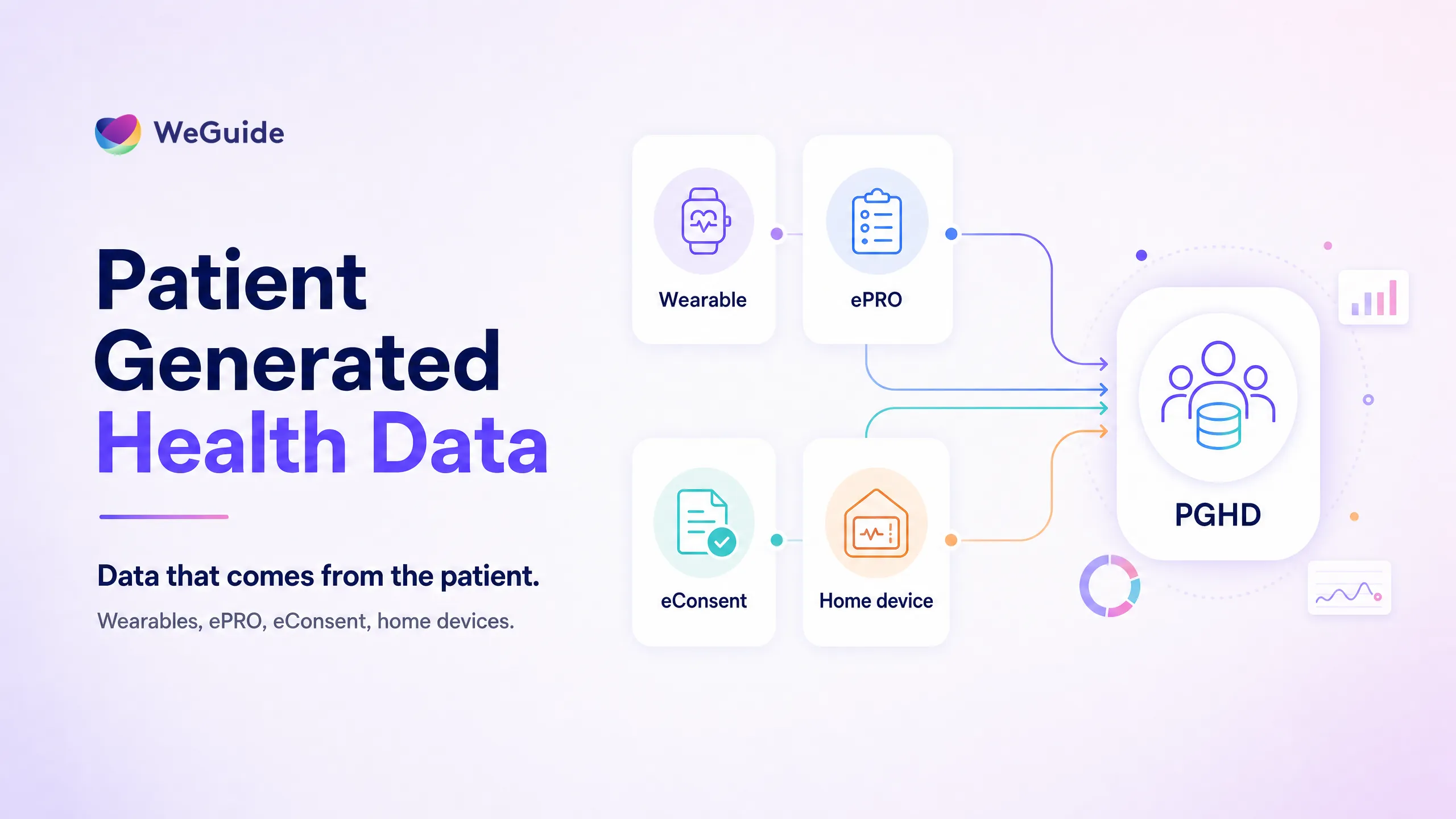


Patient generated health data is health information that participants create, record, or gather themselves, outside a clinical setting, and then share with a research or care team. In a clinical trial, patient generated health data covers the wearable readings, ePRO responses, home device measurements, and app entries a person produces between visits, rather than the measurements a clinician takes at site. The category has grown because trials now run partly in daily life, and the richest signal often sits in the days between appointments.
For sponsors, CROs, and study teams, the appeal is objective, frequent data with less burden on the participant. The challenge is making that data trustworthy enough for analysis and for a regulator. This guide defines the term, maps its sources, sets it apart from clinician collected data, shows how trials actually use it, and covers the governance, quality, and consent that hold it together. WeGuide captures this kind of data every day through one participant app, so the focus here is practical. You can see the supported wearable devices we connect and how our patient engagement software brings these streams into a single record.
Key Takeaways
- Patient generated health data is created by participants, not clinicians. It is the wearable, ePRO, home device, and app data a person records in daily life and shares with the study.
- The sources are broad. Wearables and sensors, ePRO and eDiaries, home medical devices, mobile apps, and eConsent records all produce patient generated health data.
- It complements clinician collected data, it does not replace it. PGHD adds frequent real world context between the standardised measurements taken at site.
- Quality and consent decide its value. Wear time, completeness, clear provenance, and informed consent are what make PGHD usable for analysis and acceptable to regulators.
- Trials use it for endpoints, monitoring, and engagement. From digital biomarkers to adherence tracking, PGHD supports decentralised and hybrid designs.
What Is Patient Generated Health Data?
Patient generated health data, often shortened to PGHD, is health related data created, recorded, or collected by patients or their carers and shared with clinicians or researchers. It includes biometric readings, symptoms, treatment history, and lifestyle information gathered outside a clinical visit. The defining feature is who controls the capture: the participant, not the provider.
The term comes from health policy work in the United States, where the Office of the National Coordinator for Health IT set out two features that mark data as patient generated. Participants are responsible for capturing or recording the data, and they decide how to share it. The ONC patient generated health data fact sheet frames it this way to separate it from data created during routine care.
In research, that distinction matters. A blood pressure reading taken by a coordinator at a study visit is clinical data. The same reading taken by a participant at home, on their own cuff, and synced to the study app is patient generated health data. The measurement looks similar, but the provenance, the setting, and the controls around it are different, which shapes how a study team treats it.
Sources of Patient Generated Health Data
Patient generated health data is not one thing. It spans several sources, each with its own format, accuracy, and role in a trial. The main sources of patient generated health data are wearables and sensors, electronic patient reported outcomes, home medical devices, mobile health apps, and the records produced during digital enrolment.
- Wearables and sensors capture passive, continuous signals like heart rate, activity, sleep, and movement. They are the largest growth area and the foundation of many decentralised designs. Our pillar guide to wearables in clinical trials covers the device types in depth.
- Electronic patient reported outcomes (ePRO) are the symptoms, pain scores, and quality of life answers a participant enters directly, often as an eDiary on their phone.
- Home medical devices such as blood pressure cuffs, spirometers, pulse oximeters, and connected scales produce objective readings away from the clinic.
- Mobile health apps log medication, mood, diet, and steps, adding behavioural and adherence data over time.
- eConsent and digital intake create their own records, from consent versions to screening answers and medical history. Our eConsent platform captures these with an auditable trail.
The table below shows common patient generated health data examples and how a study team puts each one to work.
| PGHD source | Example | How it is used in a trial |
|---|---|---|
| Wearables and sensors | Smartwatch, ECG patch, continuous glucose monitor | Continuous activity, heart rate, sleep, and glucose between visits, feeding digital biomarkers |
| ePRO and eDiaries | Symptom diary, pain score, quality of life questionnaire | Patient reported outcomes captured in the moment, reducing recall bias |
| Home medical devices | Blood pressure cuff, spirometer, pulse oximeter, scales | Objective readings measured at home, supporting remote and hybrid visits |
| Mobile health apps | Medication logs, mood check ins, step counters | Adherence and behavioural data tracked over time |
| eConsent and intake | Consent records, screening responses, medical history | Enrolment data and a documented, auditable consent trail |
Capture clean patient data in one app
WeGuide brings wearables, home devices, ePRO, and eConsent into a single branded participant app, so patient generated health data lands ready for analysis alongside your existing systems.
PGHD vs Clinician Collected Clinical Data
The clearest way to understand patient generated health data is to set it against clinician collected data. Clinician collected data is recorded by a trained professional, usually at a site, under controlled conditions. PGHD is recorded by the participant, in daily life, on their own or study issued devices. Both are valuable, and most modern trials use a mix.
Clinician collected data is standardised and supervised. A coordinator follows the same protocol for every participant, which keeps the measurement consistent. The trade off is that it only captures a moment, every few weeks, in an artificial setting. Patient generated health data fills the gaps. It is frequent, sits in the real world, and lowers the burden of travelling to site. The trade off there is variability, since wear time, device models, and missing data all affect quality.
This is also where PGHD overlaps with real world data. Much of what participants generate at home feeds real world evidence alongside trial endpoints, which is one reason regulators have paid closer attention to how it is captured.
| Feature | Patient generated health data | Clinician collected data |
|---|---|---|
| Who records it | The participant, at home | A clinician or coordinator, at site |
| When | Continuous or daily, between visits | At scheduled study visits |
| Setting | Daily life, real world | Clinic or hospital |
| Strengths | Frequent, real world, lower burden | Standardised, supervised, controlled |
| Watch points | Variable wear time, missing data, device differences | Snapshots only, visit burden, recall gaps in diaries |
How PGHD Is Used in Clinical Trials
Patient generated health data earns its place in a trial when it answers a question that site visits cannot. There are four main uses.
First, endpoints and digital biomarkers. A wearable stream can be processed into a measure like daily step count, sleep duration, or gait speed, and once verified and validated, that measure can become a digital biomarker or a prespecified endpoint. We cover the detail in our guide to digital biomarkers in clinical trials.
Second, remote and continuous monitoring. Home devices and sensors let a study watch symptoms and key readings between visits, which catches events that periodic appointments would miss and supports safety monitoring.
Third, adherence and engagement. App logs and ePRO completion show whether participants are taking medication, wearing devices, and staying on protocol, so teams can act early when engagement drops.
Fourth, decentralised and hybrid designs. PGHD is what lets a participant contribute from home, so it is central to any trial that moves data capture out of the clinic. Paired with telehealth and eConsent, it widens reach and supports retention.
WeGuide has run this kind of capture at scale. In the BRACE trial with the Murdoch Children's Research Institute, more than 6,000 participants across five countries took part largely through mobile data capture and remote workflows, with over 90% adherence during a six week deployment. It is one trial in a specific design, not a guarantee, but it shows that clean participant generated data is achievable across borders when the experience is built around the person.
Governance, Data Quality, and Consent
The promise of patient generated health data only holds if the data can be trusted and the participant has agreed to how it is used. Three areas decide that: quality, consent, and provenance.
Quality. Because participants capture the data, the usual quality controls move with them. Wear time, missing data, and standardisation are the three issues that most often undermine a dataset. Good studies plan for them with reminders, simple syncing, and real time monitoring rather than discovering gaps at analysis. Our guide to wearable data quality in clinical trials sets out the controls in full.
Consent and ownership. PGHD raises questions a single site visit does not. What exactly is being collected, how long is it kept, who can see it, and can the participant withdraw it. Clear, plain language consent is the foundation, and it needs to cover passive data like location or continuous heart rate, not just the obvious survey answers. Capturing consent digitally keeps a versioned, auditable record of what each person agreed to.
Provenance and standards. Regulators accept patient generated health data when its origin and handling are documented from device to database. The FDA's guidance on digital health technologies for remote data acquisition sets out how sponsors select, verify, and validate the technology behind the data, and the Digital Medicine Society maintains frameworks for turning sensor measures into trusted endpoints. WeGuide is TGA Class I certified medical device software and supports GCP aligned data capture, though sponsors remain responsible for endpoint validation and regulatory strategy.
Frequently Asked Questions
What is patient generated health data?
Patient generated health data is health information that participants create, record, or collect themselves, outside a clinical setting, and then share with a research or care team. It includes wearable readings, symptom diaries, home device measurements, and app entries. The participant controls the capture, which sets it apart from clinician recorded data.
What are examples of patient generated health data?
Common patient generated health data examples include smartwatch heart rate and step counts, sleep data, home blood pressure readings, glucose from a continuous monitor, ePRO symptom and pain diaries, medication and mood logs from health apps, and the consent and screening records created during digital enrolment.
How is PGHD different from EHR or clinician collected data?
The difference is who captures the data and where. EHR and clinician collected data are recorded by professionals during care or study visits, under controlled conditions. Patient generated health data is recorded by the participant in daily life. PGHD is more frequent and real world, while clinical data is more standardised and supervised.
How is patient generated health data used in clinical trials?
Trials use patient generated health data for digital biomarkers and endpoints, remote and continuous monitoring between visits, adherence and engagement tracking, and decentralised or hybrid designs. It gives study teams objective, frequent data from daily life, filling the gaps that periodic site visits leave open.
What are the challenges of patient generated health data?
The main challenges are data quality and trust. Variable wear time, missing data, and differences between devices can weaken a dataset. Consent, privacy, and clear provenance add more. Studies manage these with reminders, real time monitoring, plain language consent, and documented handling from device to database.
Is patient generated health data reliable for clinical research?
It can be, when it is captured and governed well. Reliability depends less on the brand of device and more on wear time, completeness, validation, and a documented data chain. With the right participant experience and quality controls, PGHD in clinical research is trustworthy enough to support endpoints.
Conclusion
Patient generated health data turns the days between visits into usable evidence, which is why trials keep adopting it. The value is not any single device but the chain behind it: a clear definition, well chosen sources, a sensible split with clinician collected data, real uses from biomarkers to engagement, and the governance that makes it trustworthy. Get that chain right and PGHD adds frequency, reach, and real world context that site visits cannot match.
The order matters. Decide what you need to measure, choose the sources that fit your participants, then build an experience that keeps the data flowing and the consent clear. WeGuide is the participant facing layer that brings wearables, home devices, ePRO, and eConsent into one branded app, supporting your decentralised or hybrid design alongside your existing systems.
Bring patient data into one trusted app
See how WeGuide captures clean patient generated health data across your trial, from wearables and ePRO to eConsent and home devices.
Book a demoNo pressure, just a conversation.

