

.svg)
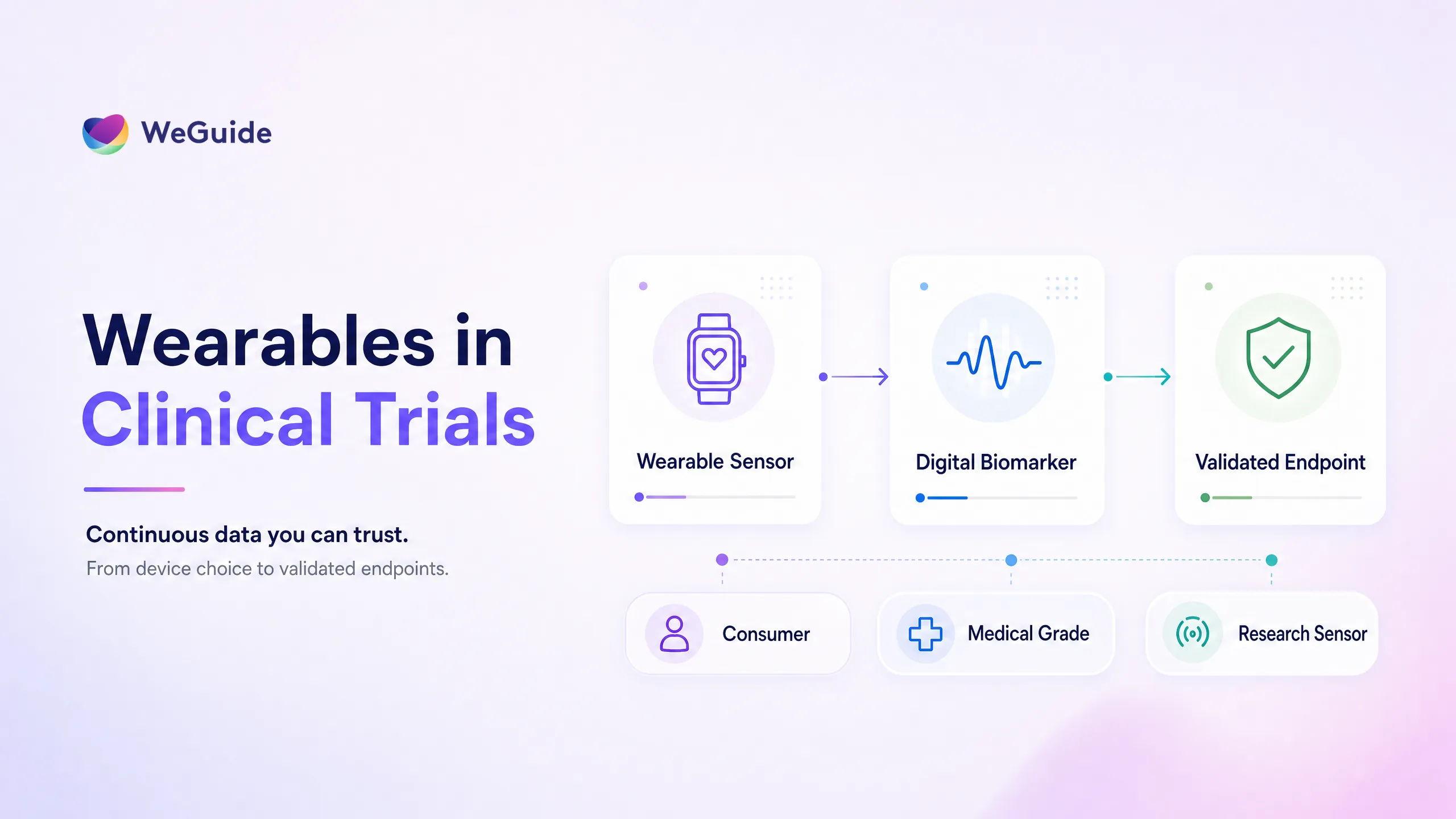


Wearables in clinical trials are body worn sensors that capture physiological and behavioural data, such as heart rate, activity, sleep, and gait, continuously and remotely while a participant goes about daily life. Sponsors and research sites use them to collect objective, real world measurements between visits, reduce the burden of site based data capture, and build novel digital endpoints that paper diaries and clinic snapshots cannot match.
The pull is obvious, but so is the uncertainty. Which devices are fit for a regulated study? Is consumer grade data trustworthy for an endpoint? Do you let participants use their own phone, or ship them a device? This guide answers those questions in the order a study team actually meets them. It covers the device categories, the types of data and digital biomarkers wearables produce, how that data becomes a validated endpoint, the BYOD versus provisioned decision, the data quality controls that make regulators comfortable, and where wearables fit in decentralised and hybrid designs. WeGuide has run wearable data capture at scale, including the BRACE trial with the Murdoch Children's Research Institute, so the focus here is practical rather than theoretical.
Key Takeaways
- Wearables capture continuous, objective data. They record heart rate, activity, sleep, and movement remotely, filling the gaps between clinic visits that paper diaries leave open.
- The value is digital endpoints, not step counts. A wearable measure becomes useful when it is verified, validated, and accepted as a digital biomarker or endpoint, following the DiMe V3 framework.
- BYOD or provisioned is a real choice. Bring your own device widens reach and cuts cost, provisioned devices give tighter data control and equity. Most trials run a mix.
- Data quality is the gate, not the device. Wear time, missing data, and validation decide whether sensor data holds up, which is why capture and monitoring matter more than the brand.
- The FDA has a clear framework. The 2023 DHT guidance sets out how sponsors select, verify, and validate wearables for remote data collection in regulated trials.
What Are Wearables in Clinical Trials?
A wearable in a clinical trial is any sensor worn on or near the body that records health data and sends it to the study, without a clinician taking the reading. That covers a consumer smartwatch measuring resting heart rate, a medical grade patch recording a single lead ECG, a continuous glucose monitor, and a research actigraphy unit tracking sleep and activity. What unites them is passive, continuous capture: the participant wears the device and data flows in, rather than answering a question at a visit.
This matters because traditional trials see a participant for a few hours every few weeks. A wearable sees them every minute in their own home. That shift from snapshot to continuous record is the reason interest has grown, and a 2018 review in PMC framed both the promise and the early caution around using these devices for trial endpoints.
It helps to group wearables by how regulated and how accurate they are:
| Device category | Examples | Typical data | Best fit in trials |
|---|---|---|---|
| Consumer wearables | Fitbit, Apple Watch, Garmin | Heart rate, steps, activity, sleep, SpO2 | Engagement, activity and sleep measures, exploratory endpoints, broad reach |
| Medical grade devices | ECG patches, continuous glucose monitors, blood pressure cuffs | Single or multi lead ECG, glucose, blood pressure | Primary or secondary clinical measures needing regulatory grade accuracy |
| Research sensors | Actigraphy units, accelerometers, gait sensors | Movement, sleep architecture, gait and mobility | Validated digital endpoints in neurology, sleep, and mobility studies |
The right category depends on the question. A study measuring physical activity as a supportive endpoint can use a consumer device. A study where the measurement is the primary endpoint usually needs a medical grade or validated research sensor. Our overview of wearable device studies sets out how WeGuide connects these devices into one participant facing app.
Why Sponsors Use Wearables in Clinical Trials
Sponsors adopt wearables for four practical reasons: better data, lower burden, broader reach, and new endpoints. Each one removes a limit that site based capture has lived with for decades.
The data is objective and continuous. Instead of a participant recalling how well they slept last week, an actigraphy unit records it night after night. That removes recall bias and gives a fuller picture of how a treatment affects daily life. It also catches events that happen between visits, which is where much of the real signal sits.
The burden falls. When activity, heart rate, and sleep flow in passively, participants make fewer trips and complete fewer manual diaries. Lower burden is the main reason remote elements improve retention, a pattern we cover in our guide to decentralised clinical trials and patient retention. Reach widens too, because a participant in a regional town can contribute the same data as one near a city hospital.
Finally, wearables create endpoints that did not exist before, from continuous mobility scores to nocturnal activity patterns. These digital endpoints can be more sensitive than a single clinic measurement, which is why regulators and sponsors are paying attention. The catch is that a raw data stream is not an endpoint until it has been validated, which is the subject of the next sections.
Bring wearable data into one participant app
WeGuide connects consumer and medical grade devices, eConsent, and ePRO in a single branded app, so sensor data lands clean and ready for analysis alongside your CTMS and EDC.
Types of Wearable Data and Digital Biomarkers
Wearables produce two things: raw sensor streams and the digital biomarkers derived from them. A digital biomarker is a measurable indicator of a health state, collected through a digital device, that stands in for how a patient feels or functions. Resting heart rate is raw data. Heart rate variability used as a marker of recovery is a digital biomarker.
Common wearable derived biomarkers include:
- Daily step count and physical activity
- Sleep duration and sleep architecture
- Heart rate and heart rate variability
- Gait speed and mobility
- Continuous glucose
In neurology, mobility and tremor measures are active areas. In sleep medicine, actigraphy derived sleep metrics are well established. Wearable data is also one form of patient generated health data, the wider category that includes ePRO responses and home device readings. We go deeper on definitions, types, and validation in our guide to digital biomarkers in clinical trials, and you can see how WeGuide handles this on the biomarkers page.
The distinction that trips teams up is biomarker versus endpoint. A digital biomarker is the measure. A digital endpoint is the specific, predefined outcome a trial uses to judge whether a treatment works. The same gait sensor can produce a biomarker that, once validated and prespecified in the protocol, becomes a primary or secondary endpoint. That promotion from measure to endpoint is where the regulatory work happens, and we cover it next.
From Sensor Data to Digital Endpoints
A wearable measurement becomes a digital endpoint only after it has been shown to be trustworthy and meaningful. The accepted way to do this is the V3 framework from the Digital Medicine Society, which breaks the work into three questions: does the sensor measure what it claims (verification), does the algorithm turn that signal into an accurate measure (analytical validation), and does the measure reflect something that matters to patients or clinicians (clinical validation).
Getting all three right is what lets a sponsor prespecify a wearable measure as an endpoint and defend it to a regulator. Skip a step and the data may be interesting but unusable for the primary analysis. This is why experienced teams decide the endpoint and its validation evidence before they pick a device, not after.
The payoff is real. Digital endpoints can be more sensitive and more frequent than clinic measures, which can shrink sample sizes or shorten studies when they hold up. Our guide to digital endpoints in clinical trials walks through how a measure earns endpoint status and how regulators view novel endpoints. For the regulatory frame around all of this, see the section on the FDA framework below.
BYOD vs Provisioned Devices
One of the first operational choices is whether participants use their own smartphone and wearable (bring your own device, or BYOD) or whether the study ships a provisioned device to each person. Both work, and the right answer depends on the protocol, the population, and the measurement.
BYOD widens reach and cuts cost. Most participants already own a phone, so there is nothing to ship, configure, or recover, and they use a device they know. The trade off is variability. Different phone models, operating systems, and wearables produce data in slightly different ways, which can complicate analysis.
Provisioned devices give the opposite balance. Everyone has the same hardware and settings, so the data is consistent and easier to validate. You can also reach people who do not own a suitable device, which supports equity. The cost is logistics, from shipping and support to recovering devices at the end.
| Factor | BYOD | Provisioned |
|---|---|---|
| Cost | Lower, no hardware to buy or ship | Higher, hardware plus logistics |
| Data consistency | Variable across devices | Uniform, easier to validate |
| Reach and equity | Excludes participants without a suitable device | Includes everyone, supports equity |
| Participant familiarity | High, uses own device | Lower, learns a new device |
| Best fit | Exploratory measures, large or geographically spread studies | Primary endpoints, regulated measures, mixed digital access |
Most studies land on a mix: BYOD where it is good enough, provisioned where the measurement or the population demands it. WeGuide supports both models in the same study. Our deep dive on BYOD vs provisioned devices in clinical trials covers the cost, compliance, and equity decision in full.
Is Wearable Data Trustworthy? Data Quality and Validation
The honest answer is that wearable data is trustworthy when it is captured and monitored well, and unreliable when it is not. The device brand matters less than wear time, completeness, and validation. A validated sensor that participants stop wearing produces worse data than a humbler device worn consistently.
Three quality issues decide the outcome:
- Wear time. Whether participants keep the device on long enough to produce a usable signal.
- Missing data. The gaps that open when a device is not charged, syncing fails, or the person takes it off.
- Standardisation. Capturing the same measure the same way across participants and sites.
Good studies plan for all three, with reminders, real time data monitoring, and clear wear time rules, rather than finding the problem at analysis.
This is where the participant experience does the heavy lifting. Reminders, simple syncing, and a single app that participants check anyway keep wear time high and gaps low. We cover the controls in detail in our guide to wearable data quality in clinical trials. The short version: design for the participant and the data quality follows.
Consumer Devices in Research: Fitbit, Apple Watch, and Garmin
Consumer wearables now sit alongside medical grade devices in many trials, because they are familiar, affordable, and increasingly accurate. Fitbit, Apple Watch, and Garmin each offer research programmes and developer access, and each suits different measures. WeGuide already supports this work, including a Garmin integration that brings heart rate, sleep, and activity into the study, and our analysis of Google and Fitbit for clinical research looks at one device family in depth.
The differences that matter to a study team are data access, validation status, battery life, and cost. Apple Watch has strong cardiac features and a large developer ecosystem. Garmin offers long battery life and a health SDK suited to research. Fitbit has a long research track record and broad population reach. None is "best" in the abstract. The right device depends on the measure and the population. Our comparison of consumer wearables in clinical research puts Fitbit, Apple Watch, and Garmin side by side for trial use.
Individual devices are covered in their own deep dives, each written for study teams rather than consumers: the Apple Watch, the Garmin CIRQA, the Oura Ring, and WHOOP. Each works through the same four questions: what the device actually measures, whether the accuracy evidence holds up, what data you can get out, and what its regulatory status does and does not permit.
Wearables in Decentralised and Hybrid Trials
Wearables are a core building block of decentralised and hybrid trials, because they move data capture out of the clinic and into the participant's daily life. In a decentralised design, a wearable can replace some clinic measurements entirely, while in a hybrid design it supplements periodic site visits with continuous remote data.
This is where wearables compound with the rest of the remote stack. Paired with eConsent, ePRO, and telehealth visits, a wearable lets a participant join from home and still produce rich, continuous data. That combination is what widens recruitment and supports retention, and it is the model WeGuide delivers through one decentralised clinical trial platform. We focus specifically on the remote data role of wearables in our guide to wearables in decentralised clinical trials.
The Regulatory Picture: The FDA DHT Framework
Regulators have moved from caution to clear guidance. In December 2023 the FDA finalised its guidance on digital health technologies for remote data acquisition in clinical investigations, which sets out how sponsors should select a DHT that fits the trial population, verify and validate it for the measure, manage data integrity, and document the whole chain.
The practical message is that wearables are accepted in regulated trials when the sponsor does the homework: choose a device suited to the participants, validate the measure using a framework like V3, and keep a clear record of how data was captured and handled. WeGuide is TGA Class I certified medical device software and supports GCP aligned data capture, though sponsors remain responsible for endpoint validation and regulatory strategy. We unpack the framework in our guide to digital health technologies in clinical trials.
A Real Example: The BRACE Trial
The BRACE trial is a concrete proof point for wearable and mobile data capture at scale. Run on a custom WeGuide app with the Murdoch Children's Research Institute, it supported more than 6,000 participants across five countries and recorded over 90% participant adherence, with a six week deployment during COVID 19 restrictions. Participation ran through mobile data capture, wearables, and remote workflows rather than routine clinic visits.
What makes BRACE useful here is the honesty of the claim. It is one trial, in a specific design, not proof that every wearable study reaches the same number. But it shows that high adherence and clean remote data are achievable across borders when the participant experience is built around the person, with reminders and low friction capture doing the retention work.
Frequently Asked Questions
What are wearable devices in clinical trials?
Wearable devices in clinical trials are body worn sensors, such as smartwatches, ECG patches, continuous glucose monitors, and actigraphy units, that capture health data remotely and continuously. They record measures like heart rate, activity, sleep, and glucose between visits, giving study teams objective real world data instead of occasional clinic snapshots.
Are consumer wearables like Fitbit and Apple Watch accurate enough for trials?
For many measures, yes, when validated for the specific use. Consumer wearables suit activity, sleep, and heart rate measures and exploratory endpoints. For a primary endpoint that needs regulatory grade accuracy, teams usually choose a medical grade device or validate the consumer measure carefully using the V3 framework before relying on it.
What is the difference between a digital biomarker and a digital endpoint?
A digital biomarker is a measure derived from device data, such as gait speed. A digital endpoint is a predefined trial outcome based on that measure, used to judge whether a treatment works. A biomarker becomes an endpoint only after verification, analytical validation, and clinical validation, and after it is prespecified in the protocol.
What is BYOD in clinical trials?
BYOD, or bring your own device, means participants use their own smartphone and wearable to take part, rather than receiving study issued hardware. It lowers cost and widens reach because people use a device they already own, but it introduces data variability across device models, so many trials combine BYOD with provisioned devices where consistency matters.
Does the FDA accept wearable data in clinical trials?
Yes, within a clear framework. The FDA's 2023 guidance on digital health technologies explains how sponsors select, verify, and validate wearables for remote data collection in regulated trials. Wearable data is accepted when the device fits the population, the measure is validated, and data handling is documented, so the sponsor can defend the endpoint.
How do you keep wearable data quality high?
Plan for wear time, missing data, and standardisation from the start. Use reminders, simple syncing, and real time monitoring so participants keep devices on and gaps stay small, and define how each measure is captured across sites. A single participant app that people already check keeps wear time high, which is the main driver of usable data.
Conclusion
Wearables in clinical trials turn occasional clinic snapshots into continuous, objective records, and that is why sponsors keep adopting them. The value is not the device but the chain behind it: pick a sensor that fits the population, derive a digital biomarker, validate it into an endpoint, and capture clean data with high wear time. Get that chain right and wearables can shrink burden, widen reach, and produce endpoints that traditional methods miss.
The decisions follow a clear order. Decide the measure and its validation evidence first, choose BYOD or provisioned to match the population, then build a participant experience that keeps the data flowing. WeGuide is the patient facing layer that brings devices, eConsent, ePRO, and reminders into one branded app, supporting your decentralised or hybrid design alongside your existing CTMS and EDC.
Plan your wearable study with confidence
Walk through how WeGuide captures clean wearable and device data across your trial, from device choice to validated endpoints.
Book a demoNo pressure, just a conversation.

