

.svg)
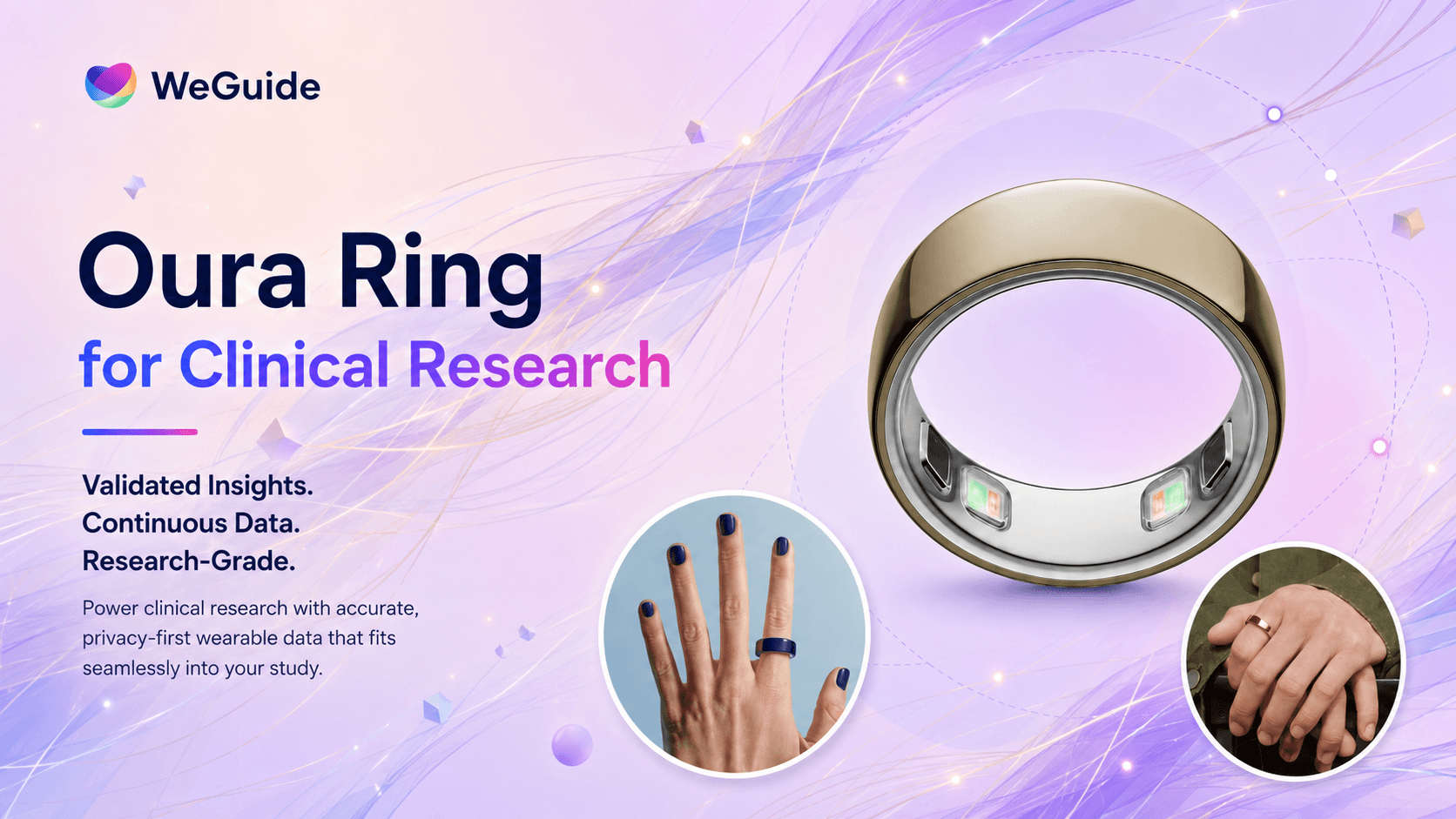


The Oura Ring can be used in clinical research as a wellness grade source of overnight heart rate, heart rate variability (HRV), skin temperature and sleep data. It's a finger worn wearable, not an FDA cleared medical device, so its outputs suit exploratory and secondary endpoints rather than a primary regulatory endpoint without extra validation. Used inside those limits, Oura is one of the most studied consumer wearables in research, which is what makes Oura Ring clinical research worth a careful look.
Oura has an unusual track record for a consumer device. Roughly 116 to 128 studies registered on ClinicalTrials.gov mention Oura, and its distal temperature signal anchored large COVID era detection work like the UCSF TemPredict programme. The current flagship is the Oura Ring 5, announced in May 2026, though most published validation still runs on the Gen3 and Ring 4 hardware that remain in wide use. For a study team, the ring is interesting for one reason a wrist device rarely matches: people keep it on all night, every night, because they never take it off to charge mid sleep.
Wearable substudies tend to succeed or fail on three questions: whether participants keep wearing the device, whether the signal is good enough for the endpoint, and whether you can get the data out cleanly. This guide works through all three for the Oura Ring, covering what it measures, how accurate each signal is, what the Oura API actually exposes, and how the ring compares to WHOOP, the Fitbit Air and other research wearables. WeGuide runs consented wearable device studies end to end, so we look at any new device through the lens of a real research data pipeline.
Key Takeaways
- Oura is a wellness device, not a cleared instrument. No Oura output (heart rate, HRV, temperature, SpO2 or sleep staging) is FDA cleared, so plan Oura data as exploratory or secondary endpoints and validate any metric your endpoint depends on.
- Its strongest signals are nocturnal heart rate and time domain HRV. These validate well against ECG, and total sleep time validates well against sleep studies. Sleep staging is moderate, and SpO2 has little independent evidence.
- The API gives you 5 minute summaries, not raw signals. The Oura API v2 exposes daily summaries plus 5 minute nocturnal heart rate and rMSSD. It does not expose raw PPG waveforms, beat to beat intervals or raw accelerometer data.
- Budget for a subscription per participant. Each participant needs an active Oura Membership ($5.99 per month or $69.99 per year) or the API returns an error, so a lapse mid study creates a data gap.
- Generation matters. Sensors and algorithms differ across Gen3, Ring 4 and Ring 5, so mixing generations in one cohort introduces a version confound worth controlling.
What Is the Oura Ring?
The Oura Ring is a titanium smart ring that tracks sleep, heart rate, HRV, respiration, blood oxygen and skin temperature from the finger, using an optical sensor, a temperature sensor and an accelerometer. All data is read through the Oura mobile app, and the detailed metrics sit behind a paid membership.
Oura has shipped roughly one new generation every three years since 2015. The relevant models for research today are the Gen3, the Oura Ring 4 (October 2024) and the Oura Ring 5 (May 2026), which Oura describes as its smallest ring yet at about 40% smaller than Ring 4. Each generation changes the optical geometry and the proprietary algorithms, which is why the generation a participant wears is a variable worth recording in a protocol.
The sensor stack on Ring 4 combines multi wavelength optical sensors (green, red and infrared light), a negative temperature coefficient skin temperature sensor, and a 3D accelerometer. Red and infrared light drive overnight blood oxygen estimation, while green and infrared light drive continuous heart rate, HRV and night time respiration. The ring is rated to 100 m water resistance and runs about 5 to 8 days per charge.
Two commercial details shape any study budget. First, the hardware costs from about $349 for Ring 4 and from about $399 for Ring 5. Second, and more important, Oura uses a mandatory subscription: without an active membership, the app shows only three daily scores, and detailed sleep, heart rate, temperature and trend data stay locked. For a cohort, that means a recurring per participant cost, not a one off hardware purchase.
Why the Oura Ring Matters for Clinical Trials
Oura earned its place in research through the ring form factor and a strong temperature signal, not through raw specifications. Four things make it a genuine option for Oura Ring clinical trials.
Adherence that protects the dataset. A ring is easy to wear continuously, and participants rarely remove it, so the missing data problem that plagues wrist devices is smaller. Healthcare worker studies have reported wear on about 87.8% of study nights, and one eight week study reported 24 hour wear in 95% of participants. That adherence is often the difference between a publishable dataset and a thin one.
A distal temperature signal. Oura reports skin temperature as a deviation from each wearer's own baseline, which turns out to be a sensitive early signal for illness onset and menstrual cycle phase. This is the signal behind its COVID era reputation, and it is a natural fit for infectious disease, fertility and women's health research.
Continuous overnight physiology. Because the ring stays on through the night, it captures resting heart rate, HRV and respiration during sleep, the window where autonomic and recovery signals are cleanest. For studies that pair passive physiology with wearable data quality controls, that overnight coverage is the point.
A fit for remote and hybrid designs. Automatic overnight collection suits decentralised clinical trials, where site visits are rare and passive signals fill the gaps between patient reported outcomes. Our guide to wearables in clinical trials covers how sensor signals become defensible endpoints.
The honest counterweight is scale and status. Around 116 to 128 ClinicalTrials.gov records mention Oura, against roughly 1,431 for Fitbit, so Oura sits in the research second tier and concentrates in sleep, recovery, temperature and women's health rather than step count endpoints.
Run your Oura substudy on a proven pipeline
WeGuide powers wearable device studies end to end, from eConsent through consented API based data collection to analysis ready export, alongside your ePRO.
What the Oura Ring Measures: Signals Versus Scores
For trial design, the useful split is between near raw signals, which can be validated against reference instruments, and proprietary scores, which are composite indexes that change with firmware. Only the signals belong in a defensible endpoint.
| Metric | Type | What it is | Notes for research |
|---|---|---|---|
| Resting heart rate | Signal | Overnight heart rate in bpm | Strong validation against ECG |
| HRV (rMSSD) | Signal | Time domain HRV, nightly and at 5 minute steps | Good validation; the defensible HRV metric |
| Respiratory rate | Signal | Overnight breaths per minute, from the optical sensor | Reported by Oura, thin independent validation |
| Skin temperature | Signal | Deviation from personal baseline, not core temperature | Useful as a relative trend, not a thermometer |
| Blood oxygen (SpO2) | Signal | Overnight average and a breathing regularity index | Wellness feature, no strong independent accuracy study |
| Sleep stages | Score | Awake, light, deep and REM hypnogram | Moderate accuracy, generation dependent |
| Sleep, Readiness, Activity Scores | Score | 0 to 100 composite indexes | Proprietary, sensitive to algorithm updates |
| Resilience, Stress, Cardiovascular Age | Score | Higher level derived indexes | Exploratory only, treat with caution |
Two points matter most. Oura's headline HRV is rMSSD, a time domain measure that validates well, so restrict HRV endpoints to rMSSD rather than short window frequency domain measures. And temperature is a deviation from the wearer's own baseline, so it supports relative change detection, illness or cycle tracking, but it is not an absolute core temperature reading.
Is the Oura Ring Accurate Enough for Clinical Research?
Oura Ring accuracy is uneven by signal: strong for nocturnal heart rate and time domain HRV, strong for total sleep time, moderate for sleep staging, and thin for SpO2 and respiratory rate. The right answer for a protocol is to validate the specific metric your endpoint depends on, in your population, before you rely on it.
The cardiovascular evidence is the most reassuring. In an ECG referenced study, Oura's nocturnal heart rate and HRV tracked a reference closely. Heart rate correlations sat near 0.99, with strong time domain HRV agreement. A 2025 comparison across consumer wearables ranked Oura highest for both resting heart rate and HRV against WHOOP, Garmin and Polar.
There's one caveat. The systematic HRV bias differs between studies, so agreement is high but the exact offset is study and algorithm dependent. Beat to beat and short window frequency analysis aren't supported.
Sleep is a two part story. For total sleep time and sleep versus wake, agreement with sleep studies is good. A 2025 meta analysis found total sleep time differed from reference by only about three minutes on average.
Sleep staging is weaker. A Gen3 sleep staging validation reported around 94% sensitivity to sleep but only about 73% to 75% specificity. In plain terms, the ring tends to over call sleep and under detect wake. That study was also funded by Oura and drew a published methodological critique, so treat it as vendor supported rather than independent. Expect accuracy to drop further in insomnia, fragmented sleep, and older or comorbid populations that validation samples underrepresent.
For an independent view of how these signals hold up under sleep lab conditions, this scientific review tests the Oura Ring against reference devices:
Temperature is best treated as a relative trend rather than a calibrated measurement, and it is well suited to illness and cycle signals: the TemPredict COVID study used ring temperature within a multimodal model that flagged infection on average about 2.75 days before a positive test. Respiratory rate and especially SpO2 rest on much thinner independent evidence, so keep those signals exploratory.
Several limits cut across every signal. Optical readings degrade with motion, so daytime and exercise data are less reliable than overnight data. HRV assumes normal sinus rhythm, so the ring is not an arrhythmia tool. And because the algorithms are proprietary and update over time, longitudinal comparability depends on recording the hardware generation and firmware version, and ideally locking firmware for the study duration.
Regulatory note: The Oura Ring is a general wellness device with no FDA clearance for any of its features. Before using any Oura signal as a study endpoint, validate the specific metric against an appropriate reference in your population, follow the FDA framework for digital health technologies in clinical investigations, and confirm the approach with your ethics committee or regulatory adviser.
How the Oura Ring Compares to Other Research Wearables
Study teams rarely assess a device in isolation. Here is how the Oura Ring sits alongside the wearables most often shortlisted for research in 2026, on the axes that matter for a protocol rather than for a consumer.
| Device | Form factor | Approx. cost | Subscription | Battery | Key research signals | Data access | Regulatory footing (US) |
|---|---|---|---|---|---|---|---|
| Oura Ring 4 or 5 | Smart ring | $349 to $499 | Required | 5 to 8 days | HR, HRV, temperature, SpO2, respiration, sleep | Oura API v2, summaries only | General wellness, no cleared feature |
| WHOOP 5.0 | Screenless band | Hardware bundled | Required | Up to 14 days | HR, HRV, SpO2, respiration, sleep | WHOOP API | Wellness, recently added an ECG feature |
| Google Fitbit Air | Screenless tracker | About $99 | None for core data | Up to 7 days | HR, HRV, SpO2, skin temp, AFib alerts, sleep | Google Health API | Some cleared features on Fitbit models |
| Garmin | Wrist or band | $150 to $500 | None | Days to weeks | HR, HRV, SpO2, respiration, sleep, activity | Health API and SDKs | Largely wellness |
| Apple Watch | Smartwatch | $250 to $800 | None | 18 to 36 hours | HR, ECG and AFib, SpO2, sleep, movement | HealthKit and SensorKit | FDA cleared ECG and AFib |
Prices and specifications are approximate as of July 2026 and vary by model and region.
Oura's edge in this field is not a raw specification. It is the ring form factor, the distal temperature signal, and a published validation and research footprint that newer smart rings such as the Samsung Galaxy Ring and Ultrahuman Ring Air do not yet match on independent evidence. Where a study needs step count endpoints, GPS, ECG or a longer daytime dataset, a wrist device is the stronger default. For a broader look across devices, see our guides to consumer wearables in clinical research and the low cost Fitbit Air for clinical research.
Oura Ring vs WHOOP for research
Oura and WHOOP are the two subscription based recovery wearables most often compared. Both deliver strong overnight heart rate and HRV, both require an ongoing membership, and both are wellness devices. The practical differences: Oura's ring form factor tends to win on comfort and overnight adherence, and the 2025 cross device comparison placed Oura ahead for resting heart rate and HRV agreement, while WHOOP offers a longer battery and has more recently added an ECG feature. For a recovery or sleep endpoint, the choice usually comes down to form factor and which device your participants will actually keep wearing.
The closest comparators each have their own deep dive. WHOOP for clinical research is the other subscription based screenless device and the most direct alternative to a ring, the Apple Watch carries the widest set of cleared features of any consumer wearable, and the Garmin CIRQA is the closest screenless band that needs no subscription at all.
Data Access and the Oura API for Clinical Research
This is where a wearable moves from a participant's finger into a study workflow, and it is where the Oura Ring has real strengths and one hard limit. Data syncs from the ring to the Oura app, and researchers pull it programmatically through the Oura API v2.
Access uses OAuth2, with each participant consenting to the specific data scopes a study requests. Personal access tokens were retired at the end of 2025, so any legacy single user scripts need moving onto the standard authorisation flow. Two operational details matter for a cohort: an unapproved API application is capped at 10 users until Oura approves it, and the API returns an error when a participant's membership lapses, so subscription renewal is a data continuity issue, not just a billing one.
The single most important design constraint is resolution. The Oura API exposes daily summaries plus a 5 minute nocturnal series for heart rate and rMSSD. It doesn't expose raw PPG waveforms, beat to beat (RR) intervals or raw accelerometer data. Skin temperature arrives as a daily deviation rather than a continuous trace, and SpO2 as a nightly average.
So the lowest level cardiac quantity you can pull is 5 minute rMSSD. Any protocol that assumes raw signal access can't be satisfied through the supported path. That's the opposite of Garmin's developer stack, which can stream beat to beat intervals, and it's the first thing to check against your endpoint.
Operationally, the API is well built. It supports webhooks, so you receive data as it syncs rather than polling. It allows 5,000 requests per 5 minute window, and provides a sandbox for integration testing. One sandbox caveat: it returns 60 second intervals while production returns 5 minute intervals, so never calibrate resolution from sandbox data.
For studies, Oura runs a dedicated Oura for Business and academic research offering that advertises CSV and JSON export, group dashboards and a stated HIPAA posture. Confirm the specifics in a contract rather than from a marketing page. In particular, check whether the export includes the 5 minute nocturnal series or only daily summaries, and whether Oura will sign a Business Associate Agreement and a data processing agreement for your deployment.
The upshot for a trial is simple. Oura is genuinely operationalisable through OAuth2, webhooks, per participant consent scoping and a documented export path. You just have to design endpoints around 5 minute summaries rather than raw waveforms.
That capture, consent and pipeline layer is exactly what a platform like WeGuide provides. We bring Oura API data into a study through the Integration Engine and API, alongside ePRO and eConsent, on a TGA certified (Class I), ISO 27001 platform that has supported over 200,000 participants.
How to Run an Oura Ring Study
At a high level, an Oura integration looks like any modern consented data flow, and it can be stood up in five steps.
- Match the device to the endpoint. Confirm the signals you need are ones Oura validates well: overnight resting heart rate, rMSSD, total sleep time and temperature trend, not raw waveforms, ECG or daytime step count endpoints.
- Choose BYOD or provisioned. Sponsor provisioned rings control the hardware generation and guarantee an active membership, avoiding both the version confound and lapsed subscription gaps. A BYOD approach lowers hardware cost but adds heterogeneity in generation, firmware and subscription status.
- Budget the subscription. Every participant needs an active Oura Membership for the API to return data, so carry it as a recurring per participant line item for the full study and follow up window, and monitor for expiry driven data loss.
- Design the consent and pipeline. Participants should see clearly what the ring collects, where it flows, and how to pause or withdraw. Plan the OAuth2 flow, per scope consent, webhook ingestion, and firmware and generation logging up front.
- Pilot, validate, then scale. Run a short pilot to check data completeness and wear adherence, validate the endpoint metric against a reference, and only then roll out to the full cohort.
Oura fits some designs far better than others. It's a good fit for sleep endpoints centred on total sleep time, autonomic recovery using nocturnal heart rate and rMSSD, temperature driven illness or cycle signals, and any study that needs high overnight adherence. It's a poor fit for daytime activity or step count primary endpoints, anything needing raw waveforms or intraday SpO2, arrhythmia detection, or a primary regulatory endpoint without independent validation. Matched to the right endpoint, and captured through a consented pipeline that also handles ePRO and device data, the ring adds continuous overnight physiology that a wrist device often misses.
Oura Ring Clinical Research FAQs
Can you use the Oura Ring in clinical research?
Yes. The Oura Ring captures research relevant signals including overnight heart rate, HRV, skin temperature, respiration, blood oxygen and sleep, and its data flows through the Oura API v2 into a study pipeline. Because it is a general wellness device rather than a cleared instrument, suitability depends on your protocol and endpoints, and any metric you rely on should be validated in your population first.
Is the Oura Ring accurate enough for clinical research?
For some signals, yes. Nocturnal resting heart rate, time domain HRV (rMSSD) and total sleep time validate well against reference measures. Sleep staging is only moderate and generation dependent, and SpO2 and respiratory rate have little independent validation. Validate the specific metric your endpoint depends on before relying on it, especially in clinical populations that differ from Oura's mostly healthy validation samples.
Does the Oura Ring have an API?
Yes. The Oura API v2 uses OAuth2 and delivers daily summaries plus a 5 minute nocturnal series for heart rate and rMSSD, along with sleep, readiness, activity, temperature and SpO2 data. It does not expose raw PPG waveforms, beat to beat intervals or raw accelerometer data, so protocols that need raw signals cannot use the supported API for them.
What data does the Oura Ring collect?
The Oura Ring collects overnight heart rate, heart rate variability (rMSSD), skin temperature, respiratory rate, blood oxygen (SpO2), and sleep timing and stages, plus movement from its accelerometer. Through the API it delivers these as daily summaries and a 5 minute nocturnal series for heart rate and rMSSD. It doesn't collect raw PPG waveforms, beat to beat intervals or core body temperature.
How do you export Oura Ring data?
Data syncs from the ring to the Oura app, then flows to your systems through the Oura API v2, with webhooks for near real time delivery. Oura's academic and business research offering also advertises CSV and JSON export and group dashboards. A research platform can automate the pipeline so study teams receive cleaned, analysis ready datasets rather than handling manual downloads.
Is the Oura Ring FDA cleared?
No. As of mid 2026, no Oura Ring generation holds FDA clearance for any feature, and Oura markets the ring as a general wellness product. Oura has announced plans to pursue FDA clearance for a future blood pressure feature, but that is a study stage pursuit, not a current clearance. For a regulated trial, treat Oura data as a wellness grade source that needs sponsor side validation, not a cleared clinical measurement.
Oura Ring vs WHOOP for clinical research?
Both are subscription based wellness wearables with strong overnight heart rate and HRV. Oura's ring form factor tends to win on comfort and overnight adherence, and a 2025 cross device comparison ranked it ahead of WHOOP for resting heart rate and HRV agreement. WHOOP offers a longer battery and has more recently added an ECG feature. For a sleep or recovery endpoint, the practical decision usually comes down to which device your participants will keep wearing.
Does the Oura Ring need a subscription?
Yes, and it matters for study budgeting. Each participant needs an active Oura Membership ($5.99 per month or $69.99 per year) for the app and the API to return detailed data. Without it, only three daily scores are visible, and the API stops returning data, so a lapsed membership mid study creates a data gap. Budget the subscription as a recurring per participant cost.
Who owns Oura Ring data, and what about data privacy?
Data ownership and processing terms depend on the agreement you sign with Oura for a research deployment, not the consumer defaults. Oura's research offering states a HIPAA posture, but Business Associate Agreement availability, data controller versus processor roles, retention and deletion on study close should be confirmed contractually. Participant consent should also cover what is collected, where it flows and how to withdraw. Public concern about Oura data privacy, including reports about whether Oura shares or sells data, applies to the consumer app rather than a governed research deployment, but it's worth pre-empting with participants: in a study, a signed agreement and per participant consent define who holds the data and how it's used.
The Oura Ring Clinical Research Verdict
The Oura Ring gives clinical research teams a rare combination: high overnight adherence, a sensitive distal temperature signal, and genuinely strong validation for nocturnal heart rate, time domain HRV and total sleep time. That evidence base, larger than almost any other consumer wearable, is what earns Oura a place in sleep, recovery, temperature and women's health research. Its limits are equally clear. It is a wellness device with no cleared feature, its API gives you 5 minute summaries rather than raw signals, it carries a subscription per participant, and its sleep staging and SpO2 are weaker than its headline metrics suggest.
If you are scoping a wearable substudy now, the path is short: confirm Oura measures your endpoint signal well, design around the 5 minute API resolution, decide between provisioned and BYOD, pilot with a handful of participants, and validate before scaling. Done in that order, the Oura Ring is one of the most dependable ways to add continuous overnight physiology to a study, provided you hold it to what a wellness wearable can honestly support.
See an Oura ready pipeline against your protocol
We'll walk through consented wearable and API data collection, from eConsent to analysis ready export, alongside the systems you already run.
Book a demoNo pressure, just a conversation.

