

.svg)
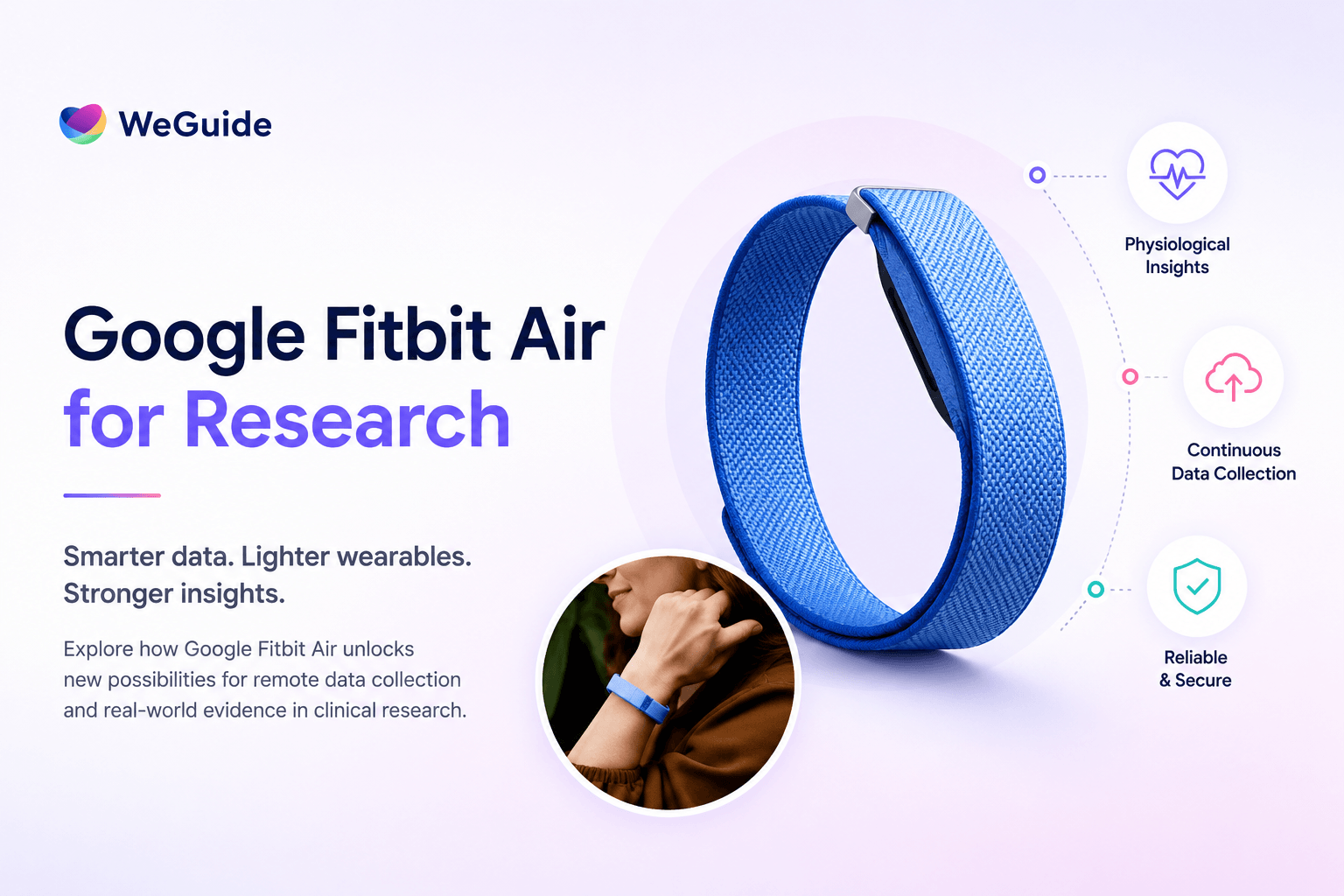


The new Google Fitbit Air can be used in clinical research, and it may be one of the most accessible options yet for capturing continuous health data at scale. Google has just launched the Fitbit Air, a screenless, pocket-money-priced tracker built to be worn around the clock. For most consumers it is a simpler, lighter way to keep an eye on their health. For clinical research teams, it is something more interesting: a low-cost, comfortable, passive sensor that could lower two of the oldest barriers in wearable studies, recruitment and adherence.
Fitbit has worked with the research community since 2013, and its devices are already among the most widely used wearables in clinical trials. The Fitbit Air takes that heritage and strips it back to the essentials. Below we look at what the device captures, why it suits decentralised research, and how Fitbit Air data is exported and integrated into a study.
What is the Google Fitbit Air?
The Fitbit Air is Google's smallest and most affordable tracker to date. It has no screen at all, just a slim sensor puck tucked beneath a band, and is priced at around $99. There is no need to charge it daily either: battery life runs up to a week, with fast charging that adds a day of power in roughly five minutes. It is water-resistant to 50 metres and pairs with the Pixel Watch, so a participant can wear the watch by day and switch to the lighter Air for sleep.
All data is managed through the Google Health app, the rebranded and rebuilt version of the old Fitbit app. The one notable omission for some study designs is GPS, which the Air does not include.
Why the Google Fitbit Air matters for clinical research
Fitbit is not a newcomer to research; it is the established leader. Among wrist-worn wearables on ClinicalTrials.gov, Fitbit devices feature in roughly 323 active studies, against around 71 for Garmin and 58 for Apple Watch, and Fitbit has accounted for more than 80% of consumer activity-monitor use across published research. The Fitbit Air inherits that whole ecosystem from day one, which positions it well for Fitbit Air clinical trials from launch. What it adds is a lower price and a form factor designed for genuine all-day wear.
The value of any wearable in a trial comes down to whether participants actually wear it and whether the data is clean. The Fitbit Air is built around exactly those problems:
- Affordability. At roughly $99 a unit, kitting out a large cohort is far cheaper than with clinical-grade devices, which matters when you are shipping hardware to hundreds of remote participants.
- Comfort and 24/7 wear. A screenless, lightweight design is easy to forget you are wearing, which is exactly what remote patient monitoring over weeks or months needs. Higher comfort tends to mean better adherence and lower attrition, the difference between a dataset you can publish and one full of gaps.
- Passive, naturalistic data. With no screen and no notifications, participants are less likely to change their behaviour in response to the device, which helps protect the quality of real-world data.
- Fewer data gaps. A week of battery life and automatic syncing reduces the missing-data windows that come with daily charging.
- Recruitment pull. A trusted, familiar consumer brand can make a study more appealing to prospective participants.
Adherence is not a minor detail. In wearable cancer-treatment studies, for instance, the proportion of participants actually wearing the device has ranged from around 60% to 100%, and that spread often decides whether a study reaches its endpoints. A tracker people barely notice, with a week of battery between charges, is designed to sit at the higher end of that range.
Health data you can capture with the Fitbit Air
Despite its size, the Air carries a capable sensor array. The metrics most relevant to research include:
- 24/7 heart rate, resting heart rate and heart rate variability (HRV)
- Heart rhythm monitoring with atrial fibrillation (AFib) alerts
- Blood oxygen saturation (SpO2)
- Skin temperature
- Sleep stages and duration, using Google's newer sleep models
- Activity and movement via the onboard accelerometer
That spread covers a lot of ground: cardiology and heart-rhythm research, sleep medicine, respiratory and metabolic studies, recovery and activity research, and the physiological signals that increasingly feature in mental-health and chronic-disease work.
Is the Google Fitbit Air accurate enough for research?
It is the right question to ask of any consumer device, and the honest answer is that it depends on the metric, and that the Air itself is too new to have its own published validation studies yet. What we do have is a large evidence base on Fitbit's sensor platform and on consumer wearables in general, which gives a fair guide to what to expect.
The headline signals look strong. Across consumer wearables, heart rate typically falls within about 3% of a reference measure, and pooled arrhythmia detection has reported sensitivity close to 100% with specificity around 95%. Heart rate and rhythm are exactly what the Fitbit Air is built around.
Other measures call for more caution. Sleep-stage classification is less reliable than clinical polysomnography, step counts can be over- or under-estimated, and accuracy can fall for participants with darker skin tones, higher BMI, or arrhythmias that disturb the optical signal. None of this rules the device out. It means a study should validate the specific metric it relies on against an appropriate reference and design around the device's known limits, rather than assume research-grade precision across the board.
How the Fitbit Air compares to other research wearables
Researchers rarely choose a device in isolation. Here is how the Fitbit Air sits alongside the other wearables most often considered for studies.
| Device | Form factor | Approx. cost | Battery | GPS | Key research signals | Data access | Research footprint |
|---|---|---|---|---|---|---|---|
| Fitbit Air | Screenless tracker | ~$99 one-off | Up to 7 days | No | HR, HRV, SpO2, skin temp, AFib, sleep | Google Health API | Largest (Fitbit ~323 trials) |
| Apple Watch | Smartwatch (screen) | ~$250-800 | ~18-36 hours | Yes | HR, ECG/AFib, SpO2, sleep | HealthKit / SensorKit | ~58 trials |
| Garmin | Watch or band (screen) | ~$150-900 | Days to weeks | Most models | HR, HRV, SpO2, stress, sleep | Garmin Health API | ~71 trials |
| WHOOP 5.0 | Screenless band | Subscription (~$239/yr) | ~14 days | No | HR, HRV, SpO2, skin temp, respiratory rate, sleep | WHOOP API | Growing, athletics-led |
| Oura Ring 4 | Smart ring (no screen) | ~$349 + ~$6/mo | Up to 8 days | No | HR, HRV, SpO2, temperature, respiratory rate, sleep | Oura API | Sleep and temperature research |
Prices and specifications are approximate and vary by model, accurate as of 2026.
For a screenless, all-day device, the Fitbit Air's closest comparators are WHOOP and Oura. It undercuts both on cost, avoids their mandatory subscriptions, and connects through the Google Health API to the deepest research track record of the group. The trade-off is no GPS and no on-device screen for participant prompts, which matters for some protocols and not others.
Weighing up the Fitbit Air for a study?
If you are scoping a protocol and want to talk through whether it fits your endpoints, tell us what you are trying to measure and we will think it through with you.
Tell us what you are measuringEach of those devices has its own deep dive on this blog. We cover the Garmin CIRQA for clinical research, the Oura Ring for clinical research, WHOOP for clinical research, and the Apple Watch for clinical research, each written to the same questions: what the device measures, whether the accuracy evidence holds, what data you can get out, and what its regulatory status permits. For the wider picture, our pillar guide to wearables in clinical trials sets out how any of these fits a protocol, the comparison of consumer wearables in clinical research puts the mainstream brands side by side, and wearable data quality and validation covers how to judge whether a signal will hold up as an endpoint.
Google Fitbit Air data export for research teams
This is where the device fits into a study workflow rather than just a participant's wrist. Readings flow from the Fitbit Air into the Google Health app, and from there they can be accessed programmatically through the Google Health API, the next generation of what was previously the Fitbit Web API.
The shift is more than a rename. The new API consolidates a sprawling set of legacy endpoints into cleaner data bundles, runs on Google's OAuth 2.0 framework, and, importantly for researchers, exposes much higher-resolution data by default. Heart-rate sampling that once required a special application for "intraday" access can now arrive at intervals of a few seconds. For continuous-monitoring studies, that is a meaningful jump in granularity.
One scheduling note worth flagging to study teams: Google is retiring the legacy Fitbit Web API in favour of the Google Health API, with the full transition slated for September 2026. Any new integration should be built against the Google Health API from the outset. On the study side, a platform purpose-built for collecting and exporting wearable health data can turn that raw API output into clean, analysis-ready datasets.
How to integrate the Google Fitbit Air into a study
At a high level, integrating the Fitbit Air looks like any modern consented-data flow. A participant authorises access through Google OAuth 2.0, the study platform subscribes to the relevant data types, and readings arrive as a reconciled stream, automatically synced and source-tagged, without participants ever having to export or upload anything by hand.
Because the model is API-based rather than dependent on manual exports or proprietary hardware bridges, it is generally lighter to set up and easier to keep secure. Purpose-built endpoints, such as those for AFib data, also let approved health and research partners receive specific signals without building a bespoke app for every exchange. As with any health-data integration, consent management, re-consent during the API transition, and compliance handling all need to be designed in deliberately. WeGuide already runs this pattern for other consumer wearables; our Garmin integration uses the same consented, API-based approach. If you are still deciding which parts of the study to move off site in the first place, our guide to what decentralized clinical trials actually involve works through it element by element.
Exploring a Fitbit Air study with WeGuide
WeGuide already powers wearable device studies end to end, from screening and eConsent through to data collection and one-click export, with native integrations for Garmin and Apple devices and all HealthKit-supported sources. The Fitbit Air, with its low cost and high adherence potential, is a natural extension of that work.
If your team is considering the Fitbit Air for an upcoming trial, we would genuinely like to hear about it. Tell us what you are trying to measure and we can explore the right approach together, including whether a tailored integration makes sense for a study of sufficient scale.
Exploring a Fitbit Air study?
WeGuide already powers wearable device studies end to end, from screening and eConsent through to data collection and one-click export. Tell us what you want to measure with the Fitbit Air and we will explore the right approach together.
Get in touch with our teamFrequently asked questions
Can you use the Google Fitbit Air for clinical research?
Yes, in principle. Fitbit devices are already widely used in clinical trials, and the Air captures research-relevant signals such as heart rate, HRV, AFib alerts, SpO2, skin temperature, sleep and activity. As always, suitability depends on your protocol, endpoints and regulatory requirements.
How do you export data from the Google Fitbit Air?
Data syncs from the device into the Google Health app and can then be accessed programmatically through the Google Health API, which supports high-resolution, automatically synced data for connected, consenting participants, removing the need for manual self-reporting.
Does the Fitbit Air have an API for integration?
There is no separate Fitbit Air API of its own; Fitbit Air data is accessed through the Google Health API, the successor to the Fitbit Web API. It uses Google OAuth 2.0 for participant consent and delivers a reconciled, source-tagged data stream. The legacy Fitbit Web API is being phased out by September 2026, so new builds should target the Google Health API.

