

.svg)
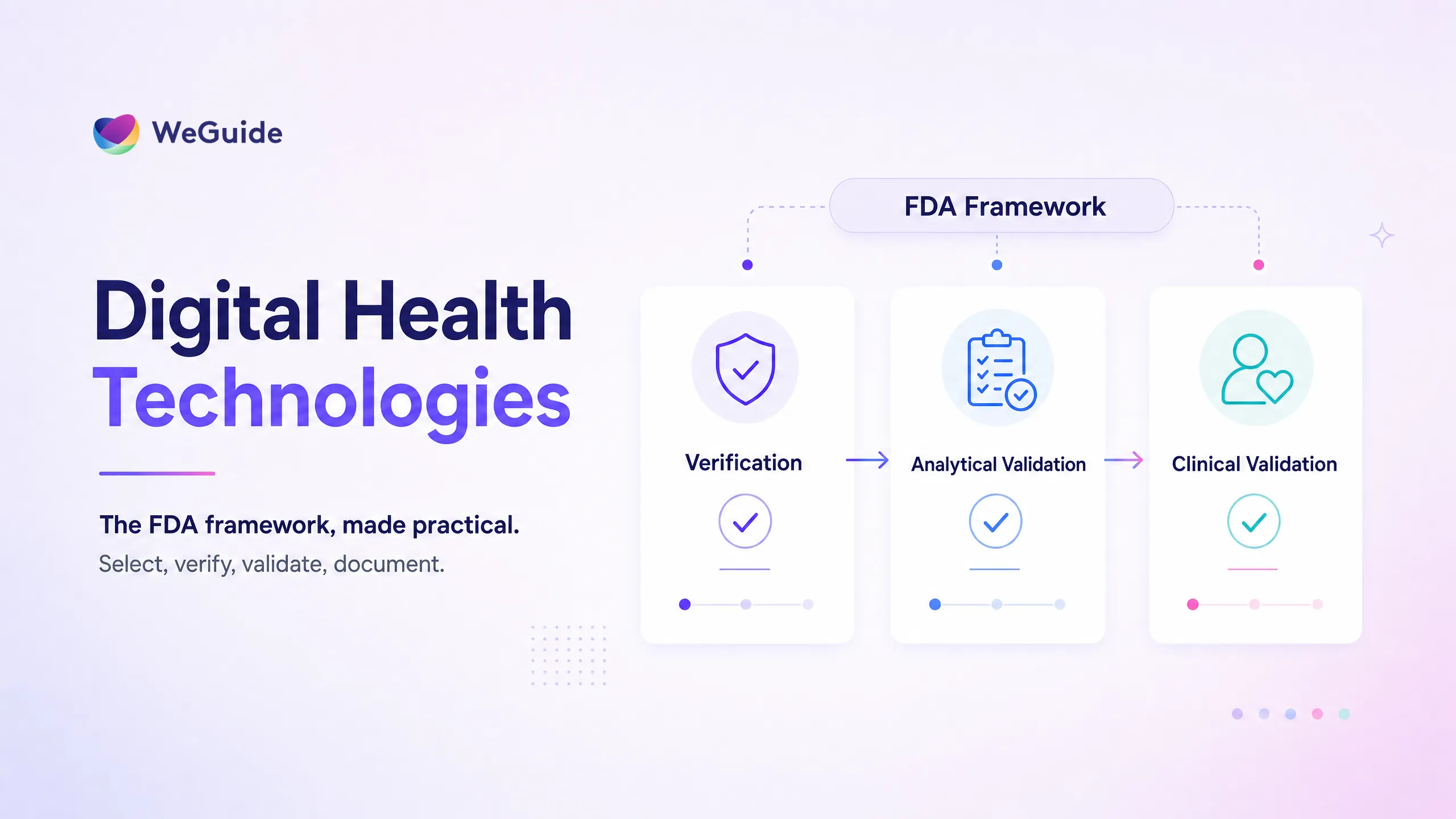


Digital health technologies (DHTs) are systems that use computing platforms, connectivity, software, or sensors to capture health data, and in clinical trials they are the wearables, mobile apps, connected medical devices, and software that collect data from participants remotely. The FDA uses this definition in its December 2023 guidance on DHTs for remote data acquisition, which is the framework sponsors work to when a study relies on these tools.
For sponsors, CROs, and study teams, the questions are practical. What counts as a DHT? How do you pick one a regulator will accept? What does it take to turn a sensor reading into trial data you can defend? This guide answers those questions in order. You will get a clear definition, the FDA framework for DHTs in clinical trials, how to choose a device that is fit for purpose, the V3 validation work behind a trusted measure, the sponsor responsibilities that protect data integrity, and how DHTs relate to digital biomarkers and digital endpoints.
Key Takeaways
- DHTs are the tools, not the measures. A digital health technology is the wearable, app, connected device, or software that captures health data remotely. The measure it produces is a separate question.
- The FDA has a clear framework. The 2023 guidance on DHTs for remote data acquisition tells sponsors how to select, describe, verify, and validate a DHT for a clinical trial.
- Fit for purpose comes first. A DHT has to suit the trial population, the use environment, and the specific measure before any validation work is worth starting.
- V3 is how a measure earns trust. The Digital Medicine Society's verification, analytical validation, and clinical validation framework decides whether sensor data can support an endpoint.
- Sponsors own data integrity. Selecting the device, documenting the chain, and protecting the records stay the sponsor's responsibility under the FDA framework.
What Are Digital Health Technologies (DHTs)?
A digital health technology is any system that uses a computing platform, connectivity, software, or sensors to capture health data, used here for clinical research rather than routine care. That definition is broad on purpose. It covers a consumer smartwatch tracking heart rate, a mobile app collecting a daily symptom diary, a connected spirometer measuring lung function at home, and the software that turns a raw sensor signal into a usable number.
What ties these together in a trial is remote data acquisition. The participant generates data in daily life, and it reaches the study without a clinician taking the reading at a site. Our overview of wearable device studies shows how WeGuide brings these tools into one participant facing app, and the broader wearables in clinical trials guide covers the device side in depth.
It helps to group DHTs by what they are, because each type plays a different role.
| DHT type | Examples | Use in clinical trials |
|---|---|---|
| Wearable sensors | Smartwatches, ECG patches, actigraphy units, continuous glucose monitors | Continuous heart rate, activity, sleep, and glucose between visits |
| Mobile apps | ePRO diaries, symptom trackers, cognitive tests | Patient reported outcomes, adherence, remote assessments |
| Connected medical devices | Home spirometers, blood pressure cuffs, smart scales, inhaler sensors | Home based readings of blood pressure, weight, and lung function |
| Software | Algorithms and apps that process signals into measures | Deriving digital biomarkers from raw sensor streams |
A single study often mixes several of these, which is why the FDA treats the DHT as the whole system, the hardware, the software, and the data pathway, rather than just the gadget on the wrist.
The FDA Framework for Digital Health Technologies in Clinical Trials
In December 2023 the FDA finalised its guidance on digital health technologies for remote data acquisition in clinical investigations. It is the reference point for any trial that collects data through a DHT, and it moves the field from case by case judgement to a shared set of expectations.
The guidance does not approve specific devices. Instead it describes what a sponsor should do across the life of a study. In short, the FDA expects a sponsor to select a DHT that fits the trial and the participants, describe the technology and its role in the protocol, verify and validate it for the measure it will produce, manage the risks that come with remote capture, and keep records that show how the data was collected and handled.
The agency also runs a wider programme on digital health technologies for drug development, which gives the broader policy context around the guidance. The practical message for study teams is steady. DHTs are accepted in regulated trials when the sponsor does the homework and documents it. The sections below break that homework into the parts you act on: choosing the device, validating the measure, and protecting the data.
Cleared, granted, or general wellness: what the label actually tells a sponsor
The most common mistake in DHT selection is reading a regulatory status as a fitness for purpose statement. They are different things, and the same manufacturer can occupy several positions at once.
The consumer smartwatch market in 2026 makes the point. Samsung's sleep apnea feature was granted through a De Novo, and its ECG and irregular rhythm notifications are cleared, yet its blood pressure feature reached United States users in March 2026 as a general wellness feature with no clearance at all, and the company itself claims none for it. Apple holds separate per feature clearances, including hypertension notifications, and its atrial fibrillation history feature is one of only 21 tools qualified under the FDA Medical Device Development Tool programme. The Polar H10 chest strap, the reference device most consumer accuracy claims are validated against, holds no United States clearance whatsoever and carries CE marking as radio equipment rather than as a medical device.
Three practical rules follow. A clearance covers a named function on named hardware, not the device as a whole. A cleared function used outside its cleared indication is, for your protocol, unvalidated. And general wellness is a regulatory category rather than a quality judgement: plenty of general wellness signals are perfectly defensible as exploratory endpoints, provided nobody writes them into the protocol as though they had been cleared.
Fit for Purpose: Selecting a Digital Health Technology
Before any validation work, a DHT has to be fit for purpose. The FDA frames this as a match between the technology and three things: the trial population, the way the device will be used, and the specific measure the study needs. Get the match wrong and no amount of later validation rescues the data.
Match the population
Start with the people. A device that suits healthy adults in a usability study may fail older participants, children, or people with limited dexterity or low digital access. Screen size, battery life, charging, and how easy the device is to wear all affect whether participants keep using it. A DHT that participants abandon produces gaps, and gaps undermine the measure.
Match the use environment
A reading taken in a clinic under supervision is not the same as one taken at home, in the rain, or during sleep. Fit for purpose means the device performs in the real setting where participants will use it, not only on the bench. This is also where bring your own device versus provisioned hardware comes in, because the model you choose shapes how consistent the data will be.
Match the measure
Finally, the device has to capture the specific concept the trial cares about, at the frequency and accuracy the endpoint demands. A consumer wearable may be fine for an exploratory activity measure and unsuitable for a primary cardiac endpoint. Deciding the measure first, then the device, is the order experienced teams follow.
Capture DHT data that holds up to review
WeGuide brings wearables, connected devices, eConsent, and ePRO into one branded participant app, so data lands clean and traceable alongside your CTMS and EDC.
Verifying and Validating a DHT (V3)
Once a DHT is chosen, the sponsor has to show the measure it produces is trustworthy. The accepted method is the V3 framework from the Digital Medicine Society, which the FDA guidance points to. V3 stands for verification, analytical validation, and clinical validation, and it breaks the work into three plain questions.
| V3 stage | Question it answers | Example |
|---|---|---|
| Verification | Does the sensor capture the raw signal accurately? | Bench testing an accelerometer against a known reference |
| Analytical validation | Does the algorithm turn that signal into an accurate measure? | Confirming a step count algorithm matches observed steps |
| Clinical validation | Does the measure reflect something meaningful in this population? | Showing a gait speed measure tracks mobility in the target group |
The three stages run in order, and each depends on the one before. A sensor that fails verification cannot support a valid measure no matter how good the algorithm is. A measure that passes verification and analytical validation but lacks clinical validation may be accurate yet meaningless for the trial. Completing all three is what lets a sponsor prespecify the measure and defend it to a regulator.
This is also the work that connects a DHT to an endpoint. The validation evidence is what promotes a raw data stream into a measure a trial can rely on, which we return to in the section on biomarkers and endpoints below.
Sponsor Responsibilities and Data Integrity
The FDA framework keeps responsibility with the sponsor. Even when a vendor supplies the technology, the sponsor owns the decisions and the data. Three areas carry most of the weight.
First, documentation. The protocol should describe the DHT, what it measures, how participants use it, and how the data flows from device to database. Clear description up front is what lets a reviewer follow the chain later.
Second, data integrity. Electronic records from a DHT are expected to meet the same standards as any trial data, which means attributable, legible, contemporaneous, original, and accurate, the ALCOA principles, along with the controls in 21 CFR Part 11 for electronic records and signatures. Data should be traceable to the participant and the device, with an audit trail that shows any changes.
Third, risk management. Remote capture brings risks that site based capture does not, including cybersecurity, participant privacy, device failure, and missing data when a device is not worn or not charged. The sponsor plans for these, with technical support for participants, a plan for gaps, and safeguards for personal data.
This is where the participant experience does practical work. When a single app handles reminders, syncing, and support, wear time stays high and gaps stay small, which is the main driver of clean data. WeGuide is TGA Class I certified medical device software and supports GCP aligned data capture, though endpoint validation and regulatory strategy remain the sponsor's responsibility. On the BRACE trial with the Murdoch Children's Research Institute, a custom WeGuide app supported more than 6,000 participants across five countries with over 90% adherence in a six week deployment, which shows clean remote data at scale is achievable when the experience is built around the participant.
How DHTs, Digital Biomarkers, and Endpoints Relate
These three terms get used interchangeably, but they sit at different points in the same chain. A DHT is the tool. A digital biomarker is the measure derived from the data the tool collects. A digital endpoint is the predefined trial outcome based on that measure.
Take a wrist worn sensor. The sensor and its software are the DHT. The gait speed it calculates is a digital biomarker. When that gait speed is prespecified in the protocol as the outcome used to judge whether a treatment works, it becomes a digital endpoint. The DHT is the umbrella the other two sit under, which is why selecting and validating it correctly matters so much.
This article is the regulatory anchor for the wider set. For the measure side, see our guide to digital biomarkers in clinical trials. For the outcome side, see digital endpoints in clinical trials. DHTs are also a building block of remote and hybrid designs, which we cover in our guide to decentralized clinical trials.
Frequently Asked Questions
What are digital health technologies (DHTs)?
Digital health technologies are systems that use computing platforms, connectivity, software, or sensors to capture health data. In clinical trials they include wearables, mobile apps, connected medical devices, and the software that turns sensor signals into measures. The FDA uses this definition in its 2023 guidance on remote data acquisition.
What is the FDA DHT framework?
The FDA DHT framework is the set of expectations in the agency's December 2023 guidance on digital health technologies for remote data acquisition. It tells sponsors how to select a fit for purpose DHT, describe it in the protocol, verify and validate the measure, manage risk, and protect data integrity.
What are some digital health technology examples?
Common digital health technology examples in trials include smartwatches and ECG patches, actigraphy units and continuous glucose monitors, home spirometers and blood pressure cuffs, ePRO and symptom tracking apps, and the algorithms that process raw signals into measures like step count, gait speed, or sleep duration.
What does fit for purpose mean for a DHT?
Fit for purpose means a DHT suits the trial population, the environment where it will be used, and the specific measure the study needs. A device may fit one trial and not another. Confirming the match before validation avoids collecting data that cannot support the endpoint.
What is V3 validation for digital health technologies?
V3 is the Digital Medicine Society framework for validating a DHT measure through three stages: verification, where the sensor captures the signal accurately, analytical validation, where the algorithm produces an accurate measure, and clinical validation, where the measure is meaningful in the target population. The FDA guidance points to this approach.
Does the FDA accept data from digital health technologies?
Yes, within the framework. The FDA accepts DHT data when the sponsor selects a device that fits the population, validates the measure, manages risk, and documents how data was captured and handled. The 2023 guidance sets out exactly what that involves, so sponsors can plan and defend their approach.
Is FDA cleared the same as FDA approved?
No, and for a sponsor a third question matters more than either term. Cleared means the FDA agreed a device is substantially equivalent to one already on the market, usually through a 510(k). Approved is a higher bar applied mainly to high risk devices through premarket approval. Most wearables used in trials are neither, because they are general wellness products. The question that actually decides your protocol is narrower: does the specific function you intend to use have evidence in a population like yours, generated on the hardware generation you will actually deploy? A cleared device used outside its cleared indication carries no more weight in your submission than an unregulated one.
Conclusion
Digital health technologies in clinical trials are no longer a grey area. The FDA framework gives sponsors a clear path: define the DHT, choose one that is fit for purpose, validate the measure with V3, and protect data integrity from device to database. Follow that order and a wearable, app, or connected device can produce data a regulator will accept.
The chain is what matters, not the gadget. A DHT is the tool, a digital biomarker is the measure, and a digital endpoint is the outcome, and each step depends on the work before it. WeGuide is the participant facing layer that brings DHTs, eConsent, ePRO, and reminders into one branded app, supporting your decentralised or hybrid design alongside your existing CTMS and EDC so the data lands clean and traceable.
Build your DHT data capture on solid ground
Walk through how WeGuide captures clean, traceable digital health technology data across your trial, from device choice to validated endpoints.
Book a demoNo pressure, just a conversation.

