

.svg)
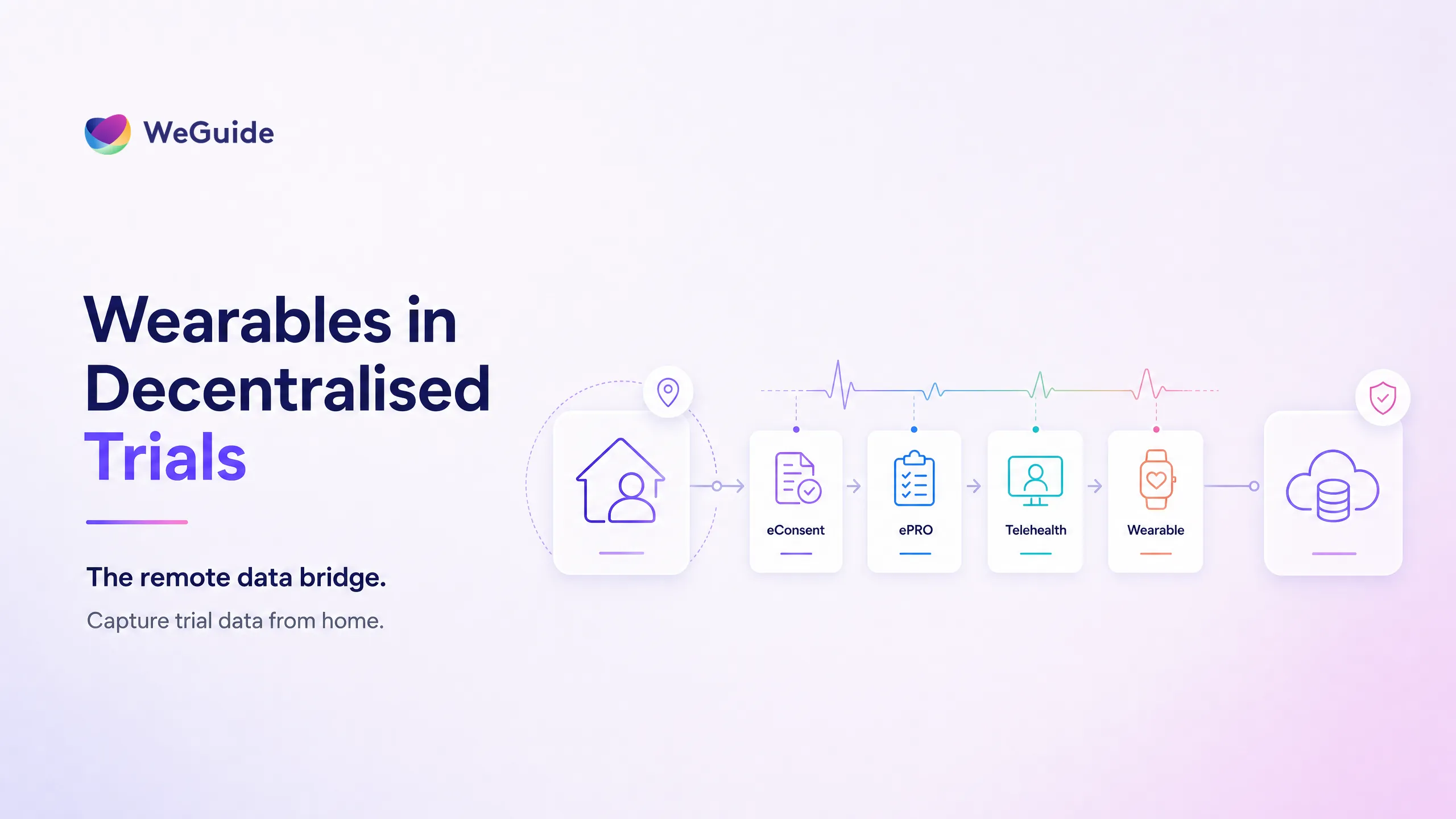


Wearables in decentralized clinical trials are body worn sensors that capture health data remotely, so a study can record heart rate, activity, sleep, and other measures while participants stay at home instead of travelling to a site. They are the remote data bridge that lets a decentralised or hybrid design keep measuring between visits, or in place of them, without a clinician taking each reading.
This guide stays on the wearable and remote data lens, rather than the case for decentralisation itself. You will get a plain answer on how wearables make remote trials work, what site procedures they can and cannot replace, where they sit alongside the rest of the remote stack, how their role shifts between hybrid and fully decentralised designs, and the data and logistics rules that decide whether the data holds up. For the wider device picture, our pillar on wearables in clinical trials covers device types, validation, and BYOD. The WeGuide decentralised clinical trial platform brings wearables together with eConsent, ePRO, and telehealth in one participant app.
Key Takeaways
- Wearables are the remote data bridge. They carry continuous physiological and behavioural data from the participant's home to the study, which is what makes a decentralised design possible.
- They replace some site measurements, not all. Wearables cover vitals, activity, sleep, and continuous signals well, while procedures like infusions or imaging still need a clinic.
- They are one layer in the DCT stack. Wearable capture works alongside eConsent, ePRO, and telehealth, not on its own, and the value comes from the combination.
- The role shifts by model. In hybrid trials wearables supplement site visits, in fully decentralised trials they often carry the primary remote signal.
- Data quality and logistics decide the outcome. Wear time, connectivity, device provisioning, and data integrity matter more than the device brand.
How Wearables Enable Decentralised Clinical Trials
Wearables enable decentralised trials by moving measurement out of the clinic and into daily life, so data keeps flowing when the participant is at home, at work, or asleep. A decentralised design needs a way to collect trial grade data without a site visit, and a body worn sensor is the most direct answer for physiological and behavioural measures. The participant wears the device, data syncs through a phone app, and the study sees it remotely.
This is the part people mean by remote patient monitoring in clinical trials: a continuous or scheduled stream of objective data, captured passively, that stands in for measurements a nurse would otherwise take in person. Instead of a single blood pressure reading at a visit every few weeks, a study can follow a trend across weeks. Instead of asking a participant to recall their sleep, an actigraphy sensor records it night after night.
Two properties make wearables the data bridge for remote designs. The first is passive capture, which means the participant does little beyond wearing and charging the device, so the data arrives even on days they would never visit a site. The second is continuity, which fills the long gaps between visits that traditional designs leave empty. Wearables also help keep participants connected to a remote study, though retention is its own subject that we cover in decentralised trials and patient retention.
What Wearables Replace in a Remote Design
Wearables replace the routine, repeatable measurements that used to need a clinic chair, while leaving the procedures that genuinely need a site in place. The honest framing is substitution where it is safe, not removal of the site altogether. Mapping each trial element to its remote equivalent makes the boundary clear.
| Trial element | Traditional site method | Remote wearable or capture method |
|---|---|---|
| Resting and ambulatory vitals | Nurse takes heart rate and blood pressure at a visit | Smartwatch or connected cuff records heart rate and blood pressure across the day |
| Physical activity and mobility | Periodic in clinic assessment or recall | Accelerometer tracks steps, activity, and gait continuously |
| Sleep | Sleep diary or lab study | Actigraphy or wrist sensor records sleep duration and patterns at home |
| Continuous biochemical signals | Spot blood draw at a visit | Continuous glucose monitor streams glucose between visits |
| Cardiac rhythm screening | Clinic ECG | Patch or smartwatch single lead ECG captured at home |
| Symptom and outcome reporting | Paper diary handed in at a visit | ePRO entries paired with wearable context, captured on the participant's phone |
Read the table as a guide to scope, not a promise that every measure moves home. A study where the primary endpoint is a clinic imaging result or an infusion cannot decentralise that step, so wearables supplement rather than replace it. Where the measure is a heart rate reading, an activity pattern, or a continuous signal, wearable data in decentralised trials can carry it well, provided the device is fit for the measure and the data is captured cleanly.
Wearables in the DCT Tech Stack
Wearables are one layer of the decentralised clinical trial (DCT) tech stack, not the whole of it, and their value shows when they sit alongside the other remote elements rather than alone. A participant in a remote trial consents through eConsent, reports symptoms through ePRO, speaks to the team over telehealth, and wears a sensor that feeds the continuous data. Each layer covers a different job, and together they replace most of what a site visit used to do.
Here is how the pieces fit. eConsent handles enrolment and ongoing consent without a site trip. Electronic patient reported outcomes (ePRO) and eCOA capture what the participant reports and how clinicians rate it, which gives context to the sensor numbers. Telehealth covers the clinical conversation and visual checks that still need a human. Wearables carry the passive, objective signal underneath all of it. The sensor data is more useful when a symptom report or a televisit sits next to it, because a spike in heart rate means more when you know what the participant was doing.
This is why remote data capture in decentralised trials is a platform question, not a device question. Connecting one wearable is straightforward. Connecting many device types into a single, clean dataset, alongside consent, reporting, and visit records, is the harder part, and it is the job WeGuide does as the participant facing layer beside your CTMS and EDC.
Bring the remote stack into one app
WeGuide connects wearables with eConsent, ePRO, and telehealth in a single branded app, so remote data lands clean and ready to analyse alongside your existing systems.
Hybrid vs Fully Decentralised: Where Wearables Fit
The wearable's role changes with the model. In a hybrid trial, wearables supplement periodic site visits with continuous data between them. In a fully decentralised trial, wearables often carry the primary remote signal, because there are few or no visits to lean on. Same device, different weight on the data.
Hybrid trial wearables tend to play a supporting part. The site still runs the procedures that need a clinic, and the sensor fills the gaps in between with activity, sleep, or vitals that would otherwise go unmeasured. This lowers the risk of going remote, since a clinic visit can confirm or correct a remote signal, which suits complex or interventional protocols.
In a fully decentralised design, the wearable moves to the centre. With visits kept to a minimum, the continuous sensor stream may be the main objective measure the study has, so device choice, validation, and data completeness carry more weight. The table below sets out the contrast.
| Aspect | Hybrid trial | Fully decentralised trial |
|---|---|---|
| Wearable role | Supplements site visits between touchpoints | Carries the primary remote signal |
| Data dependence | Site data backs up the sensor | Sensor data stands largely on its own |
| Best fit | Complex or interventional protocols | Observational or simple interventional designs |
| Main risk to manage | Aligning remote and site data | Wear time and data completeness |
Neither model is better in the abstract. The choice follows the protocol, and many teams start hybrid, then move steps remote as they come to trust the wearable data.
Data and Logistics Considerations
Remote wearable data holds up when it is captured and handled well, and falls apart when wear time, connectivity, or logistics are left to chance. The device matters less than the operational chain around it. A few considerations decide whether the data is usable.
Wear time and missing data come first. A sensor only helps if the participant keeps it on and charged, so reminders, simple syncing, and a clear wear schedule do real work in a remote design where no site staff are there to prompt. Connectivity is the next gap. Data has to move from device to phone to study, and patchy coverage or a flat battery breaks the chain, so the capture app needs to buffer and resend rather than lose readings.
Logistics shape the rest. A decentralised trial has to get devices to participants and, where needed, back again, which means shipping, setup support, and a plan for replacements. Bring your own device (BYOD) can remove some of that for consumer measures, and our guide to consumer wearables in clinical research weighs that choice against provisioned hardware. Data integrity runs through all of it, since remote capture still has to meet the same audit and source data standards as a site, which the FDA addresses in its guidance on digital health technologies for remote data acquisition in clinical investigations. For practical method work on building and validating remote measures, the Digital Medicine Society publishes open frameworks that many teams follow.
This is provable at scale. The BRACE trial, run on a custom WeGuide app with the Murdoch Children's Research Institute, supported more than 6,000 participants across five countries with over 90% adherence in a six week deployment, using mobile and wearable capture rather than routine clinic visits. WeGuide is TGA Class I certified medical device software and supports GCP aligned data capture, though sponsors remain responsible for endpoint validation and regulatory strategy.
Frequently Asked Questions
How do wearables work in decentralised clinical trials?
A participant wears a sensor that records data such as heart rate, activity, or sleep, then a phone app syncs it to the study. This lets a decentralised trial collect objective measurements continuously from home, without a clinician taking each reading at a site visit.
What is remote patient monitoring in clinical trials?
Remote patient monitoring in clinical trials means collecting health data from participants outside a clinic, usually through wearables, connected devices, and apps. It gives study teams a continuous view of vitals, activity, and other measures between or instead of site visits, which is central to how decentralised designs operate.
Can wearables replace site visits in a clinical trial?
For some measures, yes. Wearables can replace routine vitals, activity, sleep, and continuous signal checks that once needed a clinic. They cannot replace procedures like infusions, imaging, or physical exams, so most trials keep those on site and move the measurable, repeatable data to wearables.
How is wearable data captured and transmitted in a remote trial?
The sensor records data and pairs with a phone app over Bluetooth, then the app sends readings to the study platform. Good systems buffer data when connectivity drops and resend later, so a flat battery or weak signal delays the data rather than losing it, keeping the remote record complete.
What is the difference between hybrid and fully decentralised trials for wearables?
In hybrid trials, wearables supplement periodic site visits with continuous data between them. In fully decentralised trials, wearables often carry the primary remote signal because there are few or no visits. The fully remote model puts more weight on device choice, validation, and data completeness.
Are wearables required for a decentralised clinical trial?
No. A decentralised trial can run on eConsent, ePRO, and telehealth alone. Wearables are added when the protocol needs objective physiological or behavioural data, such as heart rate, activity, or sleep. They are common in remote designs but optional, depending on the measures the study needs.
Conclusion
Wearables in decentralised clinical trials are the remote data bridge that carries objective measurement from the participant's home to the study, which is what lets a remote or hybrid design work at all. They replace the routine, repeatable measures that once needed a clinic, sit alongside eConsent, ePRO, and telehealth as one layer of the remote stack, and shift from a supporting role in hybrid trials to the primary signal in fully decentralised ones.
The decisions follow a clear order. Decide which measures can move home, choose devices that fit those measures, then build the wear time, connectivity, and logistics that keep the data clean. Get that right and wearable data can carry a remote trial without sacrificing the quality regulators expect. WeGuide is the participant facing layer that brings wearables, eConsent, ePRO, and telehealth into one branded app, supporting your decentralised or hybrid design beside your existing CTMS and EDC.
Build your remote data bridge
Walk through how WeGuide captures clean wearable and remote data across your decentralised or hybrid trial, from device choice to a single dataset.
Book a demoNo pressure, just a conversation.

