

.svg)
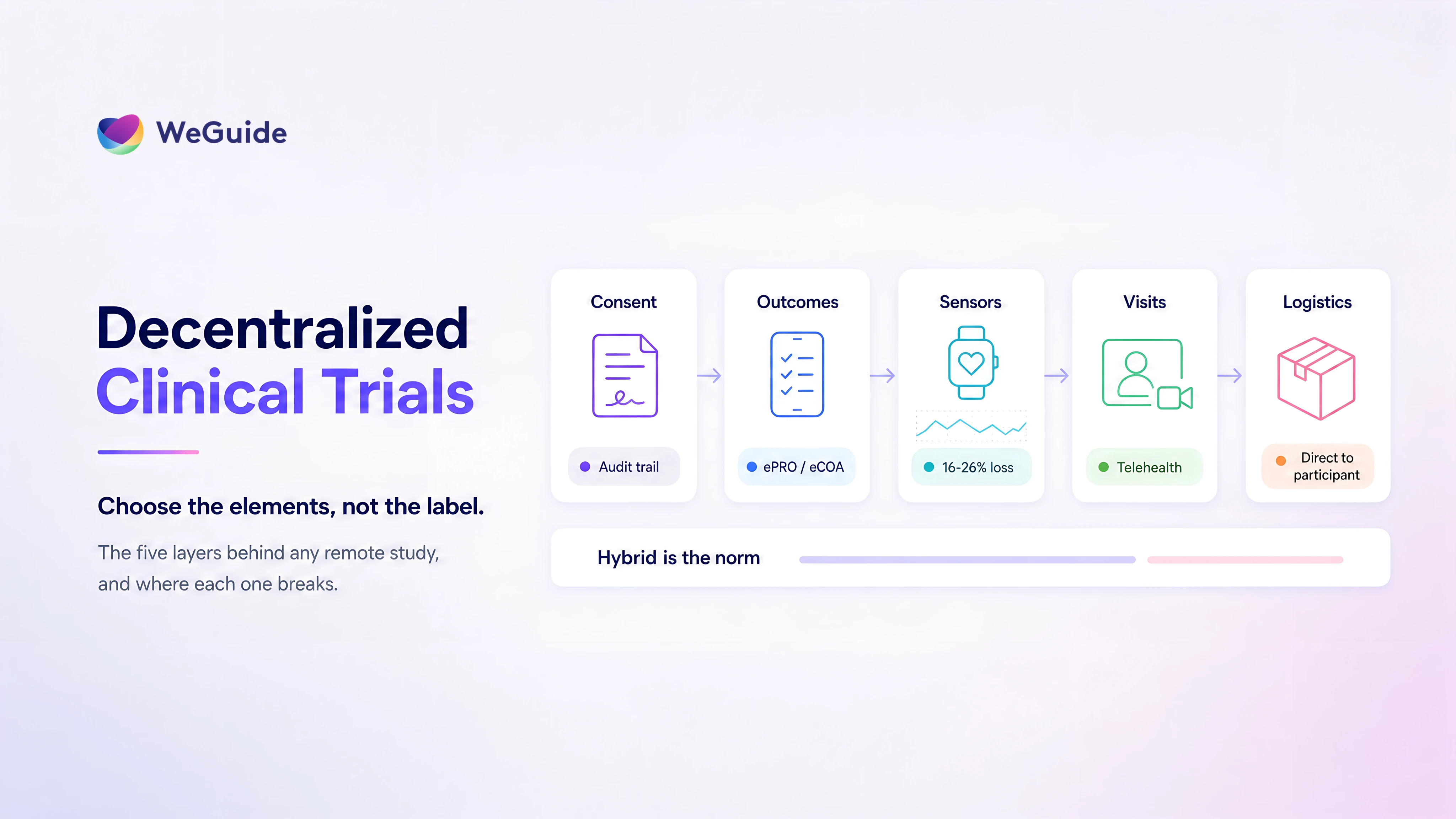


Decentralized clinical trials, often shortened to DCTs, are studies in which some or all activity happens where the participant is, rather than at an investigator site. Visits become remote or local, consent is signed digitally, outcomes arrive from a phone or a wearable, and the investigational product may be shipped to the home. Nothing about the scientific standard changes. What changes is where the work happens and who carries the burden of travel.
The useful version of this topic is not the definition. It is the decision. Very few studies are fully decentralized in practice, and the regulator has reframed the topic to match. The FDA's draft guidance in May 2023 was titled Decentralized Clinical Trials for Drugs, Biological Products, and Devices. The final version, published in September 2024, is titled Conducting Clinical Trials With Decentralized Elements, and it now defines a decentralized clinical trial as one that includes decentralized elements. That change of noun is the whole point. You are not choosing between a decentralized trial and a traditional one. You are choosing which elements to decentralize, and living with the consequences of each. This guide walks through the elements one at a time, the infrastructure behind each one, what the FDA expects of a sponsor, and the trade offs that show up during conduct rather than in the proposal.
Key Takeaways
- Decentralization is not a trial type, it is a set of elements. The FDA retitled its guidance from Decentralized Clinical Trials in draft to Conducting Clinical Trials With Decentralized Elements in the September 2024 final, and now defines a DCT as a trial that includes decentralized elements. Choose element by element, and justify each one against your endpoint.
- The stack is consent, outcomes, sensors, visits, and logistics. eConsent, ePRO and eCOA, wearable and device data, telehealth visits, and direct to participant shipping. Most studies decentralize two or three of these, not all five.
- The benefits are reach, retention and frequency. A quarterly clinic visit gives you four data points a year. A weekly ePRO gives you 52, and a wearable gives you a continuous record.
- The trade offs are completeness, equity and cost. A meaningful share of wearable data arrives unusable, device ownership becomes a hidden eligibility criterion, and the savings tend to arrive as time rather than as budget.
- Decentralizing does not lower the evidentiary bar. A remotely collected endpoint still has to be fit for purpose. A device cleared for your exact measure carries some of that burden for you. One that is not leaves the verification and validation work with the sponsor.
What Are Decentralized Clinical Trials?
A decentralized clinical trial is a clinical study that uses remote and local activity in place of some or all traditional site visits. Participants may consent on a tablet at home, complete symptom diaries on their phone, wear a sensor that streams data continuously, meet the investigator by video, and have study medication delivered to their door.
The term covers a spectrum rather than a single design:
- A fully decentralized trial runs with no required visit to a traditional investigator site.
- A hybrid trial keeps some in person visits, usually for procedures that genuinely need a clinic, and moves the rest remote. This is the shape most decentralized studies take in practice.
- A site based trial with decentralized elements is a conventional study that adds one or two remote components, most often eConsent or electronic diaries.
The distinction matters less than people expect, because regulators assess the elements, not the label. A study that calls itself decentralized still has to show that each remote element produces data fit for its purpose.
| Traditional site based trial | Decentralized clinical trial | |
|---|---|---|
| Where activity happens | Investigator site | Participant's home or a local provider |
| Consent | Paper, signed on site | eConsent, signed remotely |
| Outcome data | Collected at scheduled visits | ePRO on a phone, sensors, continuous |
| Visits | In person | Telehealth, home nursing, or local labs |
| Investigational product | Dispensed at site | Direct to participant shipping |
| Geographic reach | The site catchment | Anywhere the study is approved |
| Main risk | Recruitment and retention | Data completeness and device access |
Decentralized designs existed before 2020 but stayed niche. The COVID-19 pandemic forced the issue. Sites closed, visits could not happen, and regulators issued emergency guidance so studies could continue remotely. What began as an exception became a set of tools that stayed in use afterwards. Our COVID era decentralized trial case study shows what that looked like in practice.
Decentralized, Hybrid, or Traditional: Which Elements Fit Your Study
There is no single decentralized clinical trial model to adopt. Rather than asking whether your trial should be decentralized, work through the elements one at a time and ask what each one buys you and what it costs.
| Element | Decentralize when | Keep at site when |
|---|---|---|
| Informed consent | Recruitment is geographically spread, or the population travels with difficulty | The consent conversation is complex, or the population needs in person support to understand risk |
| Patient reported outcomes | The instrument is validated for electronic self completion and the schedule is frequent | The instrument has no validated electronic version, or completion needs supervision |
| Vital signs | An exploratory or secondary endpoint, and a suitable device exists with evidence in your population | The measure is a primary endpoint and no remote method has been validated for it |
| Clinical assessments | The assessment is observational and can be done reliably by video | The assessment requires physical examination, imaging, or a procedure |
| Investigational product | The product is stable, simple to store, and low risk to administer | The product needs controlled administration, monitoring, or cold chain the participant cannot manage |
| Safety monitoring | Adverse events can be captured reliably through remote reporting plus scheduled contact | The safety profile requires immediate clinical assessment |
Decentralizing works best where the activity is frequent, low risk, and already digital in nature. It works worst where clinical judgement or physical contact is the point of the visit.
The DCT Stack: What Actually Runs a Decentralized Clinical Trial
Behind any decentralized element sits a piece of infrastructure. In practice there are five layers, and a study team should be able to name the owner of each one before the protocol is final.
| Layer | What it has to do | Where it usually breaks |
|---|---|---|
| Consent | Version control, comprehension checks, re-signature on amendment, an inspectable audit trail | A participant signing at home has less chance to ask a follow up question |
| Outcomes | Deliver validated instruments on a screen without changing their measurement properties | The paper instrument was never validated for electronic self completion |
| Sensors | Capture the physiological signal at the resolution the endpoint requires | The vendor API returns summaries, not the raw signal the analysis needs |
| Visits | Replace the visits that do not need hands, and staff the ones that do | Telehealth licensure and local provider oversight differ by jurisdiction |
| Logistics | Ship product and devices out, and get the devices back | Reverse logistics is planned last and costs more than expected |
Consent. Remote enrolment starts with eConsent in clinical trials, which has to handle version control, comprehension checks, a way to consent participants again when the protocol changes, and an audit trail that stands up to inspection. Running that at a distance is what an electronic informed consent platform is built for. Consent is also where the ethical questions concentrate.
Outcomes. Electronic patient reported outcomes (ePRO) and electronic clinical outcome assessments (eCOA) carry most of the endpoint weight in decentralized designs. The instrument matters more than the app. A paper instrument does not automatically retain its measurement properties when it moves to a screen, which is exactly what eCOA validation exists to demonstrate. Choosing between the two formats starts with the difference between eCOA and ePRO, and it is a scientific decision, not an IT one.
Sensors. Wearables and connected devices supply the continuous layer, and this is where most of the recent change has happened. The choice is rarely about the brand. It's about whether the specific function you need has been validated on the hardware generation you'll actually ship, and whether the vendor's API returns the resolution your endpoint needs. Our guide to wearables in clinical trials sets out how to make that call, the side by side view is in consumer wearables in clinical research, and we work through it device by device for the Apple Watch, which stacks per-feature clearances, WHOOP, which exposes raw signal through its API, and the Oura Ring, which has the deepest published validation record of any consumer wearable. The specific role sensors play in remote designs is covered in wearables in decentralized clinical trials.
Visits.Telehealth replaces the visits that do not need hands, and local providers or visiting nurses cover the ones that do.
Logistics. Direct to participant shipping moves product and devices, and reverse logistics brings devices back. This layer is unglamorous and it is where decentralized studies most often run into friction.
WeGuide sits on the participant facing side of that stack. We're the layer the participant actually touches, covering consent, outcomes and form building, education, reminders and wearable device data capture in one branded app. We don't do the other two layers. We're not a telehealth provider and not a logistics vendor, and we're not a CRO, a CTMS or an EDC either. A decentralized trial still needs all of those, and we're built to run alongside them through our integration engine. If you're shortlisting a decentralized clinical trial platform, that page sets out which layers we cover and which we do not.
Run the participant facing layer of your DCT in one place
WeGuide brings eConsent, ePRO, patient education, reminders and wearable data capture into a single branded participant app, alongside the systems you already run.
Benefits of Decentralized Clinical Trials
The case for decentralizing is strongest in three places, and it is worth being specific about which benefit you are actually buying.
Reach. Removing the requirement to travel to a site widens the eligible population from people who live near a research centre to people who live anywhere the study is approved to run. For rare disease and for conditions concentrated outside major cities, this is often the difference between a feasible study and an infeasible one. In the BRACE trial, run with the Murdoch Children's Research Institute, WeGuide's app carried consent and daily symptom reporting for more than 6,000 participants across five countries. Vaccination and blood collection stayed in person, which makes BRACE a hybrid rather than a reach story, and the reach benefit is clearest where the remaining visits can be run locally.
Retention. Burden and dropout are linked, and travel is one of the largest sources of burden. Scale is achievable when the participant facing layer is built for it. Generation Victoria, a longitudinal birth cohort study running on WeGuide's participant facing layer, has enrolled more than 120,000 people, close to 50,000 children and their parents and guardians. That number does not follow from decentralizing on its own. It depends on what the participant is asked to do each week, which we work through in how decentralized trials improve engagement and retention.
Measurement frequency. A quarterly clinic visit produces four data points a year. A wearable produces a continuous record, and a weekly ePRO produces 52. Frequency changes what questions the study can answer, not just how comfortable it is to participate.
The Trade Offs of Decentralized Trials Nobody Puts in the Brochure
Every one of the benefits above has a cost attached, and a protocol that has not budgeted for these will discover them during conduct.
Missing data rises, and it is technical more often than behavioural. When measurement moves to a device in someone's home, sync failures, flat batteries and unworn devices all become sources of loss, and on top of that a share of the data that does arrive is not usable. Across four independent Samsung Galaxy Watch studies, including Samsung's own De Novo submission where 205 of 1,229 nights were rejected, between 16% and 26% of nights or tracings were classed as insufficient or inconclusive. The failure is usually not that the participant refused. It's that the data never arrived, or arrived unusable. Our guide to wearable data quality and validation sets out how to plan for this.
Device ownership becomes a hidden eligibility criterion. A bring your own device design quietly excludes anyone without a suitable smartphone, and that group is not random. It skews older, lower income, and more rural, which is often exactly the population the treatment needs to reach. The FDA makes the same point in its guidance, recommending that sponsor provided technology be offered as an option so that participants who cannot afford a device are not excluded for that reason. Provisioning devices solves the access problem and creates a logistics problem. The full comparison is in BYOD versus provisioned devices.
Site workload shifts rather than disappears. Remote monitoring, chasing missing data, troubleshooting devices and running video visits all take coordinator time. Decentralizing removes the waiting room, not the work.
Participant burden can go up, not down. Removing travel is a real win and it is often spent immediately. A daily diary, a device to charge, a sync to check and a video call to join can add up to more contact with the study than four clinic visits a year did. Decentralizing redistributes burden across the week rather than removing it, and that gets decided in the schedule of assessments, not in the app.
Regulatory complexity increases. Telehealth licensure, local provider oversight, cross border data transfer and drug shipping rules all vary by jurisdiction, and a multi country decentralized design multiplies rather than adds these questions.
Not every measure survives the move. This is the important one. Collecting a signal remotely does not make it an acceptable endpoint. Clearance is a shortcut, not a gate. The FDA treats an existing marketing authorisation as supporting evidence only where your context of use falls inside the cleared indication, and where it does not, the burden of verification and validation falls back on you. Our guide to the FDA framework for digital health technologies covers what a sponsor has to demonstrate before a remote measure carries endpoint weight.
The Regulatory Picture: What the FDA Expects From Decentralized Trials
The FDA finalised its guidance on conducting clinical trials with decentralized elements in September 2024, replacing the May 2023 draft. The guidance does not endorse or authorise particular platforms or vendors. It describes what sponsors are expected to do:
- Justify the decentralized elements chosen.
- Describe them in the protocol.
- Maintain oversight of remote activity and local providers.
- Keep the data traceable.
For the technology itself it points to the FDA's companion guidance on digital health technologies for remote data acquisition, finalised in December 2023, which sets the fit for purpose standard a digital health technology has to meet.
Two points are worth carrying into protocol design. First, the sponsor retains responsibility for trial conduct regardless of where the activity physically happens. The guidance is explicit that regulatory requirements are the same whether or not a trial includes decentralized elements. Second, the choice of any technology used to capture data has to be justified against the specific measure it supports, which means device selection is a scientific argument and not a procurement decision.
Europe has gone the same way. The European Commission, the Heads of Medicines Agencies and the EMA published a recommendation paper on decentralised elements in clinical trials in December 2022, covering remote consent, home visits, direct to participant shipping and the use of electronic systems. Australia has no single equivalent document, so telehealth, shipping and local provider questions sit with the HREC and the sponsor's regulatory adviser, and should be settled before the protocol locks.
How to Run a Decentralized Clinical Trial: A Practical Sequence
- Define the endpoints first, then decide what can be decentralized. Working the other way round is how studies end up with a remote measure that cannot support the claim.
- Map each element to an owner and a system. Consent, outcomes, sensors, visits and logistics each need a named platform and a named responsible party.
- Choose devices against the measure, not the brand. Check whether validation evidence exists in a population like yours, on the hardware generation you will actually deploy.
- Design the consent for the way it will be signed. Remote consent needs comprehension checks and a route to a real conversation.
- Budget for incompleteness. Set a data completeness target, plan the reminder and repeat measurement workflow, and power the study on realistic rather than ideal capture rates.
- Plan reverse logistics before the first shipment. Getting devices back is harder than sending them out.
- Decide what happens when the technology fails. Every remote element needs a documented fallback.
Common Decentralized Clinical Trial Myths
"Decentralized means fully remote." It rarely does. Hybrid designs are the norm, and the regulator assesses elements rather than labels.
"It is automatically cheaper." Site and monitoring costs typically fall while technology, logistics and data management costs rise, and the net depends on the design. The reliable return is time, faster enrolment and fewer dropouts, rather than a smaller budget line. Model it as a shift in cost, not a reduction, and name the line items you expect to move.
"Remote data is lower quality." Not inherently. Continuous passive measurement can be far richer than a quarterly visit. The risk is not fidelity, it is completeness, and completeness is a design problem with known mitigations.
"Any wearable will do." No. The measure has to be validated for the population and the hardware, and where the device carries no clearance for that measure, the sponsor owns the verification and validation.
Decentralized Clinical Trial FAQs
What does DCT mean in clinical trials?
DCT stands for decentralized clinical trial. A DCT clinical trial moves some or all study activity to where the participant is, rather than requiring visits to an investigator site. In practice DCT trials, DCT clinical trials and decentralized trials all describe the same thing, and most are hybrid rather than fully remote.
What is a decentralized clinical trial?
It is a study in which the activity travels to the participant instead of the participant travelling to the site. Consent may be given digitally, outcomes may be reported from a phone, physiological data may come from a wearable, visits may be conducted by video, and the investigational product may be shipped to the home. The scientific and regulatory standards are unchanged.
What is the difference between a centralized and a decentralized clinical trial?
A centralized or site based trial requires participants to attend an investigator site for study activity. A decentralized trial moves some or all of that activity to the participant through remote and local alternatives. Most studies today sit between the two as hybrid designs, keeping in person visits only where a procedure or clinical assessment genuinely requires them.
What are the benefits of decentralized clinical trials?
The main benefits are wider geographic reach and access for participants who cannot easily travel, lower travel burden which supports retention, and much higher measurement frequency than periodic clinic visits allow. The size of each benefit depends on which elements you decentralize.
Are decentralized clinical trials cheaper?
Not automatically. Site costs and monitoring costs fall, while technology, logistics and data management costs rise. The saving usually shows up in time to enrolment rather than in total budget, and it depends entirely on which elements you decentralize.
What are the challenges of decentralized clinical trials?
Five challenges recur. Data completeness suffers, because remote capture adds technical failure modes a site visit does not have. Equity suffers, because device ownership can become a hidden eligibility criterion. Site workload shifts rather than falls. Rules on telehealth, data transfer and shipping multiply across jurisdictions. And any remotely captured measure still has to be shown fit for its intended purpose.
What is an example of a decentralized clinical trial?
The BRACE trial, led by the Murdoch Children's Research Institute, ran across five countries with a participant app carrying consent and outcome reporting. Generation Victoria, a longitudinal birth cohort study, has enrolled more than 120,000 people the same way. Both moved enrolment and follow up out of the site while keeping clinical procedures where they belonged.
Does the FDA allow decentralized clinical trials?
Yes. The FDA's regulatory requirements are the same whether or not a trial includes decentralized elements, and it published final guidance on conducting clinical trials with decentralized elements in September 2024. The guidance does not endorse or authorise specific platforms. It sets out what sponsors must do to justify, describe, oversee and document the decentralized elements they use.
What technology do decentralized clinical trials need?
At minimum, an eConsent system, an electronic outcomes system for ePRO and eCOA, a route for device and sensor data, a telehealth capability for remote visits, and a logistics arrangement for shipping product and devices. Many studies use a single participant facing application for the layers the participant touches, integrated with the sponsor's existing systems.
What to Take Into Your Next Protocol
Decentralized clinical trials are no longer a special category. They are a set of design choices available to any protocol, and the regulator now frames them exactly that way. The teams who get the most from them are not the ones who decentralize the most. They're the ones who decide element by element, choose devices against the measure rather than the brand, and plan for the data that will not arrive.
Talk through the decentralized elements in your protocol
We'll look at which parts of your study can move to the participant, what that means for consent, outcomes and device data, and where the completeness risks sit.
Book a demoNo pressure, just a conversation.

