


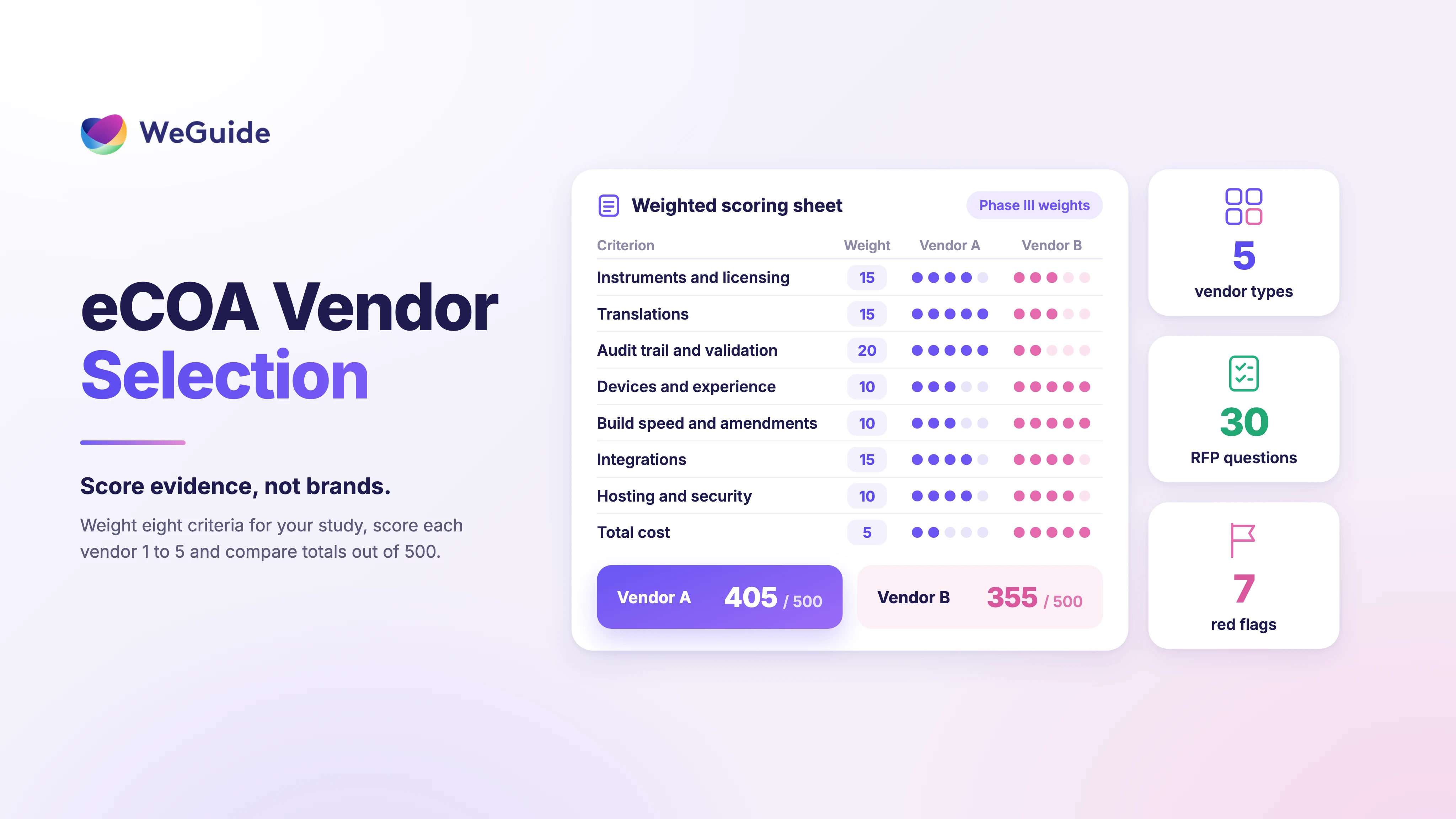


eCOA vendors, also called eCOA companies or eCOA providers, fall into five types: full service specialists, unified eClinical suites, EDC first platforms, configurable participant engagement platforms and academic tools. To compare them (and ePRO vendors), define your study first, then score each vendor on eight weighted criteria, led by instrument licensing and validated translations, audit trail and validation evidence, device model (BYOD or provisioned), how fast they build and amend, and integration with your EDC. The right vendor type for a Phase III trial is rarely the right one for an academic study or a registry.
WeGuide is one of the vendors in this market. This guide stays vendor neutral, lists vendors alphabetically by type, and links each to a side by side comparison.
Key Takeaways
- Start with the protocol, not the demo. Endpoints, COA types, population, countries and devices decide which vendor type fits, before any feature comparison starts.
- Five vendor types, not one market. Full service eCOA specialists, unified eClinical suites, EDC first platforms with ePRO modules, configurable participant engagement platforms and academic tools each fit a different study.
- The sponsor keeps responsibility. ICH E6(R3) principle 10.2 says quality and integrity of trial data stay with the sponsor when work moves to a service provider, so ask for validation evidence and audit access.
- Score, don't shortlist by brand. Weight 8 criteria differently for a Phase III trial, an investigator initiated trial and a registry, and compare totals out of 500.
- Some red flags are written into guidance. EMA says systems from a provider that won't allow documentation access, audits or inspections "should not be used in clinical trials".
Start with the study, not the vendor
Before you contact any eCOA vendor, write down five things: endpoints and COA types, population, countries and languages, device model, and timeline. Every later answer depends on them, and two vendors can quote the same study in completely different ways if they're guessing.
A one page study profile should cover:
- COA types. Which assessments are patient reported (PRO), clinician reported (ClinRO), observer reported (ObsRO) or performance outcomes (PerfO). Rater trained ClinROs and timed PerfO tasks narrow the field fast.
- Named instruments and their owners. Each instrument, its version and its copyright holder. Licensing often takes longer than the build.
- Population. Age, literacy, vision, dexterity, smartphone access, and whether a caregiver answers on the participant's behalf.
- Countries and languages. Every language a licensed instrument runs in needs a validated translation, and many copyright holders also ask for a screenshot review.
- Devices and wearables. BYOD, provisioned or both, plus any wearable data that should sit in the same participant record.
- eConsent. Whether consent runs in the same app as the questionnaires or in a separate system.
- Timeline and amendment risk. First participant date, study length and how likely the protocol is to change.
Instrument choice is a scientific decision, and it's yours. The FDA's final Guidance 3 on selecting, developing or modifying fit for purpose clinical outcome assessments (October 2025) frames that choice around what you're measuring and the context of use in your study. A vendor builds the instrument. It can't make the instrument fit for purpose.
If your team is new to the category, our guide to electronic clinical outcome assessment covers the basics, and eCOA vs ePRO explains where the two terms overlap. Vendors use both labels loosely, so judge them on what they build rather than on what they call it.
The five types of eCOA and ePRO vendors, compared
The type matters more than the brand, because it decides what's in the box and what you'll need to buy elsewhere.
| Vendor type | What you buy | Best fit when | Watch for |
|---|---|---|---|
| Full service eCOA specialists | Software plus scientific, translation, device logistics and helpdesk services | Global Phase II to III trials, complex endpoints, provisioned devices, rater ClinROs | Cost and lead time for small studies |
| Unified eClinical suites | eCOA as one module next to EDC, IRT/RTSM and more, from one vendor | The sponsor has already standardized on that suite | Implementation length; depth of the participant app |
| EDC first platforms with ePRO | ePRO added to an EDC or eCRF product | Data management led studies with simple PRO schedules | Participant experience, reminders, device range |
| Configurable participant engagement platforms | A configurable app for ePRO, eConsent, reminders, education and wearables; the sponsor or a partner supplies scientific services | Academic, mid market, registry and hybrid studies that need a branded app and fast setup | IRT, rater training and in house linguistic validation are often out of scope |
| Academic tools | Institution hosted survey and EDC tools such as REDCap with MyCap | Low budget investigator initiated studies with simple surveys | The institution owns validation, hosting and support; branded apps and wearables are limited |
Here are named examples of the eCOA and ePRO companies in each type. They're listed alphabetically, not ranked, and each name links to a side by side comparison page.
| Vendor type | Named examples (alphabetical, unranked) |
|---|---|
| Full service eCOA specialists | Clario, Kayentis, Signant Health, YPrime |
| Unified eClinical suites | IQVIA, Medidata, Veeva |
| EDC first platforms with ePRO | Medrio, Viedoc |
| Configurable participant engagement platforms | Datacubed Health, Medable, THREAD, WeGuide (this site) |
| Academic tools | REDCap with MyCap (see the academic section below) |
The lines between types blur: several specialists also sell IRT, the suites include participant apps, and some participant platforms connect to the large EDCs. Treat the type as a starting point, not a verdict, and open the vendor links above for a head to head view.
eCOA RFP questions: a 30 point checklist
A good eCOA RFP asks 30 questions across eight areas: instruments, translations, data integrity, devices, participant experience, build and amendments, integrations, and hosting, support and commercials. The table below is the full list, with the evidence to request for each answer. Copy it into your RFP as is, then cut what doesn't apply.
| # | Area | Question | Evidence to request |
|---|---|---|---|
| 1 | Instruments | Which of our instruments are already in your library, and which need a new build? | Library list with instrument versions |
| 2 | Instruments | Who holds and pays for each license, and has the copyright holder approved the electronic version? | License terms; copyright holder screenshot approval |
| 3 | Instruments | How do you keep wording, response options, recall period and one item per screen faithful to the original? | Build standards SOP; sample screens next to the original |
| 4 | Instruments | What evidence do you provide when the electronic layout differs from paper, and have participants tested the app? | Cognitive debriefing or usability testing reports |
| 5 | Translations | Which validated translations exist for our instruments and countries, and who sources new ones? | Translation inventory by language |
| 6 | Translations | Who runs linguistic validation and screenshot review for each language? | Named provider; process document |
| 7 | Translations | Do you support right to left scripts and local date and number formats? | Screens in a right to left language |
| 8 | Data integrity | Can we export the full audit trail with metadata in human readable form? | Sample audit trail export |
| 9 | Data integrity | What system validation documentation can we review? | Validation plan, test evidence, change control, SOPs |
| 10 | Data integrity | Will you support our prequalification audit and regulatory inspections, and how many of your studies have been inspected? | Audit clause; summary of inspection history and findings |
| 11 | Data integrity | How do you support the 21 CFR Part 11 controls we must meet? | Controls mapping: signatures, access, time stamps |
| 12 | Data integrity | Can investigators get a contemporaneous certified copy of their participants' ePRO data, independent of the sponsor? | Data flow diagram; site access description |
| 13 | Devices | Can the same build run on participants' own phones and on provisioned devices? | Supported device list; demo on both |
| 14 | Devices | What are the minimum OS versions and screen sizes, and how do you handle OS updates mid study? | Device policy; OS update procedure |
| 15 | Devices | Who ships, replaces and recovers provisioned devices, and in which countries? | Logistics partner and country list |
| 16 | Devices | Is there an offline mode, and how are late entries time stamped? | Audit trail sample showing device and server times |
| 17 | Participant experience | What reminders and missed entry alerts exist, and can sites see compliance in real time? | Site dashboard demo |
| 18 | Participant experience | What accessibility support exists, including font scaling, screen readers and proxy entry? | Accessibility statement |
| 19 | Participant experience | Can participants complete eConsent, education and ePRO in the same app? | Demo of the full participant flow |
| 20 | Build and amendments | What's your build timeline from final specification to go live, and what drives it? | Timelines from recent comparable studies |
| 21 | Build and amendments | Who writes UAT scripts, and who executes them? | UAT plan template; responsibility matrix |
| 22 | Build and amendments | How are protocol amendments built, retested and versioned without locking the study? | Change control SOP; sample amendment record |
| 23 | Build and amendments | How do you migrate data if we change vendor or decommission the study? | Exit plan; export formats |
| 24 | Integrations | How does data reach our EDC, how often, and who reconciles it? | Integration specification |
| 25 | Integrations | Do you connect to our IRT/RTSM, or does randomization sit elsewhere? | List of live integrations |
| 26 | Integrations | Which wearables and health platforms can feed the same participant record? | Device list, direct versus via a health platform |
| 27 | Hosting and commercials | Where is participant data hosted, and can you meet our data residency rules? | Hosting regions; subprocessor list |
| 28 | Hosting and commercials | Which security certifications do you hold, and what are your encryption, uptime, backup and disaster recovery commitments? | Certificates with scope and expiry; uptime SLA; disaster recovery test summary |
| 29 | Hosting and commercials | What are your support hours and response times for participants, sites and the study team? | Support SLA |
| 30 | Hosting and commercials | What's the pricing model, and what's excluded? | Itemized quote incl. licenses, translations, devices, amendments |
The notes below explain what each group of questions protects you from.
Instruments and licensing (questions 1 to 4)
Licensing is where timelines quietly slip. Most established instruments have a copyright holder who sets the license fee and often has to approve screenshots of the electronic version. ePROVIDE (Mapi Research Trust) is one common place to request licenses and translations.
For layout changes, ISPOR's 2023 good practices report says new comparability testing is unnecessary when enough evidence already exists and faithful migration practices are followed. When the electronic version departs from those practices, you need evidence. Our eCOA validation guide covers what that evidence looks like. If your protocol includes rater ClinROs, add a question on rater training and central rating services.
Translations and multi country studies (questions 5 to 7)
A translated questionnaire isn't a validated one until it has been through forward translation, back translation and cognitive debriefing. That process comes from the ISPOR principles of good practice for translation and cultural adaptation (2005). Ask who runs it and who pays. Our guide to linguistic validation for eCOA walks through each step.
Data integrity, audit trail and validation evidence (questions 8 to 12)
This is the area with the most regulator guidance. The FDA's electronic systems Q&A (October 2024) says copies supplied for inspection "should include metadata and audit trail information". It also says the sponsor may review a service provider's validation documentation. Map the 21 CFR Part 11 controls you need to each answer (our Part 11 guide breaks them down), and check the system against our ALCOA+ checklist for ePRO, eConsent and wearable platforms.
Question 12 comes from EU guidance and is easy to miss. The EMA guideline on computerised systems (2023, section 6.6) says investigators should be able to download a contemporaneous certified copy of their data, including ePRO data. Our guide to eSource and investigator copies explains the data flows that satisfy it, and sponsor oversight under ICH E6(R3) covers what you must document.
Devices and logistics (questions 13 to 16)
Device questions are about logistics as much as software. OS updates arrive mid study whether you plan for them or not, and provisioned devices need shipping, replacement and recovery in every country. Offline entry is fine if the audit trail shows when the participant answered and when the server received it.
Participant experience and engagement (questions 17 to 19)
Completion rates depend on reminders, simple screens and one place to go. Ask to see the participant flow on a phone, not slides. If consent, education and questionnaires live in separate apps, participants juggle logins and sites juggle reconciliation. Running eConsent in the same app removes one handoff.
Build, UAT and mid study amendments (questions 20 to 23)
The vendor validates its system, but you still run user acceptance testing. That's the position of the UAT recommendations from the ePRO and PRO Consortia at the Critical Path Institute (2022). Ask who writes the scripts and how long a typical amendment takes. Plan the exit now: data migration and decommissioning are cheaper to agree before signature than after.
Integrations (questions 24 to 26)
Every integration needs an owner for reconciliation. If ePRO data reaches the EDC nightly by file, someone checks it nightly. For wearables, ask whether each device connects directly or through Apple Health or Health Connect, because that decides which data you get. Our guide to wearable APIs explains the difference, and the FDA's digital health technologies guidance (December 2023) sets expectations for remote data.
Hosting, security, support and commercials (questions 27 to 30)
Data residency can rule a vendor out before scoring starts, so ask early, and ask for certificates with their scope and expiry date, not logos. On price, the exclusions (licenses, translations, devices, amendments) are where budgets usually break.
Build ePRO and eCOA forms your participants will finish
Configure licensed instruments, multilingual forms, reminders and eConsent in one branded app, typically in two to four weeks.
Settle the device model before you send the RFP
The device model changes who can bid and what they'll charge. Three questions settle most cases:
- Do participants have suitable phones? Older, low income or highly specific populations may not, and excluding them by design can bias who takes part.
- Does any task need a fixed screen? Timed PerfO tasks and some ClinROs depend on screen size and touch response, which favors provisioned devices.
- Can you ship devices to every country? Provisioned devices need import, replacement and recovery logistics in each one.
The evidence for BYOD with migrated PROs is reasonable. A 2019 review by Byrom and colleagues found that a decade of studies "overwhelmingly supports" measurement equivalence of screen based PROs. The review extends that to BYOD if a minimum device specification can be ensured and the instrument uses standard response scales. In a COPD crossover study of 64 participants, scores on provisioned devices and participants' own phones were equivalent, with ICCs of 0.863 to 0.908.
A hybrid design, with BYOD as the default and provisioned devices for participants who need them, keeps both options open. Our guide to BYOD vs provisioned devices covers the trade offs in detail.
How to score eCOA vendors: a weighted sheet
Score each vendor 1 to 5 on eight criteria, multiply by the weight for your study type, and compare totals out of 500. The weights below are a starting template. Each column sums to 100, and you should adjust them to your protocol before anyone sees a demo.
| Criterion | Phase III sponsor trial | Academic investigator initiated trial | Registry | Vendor A (1 to 5) | Vendor B (1 to 5) |
|---|---|---|---|---|---|
| Instruments and licensing | 15 | 10 | 10 | ||
| Translations and multi country | 15 | 5 | 10 | ||
| Data integrity, audit trail, validation evidence | 20 | 15 | 10 | ||
| Devices and participant experience | 10 | 20 | 20 | ||
| Build speed and amendments | 10 | 15 | 10 | ||
| Integrations (EDC, IRT, eConsent, wearables) | 15 | 10 | 10 | ||
| Hosting, security and support | 10 | 10 | 10 | ||
| Total cost | 5 | 15 | 20 |
Why the weights differ: a Phase III trial lives or dies on inspection readiness and comparable data across countries, so validation evidence and translations carry 35 of 100 points. An investigator initiated trial has a small team and a fixed grant, so build speed and cost matter more. Registries run for years on low per participant budgets, so participant experience and total cost carry 40 points between them.
Fill the sheet from evidence, not from the sales deck. That means scoring after you've seen the evidence listed in the RFP table above, a scripted demo using one of your own instruments, and two reference calls with teams that ran a similar study. Have at least two people score independently, then discuss the gaps. A 2 point gap on data integrity deserves a follow up question. A 2 point gap on screen colors does not.
Red flags in an eCOA or ePRO proposal
The biggest red flag is a vendor that won't let you see how its system is validated. Regulators have written several of the others down for you.
Refuses documentation access, audits or inspections. EMA's guideline (Annex 1) is blunt: if a service provider won't allow access to important documentation or support prequalification audits or regulatory inspections, "systems from such a service provider should not be used in clinical trials".
Can't export the audit trail with metadata. The FDA Q&A expects inspection copies to include both, and a PDF of answers without the history doesn't.
"Licenses included" with no names. Ask which copyright holder, which instrument version and which license terms. A vague line here usually becomes a change order later.
Translations without a validation step. If there's no named linguistic validation provider and no screenshot review per language, you're buying translation, not validated translation.
No written amendment process. Every protocol change becomes a change order with no published rate, and your timeline depends on their queue.
Vague hosting. No hosting region, no subprocessor list and no answer on data residency. EMA's guideline (Annex 1) says that when a vendor hosts data, the location of data storage and control should be described in the agreement. Question 17 of the FDA Q&A recommends a written agreement that covers roles, scope and sponsor access to data for the whole retention period.
The vendor can delete data without your sign off. In a warning letter to Applied Therapeutics dated November 2024, FDA wrote that "a third-party vendor contracted by Applied Therapeutics deleted electronic data" for critical eCOAs, "including associated audit trails", for all 47 subjects in the study. It happened two days after FDA preannounced a site inspection. The sponsor's planned preventive actions included making sure external vendors "will not have the ability to delete files from any electronic systems".
That last case shows why the contract matters. ICH E6(R3) principle 10.2 says that when activities are transferred to service providers, "the responsibility for the conduct of the trial, including quality and integrity of the trial data, resides with the sponsor or investigator". Section 3.6.7 adds that the sponsor is responsible for assessing the suitability of and selecting the provider. The FDA adopted E6(R3) as final guidance in September 2025.
How long eCOA vendor selection and setup take
There's no reliable industry average for eCOA setup, so be wary of anyone who quotes one without seeing your protocol. What you can do is map the steps and see which ones run in parallel.
| Step | Owner | What drives the timeline |
|---|---|---|
| Specification | Sponsor with vendor | Number of instruments, schedule complexity, protocol stability |
| Instrument licenses and screenshot approval | Sponsor (vendor may coordinate) | Copyright holder response times; number of instruments |
| Translations and linguistic validation | Sponsor or specialist provider | Number of languages; new versus existing translations |
| Build | Vendor | Library versus new builds; integrations |
| Vendor validation and sponsor UAT | Vendor, then sponsor | Script quality; number of defects and retest cycles |
| Site and participant training | Sponsor, vendor support | Number of sites and countries |
| Go live | Joint | Ethics approvals, site activation |
| Amendments | Joint | Change control process; retesting scope |
Licenses and new translations often take longer than the build itself, so start them the day you pick your instruments, before vendor selection ends. The build can run in parallel once the specification is stable.
For one data point, WeGuide typically needs two to four weeks of configuration. Licenses, new translations and ethics approvals sit outside that figure, as they do for every vendor.
Choosing eCOA on an academic or investigator initiated budget
If your study has simple survey schedules and your institution already runs REDCap, start there. REDCap is free to nonprofit organizations that join the REDCap Consortium, and its participant app, MyCap, is available at no cost to research teams at academic, nonprofit and government organizations. The trade off is that REDCap licenses go only to nonprofit organizations that can host it themselves, so each institution hosts, validates and supports its own instance. For a single site study with a few questionnaires, that's often the right answer.
Teams move to a vendor when the study outgrows that setup. The common triggers are a licensed instrument that needs a faithful, approved electronic build, a branded app that participants will keep for years, wearable data in the same record, multilingual cohorts, or eConsent with version control and reconsent tracking. At that point, you're adding vendors around REDCap anyway, and the scoring sheet above (academic column) applies.
You don't have to choose one or the other. WeGuide integrates with REDCap through the REDCap API, so REDCap can stay the database while the participant app sits on top. In the BRACE trial led by Murdoch Children's Research Institute (6,800+ healthcare workers, five countries), participants logged daily symptoms in the WeGuide app, with data flowing into REDCap. For a direct comparison, see our page on REDCap alternatives.
Where WeGuide fits, and where it does not
WeGuide is a patient engagement and data collection platform for clinical research and care, covering screening, eConsent, ePRO and PROMs, wearable data and patient registries, on participants' own phones. In the vendor type table, it sits in the fourth row, with the configurable participant engagement platforms covered in our guide to clinical trial patient engagement software.
Where it fits. Studies that need ePRO and eCOA, eConsent, reminders, education and wearable data in one white label app. WeGuide is BYOD first, and provisioned devices are supported when a protocol needs them. The ePRO and eCOA form builder handles questionnaires, and multilingual research is supported with your own translators or WeGuide's professional medical translation services (INHERIT, a COVID-19 trial, engaged communities in ten languages).
Native Garmin integration collects raw accelerometer and gyroscope data at 25 Hz on supported models. Other devices connect via Apple Health or Health Connect. WeGuide connects to REDCap, Castor and Medidata Rave. Pricing is project based, with all modules in the core license.
On regulation and security, WeGuide is TGA registered Class I medical device software (ARTG 355337), ISO 27001 certified, and supports 21 CFR Part 11, HIPAA and GDPR requirements. A BAA is available on request.
Where it does not. Participant data is hosted in Australian data centers (on premise deployment is available if required), so check your residency rules first. WeGuide doesn't offer IRT/RTSM. It doesn't run linguistic validation of licensed instruments in house. That goes through specialist providers and licensed content. And it isn't a substitute for a full service specialist on rater trained ClinROs, cardiac safety or imaging endpoints.
Ask us, like every vendor, for support hours, response times and our validation documentation, and score the answers the same way.
eCOA and ePRO vendor FAQs
What does an eCOA vendor do?
An eCOA vendor builds, hosts and supports the software that collects clinical outcome assessments electronically, on participants' phones, provisioned devices or site tablets. Depending on the type, it may also license instruments, manage translations, ship devices and run a helpdesk. The sponsor still owns instrument choice, user acceptance testing and oversight of the vendor.
Who are the main eCOA vendors?
The main eCOA vendors fall into five types: full service specialists (Clario, Kayentis, Signant Health, YPrime), unified eClinical suites (IQVIA, Medidata, Veeva), EDC first platforms with ePRO (Medrio, Viedoc), configurable participant engagement platforms (Datacubed Health, Medable, THREAD, WeGuide) and academic tools (REDCap with MyCap). No single vendor is best for every study, and the right type depends on your protocol.
What are the best eCOA vendors and ePRO vendors?
There's no single best eCOA vendor, only the best fit for a protocol. Full service specialists suit global Phase III trials with rater ClinROs. Unified suites suit sponsors already on that suite, EDC first platforms suit simple PRO schedules, and configurable participant engagement platforms suit academic, registry and hybrid studies. Score your shortlist with the weighted sheet above, not a ranked list.
What is the difference between eCOA and ePRO vendors?
Electronic patient reported outcomes vendors, or ePRO vendors, build questionnaires that participants complete themselves. eCOA is the wider category and also includes clinician, observer and performance outcomes. Most eCOA vendors also sell ePRO, but not every ePRO vendor handles rater ClinROs or PerfO tasks.
What questions should an eCOA RFP include?
An eCOA RFP should cover eight areas: instruments and licensing, translations, data integrity, devices, participant experience, build and amendments, integrations, and hosting and commercials. The 30 questions above, each with the evidence to request, are a ready made starting point.
How do sponsors evaluate ePRO vendors?
A sound ePRO vendor evaluation has four steps: an RFP with evidence requests, a scripted demo using one of your own instruments, a review of validation documentation (often in a prequalification audit), and reference calls. Then score each vendor against weighted criteria, with data integrity weighted highest for registration trials.
What ePRO and eCOA vendors do CROs typically recommend?
CROs often keep preferred vendor lists tied to their own systems, contracts and past studies. That's useful experience, but it isn't a neutral ranking. Ask your CRO which eCOA vendors it has run comparable studies with, what went wrong, and who did the UAT. Then score those vendors on the same sheet as everyone else.
How much does eCOA cost?
eCOA pricing follows four common models: per study, per participant, per module, or a license. The number moves with the count of instruments, license fees, languages, devices, integrations and amendments. Ask for an itemized quote that shows exclusions, because licenses, translations and change orders are where budgets break.
Who is responsible for eCOA validation, the sponsor or the vendor?
Both have a role, but the sponsor keeps responsibility under ICH E6(R3) principle 10.2. The vendor validates its system, while the sponsor runs user acceptance testing and can review the provider's validation documentation, as the FDA Q&A describes.
Does an eCOA vendor make your study 21 CFR Part 11 ready?
Not on its own. A vendor can support Part 11 requirements with audit trails, access controls and electronic signatures, but whether your records meet Part 11 depends on how the system is validated, configured and used in your study. Map each control to evidence, as our 21 CFR Part 11 guide explains.
Can you switch eCOA vendors in the middle of a study?
Yes, but it's expensive. You'll need data migration with audit trails, a new build, revalidation, UAT and retraining for sites and participants. EMA's guideline expects agreements to keep data accessible after a change of vendor (Annex 1) and to make decommissioned databases restorable (section 6.12). Write the exit plan into the contract.
How long does it take to set up an eCOA system?
Setup time depends on the number of instruments, license approvals, languages, integrations and UAT cycles, so ask each vendor for timelines from comparable studies. Licenses and new translations often run longest. As one data point, WeGuide typically needs two to four weeks of configuration.
Compare notes on your eCOA shortlist
Book a walkthrough and see how WeGuide handles ePRO, eConsent and wearables in one branded app.
Book a demoNo pressure, just a conversation.

