


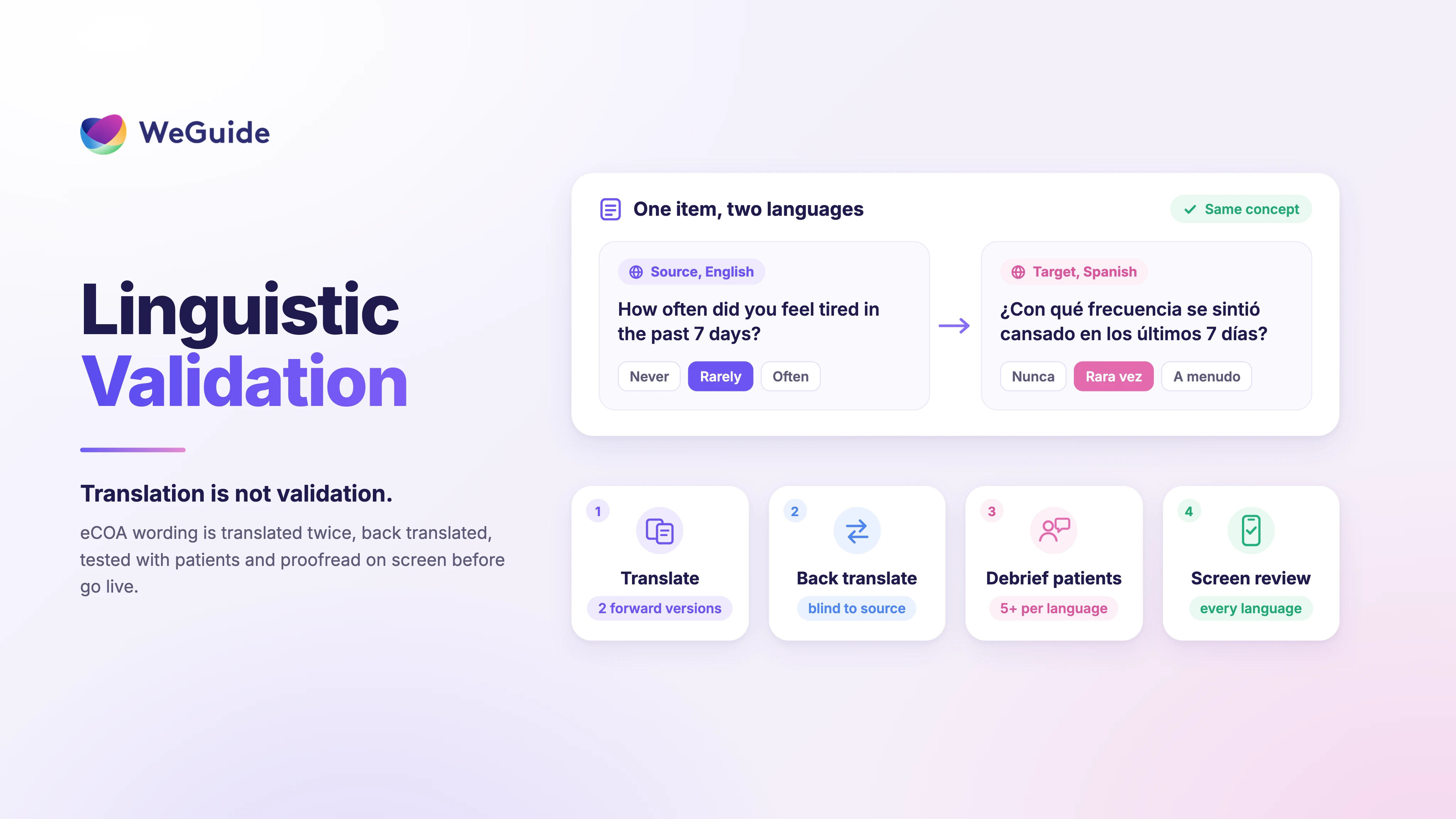


Linguistic validation is the process that confirms a translated clinical outcome assessment (COA) measures the same concept as the original. It also confirms that patients in the target language understand it the same way. It combines independent forward translations, reconciliation, back translation, expert review, and cognitive debriefing interviews, and it leaves a documented evidence trail for regulators.
For eCOA in clinical trials, there's a second job that most translation guides skip: getting the validated wording onto a phone screen without changing it. A translation can pass every linguistic step and still fail when response options wrap badly or an error message was never translated.
This guide explains linguistic validation for clinical trials: the process, who owns each step, cognitive debriefing numbers, screen review, AI, and a go live checklist. It's vendor neutral: WeGuide hosts validated translations, but doesn't produce them.
Key Takeaways
- Translation is not validation: linguistic validation adds a second forward translation, back translation, expert review, and patient interviews, plus a documented evidence trail.
- Five per language and country is the floor: the PRO Consortium sets a minimum of 5 cognitive interview participants per language and country, and experts in the ISOQOL survey published in 2025 reported 5 to 10 as the usual range.
- eCOA adds a screen step: validated text has to be proofread on screen, in every language, before go live. Nine of 10 copyright holders surveyed named response option layout as a common problem.
- Ownership is shared: licensors grant permission, language service providers translate and test, sponsors approve, and eCOA platforms implement.
- AI can assist, not replace: the ISOQOL AI working group paper (2026) recommends AI only under human oversight, and not for conducting cognitive debriefing interviews.
What Is Linguistic Validation?
Linguistic validation (LV) is the documented process of showing that a translated questionnaire means the same thing to patients as the source version. The PRO Consortium defines it as "the process of assessing and confirming the conceptual equivalence and content validity of translations of PRO measures."
The word that matters is conceptual. A literal translation can be grammatically perfect and still change what an item asks. Idioms about mood, words for pain intensity, and frequency words such as "rarely" don't always carry the same weight in another language.
That's why LV puts the translation in front of patients before it collects trial data. It's one of the four types of eCOA validation, and the one that protects data pooled across countries.
| Certified translation | Linguistic validation | eCOA implementation of a translation | |
|---|---|---|---|
| Goal | Accurate text | Conceptual equivalence and patient understanding | Validated text appears on screen unchanged and usable |
| Typical steps | Translate, edit, proofread | Two forward translations, reconcile, back translate, review, harmonize, cognitive debriefing, report | Feasibility review, programming, screenshot proofreading, copyright holder review, UAT |
| Patients involved | No | Yes (cognitive interviews) | Sometimes (interviews on screenshots or device) |
| Used for | Consent forms, letters, site documents | COAs: PRO, ClinRO, ObsRO, PerfO | Every eCOA language version |
| Who usually does it | LSP | LSP, often the licensor's preferred vendor | eCOA provider, with LSP proofreading |
Who Owns What: A Responsibility Matrix for eCOA Translation
Four groups share the work on an eCOA translation: the instrument owner or licensor, the language service provider (LSP), the sponsor or its CRO, and the eCOA platform. In the ISOQOL survey, the top reported cause of longer timelines was approval time from clients and other stakeholders.
The teams are bigger than people expect. In the 2025 ISOQOL good practice paper on eCOA translation, 18 LSP and eCOA provider experts said projects combining migration and translation of the same COA involve a project manager (94%), an eCOA expert (89%), and a linguist (72%).
Start with licensing. Instruments are licensed through their developers or through organizations such as Mapi Research Trust and FACIT. Mapi's ePROVIDE portal gives access to its COA databases.
Before planning new LV, look the instrument up in our instrument directory and ask the licensor which validated translations already exist.
| Task | Instrument owner or licensor | LSP | Sponsor or CRO | eCOA platform |
|---|---|---|---|---|
| Permission to translate, license for electronic use | Approves | None | Leads | None |
| Check for existing validated translations | Supports | Supports | Leads | None |
| Forward translation, reconciliation, back translation | Reviews | Leads | Reviews | None |
| Clinician review (ClinRO, PerfO) | None | Leads | Supports | None |
| Cognitive debriefing | Reviews | Leads | Supports | Supports |
| Harmonization across languages | Reviews | Leads | Reviews | None |
| Supplementary eCOA text (buttons, errors, skip alerts) | None | Supports | Approves | Leads |
| Programming each language into the eCOA | None | None | Reviews | Leads |
| Screenshot proofreading | None | Leads | Reviews | Supports |
| Copyright holder approval of screens (source language, others where licensed) | Approves | Supports | Supports | Supports |
| UAT and go live sign off | None | None | Approves | Supports |
| Archiving certificates, reports, screen versions | None | Leads | Approves | Supports |
This split follows the PRO Consortium process and the ISOQOL survey, but contracts vary. Write it into each statement of work, especially screenshot proofreading, which the PRO Consortium says "needs to be included in the translation company's scope of work."
Pre Go Live Translation Checklist
Run this list before any translated eCOA reaches a participant. The sections below explain each item.
- The license covers every language, every country, and electronic administration.
- Existing validated translations were requested from the licensor first.
- The sponsor and licensor agreed a universal or country specific approach for shared languages.
- The LSP's scope includes screenshot proofreading for every language.
- Navigational and system text (buttons, error messages, skip alerts) was listed early.
- An electronic language feasibility assessment was planned early and covered every target language on draft screens.
- Screenshots were proofread in every language, and approved by the copyright holder where the license requires it.
- Cognitive debriefing is complete (at least 5 participants per language and country), or in country review was agreed for a translation that's only being migrated.
- UAT covered target devices, right to left scripts, and long text languages.
- Certificates, the LV report, and approved screen versions are archived.
When Does an eCOA Instrument Need Linguistic Validation?
A new language version of a COA that supports an endpoint needs linguistic validation. If the licensor already has a validated version for your language and country, the work becomes electronic implementation and screen review instead, which is quicker and cheaper.
The same applies outside drug trials. Medical device manufacturers that send translated PROMs in post market clinical follow up (PMCF) surveys need validated language versions too.
A new language version
Regulators look at how translations were made. The FDA's 2009 PRO guidance asks sponsors to "provide evidence that the content validity and other measurement properties are adequately similar between all versions used in the clinical trial," and says the agency "will review the process used to translate and culturally adapt the instrument."
The FDA's final PFDD Guidance 3 (October 2025) lists "translating from one language to another" as a COA modification and recommends "using best practices for adaptation/translation," citing Eremenco 2018, McKown 2020, and Wild 2005. In Europe, the EMA's reflection paper on HRQL measures (2005) says the strength of HRQL evidence depends partly on "the evidence of validation (and of cultural adaptation/translation if applicable)".
The same language in different countries
A universal translation is one version written to work in every country that shares a language. A country specific approach adapts a "mother" version for each country. The ISPOR task force on multinational trials (Wild 2009) covers both, and how to pool the data.
Either way, testing happens where the language is used. The PRO Consortium's example is German, tested "in both Germany and Austria." Mapi puts it plainly: "All languages must be tested in each country where they will be used." For US trials, Spanish for the US versus Spain is the obvious case, and it's a decision to make with the licensor.
What doesn't need full linguistic validation
Other clinical trial translation work, such as consent forms, letters, and site materials, needs accurate certified translation and ethics approval, not cognitive debriefing. Translated consent still needs version control, which is why multilingual eConsent should record which language and version each participant signed. Navigational text, the PRO Consortium notes, "does not require the rigorous translation and cognitive interviewing process."
ClinRO, ObsRO, and PerfO measures
In the McKown 2020 good practice survey, clinician review was judged necessary by 82% of ClinRO and 90% of PerfO respondents, while most ObsRO respondents did not consider it necessary (only 2 of 9 did). For ObsRO measures, cognitive interviews are run with caregivers or other observers. Our guide to ClinRO, ObsRO, and PerfO covers the definitions.
The Linguistic Validation Process, Step by Step
Most LSPs follow the ISPOR 2005 principles or the PRO Consortium's 12 step process, which builds on them. The PRO Consortium describes the ISPOR report's 10 steps as "frequently referenced as a recognized LV methodology within the pharmaceutical industry and by FDA." Academic teams often cite Beaton 2000 for cross cultural adaptation.
The PRO Consortium's 12 steps, each with the record it leaves behind:
- Preparation: permission, the approach, and an item definition table explaining each item.
- Forward translation: a minimum of 2 independent translations.
- Reconciliation: one merged version, with the rationale recorded.
- Back translation: at least one, by a translator kept blind to the source.
- Revision: the reconciled version revised against the back translation.
- International harmonization: all language versions checked against each other.
- Proofreading: spelling, diacritical, and grammar errors removed by two or more proofreaders.
- Cognitive interviewing: at least 5 participants per language and country who match the target population.
- Post interview review: wording changed where patients misread items.
- Final review and documentation: includes proofreading for each mode, such as screenshots or paper.
- Report: the translation and cognitive interview report.
- Archiving: certificates, change logs with reasons, and team qualifications.
Step 10 is where eCOA enters the formal process. Screenshots are a mode that needs its own final proofread.
Cognitive Debriefing: Who, How Many, and What It Checks
Cognitive debriefing is a structured one to one interview in which patients from the target population complete the translated instrument and explain, item by item, how they understood it. It's the patient facing part of linguistic validation, and the source of most wording changes.
How many participants are enough
The PRO Consortium sets a minimum of 5 participants per language and country. In the ISOQOL survey, experts said "a typical sample size to conduct this research is 5 to 10 participants." Translation providers more often reported 5, and eCOA providers up to 10. Mapi Research Trust describes pilot testing each translation with 5 to 10 patients who have the disease.
Who takes part and what the interview checks
Participants should match the trial population as closely as practical, and 88% of the surveyed experts (15 of 17) said theirs closely match it. For ObsRO measures, you interview the observers, such as parents or caregivers.
The interviewer checks comprehension of each item, the instructions, the recall period, and the response options, and listens for culturally awkward wording. Common techniques are think aloud, where participants say what they're thinking as they answer, and follow up questions about specific items, as the FDA's 2009 PRO guidance describes. Typical follow up questions ask participants to put an item in their own words, explain how they chose an answer, and say what the recall period means to them.
On screen, and not the same as usability testing
For eCOA, the ISOQOL group recommends testing eCOA versions in cognitive interviews "at least as screenshots or on the device itself, if possible." For a translation that's only being migrated, it accepts in country or patient representative reviews instead of new interviews.
Cognitive debriefing tests meaning, while usability testing tests whether people can work the screens. An eCOA study may need both.
Humans conduct the interviews
The ISOQOL working group on AI says use of AI for "conducting cognitive debriefing interviews with patients" is "not recommended." A trained person runs the conversation.
Run one study in every language your participants use
See how WeGuide hosts licensed translations, multilingual consent, and one dataset across languages.
Putting Validated Translations Into eCOA: Screen Review and Go Live
A validated translation can still fail on screen, which is why eCOA and ePRO translation doesn't end with the LV certificate. The fix is a planned screen review step for every language, run by the LSP, with copyright holder approval where the license requires it, before any participant sees it.
Start with an electronic language feasibility assessment
The ISOQOL eCOA translation paper recommends an electronic language feasibility assessment (ELFA) for every target language, discussed early, to find the content and formatting changes each language needs, including navigational text such as back and next buttons. It's done on draft screenshots or on the device, before implementation. The eCOA provider can start it by sending the source language screens to the sponsor for review and to the copyright holder for approval, while the LSP reviews the screens for every other language.
Screenshot proofreading
The PRO Consortium says screenshot proofreading should ideally be done "by the same translation company responsible for the translation of the content to prevent unauthorized changes." The ISOQOL group lists what to watch: titles, navigational prompts, bolding, coloring, and underlining. Plan at least two review rounds. When the developer is involved, experts reported one to three rounds, with an average of two.
What goes wrong on screen
Copyright holders in the ISOQOL survey listed the problems they see after electronic migration. The base is small (9 to 10 developers per question), but the pattern is clear.
| Problem seen by copyright holders | Share reporting it |
|---|---|
| Layout of response options | 90% |
| Unapproved changes to item wording or response options | 78% |
| Presentation of copyright information | 78% |
| Presentation of instructions or recall period | 67% |
| Text formatting | 60% |
| Number of items per screen | 60% |
| Scrolling or zooming to see all response options | 50% |
Platform choice matters here. Eight of 12 developers (67%) said discrepancies came at least partly from limitations of eCOA platforms. Long text languages such as German, and right to left scripts such as Arabic, need their own checks. So do screen size differences on BYOD, where one item can render differently on two phones.
Navigational and system text
Buttons, error messages, skip alerts, and reminders exist only in the electronic version. List them at the start. They need accurate translation, not the full LV process.
Does an eCOA version need a new equivalence study?
Usually not, for small format changes. PFDD Guidance 3 says extra comparability evidence "is unlikely to be necessary if (a) the changes are small to moderate" and sponsors followed migration best practices, citing O'Donohoe 2023 and Mowlem 2024. See our guides on paper to eCOA migration and equivalence and paper vs ePRO.
Versioning and Mid Study Wording Changes: What to Ask Your eCOA Platform
Translations change during a study, so every language version needs a version number, an approval record, and a deployment date you can show an auditor.
Under the ALCOA principles for data integrity, a response should be attributable and original, so you should be able to say which wording a participant saw when they answered. Translated consent versions raise the same question under ICH E6(R3). These are the questions we'd ask any eCOA platform.
| Question to ask | Why it matters |
|---|---|
| Can validated text be imported exactly as supplied, without retyping? | Retyping is where unapproved wording changes start |
| Can each language be previewed and exported as screenshots for review? | Reviewers approve screens, not source files |
| How are changes to one language versioned and approved, with an audit trail? | Auditors ask who changed what, and when |
| Can a corrected translation go live mid study without changing the data structure? | Answers should stay in one dataset |
| Which language and version did each participant see for each response? | Supports attributable, original records |
| Does the system support the audit trail and record requirements of 21 CFR Part 11? | Electronic records in FDA regulated trials |
| How are right to left scripts and long text languages rendered on small screens? | Layout is the most reported failure |
| Can participants switch language, and is that switch recorded? | Language changes can affect how data is read |
For vendor questions beyond translation, use the full eCOA vendor RFP question list.
How Long Linguistic Validation Takes, and What Drives Cost
Timelines depend more on licensing, approvals, and screen review rounds than on translation itself. We found no published benchmark for total LV duration, but there's data on what the electronic step adds.
In the ISOQOL survey, 42% of experts said combined eCOA migration and translation takes longer than translating a paper COA. The extra time ranged "from an additional 2 weeks to 8 to 10 weeks, and even several months."
The top causes of delay were stakeholder approval time (65%), programming of the COA (59%), the vendor (47%), and quality controls (41%).
Cost follows the number of languages and countries, the universal or country specific choice, and how many instruments you translate. Rare languages, rare diseases, and children make interview recruitment harder. Clinician review, extra screenshot rounds, licensing fees, and late changes add to the bill.
WeGuide doesn't publish linguistic validation prices, because LSPs and licensors set them. Ask for a quote per language and country, with screenshot proofreading as its own line item.
Can AI or Machine Translation Be Used for Linguistic Validation?
Only under human oversight, and not for the patient interviews. That's the position of the ISOQOL AI working group (2026), based on a literature review, a survey of 50 stakeholders, and interviews with AI experts.
| LV step | 2026 ISOQOL recommendation |
|---|---|
| Concept definition guide | Highly recommended, under human oversight |
| Dual forward translation | Recommended, one human and one AI or machine translation |
| Reconciliation | Not recommended |
| Back translation | Recommended, under human oversight |
| Clinician review | Not recommended |
| Scheduling cognitive interviews | Highly recommended, under human oversight |
| Conducting cognitive interviews | Not recommended |
| Interview data review and report | Highly recommended, under human oversight |
| Migrating translated text into eCOA files | Highly recommended, under human oversight |
| Proofreading eCOA screen reports | Highly recommended, under human oversight |
The group also says translation certificates "should note if AI was used" for each step. Unsupervised machine translation of a validated COA isn't linguistic validation.
How WeGuide Hosts Validated Translations
WeGuide is the platform, not the translator. Your licensor or LSP supplies the validated wording, and WeGuide delivers it to participants on their own phones.
- Load wording as supplied. Form content exports to Excel and imports back into WeGuide, so a validated translation from an instrument owner or vendor isn't retyped.
- One form, every language. In the Form Builder, one form serves all supported languages, and question display can be customized to meet validated instrument provider requirements. Translations update in bulk through the same Excel export and import.
- Participants choose their language. They pick and can switch language in the app. Letters, education, and forms then appear in that language, including right to left scripts such as Arabic.
- One dataset. Responses from every language land in one study dataset, and reminders reach participants in their language in the app, by SMS, and by email.
- Multilingual consent. Consent forms can go out in several languages at once, with version control, reconsent tracking, and an audit trail.
The INHERIT trial with MCRI engaged culturally and linguistically diverse communities in ten languages, let several family members contribute to one shared family record, and launched within weeks. In the BRACE trial, also led by MCRI (6,800+ healthcare workers, five countries), participants logged daily symptoms in the WeGuide app, with data flowing into REDCap.
WeGuide is TGA registered Class I medical device software (ARTG 355337), is ISO 27001 certified, and supports 21 CFR Part 11, HIPAA, and GDPR requirements. On scope, WeGuide doesn't run forward or back translation, harmonization, or cognitive debriefing. Teams use their own LSP for COAs, or WeGuide's professional medical translation services for forms, messages, and program materials, which is translation, not linguistic validation.
Frequently Asked Questions About eCOA Translation
What is the difference between translation and linguistic validation?
Translation produces accurate text in another language. Linguistic validation proves the translated questionnaire means the same thing to patients as the original, through dual forward translation, back translation, harmonization, and cognitive debriefing, with every decision documented. COAs that support endpoints need it.
How do clinical teams translate patient diaries and eCOA instruments?
They ask the licensor for an existing validated translation first. If none exists, an LSP runs linguistic validation, including cognitive debriefing with at least 5 patients per language and country. The eCOA provider then programs each language, the LSP proofreads the screenshots, and the copyright holder reviews them where its license requires, before UAT.
Who offers linguistic validation for eCOA instruments?
eCOA linguistic validation is done by language service providers that specialize in clinical outcome assessments, often the licensor's preferred vendor. The eCOA provider implements the translation and coordinates screenshot review. eCOA platforms usually don't perform linguistic validation themselves, and WeGuide doesn't: it hosts the validated wording your LSP or licensor supplies.
How many participants are needed for cognitive debriefing?
At least 5 per language and country, under the PRO Consortium process. Experts in the ISOQOL eCOA translation survey said 5 to 10 is the usual range. Participants should match the trial population, and ObsRO measures are tested with caregivers or other observers.
How long does linguistic validation take?
We found no published benchmark for total duration, because licensing, approvals, and review rounds drive the timeline more than translation does. For eCOA, 42% of experts in the ISOQOL survey said combined migration and translation takes longer than paper, adding from 2 weeks to 8 to 10 weeks, and sometimes several months.
Do you need a separate translation for each country that speaks the same language?
Not always. A universal translation can serve several countries, but it should be tested in each country where it's used, such as German in both Germany and Austria. The sponsor decides the approach with the licensor.
Does the FDA require linguistic validation?
The FDA expects evidence that translated versions are comparable, and it "will review the process used to translate and culturally adapt the instrument" (2009 PRO guidance). PFDD Guidance 3 (October 2025) points to the PRO Consortium, McKown 2020, and Wild 2005 as best practice. There's no FDA certificate for a translation.
What is screenshot review in eCOA?
It's the proofreading of every screen in every language after the eCOA provider programs it. The LSP checks titles, buttons, bolding, and layout against the validated translation. The copyright holder approves the source language screens and, where its license requires, the translated ones.
Does a translated questionnaire need a new equivalence study when it moves from paper to eCOA?
Usually not. PFDD Guidance 3 says extra comparability evidence is unlikely to be needed for small to moderate format changes when sponsors follow migration best practices. Larger changes may need more evidence.
Can you use machine translation for patient reported outcome questionnaires?
Only as an assistant under human oversight. The 2026 ISOQOL AI working group supports AI for one of the two forward translations and for back translation, but not for reconciliation, clinician review, or conducting cognitive interviews. Certificates should note where AI was used.
Which eCOA platform supports the most languages?
Language count matters less than three tests: does the platform render your languages correctly on small screens, import validated text exactly as supplied, and support screenshot review? Ask each vendor for screenshots in your study languages. WeGuide confirms each study's languages at planning, including right to left scripts such as Arabic.
Plan your multilingual eCOA study with WeGuide
Tell us your instruments and languages, and we'll show you how validated translations, consent, and reminders run in one study app.
Book a demoNo pressure, just a conversation.

