


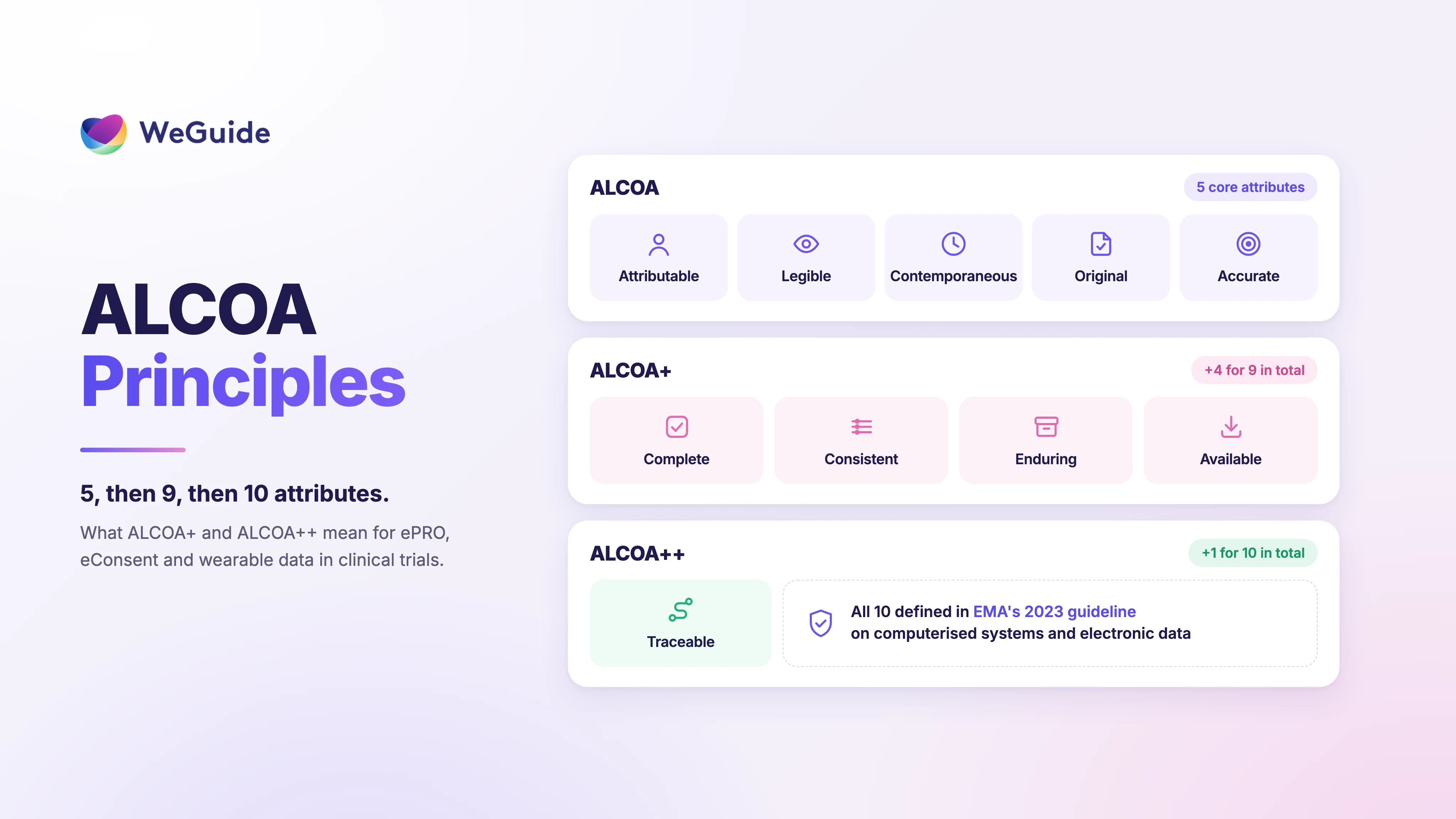


ALCOA is a set of data integrity principles: data must be Attributable, Legible, Contemporaneous, Original and Accurate. ALCOA+ adds Complete, Consistent, Enduring and Available, and ALCOA++ adds Traceable. In clinical research, the ALCOA principles apply to every trial record, including answers a participant types into an ePRO app, a signature given in eConsent and readings a wearable sends from the wrist.
Most ALCOA guides were written for labs, where a trained operator creates the record at a bench. Participant data works differently: the person creating the record is at home, on their own phone, with nobody from the site watching. The European Medicines Agency's 2023 guideline on computerised systems is the clinical trial regulator text that defines all 10 ALCOA++ attributes. It has dedicated sections on ePRO, bring your own device (BYOD) and eConsent, and covers wearables under direct data capture and BYOD.
Key Takeaways
- ALCOA, ALCOA+, ALCOA++. That's 5, then 9, then 10 attributes. EMA's 2023 clinical trial guideline defines all 10, with Traceable as the tenth.
- The participant is the data originator. In ePRO and eConsent the record starts on the participant's own device, so identity, timestamps and audit trails have to work without a site worker present.
- Wearable data comes in two tiers. Raw sensor signals are one thing, and metrics the device maker has already processed are another. Know which one you hold and define it as source before the first participant enrolls.
- Regulators agree on substance, not labels. FDA, EMA, ICH E6(R3), MHRA, PIC/S and WHO use different acronyms, but MHRA says it plainly: "There is no difference in expectations regardless of which acronym is used."
What Are the ALCOA Principles?
The ALCOA principles are the attributes that make a record trustworthy enough to support a regulatory decision. ALCOA stands for Attributable, Legible, Contemporaneous, Original and Accurate. ALCOA plus, written ALCOA+, adds Complete, Consistent, Enduring and Available, for 9 attributes in total. ALCOA++ adds Traceable, for 10.
In plain words, ALCOA means a record shows who made it, can be read, was made at the time, is the first capture (or a certified copy) and is correct. The plus versions add that it's whole, made the same way every time, kept, retrievable and traceable.
FDA's own definition is the clearest one in print. Its Data Integrity and Compliance With Drug CGMP Q&A (December 2018) says data integrity "refers to the completeness, consistency, and accuracy of data," and that such data "should be attributable, legible, contemporaneously recorded, original or a true copy, and accurate (ALCOA)."
The acronym is commonly attributed to Stan W. Woollen of FDA in the 1990s.
Good clinical practice applies the same attributes to trial data. FDA's Electronic Source Data in Clinical Investigations guidance (September 2013) states: "Source data should be attributable, legible, contemporaneous, original, and accurate (ALCOA)."
ALCOA vs ALCOA+ vs ALCOA++
| Version | Attributes | Count | Where you'll see it |
|---|---|---|---|
| ALCOA | Attributable, Legible, Contemporaneous, Original, Accurate | 5 | FDA 2013 eSource and 2018 CGMP guidance, MHRA 2018 |
| ALCOA+ | ALCOA plus Complete, Consistent, Enduring, Available | 9 | PIC/S PI 041-1 (2021), WHO TRS 1033 Annex 4 (2021) |
| ALCOA++ | ALCOA+ plus Traceable | 10 | EMA guideline on computerised systems in clinical trials (2023) |
ALCOA+ and ALCOA++ Principles: The 10 Attributes With Clinical Trial Examples
The table below paraphrases the definitions in the EMA guideline on computerised systems and electronic data in clinical trials (EMA/INS/GCP/112288/2023, section 4.5). It applies each one to the three record types that start outside the site: ePRO answers, eConsent signatures and wearable readings.
| Attribute | Added in | What it means | ePRO | eConsent | Wearable |
|---|---|---|---|---|---|
| Attributable | ALCOA | Linked to the person or system that created or changed it | Entry tied to the participant's own login, caregiver entries flagged | Signature linked to a verified identity in the audit trail | Data tied to device ID and participant ID, with the device as originator |
| Legible | ALCOA | Readable in its original context, with compression and encryption fully reversible | Export shows the question text and version the participant saw | Archive shows the exact approved version and layout | Stored in a form a reviewer can read at inspection |
| Contemporaneous | ALCOA | Captured at the time of observation, with observation and storage times kept as metadata | Entry time recorded at entry, not only at upload | Timestamp on each signature | Timestamp on each reading |
| Original | ALCOA | First capture, or a certified copy | Device copy is source, and the server copy after validated transfer is a certified copy | Approved version archived as an essential document | Raw or processed tier, with the first durable repository as source (FDA) |
| Accurate | ALCOA | At least as accurate as paper, with transfers and coding validated | Edit checks block impossible dates | Right version shown to the right participant | Device verified and validated for the measure |
| Complete | ALCOA+ | Whole record, with metadata and audit trail | Missed and late entries visible | All versions, signatories and withdrawals kept | Wear time and gaps recorded |
| Consistent | ALCOA+ | Same definitions and processes through the data life cycle, including migration | Same instrument version across sites and languages | Reconsent follows the same workflow | Same model and settings, or documented differences |
| Enduring | ALCOA+ | Intact for the full retention period | Moved off the phone early | Kept in the investigator's trial master file | Kept in the durable repository |
| Available | ALCOA+ | Ready for review when needed | Investigator sees data in time to act on safety | Retrievable for monitors and inspectors | Exportable for analysis and inspection |
| Traceable | ALCOA++ | Every change traceable, original not obscured, reason given if needed | Change history per field | Version history and reconsent trail | Firmware and app version stored with the data |
Read it by row when you design a study and by column when you evaluate a vendor. One caution: some industry sites list other ALCOA++ variants, such as Integrity or Transparency. This guide follows EMA 2023 because it's the regulator text written for clinical trials.
Why Participant Generated Data Is the Hardest ALCOA+ Test
On paper and in site eCRFs, a trained site worker is the data originator. In ePRO, eConsent and wearable studies, it's the participant or their device, at home, on a phone the sponsor doesn't own.
The clearest evidence comes from diaries. In a study by Stone and colleagues (Controlled Clinical Trials, 2003), chronic pain patients used either a paper diary instrumented to record when it was opened or an electronic diary that timestamped each entry. Paper users handed in cards for 90% of assigned times, but actual compliance was only 11%.
The electronic diary group's actual compliance was 94%. That's the Contemporaneous attribute failing in plain sight, and the core of our comparison of ePRO vs paper PRO.
EMA makes the same point in its ePRO annex (A5.1.1.4): "One of the advantages of direct data entry by the trial participant is that recall bias is minimised as the data are entered contemporaneously." The flip side is that corrections made much later need a good reason.
Here's what changes when the participant, not the site, creates the record:
- Identity without a site visit: nobody sees who is holding the phone.
- Clocks the sponsor doesn't control: a participant can change the time on their own device.
- Offline capture: entries can sit in local memory before they reach a server.
- Operating system updates: EMA notes that the sponsor "has no control over the implementation of updates to the operating system" on a participant's device (A5.1.3.1).
- Vendor clouds: wearable data can pass through the maker's servers before it reaches the study.
Each is manageable. The trade offs between participant phones and study issued devices are covered in our guide to BYOD vs provisioned devices.
Common ALCOA failures in participant data
- Shared or site held logins, so an entry can't be tied to the participant (Attributable).
- Timestamps taken from the phone clock or at upload instead of entry (Contemporaneous).
- Wear gaps and missed entries dropped from the dataset instead of flagged (Complete).
- An obsolete consent version signed after an amendment (Consistent).
Attributable and Legible: Identity and Readable Records in ePRO and eConsent
Attributable means you can tell who or what created a data point. EMA's definition goes further for important data: it "should also be traceable to the system/device, in which the data were generated/captured."
FDA's Electronic Systems, Electronic Records, and Electronic Signatures in Clinical Investigations Q&A (final, October 2024) sets out three cases in its answer to question 20:
- When a participant enters data into an ePRO app, "the participant should be identified as the data originator."
- When someone else enters it on their behalf, such as a caregiver or site staff member, that person is the originator, and "the reason that the participant is not the data originator should be documented."
- When a device such as an activity tracker sends data automatically "without any human intervention, the DHT should be identified as the data originator."
EMA adds that the participant's password "should only be known to the trial participant," and that when mobile apps are used for data entry, "access controls need to be in place to ensure attributability" (A5.1.1.7). In plain terms: no shared logins, no site staff holding participant passwords, and a flag on any proxy entry.
For eConsent, "it should always be possible to verify the identity of a trial participant with documentation available to the investigator" (A5.3.3), and the electronic signature belongs in the audit trail.
Legible means readable in context
Legible sounds trivial once handwriting is gone. EMA's version is stricter: data should be readable "in its original context," and "compression, encryption and coding should be completely reversible."
For ePRO, the answer travels with the question. A score of 3 means nothing if an inspector can't see the wording, options and linguistically validated language version the participant saw. Whatever tool you use to build ePRO forms, keep the instrument version attached to every response.
Contemporaneous and Original: Timestamps, Offline Capture and Wearable Source Data
Contemporaneous means the data was captured at the time of the observation, and the record proves it. For participant data, that proof is the timestamp.
EMA section 5.5 asks for time "in coordinated universal time (UTC) or time and time zone (set by an external standard)," which users "should not be able to modify." For BYOD apps it's blunter: the app "should use an external source for date and time and should not rely on information from the user's device" (A5.1.3.1). Three more rules complete the picture:
- Entry time, not upload time. The ePRO timestamp "should record the time of the data entry and not only the time of the data submission/transmission" (A5.1.1.1).
- Short, traceable upload delay. For data held in local memory, the time between capture and upload to a central server "should be short and traceable" (section 6.2.1).
- Time zones stated. FDA's 2024 Q&A asks sponsors of trials that span time zones to "indicate the time zone that corresponds to the date and time stamp."
What counts as original for ePRO
For ePRO, "the data saved on the device are considered source data." After a validated transfer, "the original data can be removed from the device as the data on the server are considered certified copies" (A5.1.1.2). Validating that transfer is what makes the server copy count. Our guide to eSource in clinical trials covers how to define source more broadly.
Original for wearables: raw signals versus processed metrics
Not all wearable data is original in the same sense. There are two tiers, and a study should know which one it holds.
| Tier | What you hold | Example | What it means for ALCOA+ |
|---|---|---|---|
| Raw signals | Sensor output before the maker's algorithms | Raw accelerometer and gyroscope data at 25 Hz from supported Garmin models | You can rerun your own processing and document every step |
| Processed metrics | Values the maker has already computed, such as steps or sleep stages | Data read through Apple Health (HealthKit) or Health Connect from devices such as Apple Watch, Fitbit, Oura and Withings | The record is the maker's output, and its algorithm and firmware can change mid study |
Our native Garmin integration delivers readings "with timestamps showing when each reading was recorded," and we compare raw accelerometer data and activity counts separately. Heart rate variability shows the second tier clearly: a nightly RMSSD or SDNN value can't be recomputed once the beat to beat intervals behind it are gone, as our guide to RMSSD, SDNN and pNN50 in wearable research explains.
FDA and EMA frame source differently but land in the same place. FDA's Digital Health Technologies for Remote Data Acquisition guidance (final, December 2023) "considers electronic data that are located in the first durable electronic data repository to which the data are transferred to be the source data." It doesn't plan to inspect individual devices when the data and all associated metadata are securely transferred to that repository, and it generally won't request raw data such as "voltages."
EMA says source data "should be processed as little as possible and as much as necessary" (section 4.4), and for wearables it wants device metadata such as "device version, device identifiers, firmware version" (section 6.1.3). Whichever tier you collect, write the source definition into the protocol before enrollment.
Accurate, Complete and Consistent: Audit Trails, Data Changes and Version Control
These three attributes depend on two controls: version control for what participants see, and an audit trail for every change to what they submit.
Version control in eConsent
For eConsent, Consistent mostly means version control. Only ethics approved versions "should be enabled and used," and "the system should prevent the use of obsolete versions of the information and informed consent document" (A5.3.8). When an amendment changes the information sheet, participants who already signed may need to consent again through the same workflow. Our overview of eConsent in clinical trials covers the wider process.
See how version controlled eConsent works
eConsent with version control, reconsent tracking and an audit trail, with support for legally authorized representatives and multiple signatories.
What the audit trail should show
EMA section 6.2.1 lists it: "the initial entry and the changes (value - previous and current) specifying what was changed (field, data identifiers) by whom (username, role, organisation), when (date/timestamp) and, where applicable, why (reason for change)."
Audit trails should also be visible per data point, exportable in full, and it "should not be possible for 'normal' users to deactivate them." ICH E6(R3) section 2.12.2 adds: "Changes to source records should be traceable, should not obscure the original entry and should be explained if necessary (via an audit trail)." For the US rules, see our guide to 21 CFR Part 11 requirements for electronic records.
Correcting participant data
EMA recognizes that "trial participants typically do not have the possibility to correct the data in the application" (A5.1.1.4). So a sponsor needs a written clarification process: the participant raises the error, the site documents it (phone notes count as site source), and the change is limited, timely and visible in the audit trail.
Accurate data from devices
Accurate starts with simple controls. EMA asks for logical checks that block "time travel," such as dates months in the past or in the future, and for validated transfers between systems so values stay accurate when they move.
For wearables, accuracy depends on whether the device was verified and validated for the measure in your population. The V3 framework by Goldsack and colleagues (npj Digital Medicine, 2020) splits this into verification, analytical validation and clinical validation. Our guide to wearable data quality covers wear time, gaps and device error, which is also where Complete is won or lost.
Enduring and Available: Retention, Export and Inspection Readiness for Remote Data
Enduring means the data stays intact for the whole retention period. Available means someone can get to it when they need it. Remote data adds two risks: it starts on a device that can be lost, and a vendor hosts it rather than the site.
On the first risk, EMA says data in temporary device memory is "at higher risk of physical loss," so it should move "to a durable server at an early stage, by a validated procedure" (A5.1.1.2). Sponsors also need procedures for a drained battery or lost connection, and for merging data "from several devices of a trial participant without losing traceability" when a device is replaced (A5.1.1.6).
On the second, hosting doesn't shift responsibility. "The investigator is overall responsible for the trial participants' data," which should be "made available to the investigator in a timely manner" (A5.1.1.3). An investigator who can't see a worrying symptom score until database lock can't act on it.
FDA's DHT guidance adds that device data and metadata should be retained in a durable repository "in human readable form." For eConsent, EMA treats consent documents as essential documents for the investigator's trial master file, replaceable only by certified copies (A5.3.9). For wearable device studies, ask where the data lives, for how long, and whether you can export one participant or the whole cohort without the vendor's help.
What Regulators Expect: ALCOA in GCP Across FDA, EMA, ICH, MHRA, PIC/S and WHO
No regulator certifies a system as ALCOA compliant. The attributes are expectations on data and the processes around it, and every major agency uses them, under slightly different labels.
| Regulator and document | Year | Term used | What it adds for participant data |
|---|---|---|---|
| FDA, Data Integrity and Compliance With Drug CGMP Q&A | Dec 2018 | ALCOA | Definitions of ALCOA, metadata and audit trail (drug manufacturing) |
| FDA, Electronic Source Data in Clinical Investigations | Sept 2013 | ALCOA | Source data should be ALCOA, with data originators identified |
| FDA, Digital Health Technologies for Remote Data Acquisition | Dec 2023 | None | First durable repository is source, no raw voltages at inspection |
| FDA, Electronic Systems, Records and Signatures in Clinical Investigations Q&A | Oct 2024 | None | Participant, proxy or device as data originator, plus time zones |
| EMA, Guideline on computerised systems and electronic data in clinical trials | Mar 2023 | ALCOA++ | All 10 attributes, annex sections on ePRO, BYOD and eConsent, device metadata rules for wearables (6.1.3) |
| ICH, E6(R3) Good Clinical Practice | Jan 2025 | Attributes listed, no acronym | Source records "attributable, legible, contemporaneous, original, accurate and complete" |
| MHRA, GXP Data Integrity Guidance and Definitions | Mar 2018 | ALCOA, explains ALCOA+ | Same expectations whichever acronym is used |
| PIC/S, PI 041-1 Good Practices for Data Management and Integrity | Jul 2021 | ALCOA+ | ALCOA+ table, footnotes EMA GCP inspection guidance as a source for the "+" |
| WHO, TRS 1033 Annex 4, Guideline on data integrity | 2021 | ALCOA+ | "Data governance should ensure the application of ALCOA+ principles" |
Two details stand out. ICH E6(R3) defines data integrity as data being "attributable, legible, contemporaneous, original, accurate, complete, secure and reliable such that data are fit for purpose," which adds security and reliability to the familiar list. And FDA published E6(R3) as final guidance in September 2025, so ALCOA in GCP now has one shared text in the US, the EU and other regions that implement ICH E6(R3). What E6(R3) changes for remote data collection is covered in our guide to ICH E6(R3) for eConsent and eCOA.
An ALCOA+ Checklist for Evaluating ePRO, eConsent and Wearable Platforms
Use these questions in a vendor evaluation or a study risk assessment. Each maps to a regulator expectation above, and a vendor should be able to show you the answer in the product, not just in a slide.
Attributable and legible
- Is each entry tied to a personal login, and are proxy entries (caregiver, site staff) flagged with a reason?
- How is a participant's identity verified for remote consent?
- Does every exported answer carry the question wording and instrument version?
Contemporaneous and original
- Is the timestamp taken at entry, from an external time source, in UTC or with the time zone?
- Does offline data keep its original capture time after sync, and is the upload delay recorded?
- For each wearable: raw or processed data, and are device, firmware and app version stored with each record?
- Which store is the first durable repository, and is that written down as source?
Accurate, complete, consistent and traceable
- Does the audit trail record previous and new value, who, when and a reason for change, per field?
- Can the full audit trail be exported, and can normal users switch it off?
- How are participant data corrections requested, approved and documented?
- Does eConsent block obsolete versions and trigger reconsent when a version changes?
Enduring and available
- Can the investigator see participant data quickly enough to act on safety signals?
- What are the retention period, export formats and decommissioning plan?
- For BYOD, what are the minimum OS versions, what happens after an OS update, and what's offered to participants without a suitable phone?
For a longer list, see our RFP questions for eCOA and ePRO vendors, and for the data path from wrist to database, our guide to how wearable data reaches a study through APIs.
How WeGuide Supports ALCOA+ for Participant Data
WeGuide is a patient engagement and data collection platform for clinical research and care: screening, eConsent, ePRO/PROMs, wearable data and patient registries, on participants' own phones. These features support the ALCOA+ attributes above:
- eConsent with version control, reconsent tracking and an audit trail, with support for legally authorized representatives and multiple signatories.
- Native Garmin integration, which collects raw accelerometer and gyroscope data at 25 Hz on supported models, with each reading timestamped.
- Apple Health (HealthKit) and Health Connect, through which WeGuide gets processed data from devices such as Apple Watch, Fitbit, Oura and Withings.
- Exports of wearable and form data, for a single participant or the whole cohort, in a ready to analyze format.
- Hosting and security: participant data is hosted in Australian data centers, encrypted, and WeGuide is ISO 27001 certified.
- Regulatory status: Class I medical device software, included in the Australian Register of Therapeutic Goods (ARTG 355337). The platform supports 21 CFR Part 11, HIPAA and GDPR requirements.
WeGuide is BYOD first, and provisioned devices are supported when a protocol needs them. It integrates with REDCap through the REDCap API and also connects to Castor and Medidata Rave. In the BRACE trial led by Murdoch Children's Research Institute (6,800+ healthcare workers, five countries), participants logged daily symptoms in the WeGuide app, with data flowing into REDCap.
ALCOA Principles FAQ
What does ALCOA stand for?
ALCOA stands for Attributable, Legible, Contemporaneous, Original and Accurate. It's the acronym regulators use for the attributes of trustworthy data. FDA's 2018 data integrity guidance defines it as data that is "attributable, legible, contemporaneously recorded, original or a true copy, and accurate."
What is data integrity in clinical trials?
Data integrity in clinical trials means trial data stay complete, consistent and accurate across their whole life cycle, so they can support safety and efficacy decisions. FDA defines data integrity as "the completeness, consistency, and accuracy of data," and ICH E6(R3) describes data that are "attributable, legible, contemporaneous, original, accurate, complete, secure and reliable." The ALCOA principles are how inspectors test it.
What is the difference between ALCOA, ALCOA+ and ALCOA++?
ALCOA has 5 attributes. ALCOA+ adds Complete, Consistent, Enduring and Available, for 9. ALCOA++ adds Traceable, for 10, and is the version EMA uses in its 2023 guideline on computerised systems in clinical trials. MHRA, comparing ALCOA and ALCOA+, notes there's no difference in expectations whichever acronym you use.
What are the 5 principles of data integrity?
The 5 principles of data integrity are usually the original ALCOA attributes: Attributable (you know who created the data), Legible (readable in context), Contemporaneous (recorded when it happened), Original (the first capture or a certified copy) and Accurate (correct and validated).
What does legible mean in ALCOA?
Legible means a record can be read and understood for its whole retention period. EMA adds that data should be readable in its original context, with compression, encryption and coding fully reversible. For ePRO, store each answer with the question wording and language version the participant saw.
What does contemporaneous mean in ALCOA?
Contemporaneous means the data was recorded at the time of the observation, not reconstructed later. EMA adds that the time of the observation and the time of storage should both be kept as metadata. For ePRO, that means a timestamp at entry from an external time source, not only at upload.
What does ALCOA-C stand for?
ALCOA-C is ALCOA with Complete added. Some clinical research organizations and site guidance use it to stress that source records must be whole, which matches ICH E6(R3)'s list for source records.
What is ALCOA+++?
ALCOA+++ is not a regulator term. No regulator defines it, and the most extended regulator version is EMA's ALCOA++, with 10 attributes ending in Traceable. Longer lists come from industry articles, so treat them as commentary, not an inspection standard.
Is ALCOA an FDA requirement?
FDA uses ALCOA in its 2018 CGMP data integrity guidance and its 2013 eSource guidance, and both are nonbinding. The binding part sits in FDA's recordkeeping regulations. The eSource guidance says ALCOA source data "must meet the regulatory requirements for recordkeeping," and inspectors expect ALCOA either way.
How do ALCOA principles apply to wearable data in clinical trials?
Know whether you hold raw sensor signals or metrics the maker has already processed, store device, firmware and app versions with the data, and define source before enrollment. FDA treats the first durable repository the data reaches as source.
ALCOA Principles in Clinical Trials: What It Comes Down To
The ALCOA principles were written for lab benches, but participant data is where they're tested hardest now. When a phone or watch creates the record, ALCOA+ comes down to five design decisions:
- Personal logins for every participant and proxy.
- Timestamps from an external clock, taken at entry.
- A written source definition for every data stream.
- An audit trail that captures what changed and why.
- Version control that blocks obsolete consent forms.
None of this needs new regulation. Use the checklist when you choose a platform, write the answers into your data management plan, and your records will be able to explain themselves at inspection.
Walk through audit trails and consent versioning on your protocol
Book a demo to see eConsent versioning, audit trails and wearable data capture with the WeGuide team.
Book a demoNo pressure, just a conversation.

