


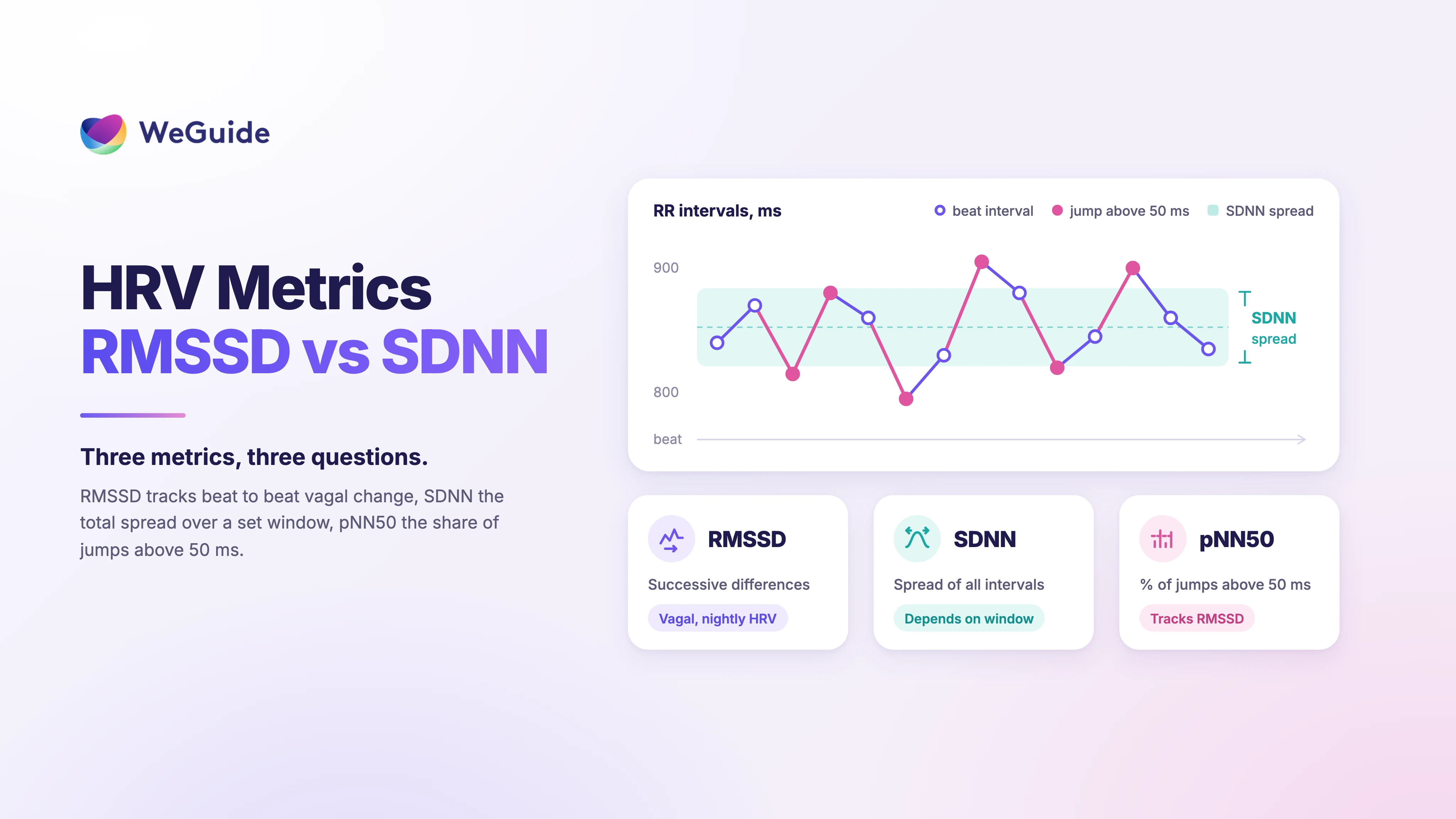


RMSSD, the root mean square of successive differences, is a heart rate variability (HRV) metric: it summarizes how much each normal heartbeat interval differs from the one before, in milliseconds, and mainly reflects vagal (parasympathetic) activity. SDNN is the standard deviation of all normal beat intervals. It captures total variability, so it grows with recording length. pNN50 is the percentage of successive intervals that differ by more than 50 ms.
In a study, three things decide the number you get: the metric, the recording window and the device. That's why HRV from different wearables can't be pooled as is, even when every device calls its output "HRV". This guide covers the formulas, recording rules, reference values, which metric each wearable reports, and how to write an HRV endpoint into a protocol. For the clinical evidence behind the measure, see our profile of heart rate variability as a digital biomarker.
Key Takeaways
- RMSSD is the vagal metric. It's the primary time domain HRV measure in short recordings, and a single 10 s ECG already gives a valid RMSSD in a study of 3,387 adults.
- SDNN depends on the window. A 24 hour SDNN and a 5 minute SDNN are different measurements, and their norms are not interchangeable.
- pNN50 tracks RMSSD. It's a threshold count, and thresholds of 20 ms or less separated healthy and clinical groups better than 50 ms did.
- Devices disagree by design. HealthKit stores SDNN (plus an RMSSD type since iOS 27), Health Connect stores RMSSD, WHOOP and Oura report a nightly RMSSD through their own APIs, and Garmin reports an overnight HRV status.
- Plan HRV per device model. Prespecify the metric, window, artifact handling and device, and don't pool SDNN and RMSSD across devices.
What Is RMSSD? (RMSSD Meaning)
RMSSD stands for root mean square of successive differences. It takes the time between consecutive normal heartbeats, finds how much each interval differs from the one before it, and summarizes those beat to beat changes in milliseconds. It's described as "the primary time-domain measure used to estimate the vagally mediated changes reflected in HRV" in Shaffer and Ginsberg's 2017 review.
A higher RMSSD means larger beat to beat changes, which at rest mostly come from the vagus nerve speeding and slowing the heart with each breath (respiratory sinus arrhythmia). A single value says little on its own. Studies use the trend within one person, measured the same way.
RR interval vs NN interval
An RR interval is the time between two consecutive R waves on an ECG, the tall spike of each heartbeat. An NN interval is an RR interval between two normal beats, after ectopic beats and artifacts have been removed. HRV metrics are defined on NN intervals, and the cleaning matters: one missed or false beat creates a huge successive difference and inflates RMSSD.
RMSSD formula, step by step
The RMSSD formula is:
RMSSD = √( Σ (NNᵢ₊₁ − NNᵢ)² / (N − 1) )
where N is the number of NN intervals, so there are N − 1 successive differences. In plain steps:
- Difference. Subtract each interval from the next one.
- Square. Square each difference, so positive and negative changes both count.
- Mean. Average the squared differences.
- Root. Take the square root, which returns the result to milliseconds.
Here's a worked example with five illustrative NN intervals (made up numbers, not participant data): 800, 850, 780, 820 and 860 ms.
| Step | Values |
|---|---|
| Successive differences | +50, −70, +40, +40 ms |
| Squared differences | 2,500, 4,900, 1,600, 1,600 |
| Mean of squares | 10,600 / 4 = 2,650 |
| RMSSD | √2,650 ≈ 51.5 ms |
Consumer apps don't always show raw milliseconds. Some report the natural log (ln RMSSD) or convert it into a score, so check which one you're getting before you pull data.
Why RMSSD is the default in wearables
RMSSD has three practical advantages. First, it holds up in short windows: in Munoz and colleagues' 2015 study of 3,387 adults, "even a single 10s (standard ECG) recording yields a valid RMSSD measurement", and RMSSD outperformed SDNN at every recording length tested.
Second, it ignores slow trends in heart rate, because it only compares neighboring beats. Third, "The RMSSD is identical to the non-linear metric SD1" of the Poincaré plot (Shaffer 2017). In practice SD1 is RMSSD on a different scale, so reporting both is redundant (Ciccone 2017). WHOOP and Oura report nightly HRV as RMSSD, and Health Connect's HRV record type is RMSSD.
What Is SDNN? (SDNN Meaning)
SDNN is the standard deviation of all NN intervals in a recording, in milliseconds. Instead of comparing each beat with the previous one, it measures how widely all intervals spread around their mean. That makes SDNN a measure of total variability: fast changes from breathing plus slower swings from posture, activity and the day and night cycle.
The "NN" matters here too. SDRR is the same calculation on all RR intervals, including abnormal or false beats (Shaffer 2017). Researchers report SDNN because ectopic beats aren't heart rate variability.
SDNN formula
SDNN = √( Σ (NNᵢ − mean NN)² / (N − 1) )
Using the same five illustrative intervals, the mean is 822 ms. The deviations are −22, +28, −42, −2 and +38 ms, their squares add up to 4,480, and 4,480 / 4 = 1,120. The square root gives an SDNN of about 33.5 ms. Same five beats, two different numbers: 51.5 ms RMSSD and 33.5 ms SDNN.
24 hour SDNN vs 5 minute SDNN
Over 24 hours, SDNN captures circadian and sympathetic contributions and is the classic cardiac risk stratifier. In Kleiger's 1987 study of patients after acute myocardial infarction, low HRV was associated with higher mortality. Shaffer 2017 summarizes the resulting 24 hour thresholds: below 50 ms classed as unhealthy, 50 to 100 ms as compromised, and above 100 ms as healthy, with a 5.3 times lower mortality risk above 100 ms than below 50 ms. Those cutoffs come from post heart attack Holter recordings and don't apply to a 5 minute or nightly wearable reading.
In a 5 minute resting recording, the main source of SDNN variation is parasympathetically mediated respiratory sinus arrhythmia (Shaffer 2017), so short term SDNN behaves more like RMSSD. Two related 24 hour measures complete the picture. SDANN is the standard deviation of the average NN interval across all 5 minute segments of a day. The SDNN index is the mean of the 5 minute standard deviations.
What Is pNN50 (and NN50)?
NN50 is the number of successive NN intervals that differ by more than 50 ms. pNN50 is NN50 divided by the total number of successive differences, multiplied by 100, so it's a percentage. In the five beat example above, only one of four differences (70 ms) exceeds 50 ms. The +50 ms change doesn't count because it isn't greater than 50, so pNN50 is 25%.
The 1996 Task Force divides NN50 by the total number of NN intervals instead, while many analysis tools divide by the number of successive differences (N − 1), as here. Over a 5 minute recording the gap is negligible, but in the five beat example it's 25% vs 20%.
pNN50 is "correlated with the RMSSD and HF power", but "most researchers prefer" RMSSD, partly because it gives a better read on respiratory sinus arrhythmia in older people (Shaffer 2017). Like RMSSD, it also shifts with breathing rate and volume without any change in vagal tone (Shaffer 2017).
The 50 ms cutoff is a convention, not a physiological constant. In Mietus and colleagues' "pNNx files" study of Holter data, thresholds "as low as 20 ms or less" separated healthy people from heart failure patients, sleep from wake, and young from elderly adults better than 50 ms did. Treat pNN50 as a secondary descriptive metric, not a primary endpoint.
RMSSD vs SDNN: Which HRV Metric Should You Use?
Use RMSSD for short or nightly recordings and for questions about vagal activity. Use SDNN for 24 hour recordings and cardiac risk stratification, and only compare SDNN values recorded over identical window lengths. pNN50 adds little once RMSSD is reported. The table summarizes the differences.
| RMSSD | SDNN | pNN50 | |
|---|---|---|---|
| Full name | Root mean square of successive differences | Standard deviation of NN intervals | Percentage of successive NN differences above 50 ms |
| Unit | ms | ms | % |
| Mainly reflects | Vagal (parasympathetic) beat to beat change | Total variability, all cyclic components | Vagal activity, similar to RMSSD |
| Standard recording | 5 min; valid down to 10 s to 60 s | 24 h (risk) or 5 min; never mix lengths | 5 min or 24 h; at least 2 min |
| Ultra short validity | Strong (Munoz 2015) | Weaker; 30 s or several 10 s recordings | About 20 s or more in one small study (Salahuddin, via Shaffer 2017) |
| Typical wearable use | WHOOP, Oura, Health Connect record, HealthKit type from iOS 27 | Apple HealthKit default | Rarely exposed by consumer devices |
| Best for | Nightly trends, vagal tone, short protocols | Holter based risk stratification | Secondary descriptive metric |
You can't convert SDNN to RMSSD with a fixed formula. Within one person and one recording length the two tend to move together, but the ratio between them shifts with breathing, heart rate and window length, because SDNN also picks up the slower oscillations that RMSSD ignores (Shaffer 2017). If a dataset holds SDNN from one device and RMSSD from another, treat them as two different variables.
HRV Metrics by Domain: Time, Frequency and Nonlinear
HRV metrics fall into three families. Time domain metrics summarize the intervals directly. Frequency domain metrics split the variability into oscillations at different speeds. Nonlinear metrics describe the pattern and predictability of the interval series.
The 1996 Task Force of the European Society of Cardiology and the North American Society of Pacing and Electrophysiology set out the definitions most papers still use.
| Domain | Metrics | What they capture | Minimum recording |
|---|---|---|---|
| Time domain | SDNN, RMSSD, NN50, pNN50, SDSD, SDANN, SDNN index, HRV triangular index | Size of beat to beat change (RMSSD, pNN50, SDSD) or total spread (SDNN, SDANN) | 5 min short term standard; 24 h for SDANN and SDNN index |
| Frequency domain | VLF (0.0033 to 0.04 Hz), LF (0.04 to 0.15 Hz), HF (0.15 to 0.40 Hz), LF/HF | HF tracks breathing linked vagal activity; LF mixes baroreflex and other inputs | 5 min standard; minimums of 1 min (HF) and 2 min (LF); VLF is best monitored over 24 h |
| Nonlinear | Poincaré SD1 and SD2, sample entropy, DFA α1 | Short and long term structure and complexity of the interval series | Varies by metric; SD1 is a rescaled RMSSD, so it adds no new information (Ciccone 2017) |
Spectral measures are more fragile than time domain ones: Nunan and colleagues found interindividual variation of up to 260,000% in the literature, "particularly for spectral measures".
Is the LF/HF ratio a measure of sympathovagal balance?
Not reliably. Billman's 2013 analysis is titled plainly: the LF/HF ratio does not accurately measure cardiac sympatho-vagal balance. Shaffer 2017 notes that the ratio "may estimate" the balance only "under controlled conditions", and that in resting conditions the LF band reflects baroreflex activity rather than sympathetic outflow.
Wearables add measurement error on top. In an Oura Ring validation against ECG, the ring's LF and LF:HF values "had high error rates" in both 5 minute and whole night tests. Report LF/HF if your field expects it, but don't build a primary endpoint on it.
Plan HRV collection for your wearable study
See how WeGuide collects Garmin, Apple Health and Health Connect data alongside ePRO and eConsent on participants' own phones.
How Long Should an HRV Recording Be?
Five minutes is the conventional short term standard and 24 hours the long term one (Task Force 1996). For time domain metrics, RMSSD stays valid down to a single 10 s ECG, while SDNN needs 30 s or several 10 s recordings, and 120 s gave near perfect agreement with 4 to 5 minute recordings for both (Munoz 2015). Norms from different lengths "are not interchangeable" (Shaffer 2017).
Ultra short recordings (under 5 minutes) need their own validation. A critical review by Shaffer, Meehan and Zerr looked at 28 ultra short HRV studies and found that 17 didn't investigate criterion validity at all. It calls ultra short measurements "proxies of proxies" and warns that "a single false heartbeat can dramatically alter HRV metrics".
Nocturnal wearable windows are a fourth category with no Task Force equivalent:
- Oura takes "five-minute samples … throughout the night", and the HRV value shown is "the mean of all five-minute samples taken while you sleep" (Oura Help).
- Garmin HRV Status "analyzes your wrist heart rate readings while you are sleeping" and compares a seven day average with a personal baseline that takes three weeks of consistent sleep data to build (Garmin owner's manual).
- WHOOP returns one RMSSD value per recovery cycle (WHOOP Developer).
Sleep stage, time of night and breathing all move a nocturnal value, so a whole night average and a 5 minute morning reading aren't the same measurement, even when both are RMSSD. Our profile of nocturnal heart rate covers the overnight heart rate signal these readings come from.
Published Reference Values for RMSSD and SDNN
The reference values below are population summaries from ECG studies. Use them for context and sample size planning, not as cutoffs for individual participants, and not as benchmarks for nightly wearable values, which come from different sensors and windows.
| Source | Population | Recording | SDNN | RMSSD | LF/HF |
|---|---|---|---|---|---|
| Nunan 2010, values as tabulated in Shaffer 2017 | 44 studies, 21,438 healthy adults | Short term (around 5 min) | 50 (SD 16) ms, range 32 to 93 ms | 42 (SD 15) ms, range 19 to 75 ms | 2.8 (SD 2.6), range 1.1 to 11.6 |
| Kleiger 1987, thresholds via Shaffer 2017 | Survivors of acute myocardial infarction | 24 h Holter | Below 50 ms unhealthy, 50 to 100 ms compromised, above 100 ms healthy | Not given | Not given |
Nunan's short term values were lower than the Task Force norms, and three of the pooled populations had a minimum age of 40, which Shaffer 2017 suggests may explain the lower values. Nunan also flagged "a systematic failure" in the literature to recognize the importance of RR editing procedures.
Age and sex shift values as well. In 24 hour recordings of 260 healthy people aged 10 to 99, RMSSD fell to 47% of its second decade level by the sixth decade, while SDNN declined only gradually, and below age 30 women had lower HRV than men, a gap that disappeared after 50 (Umetani 1998). That spread is why HRV studies analyze change within a person against a prespecified baseline, not against a population norm.
Which Wearable Reports Which HRV Metric?
Apple Watch stores SDNN in HealthKit, with an RMSSD type added in iOS 27. WHOOP and Oura report a nightly RMSSD through their cloud APIs. Garmin reports an overnight HRV status against a personal baseline. Health Connect has a single RMSSD record type, and the Polar H10 chest strap gives raw RR intervals.
The table separates what each device reports from how a study can get it.
| Device | HRV metric reported | When and over what window | Beat to beat data | How a study gets it |
|---|---|---|---|---|
| Apple Watch | SDNN (HealthKit); RMSSD type from iOS 27 and watchOS 27 (HealthKit) | Automatic readings; Recovery HRV on Series 12 and Ultra 4 is "sampled while you're still" (Apple Support); no fixed window published | Heartbeat series samples; Apple doesn't document when the watch writes them, and they aren't a continuous stream | HealthKit on the paired iPhone; no Apple cloud API |
| WHOOP | RMSSD (hrv_rmssd_milli) | One value per recovery cycle (sleep) | Not exposed | WHOOP cloud API; WHOOP writes no HRV to Apple Health or Health Connect |
| Fitbit and Pixel Watch | RMSSD (the legacy Fitbit Web API's dailyRmssd, plus deepRmssd for deep sleep) | Daily value from the sleep period, plus a deep sleep value | Not documented as a data type | Google Health API daily and interval HRV data types; the legacy Fitbit Web API has been turned off |
| Oura Ring | RMSSD (Cao 2022) | Mean of 5 min samples during sleep | Not exposed | Oura API v2 (average_hrv and 5 min hrv samples); no HRV written to Apple Health, but HRV is exported to Health Connect (Oura Help) |
| Garmin | Overnight HRV and HRV Status; formula not named in the manual | During sleep; seven day average vs a three week baseline | Enhanced beat to beat intervals for select partners (Garmin white paper) | Garmin Health API and SDK; see our native Garmin integration |
| Health Connect (Android) | RMSSD (record type) | One value at a point in time; window depends on the app that writes it | No RR interval record type | On the phone, written by each maker's app |
| Polar H10 | None built in; you compute RMSSD, SDNN or pNN50 | Set by your protocol | RR intervals in ms, plus ECG at 130 Hz (Polar BLE SDK) | Polar BLE SDK |
Apple's watchOS 27 guide says Series 12 and Ultra 4 show a recovery heart rate variability value, but doesn't name its formula. The HealthKit identifiers are what a study receives. Garmin's white paper describes its beat to beat intervals as raw data with a confidence flag, "not aggregated HRV statistics like SDNN or RMSSD".
For ECG, SpO2, raw data and regulatory status across devices, use our research wearable comparison tool.
What You Can and Cannot Get Through Apple Health and Health Connect
Phone health stores carry only the summaries each maker's app chooses to write. HealthKit has SDNN, the RMSSD type added in iOS 27, and heartbeat series samples. Health Connect has one RMSSD record type and no SDNN or RR interval record. WHOOP writes no HRV to either store, and Oura writes HRV to Health Connect but not to Apple Health.
Three practical consequences follow:
- You can't recompute HRV from a stored summary. The intervals and artifact handling behind the number are gone.
- You can't recover another device's metric. An Apple Watch SDNN doesn't tell you what WHOOP's RMSSD would have been that night.
- You need metadata with every value. Source device, writing app and OS version must travel with each value, or the dataset can't be stratified later.
WeGuide reads Apple Health (HealthKit) and Health Connect. Through them it gets data from devices such as Apple Watch, Fitbit, Oura and Withings, limited to the summaries each maker's app writes there, so confirm at setup which HRV type your study needs. Garmin is a native integration: WeGuide supports heart rate and heart rate variability from Garmin devices, and which metrics are available depends on the device model, its settings and participant consent. Oura, WHOOP and Polar are not direct integrations, so HRV that doesn't reach a phone health store would come through the maker's own API, SDK or export and needs its own plan in the protocol.
Our guide to wearable API integration for research studies covers the cloud API route in detail.
Can You Pool HRV From Different Wearables in One Study?
Not naively. Different metrics (SDNN vs RMSSD), different windows (automatic readings vs whole night averages), different sensors and different device accuracy all mean the same participant gets different numbers on different devices.
The sensor point is easy to miss. Optical wearables use photoplethysmography (PPG), which measures pulse intervals at the wrist or finger, not RR intervals from an ECG. A review by Schäfer and Vagedes found this pulse rate variability accurate enough at rest, but short term variability is "somewhat overestimated", and physical activity and some mental stressors "impair the agreement", often to an unacceptable extent.
Accuracy also differs by device for the same nightly metric. In a 2025 validation of 13 healthy adults over 536 nights against ECG, HRV concordance (Lin's CCC) was 0.99 for Oura Gen 4, 0.97 for Oura Gen 3, 0.94 for WHOOP 4.0, 0.87 for Garmin Fenix 6 and 0.82 for Polar Grit X Pro. Pool them and part of the between person variance is device error.
Design options that hold up:
- One provisioned device model when HRV is a primary or key secondary endpoint.
- Within person change per device in a bring your own device study, with device as a stratification factor or model term.
- One metric per analysis. Never mix SDNN and RMSSD in the same variable.
- Log the device model, firmware or OS version and data route with every value. A long study can straddle a change like iOS 27's new RMSSD type.
- Prespecify the transformation. HRV is skewed, so ln RMSSD is common. Decide before unblinding.
Our comparison of BYOD vs provisioned devices works through that choice in more detail. On WeGuide the model is BYOD first, and provisioned devices are supported when a protocol needs them.
How to Choose and Report an HRV Endpoint in Your Protocol
Prespecify the metric, recording length, time of day or sleep window, device and its validation evidence, artifact and ectopic beat handling, and covariates such as heart rate, breathing, age, sex and medication. Then report them following published HRV guidelines: Laborde, Mosley and Thayer's 2017 recommendations and the 2024 Society for Psychophysiological Research committee report, which covers ECG and PPG in lab and ambulatory settings and ends with design and reporting checklists.
| Item | What to specify | Source |
|---|---|---|
| Metric and unit | RMSSD in ms, ln RMSSD, or a vendor score | Task Force 1996; Shaffer 2017 |
| Window and timing | 5 min supine morning, whole night average, or 24 h; same for every visit | Munoz 2015; Shaffer 2017 |
| Device model and firmware | Exact model, firmware and phone OS, logged per value | Quigley 2024 |
| Sensor type | ECG RR intervals or PPG pulse intervals | Schäfer 2013; Quigley 2024 |
| Artifact correction | Editing rule and percentage of edited beats | Nunan 2010; Laborde 2017 |
| Transformation | Log transform or none, chosen before analysis | Laborde 2017 |
| Covariates | Heart rate, breathing, age, sex, medication, posture | Laborde 2017; Quigley 2024 |
| Validation evidence | Verification and analytical and clinical validation in your population | Goldsack 2020 (V3) |
| Data route and audit trail | API, health store or SDK; who changed what and when | ALCOA+ principles |
On the regulatory side, the FDA's 2023 guidance on digital health technologies for remote data acquisition expects sponsors to show that a digital health technology is fit for purpose for the measurement in the study population, through verification and validation.
Our guides to digital endpoints and wearable data quality and validation cover the path to an accepted endpoint and the checks in practice. Device data also has to be attributable and traceable, as set out in ALCOA+ data integrity principles. The logic matches raw accelerometer data vs activity counts: a summary is a finished product, while raw intervals can be reprocessed.
HRV Metrics FAQ
What is the difference between RMSSD and SDNN?
RMSSD measures how much each heartbeat interval differs from the previous one, so it reflects fast, vagally driven change. SDNN measures how widely all intervals spread around their mean, so it reflects total variability and grows with recording length. RMSSD suits short and nightly recordings, while SDNN is the classic 24 hour risk measure.
How do you calculate RMSSD?
Subtract each NN interval from the next, square each difference, average the squares and take the square root: RMSSD = √( Σ (NNᵢ₊₁ − NNᵢ)² / (N − 1) ). Clean the series first, because a single false beat can inflate the result.
What is pNN50 in heart rate variability?
pNN50 is the percentage of successive NN intervals that differ by more than 50 ms. It correlates with RMSSD, shifts with breathing, and works best as a secondary metric. Thresholds of 20 ms or less can separate groups better (Mietus 2002).
What is the difference between HRV, RMSSD and SDRR?
HRV is the umbrella term for variation in the time between heartbeats. RMSSD is one HRV metric, based on successive differences between normal beats. SDRR is the standard deviation of all RR intervals, including abnormal beats. SDNN is the same calculation after those beats are removed.
What is the difference between RSA and HRV?
Respiratory sinus arrhythmia (RSA) is the rise and fall of heart rate with each breath, driven by the vagus nerve. HRV is the wider variation in time between heartbeats, and RSA is one of its sources. RMSSD and HF power (0.15 to 0.40 Hz) are the HRV metrics that mainly track RSA, which is why they're read as vagal measures (Shaffer 2017).
What is the best way to measure HRV in a research study?
When HRV is a primary endpoint, use ECG RR intervals from a chest strap or Holter, a fixed protocol such as 5 minutes supine at the same time of day, and a prespecified artifact correction rule. Optical wearables measure pulse rate variability, which is close to ECG HRV at rest but less accurate during movement (Schäfer 2013).
Does Apple Watch measure HRV as SDNN or RMSSD?
HealthKit has stored Apple Watch HRV as SDNN (heartRateVariabilitySDNN) since iOS 11 and watchOS 4. It added a separate heartRateVariabilityRMSSD identifier in iOS 27 and watchOS 27. Apple doesn't name the formula behind its recovery HRV screen, so rely on the HealthKit type your study reads.
Can SDNN be converted to RMSSD?
No. Within one person and one recording length the two tend to move together, but the ratio depends on breathing, heart rate and window length. Analyze SDNN and RMSSD from different devices as separate variables.
How long does an HRV recording need to be?
Five minutes is the short term standard and 24 hours the long term one. RMSSD stays valid in a single 10 s ECG, SDNN needs 30 s or several 10 s recordings, and 120 s matched 5 minute values almost perfectly (Munoz 2015). Nightly wearable averages need their own validation.
What is a normal RMSSD and SDNN in healthy adults?
In short term ECG recordings of about 5 minutes, a review of 44 studies and 21,438 healthy adults reported SDNN of 50 (SD 16) ms and RMSSD of 42 (SD 15) ms, with RMSSD ranging from 19 to 75 ms across studies (Nunan 2010). For 24 hour Holter SDNN, values above 100 ms were classed healthy and below 50 ms unhealthy in patients after a heart attack (Kleiger 1987, via Shaffer 2017). These are population summaries for study planning, not cutoffs for individuals or for nightly wearable values.
What This Means for Your Study
RMSSD, SDNN and pNN50 answer different questions. RMSSD tracks beat to beat vagal change and works in short and nightly windows. SDNN measures total variability and only means something next to its recording length. pNN50 is a threshold count that mostly repeats what RMSSD already says.
Wearables add a second layer: each device picks its own metric, window and sensor, and phone health stores pass on only what each maker writes. Pick the metric before the device, fix the window, log the device and route with every value, and keep SDNN and RMSSD apart. Our overview of wearable device studies shows how that plays out in a running study.
Run your next wearable study on WeGuide
Collect wearable data, ePRO and eConsent on participants' own phones, with native Garmin integration and Apple Health and Health Connect support.
Book a demoNo pressure, just a conversation.

