


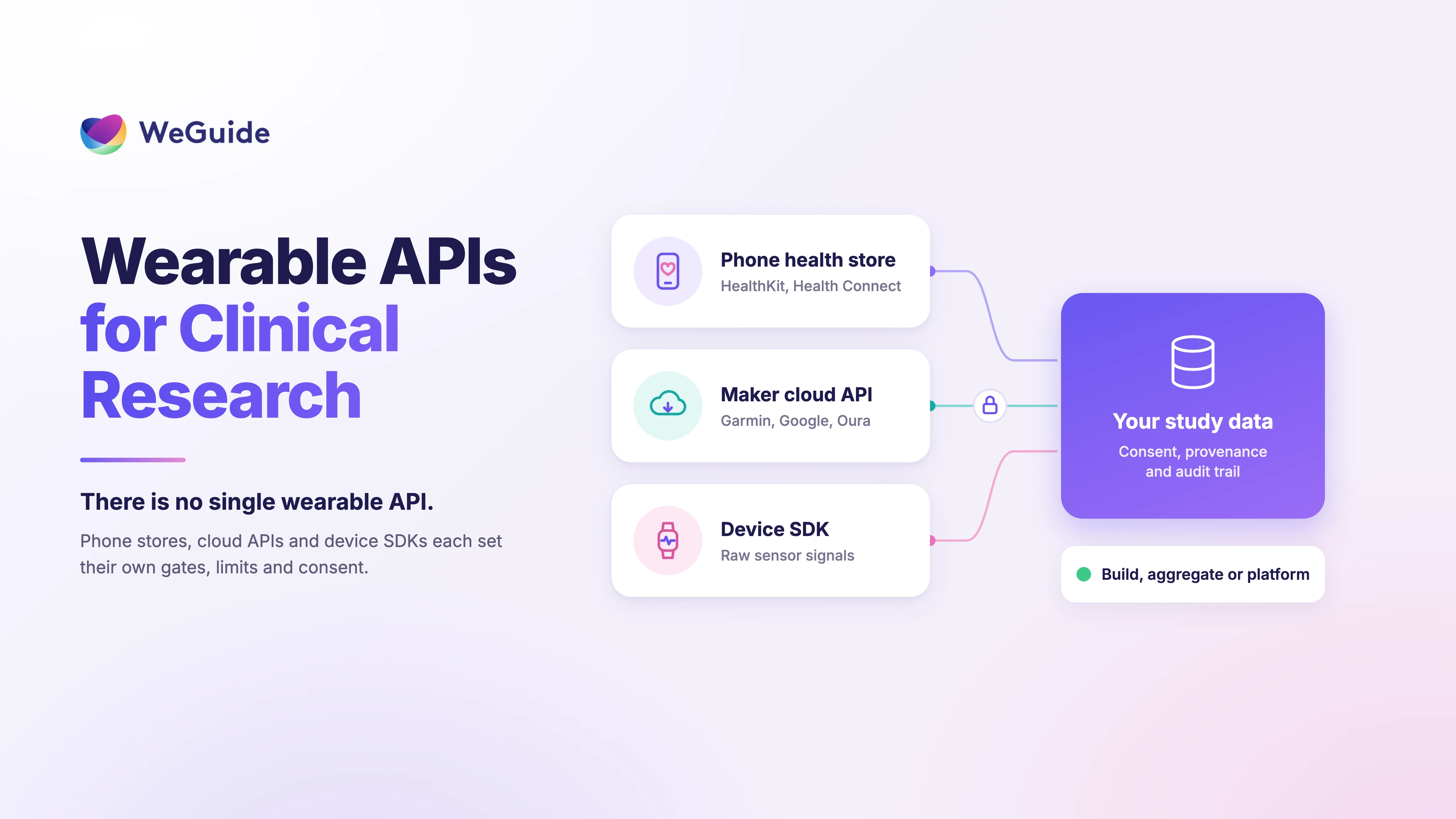


A wearable API is how a study gets data out of a participant's device and into a system the research team controls. For clinical research there's no single wearable API. iPhone data sits in HealthKit on the phone, Android data sits in Health Connect on the phone, and each maker runs its own cloud API with its own approvals, rate limits and consent screens.
If your protocol needs daily wearable data from every participant, that pipeline has to be chosen before the protocol is locked. This guide covers what each route exposes, the limits that break study pipelines, the Fitbit Web API shutdown, and how to choose between building, an aggregator and a research platform.
Key Takeaways
- There is no single wearable API. HealthKit and Health Connect are stores on the phone, each maker runs a separate cloud API, and raw signals need a device software development kit (SDK).
- The Fitbit Web API is off. Support ended on 30 September 2026 and the endpoints were turned off on 2 November 2026. New builds use the Google Health API, and every participant has to authorize again.
- Limits decide feasibility. Caps of 10 users before approval, 100 requests per minute, 30 day history windows, syncs that wait for an app to open and paid memberships all shape what a study can collect.
- Where data first lands is your source data. FDA treats the first durable electronic data repository as source data, so the pipeline choice is a data integrity decision.
- Build, aggregate or use a platform. Choose on consent, provenance and audit trail, not only on how many device brands a vendor lists.
What is a wearable API?
A wearable API is a documented interface that lets software read health data from a wearable or its maker's servers, after the wearer grants permission. In research, that means three different interfaces: a phone health store, a maker's cloud API, or a device SDK.
Aggregators and open source, self hosted stacks wrap many makers' APIs behind one integration. The Wear OS Data Layer API only passes data between a watch and a phone inside your own app, so it is not a source of health records.
Most studies need more than one route. A bring your own device (BYOD) cohort splits across iPhone and Android, then across makers, and a wearable integration built for one brand reaches only the participants who own it.
The payoff is real when it works. In the All of Us Research Program, Master and colleagues linked step data from 6,042 participants' own Fitbit devices to electronic health records, over a median of 4.0 years and 5.9 million person days. Results like this are one reason teams now plan wearables into study protocols. The API decides which data types arrive, how late, with what metadata, and where the first durable copy lives.
Phone health stores, cloud APIs and device SDKs: three ways data leaves a wearable
Phone health stores: HealthKit and Health Connect
Apple Health (HealthKit) and Android's Health Connect are stores on the phone, not cloud services. Your study needs an app on the participant's phone, and the participant grants read access one data type at a time. Only what each maker writes into the store arrives: Oura writes no heart rate variability (HRV) data to Apple Health, and WHOOP writes no HRV to either store, as our device by device comparison of how data gets out of each wearable documents.
Cloud APIs
Garmin, Google (for Fitbit and Pixel Watch), Oura, WHOOP, Withings and Polar run cloud APIs. The participant links their maker account through OAuth, and your server pulls data from, or receives pushes from, the maker's cloud. Each maker has its own developer approval, user caps and rate limits.
Device SDKs
Garmin's Health SDKs, Samsung's Health Sensor SDK and the Polar BLE SDK put code in your study app that talks to the device over Bluetooth. This is the route to raw signals, and for Garmin and Samsung it sits behind partner approval. We cover raw accelerometer data and sampling rates in a separate guide.
Wearable API comparison: access route, gates and how data reaches WeGuide
Last verified 11 November 2026 against each maker's developer documentation.
| Source | Route | What a study gets | Documented gate or limit | How it reaches WeGuide |
|---|---|---|---|---|
| Apple Health (HealthKit) | Store on the phone, iOS app required | Summaries and samples each app writes, with source metadata | Permission per data type; the app can't see denials; background reads limited when the phone is locked | Read directly (WeGuide reads Apple Health) |
| Health Connect | Store on the phone, Android app required | Records each app writes, with data origin | 30 days before first permission unless history permission is granted | Read directly (WeGuide reads Health Connect) |
| Garmin | Cloud Health API, or Health SDKs | Daily and epoch summaries; SDKs add real time streams and logged sensor data | Business program tiers; Starter is push only with no historical data; SDK commercial use needs a license fee or minimum device order | Native integration; raw accelerometer and gyroscope at 25 Hz on supported models |
| Fitbit and Pixel Watch | Google Health API (cloud) | Data type bundles, intraday data, webhooks | Restricted scopes need a privacy and security review; legacy Fitbit Web API off since 2 November 2026 | Fitbit Air: supported. Other Fitbit models: via Health Connect |
| Oura | Cloud API v2 | Daily summaries, sleep, heart rate | 10 users before Oura approval; consent per data type; sleep syncs when the app is opened | Via Apple Health or Health Connect |
| WHOOP | Cloud API | Recovery, sleep, cycles, workouts | Sandbox tier of 10 members; 100 requests per minute and 10,000 per day by default | Via Apple Health or Health Connect |
| Withings | Cloud API | Body, activity, sleep, heart measures | 10 users before review; on the free API plan, Withings accounts created after 12 October 2026 need Withings+, including via Apple Health and Google Health | Via Apple Health or Health Connect |
| Polar | AccessLink cloud API, BLE SDK | Exercises, daily activity, continuous heart rate | Exercises only from the last 30 days and after the user registers with your client | Via Apple Health or Health Connect |
| Samsung Galaxy Watch | Health Sensor SDK | Raw accelerometer and photoplethysmography (PPG) at 25 Hz | Samsung partner approval for distributed apps | Via Health Connect |
Raw accelerometer and gyroscope data (25 Hz) is available in WeGuide from supported Garmin models only.
Memberships also gate the phone store route. Oura Gen3 and later need an active membership to sync to Apple Health, WHOOP stops collecting data when a membership ends, and Withings says accounts created after 12 October 2026 need Withings+ to share data with apps on its free API plan, including through Apple Health and Google Health.
Sources for the gates: HealthKit privacy, Health Connect read data, Garmin Connect Developer Program, Google Health API, Oura API v2, WHOOP rate limits and app approval tiers, Withings API plans, Polar AccessLink and the Samsung Health Sensor SDK.
For device detail, see our guides to the Apple Watch in clinical research, the Oura Ring in clinical research, WHOOP in clinical research, Withings devices in research, the Polar H10 chest strap, the Samsung Galaxy Watch in research and the Garmin Cirqa band.
Fitbit after the Web API shutdown: the Google Health API and participant consent
The Fitbit Web API no longer works. According to Google's published timeline, support ended on 30 September 2026, and on 2 November 2026 the Fitbit Web API and Fitbit OAuth endpoints were turned off. Google's documentation says requests to them fail with an HTTP 410 Gone status code.
Google calls the Google Health API "the next generation of the Fitbit Web API." It covers Fitbit devices and Google Pixel watches, consolidates over 100 legacy endpoints into data type bundles, and replaces Fitbit authorization with Google OAuth 2.0. Two details matter for research teams:
- Every participant has to authorize again. Google's migration guide says existing access and refresh tokens "cannot be transferred, requiring users to re-consent to your updated integration." For a large cohort, plan the reauthorization wave, because consent grants count toward your Google Cloud project's OAuth rate limits.
- All scopes are Restricted. Production access needs a privacy and security review before your app can read data.
Google's Health API Research Pledge, effective 24 March 2026, adds research conditions:
- informed consent covering use, sharing, risks and withdrawal
- review by an independent ethics board
- data minimization
- whenever feasible, analysis on coded, deidentified datasets
If you or your participants are in the US, it asks you to apply for an NIH Certificate of Confidentiality.
Google Fit is being deprecated in 2026 and has not accepted new developers since 1 May 2024.
For a running study, that means budgeting the second consent wave, documenting it and checking data continuity around the cutover. eConsent with reconsent tracking makes the wave auditable. For the device itself, see our guide to the Fitbit Air in clinical research.
Garmin: cloud Health API vs Health SDKs
Garmin offers two routes. Its Connect Developer Program runs business tiers: Starter is push only, with historical data "Not included" and limited user capacity, while Enterprise adds ping or pull delivery, a month or more of history and unlimited users on commercial terms.
The Garmin Health SDKs are for Garmin Health enterprise partners. Evaluation is free, and commercial use needs a license fee or a minimum device order. The Standard SDK works without Garmin Connect or Garmin servers, while the Companion SDK works alongside Garmin Connect. Both offer real time streams and logged sensor data such as accelerometer and gyroscope.
WeGuide's Garmin integration uses the Garmin SDK and collects raw accelerometer and gyroscope data at 25 Hz on supported models.
Collect wearable data without building the pipeline
WeGuide reads Apple Health and Health Connect, supports Fitbit Air, and integrates natively with Garmin, alongside eConsent and patient reported outcomes in one participant app.
Rate limits, history windows and sync delays: the limits that break study pipelines
A wearable API that works for a 10 person pilot can fail at full enrollment, because the binding limits are user caps, request rates, history windows and sync timing.
| Limit type | Example from the docs | What it does to a study |
|---|---|---|
| User cap before approval | Oura 10 users; WHOOP Sandbox 10; Withings 10 before review | A pilot works, the full cohort can't connect until approval |
| Request rate | WHOOP 100 per minute and 10,000 per day; Polar scales with registered users | Backfills and nightly pulls for large cohorts throttle |
| History window | Health Connect 30 days before first permission; HealthKit users can grant only a recent window of history; Polar exercises from the last 30 days; Garmin Starter has no historical data | Baseline data from before enrollment may be unreachable |
| Sync delay | Oura sleep needs the app opened; HealthKit background delivery has hourly maximums for some types | Data arrives late or in bursts, and adherence alerts lag |
| Shutdowns and migrations | Fitbit Web API off 2 November 2026; Google Fit deprecated in 2026 | Pipelines break mid study and need participants to consent again |
WHOOP's approval tiers climb from Sandbox 10 to Build 100, Growth 1,000 and Scale 5,000, earned one at a time. Polar AccessLink allows "500 + number of users x 20" requests per 15 minutes. Apple's background delivery stops after three missed completion handlers.
Design for webhooks where they exist. Oura recommends them, with notifications about 30 seconds after data syncs from the mobile app. Then set a sync and wear time rule, so missing data prompts the participant instead of leaving a gap.
Record model, firmware and app version for every participant. Collins and colleagues showed why version reporting matters for activity and heart rate monitors. The stores also differ in what they hold: Apple Health stores HRV as SDNN, while Health Connect's HRV record is RMSSD, which matters for HRV metrics such as RMSSD and SDNN. Our guide to wearable data quality covers the cleaning side.
Consent, data minimization and provenance
Wearable data needs two layers of consent: your informed consent, and each platform's own permission screen (per data type in HealthKit, Health Connect and Oura, OAuth scopes elsewhere). Plan both, and make sure withdrawal revokes both.
Apple's authorization docs add a twist: an app isn't told when a user denies read access. A participant who declines heart rate looks the same as one who never wore the watch, so your monitoring has to tell those cases apart.
FDA's final guidance on digital health technologies for remote data acquisition (December 2023) asks sponsors to explain in the consent that a device's terms of service may let the manufacturer access participant data. Request only the data types the protocol needs.
Provenance is the part teams underestimate. Every HealthKit sample carries its source and source revision, and usually the device that recorded it, and every Health Connect record carries its data origin. Keep that metadata with the values, and log each device update too, since the same guidance asks sponsors to record the timing and nature of updates.
Keep the source on every value for a second reason. A participant who wears a watch and carries a phone can have the same steps written by two sources, so decide in the analysis plan which source counts instead of adding them together.
Then decide where the data first lands. FDA "considers electronic data that are located in the first durable electronic data repository to which the data are transferred to be the source data," and doesn't intend to inspect the devices themselves when transfer follows a prespecified plan. So your API route decides where your source data lives and whether it has an audit trail.
The same logic runs through the ALCOA+ principles, eSource and 21 CFR Part 11 audit trail requirements.
Build, buy an aggregator, or use a research platform for wearable integration
Build when you need one device and have engineers to maintain it. Use a consumer health data aggregator when you're building a product that has to support many devices. Use a research data platform when the wearable data must sit alongside consent, electronic patient reported outcomes (ePRO) and an audit trail.
| Criterion | Build on each maker's API or SDK | Consumer health data aggregator | Research data platform |
|---|---|---|---|
| Engineering | Your team builds and maintains every connection, token refresh and migration | One integration, the vendor maintains connectors | Configured, not coded |
| Approvals and caps | You apply to each maker | Phone store sources need no maker account; many cloud sources still need your own developer account with each maker | Covered by the platform for supported devices |
| Normalizing data across makers | You map every maker's units, definitions and duplicates | Normalized schema included | Depends on platform; check how sources are kept |
| Participant consent and eConsent | You build | Not included in most cases | Included |
| ePRO and reminders alongside device data | You build | Not included | Included |
| Audit trail and source data location | You design | Varies | Built in |
| Raw signals | Possible via SDKs, most work | Summaries in most cases | Depends on platform and device |
| Typical fit | Single device studies with engineering capacity | Consumer and digital health products | Trials, cohorts, registries |
Building gives full control. RADAR-base, an open source platform built for the RADAR-CNS program, is a published example (Ranjan and colleagues, 2019). The price is that every token refresh, schema change and shutdown like Fitbit's lands on your team, mid study.
Aggregators solve connector upkeep for app builders, but consent capture, ePRO and a research audit trail sit outside their scope. Research platforms combine device data with the rest of the participant workflow, and Fitabase and Labfront are two that teams compare (see our Fitabase alternatives). Still picking hardware? Start with choosing consumer wearables for research.
Plenty of academic teams want everything in their own electronic data capture (EDC) system. An integration engine that writes into REDCap lets you keep the database you already run.
Checklist: 12 questions to ask before your protocol is locked
An API gives you data, not a validated endpoint, and V3 validation still applies. Answer these before the protocol is final:
- Which phones and devices will participants use, and is the study BYOD or provisioned?
- Which data types and granularity does the endpoint need: daily summaries, epochs or raw signals?
- Is each route a phone store, a cloud API or an SDK?
- What are the user caps, and how long does maker approval take?
- Do the rate limits hold for your cohort size, including backfills?
- How much history do you need from before enrollment, and is it reachable?
- What sync delay is acceptable, and what's your wear time rule?
- How will you handle permission per data type, silent denials and withdrawal?
- How does the consent explain each maker's terms of service and any paid membership?
- Where does source data first land, and does that system keep an audit trail?
- Are model, firmware and app version logged for every participant?
- Who handles the next API migration, and how fast?
What WeGuide covers, and what it doesn't
WeGuide is a patient engagement and data collection platform for clinical research and care: screening, eConsent, ePRO/PROMs, wearable data and patient registries, on participants' own phones. It's the participant facing layer for wearable device studies, not a device maker or an EDC.
- Garmin: native integration, which collects raw accelerometer and gyroscope data at 25 Hz on supported models.
- Phone stores: WeGuide reads Apple Health (HealthKit) and Health Connect. Fitbit Air is supported.
- Other devices: Oura, WHOOP, Withings and Polar data arrive via Apple Health or Health Connect, and Samsung Galaxy Watch data via Health Connect, only for the data types each maker writes there. These are not direct integrations with the maker.
- Devices: BYOD first, with provisioned devices supported when a protocol needs them.
- Data out: integrates with REDCap through the REDCap API, and also connects to Castor and Medidata Rave.
- Consent: eConsent with version control, reconsent tracking and an audit trail.
- Regulatory: Class I medical device software, included in the Australian Register of Therapeutic Goods (ARTG 355337). ISO 27001 certified. Supports 21 CFR Part 11 requirements, HIPAA requirements and GDPR requirements.
In the BRACE trial led by Murdoch Children's Research Institute (6,800+ healthcare workers, five countries), participants logged daily symptoms in the WeGuide app, with data flowing into REDCap.
Frequently asked questions
Can I still use the Fitbit Web API?
No. Google turned off the Fitbit Web API and Fitbit OAuth endpoints on 2 November 2026, and its documentation says requests fail with HTTP 410 Gone. Use the Google Health API, and plan for every participant to authorize again.
Can I pull Apple Health data from the web?
No. Apple's privacy documentation says the device stores all HealthKit data locally, and there's no Apple server API. A study needs an iOS app that reads the store and sends the data on.
Is the Garmin API free?
Individuals get a Personal tier for their own data only. Business access runs through the Connect Developer Program, whose page publishes no Starter price, and Enterprise terms are commercial. Health SDK evaluation is free, and commercial use needs a license fee or a minimum device order.
Does Oura have an API for research?
Yes. API v2 needs participant consent per data type and is limited to 10 users until Oura approves the application. Our guide to the Oura Ring in clinical research covers membership and data types.
What replaced the Google Fit API?
The Google Health API for cloud integrations, and Health Connect for Android apps on the phone. Google Fit stopped accepting new developers on 1 May 2024.
Is there one API for all wearables?
No. Each maker runs its own API, and iPhone and Android keep health data in separate stores on the phone. Aggregators put one integration in front of many makers, but their access still depends on each maker's approvals, and some cloud sources need your own developer account. A research platform adds consent, ePRO and an audit trail on top of the data.
Should I build my own wearable integration or use a research platform?
Build if you need one device and engineers for the long run. Use a research platform if the data must sit next to eConsent and ePRO, or if your team has no programmer.
How can our lab get participants' wearable data into our own database automatically?
Pick a platform that writes into the database you already run. WeGuide integrates with REDCap through the REDCap API and also connects to Castor and Medidata Rave.
What wearable data platform should I budget for in an NIH grant?
Budget by cost line: platform or per participant fees, maker approvals and enterprise terms (Garmin Enterprise, SDK license fees or device minimums), devices if provisioned, engineering for migrations, and staff time for repeat consent. If you use the Google Health API, its Research Pledge asks US studies to apply for an NIH Certificate of Confidentiality.
Can I get raw accelerometer data through a wearable API?
Rarely through a cloud API. Raw signals come mostly through device SDKs under maker approval. Through WeGuide, raw data comes from supported Garmin models only, as our accelerometry guide to raw Garmin sensor data explains.
Plan your wearable data pipeline with WeGuide
See how Garmin, Apple Health, Health Connect and Fitbit Air data flow into one study alongside eConsent and ePRO.
Book a demoNo pressure, just a conversation.

