

.svg)
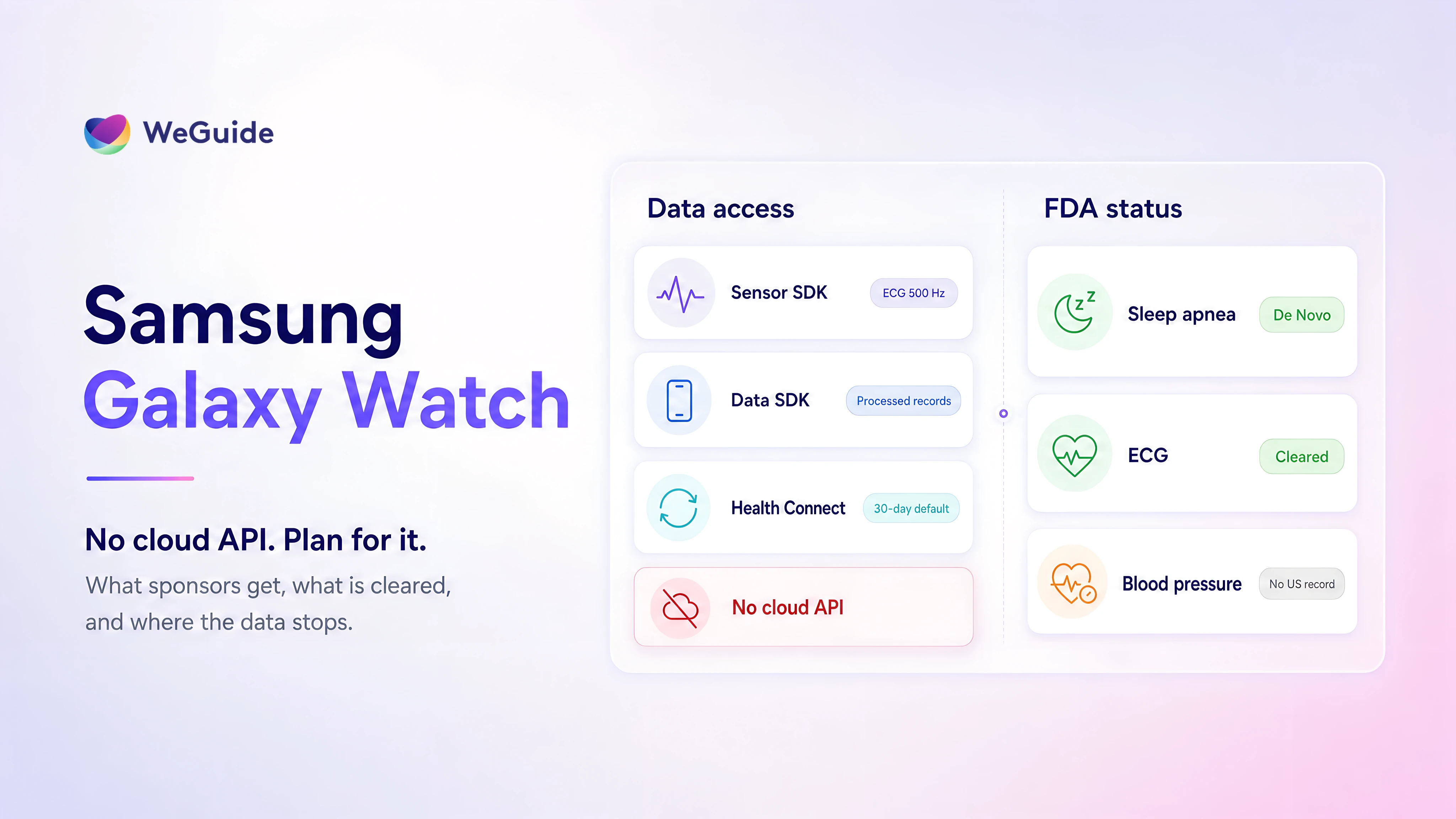


The Samsung Galaxy Watch is the only Android native wrist wearable with an FDA granted over the counter sleep apnea indication and a cleared single lead ECG stack. It offers better raw signal access than the Oura Ring or WHOOP, and it is the hardest of the major wearables to get data out of, because Samsung publishes no cloud API at all.
That combination makes Samsung Galaxy Watch clinical research a best fit for a kind of study proposition, not a general purpose instrument. What follows is the measurement set, the egress path, the clearance boundaries, the point where the published validation stops, and the cases where another device is the better call. The wider selection framework sits in our guide to wearables in clinical trials.
Key Takeaways
- Samsung publishes no cloud API. Every documented access path is an on device Android or Wear OS library. A sponsor cannot run a backend job against a refresh token, so a participant installed app is the only egress route that exists.
- Samsung holds the De Novo that created the FDA classification for over the counter sleep apnea risk assessment (DEN230041, granted February 2024), and a follow on 510(k) cleared in July 2026 superseded it. This is cleared, not approved, and the distinction matters.
- Blood pressure is not cleared in the US. Zero Samsung blood pressure records exist in the FDA databases. Do not plan a US blood pressure endpoint on this device.
- The published evidence studies old hardware. Independent validation covers the Watch Active2 through the Watch6. No peer reviewed independent validation of the Watch7 and later, or of the Galaxy Ring, was found.
- Completeness decides your sample size, not accuracy. Four independent sources, including Samsung's own regulatory submission, converge on roughly one night or tracing in six being unusable.
What the Galaxy Watch Measures
Samsung's BioActive sensor stack combines optical photoplethysmography, an electrical sensor for ECG and bioimpedance, and triaxial accelerometry. From those raw inputs Samsung derives a much larger set of consumer facing scores.
The distinction between a sensed signal and a derived score is the one that matters in a protocol. Sensed signals have a physical reference you can validate against. Derived scores are vendor defined composites with undisclosed weights.
| Layer | Examples | Research status |
|---|---|---|
| Sensed signals | PPG waveform, single lead ECG, triaxial acceleration, skin temperature, bioimpedance, interbeat intervals | Validatable against a reference, available raw through the Sensor SDK |
| Processed measures | Heart rate, SpO2, respiratory rate, step count, sleep stages | Validated to varying degrees, see the evidence section below |
| Wellness composites | Energy Score, sleep score, stress, body composition, AGEs Index, Antioxidant Index, Vascular Load | Vendor defined, no located peer reviewed validation, not usable as endpoints |
Samsung's own disclaimer on the AGEs Index reads that it is "Not intended for use in detection, diagnosis, treatment of any medical condition." Treat every composite in that bottom row the same way. Our guide to digital biomarkers in clinical trials sets out what has to be true before a derived measure can carry weight.
Data Access: The Constraint That Shapes the Protocol
Data access is where Samsung differs most from every other major wearable, and it's the constraint that reshapes a protocol rather than a detail inside one.
There is no Samsung Health API in the server to server sense. Samsung publishes no cloud endpoint you can call from a backend, while Fitbit, Garmin, Oura, Withings and Dexcom all offer one. Samsung's developer portal lists four health offerings, and all four are client side libraries: the Samsung Health Data SDK, the Health Sensor SDK, the Health Accessory SDK and the Health Research Stack.
A common misreading is that Google's new Health API closes the gap. It doesn't. Google describes it as the next generation of the Fitbit Web API, covering Fitbit devices, Pixel Watch and third party apps. It is not a Samsung path.
The practical consequence is that data egress requires a participant installed Android app that reads locally and ships to the sponsor's backend. If the participant uninstalls or force stops that app, the result is a permanent gap, not a backfillable one.
| Surface | What it yields | Where it runs | Gate |
|---|---|---|---|
| Health Sensor SDK | Raw PPG, ECG, accelerometer, bioimpedance, skin temperature, interbeat intervals | On the watch, Wear OS | Partnership approval plus SHA-256 registration |
| Health Data SDK | Samsung processed records and aggregates | On the paired phone | Partnership approval plus SHA-256 registration |
| Health Connect | Cross vendor normalised records | On the phone | Google Play health data declaration |
| Research Stack | Self hosted study platform wrapping the above | Sponsor infrastructure | Apache 2.0 on three of four repos. No push since October 2024, and the web portal repo has no LICENSE file |
The raw signal offer is genuinely good. The Sensor SDK exposes ECG at 500 Hz, on demand PPG at 100 Hz, continuous PPG and triaxial accelerometry at 25 Hz, plus interbeat intervals, skin temperature and bioimpedance. On demand measurements are capped at roughly 30 seconds, so this is a spot check instrument, not a Holter replacement.
Access is partner gated, and the gate sits on the critical path. Both SDKs require Samsung to whitelist your app's package name and SHA-256 signing certificate. Without approval the Sensor SDK blocks the connection outright. Samsung publishes no fee schedule, no service level agreement and no approval turnaround, so treat it as an unbounded dependency and start the request before the protocol is final. Signing the app again, or the app or changing the package name mid study requires a new registration.
Three further traps are worth naming before they surface at database lock:
- Health Connect reads only the last 30 days by default. Reading older records needs a history permission, and continuous collection needs a background permission. Omitting either silently truncates the dataset rather than throwing an error.
- Health Connect has no sleep apnea type. Samsung's FDA authorised sleep apnea output is reachable only through the proprietary Data SDK at version 1.1.0 or later, released in March 2026.
- Google Fit APIs are supported only until the end of 2026. Any Android pipeline still running on Fit needs moving onto Health Connect inside the current calendar year, and the Fit Goals API has no replacement at all. That is a protocol amendment and a validation event, not a sprint task.
- The legacy Samsung Health Android SDK was deprecated on 31 July 2025 and is documented as operational for roughly two more years. Any multi year study started on it will need an in flight app update.
Because there is no vendor cloud to pull from, the participant facing app is the ingestion architecture on Samsung, not a convenience layer on top of one. That app is the layer WeGuide works in. Our integration engine takes the device data into sponsor controlled storage and sits alongside the consent, outcomes and reminder layers the same participant is already using, so the Samsung read is one lane in a participant facing study app rather than a standalone integration project.
One dependency compounds all of this. The Data SDK is Android only, and the regulated features run inside Samsung Health Monitor, which ships on Samsung Galaxy phones and nowhere else. Bring your own device therefore collapses to "the participant already owns a recent Galaxy phone", a minority of most Western cohorts. Outside Korea, a sponsor provisioned watch plus a sponsor provisioned Galaxy phone is the realistic default. That is the exact mirror of Apple's iPhone lock, skewed in the opposite direction.
Run the participant facing layer of your Samsung study in one place
WeGuide brings eConsent, ePRO, education, reminders and wearable data capture into a single branded app, alongside the systems you already run.
What Is FDA Cleared, and What the Clearance Permits
Samsung's regulatory position is its strongest asset, and it is routinely described incorrectly in consumer coverage.
| Feature | Instrument | Status |
|---|---|---|
| Sleep apnea risk assessment | DEN230041, granted 2024-02-06 | De Novo that created product code QZW, 21 CFR 868.2378 |
| Sleep apnea, current instrument | K261011, cleared 2026-07-20 | Supersedes the De Novo. Lowers the age floor to 18+, adds the Galaxy Ring as a platform, carries a change control plan |
| ECG and irregular heart rhythm | K201168, K230292, K240909 | Cleared |
| Blood pressure | None | No FDA record of any kind |
Two points of vocabulary. DEN230041 was granted through the De Novo pathway. The 510(k)s were cleared. Nothing Samsung holds in this space is FDA approved, and pages describing the sleep apnea feature as an approval are wrong under the FDA's own terminology. Our guide to the FDA framework for digital health technologies sets out why the three words are not interchangeable.
Second, and more consequential for a protocol: the cleared indication is narrow enough to break a naive endpoint plan. Devices in this class are not intended to provide a standalone diagnosis, to replace polysomnography, to assist clinicians in diagnosing sleep disorders, or to be used as an apnea monitor. The De Novo also states that no raw signal, including the SpO2 signal, is provided to the user or shareable with clinicians. So the cleared output cannot be handed to an investigator as source data.
The Galaxy Watch ECG stack sits under three separate clearances, which is why the feature set differs by generation. The cleared indication also contraindicates use in atrial fibrillation, congestive heart failure, COPD, Parkinson's disease, tremor, periodic limb movement, chronic bronchitis, emphysema, pulmonary fibrosis and pregnancy. An AF or heart failure cohort sits outside it.
One correction worth carrying: Samsung is not the only smartwatch with a cleared sleep apnea feature. Apple cleared K240929 seven months later, against the classification Samsung created. The accurate framing is that Samsung was first, and holds the De Novo.
Blood Pressure: Not Cleared in the US
Zero Samsung blood pressure clearances exist in the FDA 510(k) or De Novo databases. A product code census of all 46 Samsung Electronics 510(k) records returns no blood pressure code, and targeted queries return nothing.
Samsung ships the feature under a general wellness disclaimer rather than any clearance, with a mandatory cuff calibration every 28 days, and the published literature explains exactly why it is not cleared. Studies consistently find that the uncleared feature tracks well near its calibration anchor and degrades where clinical change occurs. On the Watch6, in 896 participants across 35,592 readings, this uncleared feature showed a pre to post calibration difference of 4.64 mmHg systolic, and the authors concluded that watch based devices may not detect clinical level blood pressure variability. A Watch5 study of the same uncleared feature found agreement within 1 mmHg near the calibration point, rising to 3.4 and 5.1 mmHg once the reference moved 10 mmHg away.
Do not plan a US blood pressure endpoint on this device, and do not quote a Samsung blood pressure accuracy figure without the not cleared caveat in the same sentence.
How Accurate Is Samsung Health, Really?
The honest answer to is Samsung Health accurate is that it depends entirely on the measure and the generation studied. Name the generation every time, because the sensor stack changed across the Watch3 to the Watch9, and flag vendor funding every time, because the most flattering numbers cluster in Samsung funded or Samsung authored work.
| Measure | Best evidence | Generation studied | Verdict |
|---|---|---|---|
| Heart rate | Bias -2.67 bpm but limits of agreement -16.90 to +11.57 bpm against a chest strap during exercise | Watch6, Samsung funded | Good on average, individual readings not interchangeable with ECG. The one independent four device head to head placed it last |
| Heart rate variability | No validation against an ECG reference was located | None | Exploratory only. Deriving it yourself from the raw interbeat stream with prespecified processing is firmer ground than consuming Samsung's sleeping HRV summary |
| Steps | Roughly 10% error in free living conditions, two independent studies | Watch4, Watch Active2, independent | Supportive endpoint, not a primary count |
| Energy expenditure | Bias +56.76 kcal, with a significant device by body fat interaction | Watch5, independent | Not fit for a primary endpoint |
| Sleep staging | Epoch by epoch macro F1 between 0.26 and 0.69 across an 11 tracker comparison | Watch5, independent of Samsung | Mid pack, no current generation validation |
| SpO2 and apnea signal | Area under the curve around 0.80 at screening thresholds, specificity 64.1% | Watch4, Samsung funded and Samsung authored | A triage signal, not a diagnostic |
| ECG for atrial fibrillation | Sensitivity 85%, specificity 75%, statistically indistinguishable from Apple Watch | Watch3, independent | Genuinely usable for rhythm triage |
Note what the US sleep apnea instructions for use say verbatim: "Your Galaxy Watch is not approved by a regulatory body as a pulse oximeter." The cleared feature uses PPG derived relative desaturation, not an oximetry value.
The generation confound
The published literature studies the Watch Active2, Watch3, Watch4, Watch5 and Watch6. Only one located study includes a Watch7, and it is industry affiliated. No peer reviewed independent validation of the Watch Ultra, Watch8, Watch9, Ultra2 or the Galaxy Ring was found. Even Samsung's own 2026 clearance validated on a Watch6. Retail today is on the Watch9 and Ultra2.
Carrying a Watch4 SpO2 figure forward to a Watch9 isn't defensible in a protocol. State the model actually studied, every time. This is the same discipline we set out in our guide to wearable data quality and validation.
The number that decides your sample size
| Failure mode | Rate | Source |
|---|---|---|
| SpO2 data rejection, overnight | 26.5% | Watch4, Samsung authored PSG study |
| Overnight recording failure, sleep apnea cohort | 15.7% | Independent |
| Inconclusive ECG tracings | 17% to 19% | Independent, cardiology populations |
| Night level data insufficiency | 16.7% (205 of 1,229 nights) | Samsung's own De Novo pivotal |
Four independent sources, including Samsung's own regulatory submission, converge on roughly one night or tracing in six being unusable. In paced patients the ECG figure is far worse. Power the study on those numbers rather than on the point estimates, and design the reminder and repeat measurement workflow around them. That is an engagement problem, not a device problem.
Use in Registered Research
Roughly 20 to 22 ClinicalTrials.gov studies involve the wrist device, against 1,442 for Fitbit, 260 for Garmin, 190 for Apple Watch and 119 for the Oura Ring. The Galaxy Ring has zero.
One warning if you run the count yourself: a bare search for "Samsung" on ClinicalTrials.gov returns 3,865 studies, of which 3,313 belong to Samsung Medical Center, a 2,000 bed hospital in Seoul with no connection to the device. Never publish a bare Samsung trial count.
If a reviewer wants published precedent, Samsung won't supply it.
Galaxy Ring: A Subsection, Not a Peer Device
The Galaxy Ring became a cleared platform for the sleep apnea feature under K261011 in July 2026. It carries three sensors: accelerometer, optical PPG and skin temperature. It exposes no raw signal, has no display and therefore cannot deliver ePRO prompts, and it requires a compatible Galaxy phone.
It has zero registered trials and zero PubMed indexed articles. The only clinical dataset is Samsung's own regulatory submission, where female sensitivity was 63.2% and under 40 sensitivity was 66.7% against a 77.9% headline. If you cite the headline without those two figures, the citation is misleading.
Two operational facts dominate any deployment: sizing needs a nine ring sample kit and a 24 hour wear test, which means two shipments and a multi week gap before first data. For a low burden sleep heavy protocol on an existing Galaxy cohort it can work. As a research instrument in its own right, the evidence isn't there yet. The Oura Ring has by far the deeper validation record in that form factor.
When to Choose Samsung, and When Not To
| Choose it when | Choose something else when |
|---|---|
| The protocol has a sleep apnea screening or enrichment step in an undiagnosed population | You need a centralised server side cohort pull or retrospective backfill |
| You need cleared ECG and rhythm notification on Android, where Apple is unavailable by definition | The endpoint is blood pressure in a US study |
| The cohort is Galaxy native, or you can provision Galaxy phones | The cohort is already diagnosed with sleep apnea, or is an AF or heart failure cohort |
| Budget is capital constrained and multi wave: buy once hardware, no subscription on cleared features | You need continuous ambulatory ECG, which the 30 second cap forecloses |
| You need partner gated raw PPG, ECG and interbeat intervals for algorithm development | Published precedent or registrational grade validation is decisive |
| The team has in house Android capacity, or a patient facing platform partner who does | Charging burden threatens adherence in elderly or low engagement cohorts |
| You can provision Galaxy phones, or the cohort already carries them | The cohort must be iPhone inclusive or device agnostic |
How Samsung compares to the other research wearables
Samsung sits at one end of a real trade off. It has the strongest sleep regulatory footing and genuinely good raw signal access, and the worst centralised extraction story of the majors. The Apple Watch is its closest mirror, with a deeper stack of cleared features and the same no cloud API constraint, locked to iPhone. Fitbit and the Garmin CIRQA both offer server to server cloud APIs, which is the path of least resistance when you need a backend pull rather than raw waveforms. WHOOP carries a recurring membership with no residual hardware asset, which changes the arithmetic on a multi year cohort against Samsung's buy once model.
The broader framework for choosing between them is in our guide to wearables in clinical trials, and the ownership question of who supplies the device is covered in BYOD versus provisioned devices.
Operational Checklist for a Samsung Study
- Submit the Samsung partnership request before the protocol is final. Register the package name and SHA-256 for both SDKs. Treat approval as an unbounded critical path item.
- Version pin and log the Samsung Health app version, watch model and firmware per participant, per record. Under the change control plan the regulated algorithm can legally change between releases during a running study.
- Declare Health Connect history and background permissions at first consent, not later, or the dataset truncates silently.
- Plan the charge protocol against nocturnal endpoints. A daily charge device competes directly with overnight measurement.
- Name the actual signals in your consent language, not "activity data": 25 Hz accelerometry, optical PPG, skin temperature, on demand ECG, collected 24/7 including sleep. Cover what deletion means when the data exists on the watch, the phone and the sponsor backend. This is the passive sensing consent problem our eConsent layer is built for.
- Treat Samsung Health as a local broker, never as a processor of identifiable study data.
- Source every device in the market where it will be used. Samsung binds the regulated features to the hardware's purchase country, and they can break on factory reset. In a multi country study an identically specified watch bought in the wrong market will not deliver the cleared feature.
- Budget for one in six recordings being unusable, and build the repeat measurement workflow before enrolment opens.
Samsung Galaxy Watch Clinical Research FAQs
Can Samsung Galaxy Watch data be used in a clinical trial?
Yes, and roughly 20 to 22 registered studies have done so. The constraint is not permission but architecture. Because Samsung publishes no cloud API, a participant installed Android app is the only route by which data leaves the device, so the study team carries the app, the uptime and the retention burden.
Is there a Samsung Health API for research?
Not a server to server one. Samsung offers four options: the Health Data SDK for processed records, the Health Sensor SDK for raw signals, the Health Accessory SDK, and the self hosted Health Research Stack. Both SDKs read on the participant's device and both require Samsung partnership approval. The Research Stack wraps them but runs on sponsor infrastructure, and its repositories have had no push since October 2024.
Is the Galaxy Watch sleep apnea feature FDA approved?
No. It is FDA granted and then cleared, which are different things. DEN230041 was granted through the De Novo pathway in February 2024 and created the product code for over the counter sleep apnea risk assessment. K261011 was cleared in July 2026 and supersedes it. Several high profile consumer pages describe this as an approval, which is wrong.
Is Galaxy Watch blood pressure FDA cleared in the US?
No. There is no Samsung blood pressure record anywhere in the FDA 510(k) or De Novo databases. Samsung ships the feature under a general wellness disclaimer rather than a clearance, with a mandatory cuff recalibration every 28 days, and the published evidence shows this uncleared feature degrading in accuracy as blood pressure moves away from the calibration point.
Can I get raw PPG or ECG from a Galaxy Watch?
Yes, through the Health Sensor SDK, which exposes ECG at 500 Hz and PPG at 100 Hz. Two caveats: access is partner gated behind Samsung approval, and on demand measurements are capped at roughly 30 seconds each, so continuous ambulatory recording is not possible.
How accurate is Samsung Health?
It depends entirely on the measure and the generation. Heart rate is good on average and unreliable on any single reading. Steps carry roughly 10% error in free living. Energy expenditure is biased and subgroup dependent. Sleep staging is mid pack. The atrial fibrillation ECG performs comparably to the Apple Watch. Almost all of this evidence was gathered on the Watch6 or earlier.
The Samsung Verdict for Study Teams
Samsung is the right instrument for a narrow and real set of studies: Android majority cohorts doing sleep apnea screening, cardiac rhythm triage, or raw signal algorithm development on a capital budget. Its regulatory footing on sleep is verifiable on the FDA record rather than in press copy, and its raw signal access beats every ring and strap in the category.
It is the wrong instrument if you need a centralised pull, a US blood pressure endpoint, published precedent, or an iPhone inclusive cohort. And whichever way that decision goes, the deciding number is a completeness figure, not an accuracy point estimate: roughly one recording in six will not be usable, which makes the participant facing engagement layer the part of the study that determines whether the data arrives at all. Where that layer sits in a wider remote design is covered in our guide to wearables in decentralised trials and on our decentralised clinical trial platform page.
Talk through the device layer in your protocol
We'll look at what your endpoints need, which devices can supply them, and how the participant facing layer keeps the data arriving.
Book a demoNo pressure, just a conversation.

