

.svg)
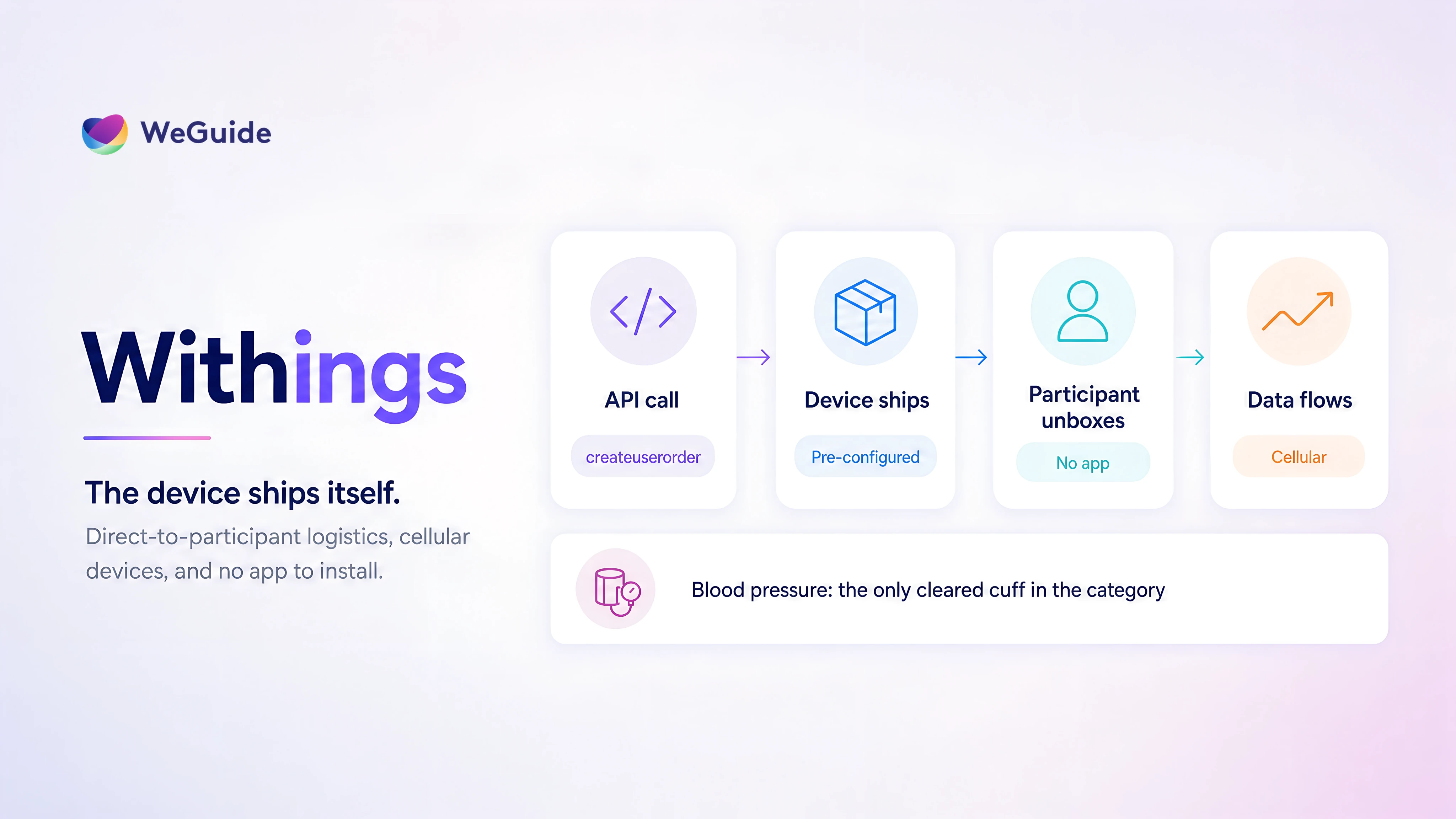


Withings is a credible option for decentralised trials where blood pressure, weight or contactless sleep screening are the endpoints and you cannot assume the cohort owns a smartphone. It ships preconfigured cellular devices directly to participants through an API, with no app install and no Bluetooth pairing. It is a weak option for continuous wrist physiology, arrhythmia detection endpoints, and anything requiring QT measurement.
Anyone scoping Withings clinical research is really evaluating two different companies under one brand: a consumer hardware business with an open API, and a contracted Health Solutions division that ships cellular devices under a business associate agreement. Only the second is a research product.
Key Takeaways
- There are two Withings, and conflating them is the most common error. The consumer pipe is retail hardware and an open API with no contract, no BAA and consumer hosting. The Health Solutions pipe is contracted, with enterprise SKUs, cellular devices, a Logistics API and Medical Cloud hosting. Only the second is a research product.
- The differentiated capability is logistics, not sensors. One server to server call creates the participant account, ships a preconfigured cellular device to their door, and returns the OAuth code the sponsor exchanges for tokens. No app install, no Bluetooth pairing.
- Blood pressure is the portfolio's strongest evidence and its strongest use case. No ring or wrist competitor in the category has any cleared noninvasive blood pressure capability at all.
- The blood pressure cuffs are not cleared under a Withings clearance. They are marketed under a 510(k) held by the contract manufacturer, Guangdong Transtek. This is a normal OEM arrangement, but the distinction matters if you cite it in a protocol.
- BeamO's uncleared function is pulse oximetry, not ECG. Its ECG, thermometer and stethoscope functions are covered. SpO2 is not covered by any Withings clearance.
What Is Withings Health Solutions, and How Is It Different?
Everything in a Withings evaluation turns on which of two commercial pipes you are buying.
| Consumer pipe | Health Solutions pipe | |
|---|---|---|
| Who can use it | Anyone. No contract required | Contracted partners only |
| Hardware | Retail SKUs bought by the individual | Enterprise SKUs: Body Pro, BPM Connect Pro, BPM Pro 2, BeamO Pro |
| Onboarding | Participant creates the account, installs the app, pairs by Bluetooth, completes OAuth | Partner creates the account, preconfigures the device, holds the tokens |
| Transport | Bluetooth or Wi-Fi to the phone, then cloud | Cellular first, with Wi-Fi and Bluetooth fallback |
| Hosting | Consumer Cloud | Medical Cloud, the only environment inside the certified security scope |
| Business associate agreement | Not offered | Available |
| Raw sensor data | No | Advanced Research API, ScanWatch only |
Anything built on the consumer path inherits consumer terms, consumer hosting and no business associate agreement. If a vendor comparison quotes Withings capabilities without saying which pipe it means, the comparison is not usable.
The Logistics Story: Shipping Devices Straight to Participants
The differentiator is documented in Withings' own technical documentation rather than in marketing copy.
A single server to server call, createuserorder, does three things at once. It creates the Withings user account, places a dropshipment order to the participant's address, and preconfigures the cellular device for that user. It returns an authorisation code, valid for ten minutes, which the sponsor platform exchanges for access and refresh tokens.
That bypasses participant initiated OAuth entirely. The sponsor holds tokens for a participant who never installs an app. Withings' documentation describes the participant experience as unboxing the preconfigured device, turning it on, and beginning to use it, with no phone or additional setup required.
Two operational details are worth building into the plan. Orders can be placed per participant as a dropshipment or in bulk to a site, and a testmode parameter lets you exercise the whole logistics chain without shipping hardware. And cellular dead zones fall back to Wi-Fi or Bluetooth, which quietly reintroduces the phone dependency for exactly the participants you were trying to reach. Screen for coverage at onboarding rather than discovering it in the data.
Smartphone ownership and successful app onboarding are the two largest hidden exclusion criteria in bring your own device wearable studies, and that exclusion is not random. It skews older, lower income and more rural, which is often exactly the population a treatment needs to reach. Removing both is a real equity gain, not a convenience feature. We work through the wider version of that trade off in BYOD versus provisioned devices.
Two boundaries on the claim. First, access to the Logistics API is gated: the documentation reserves it for partners with a Withings contract and specific privileges. Second, and more limiting, the ScanWatch is not cellular. The documented cellular devices are the Body Pro scale and the BPM Connect Pro cuff, with the BPM Pro 2 and BeamO Pro added in vendor marketing. A wrist arm still needs a participant smartphone and the Withings app.
So the smartphone free story and the wrist physiology story are mutually exclusive. Pick one.
Bring the device data and the participant into one place
WeGuide combines eConsent, ePRO, education, reminders and wearable data capture in a single branded app, and routes device streams into your existing systems.
What Is Actually FDA Cleared
Eight Withings 510(k) clearances exist: the five trial relevant ones below, plus two legacy blood pressure monitors and the Thermo thermometer. All are traditional substantial equivalence determinations. There is no premarket approval and no De Novo anywhere in the portfolio, which means "FDA cleared" is the only correct verb for every Withings device. Our guide to the FDA framework for digital health technologies covers why cleared, granted and approved are not interchangeable.
| Device | Clearance | What it covers |
|---|---|---|
| ScanWatch (original, HWA09) | K201456 | ECG, atrial fibrillation detection, SpO2. Prescription conditioned, unlike the later over the counter ECG App |
| Body Scan scale | K230812 | Six lead derived ECG and AFib. No SpO2 |
| Sleep Rx mat | K231667 | The proprietary "Withings index" as an aid to sleep apnea diagnosis, prescription only |
| ECG App (ScanWatch 2) | K240795 | Over the counter ECG, indicated for ages 22 and over |
| BeamO | K252474 | ECG (ages 22 and over), contactless thermometer, electronic stethoscope. No SpO2 |
| Blood pressure cuffs | K240102, K202891, K223374 (not Withings clearances) | Held by Guangdong Transtek, the contract manufacturer |
Four precision points that vendor comparisons routinely get wrong:
The Withings BeamO gap is oximetry, not ECG. The clearance document contains zero occurrences of SpO2, oxygen or oximetry, and Withings holds no oximeter clearance for BeamO. It also states that BeamO does not include ECG analysis or ECG derived heart rate. So the accurate statement is that three of the four functions are covered and the pulse oximetry function is not covered by any Withings clearance.
The blood pressure cuffs are OEM. BPM Vision and BPM Pro 2 are listed under a clearance held by Guangdong Transtek. This is legitimate and common, but the sentence "Withings holds a clearance for the BPM Pro 2" is false. Write it as marketed under a contract manufacturer's 510(k), or omit the number.
Weight and body composition are not cleared. They sit under 510(k)-exempt product codes. So do the galvanic skin response and stand on scale functions. That does not make them unusable, but it does mean they carry no clearance to cite.
Withings holds no irregular rhythm notification clearance in the US, unlike Apple and Fitbit. Passive or continuous AFib notification is not a US Withings capability. The EU picture is different and stronger: Withings is a registered medical device manufacturer under the Medical Device Regulation, and the ScanWatch 2 is a Class IIa device there.
Finally, treat these as uncleared wellness outputs and never as endpoints: body composition, visceral fat, basal metabolic rate, metabolic age, pulse wave velocity, vascular age, VO2 max, nerve health score, sleep score, sleep efficiency and vitality score. Withings' research page describes the portfolio as "clinically validated, medical grade devices". That is marketing copy and it does not survive contact with the clearance documents.
How Accurate Is Withings for Research Use?
The evidence splits sharply by device. Blood pressure is the strongest, wrist arrhythmia the weakest.
Blood pressure: the strongest case in the portfolio
BPM Connect, BPM Core and BPM Pro 2 each carry published ISO 81060-2 protocol validations. All are manufacturer sponsored but externally executed and protocol bound, which is a materially better evidence class than the vendor authored accuracy work common elsewhere in the consumer wearable space. The numbers are good. BPM Core came in at -0.6 plus or minus 4.8 mmHg systolic, the BPM Pro 2 at 1.0 plus or minus 4.9, and the BPM Connect at 0.6 plus or minus 5.3, each against the ISO protocol in roughly 85 participants. All three pass, and an ISO 81060-2 validation is a measurement accuracy result rather than a US clearance.
For a study where home blood pressure is a real endpoint, Withings is a serious candidate and the ring and watch vendors simply are not, because none of them has any cleared noninvasive blood pressure measurement hardware.
One labelling note: the BPM Pro 2 validation paper's authors received an honorarium and one reports personal fees from Withings, and the trial's lead sponsor is Withings. Describe it as manufacturer sponsored and externally executed rather than independent.
Atrial fibrillation: the headline number is a filtered number
The FDA submission prints two analyses side by side. Sensitivity is 0.989 for the Body Scan and 0.963 for the ScanWatch when inconclusive and noisy tracings are excluded, and 0.733 for the Body Scan and 0.77 for the ScanWatch across all records.
The single independent replication located is more sobering still. In an unselected cardiology population of 201 patients, the ScanWatch reached 58% sensitivity and 75% specificity with 24% of tracings inconclusive, the lowest sensitivity and the highest inconclusive rate of the five devices tested. In that same study the Samsung Galaxy Watch 3 and the Apple Watch 6 both reached 85% sensitivity.
Those decimals are the same numbers vendor material prints as 96.3% and 98.9%. A third figure circulates too, a 99.7% AFib sensitivity from the newer ECG App submission, which was measured only on classifiable recordings in a separate trial. Quoting any of the three without its all records counterpart, and without naming which submission it came from, is not defensible in a protocol.
What to treat as exploratory only
No heart rate variability validation for any Withings device was located. Neither was any indirect calorimetry or doubly labelled water validation of energy expenditure on a current device. The frequently quoted body composition correlations against DXA trace to a vendor support page rather than to any peer reviewed study.
Never take QT or QTc from a Withings ECG as a measurement. The API exposes QT, QTc, PR and QRS fields, and the clearance states explicitly that the ECG is not intended for manual or automated measurement of the QT interval. That is a field the API will happily hand you and the label forbids you to use.
The generation confound
The hardware generation, the PPG stack, the ECG front end and the classification algorithm all changed between the original ScanWatch and the ScanWatch 2, and the Body Scan runs a third configuration again. A 2021 to 2023 ScanWatch figure cannot be used to characterise the ScanWatch 2, Nova, Light, BeamO or Sleep Rx. Name the device and the generation actually studied, every time. The wider version of that discipline is in our guide to wearable data quality and validation.
Do not merge sleep evidence across form factors either. The wrist ScanWatch and the under mattress sleep mats are different products with different clearances, and a bias figure from one must never be attributed to the other.
How Do You Get Withings Data Into a Study? The Withings API in Practice
The Withings API comes in four integration modes: the public OAuth API, a mobile SDK for partners embedding pairing in their own app, the cellular solution with partner held tokens, and the Advanced Research API for raw signals.
A few engineering realities worth knowing before you scope the build:
- Token exchange is nonstandard OAuth2. It requires an extra
action=requesttokenbody parameter, which breaks generic OAuth clients. Multiple independent client libraries document the workaround. - Rate limit is 120 requests per minute per application on the standard plan. Higher limits sit on the enterprise plan and the terms are not published.
- Missed webhook notifications are never redelivered. Recover with an incremental
lastupdatesync rather than relying on the webhook alone. Four consecutive delivery failures trigger warnings and twenty days unresolved cancels the subscription outright. - Subscribe to notification category 46. It carries profile changes including account deletion and unlinking, which is how a study detects a participant revoking consent. Wire it to your data handling procedure.
- There is no bulk research export. Participant level CSV export exists only through the consumer app, and it carries no ECG waveforms, no raw signal and no audit trail. It is a subject access mechanism, not a study pipeline.
- Raw PPG and accelerometer access is ScanWatch only, contracted partners only, disables every other device feature while active, and cuts battery life to three or four days.
On compliance, be precise. Withings holds ISO 27001 certification on its Medical Clouds, with HDS and ISO 27701 on the EU cloud, and a self assessed HIPAA and GDPR posture. No 21 CFR Part 11, GxP, Annex 11 or computer system validation claim appears anywhere in the Withings API documentation. Withings' own materials use the phrase "HIPAA certified", which is not a thing that exists, and the same guide concedes there is no formal certification recognised by the regulator.
That is the honest gate, and it is where the sponsor's eClinical stack has to take over. Part 11 controls, audit trail, source data verification and query management come from the sponsor's validated systems. They do not come from the device vendor, and they do not come from the participant facing layer either. WeGuide's integration engine sits between the two, capturing the device stream alongside the consent and outcomes the same participant is already completing.
How Withings Compares to the Other Research Devices
| Withings | Oura | WHOOP | Apple / Samsung | |
|---|---|---|---|---|
| Cleared blood pressure | Yes, via OEM cuffs | No | No | No |
| Measurement pattern | Mostly episodic: step on, cuff up, hold the wand | Continuous | Continuous | Continuous |
| Ships to participant by API | Yes, with cellular preprovisioning | No | No | No |
| Works without a participant smartphone | Yes, except the ScanWatch | No | No | No |
| Raw signal access | ScanWatch only, contracted | None | None | Apple: no server side API, on device only. Samsung: gated SDK |
| Irregular rhythm notification (US) | No | No | No | Yes |
Withings is the operations answer: it solves provisioning, onboarding and home blood pressure better than anything else in the set. It is not the physiology answer. If you need continuous wrist signal or arrhythmia surveillance, the Oura Ring has a deeper validation record in its form factor and the wrist devices have the cleared rhythm features. Garmin is the one vendor that matches Withings for raw signal openness under contract, but it has a single ECG clearance and no logistics pipe. The full side by side across the category is in our guide to consumer wearables in clinical research. The broader selection framework is in our guide to wearables in clinical trials.
When Withings Is and Is Not the Right Choice
| Choose it when | Choose something else when |
|---|---|
| Home blood pressure is a real endpoint | You need continuous wrist physiology or heart rate variability |
| Weight or body composition tracking is needed at scale | The endpoint is arrhythmia detection or surveillance |
| The cohort cannot be assumed to own a smartphone | You need QT or QTc measurement, which the label forbids |
| You want contactless, no wear sleep screening | You need a validated sleep apnea diagnosis rather than an aid to one |
| Device provisioning and returns are the operational risk | Raw continuous signal across the whole cohort is required |
| The study is decentralised and onboarding drop off is the known failure point | The protocol needs a vendor supplied Part 11 story |
| The cohort is adult and a cardiac measure is optional | The cohort includes anyone under 22 and a cardiac measure is required |
Nothing here is a device problem so much as a fit problem. Withings solves the part of a decentralised clinical trial that most vendors leave to the sponsor, which is getting a working, connected device into a participant's hands without an onboarding funnel that quietly costs the study part of its cohort. The wider version of that problem, including what has to come back, is covered in direct to patient clinical trials.
Withings Clinical Research FAQs
Is Withings FDA cleared?
Some Withings devices and functions are cleared, and the portfolio is not cleared as a whole. Eight traditional 510(k) clearances exist, covering the ScanWatch ECG and AFib functions, the Body Scan ECG, the Sleep Rx index, the ECG App and three of BeamO's four functions. Weight, body composition and several other outputs sit under exempt codes or carry no clearance at all.
Is BeamO FDA approved?
No device in this category is FDA approved. BeamO is FDA cleared, under K252474, and the clearance covers its ECG, contactless thermometer and electronic stethoscope functions. Its pulse oximetry function is not covered by any Withings clearance.
How accurate is the Withings BeamO thermometer?
The clearance validated the contactless temporal artery thermometer against the Withings Thermo predicate in around 100 subjects, with a clinical bias close to zero and limits of agreement of roughly one degree Fahrenheit. There is no independent validation literature for BeamO at all, and the thermometer's product code is itself 510(k)-exempt, so "cleared" is a loose verb for that function even though it appears in the FDA letter.
Is the Withings ScanWatch accurate enough for research?
It depends on the signal. The Withings ScanWatch ECG waveform is a legitimate source document for adjudicated rhythm. Its AFib classifier is not dependable as a standalone endpoint: the FDA submission reports 0.963 sensitivity with inconclusive and noisy tracings excluded but only 0.77 across all records, and the one independent replication found 58% sensitivity with 24% of tracings inconclusive. No HRV validation for any Withings device was located, and the label forbids QT measurement outright.
Does a Withings study need a smartphone?
Not for the cellular devices. The Body Pro scale and BPM Connect Pro cuff ship preconfigured and connect over cellular, so a participant can use them without a phone, an app or Wi-Fi credentials. The ScanWatch is the exception: it is not cellular and does require a participant smartphone with the Withings app.
Can you get raw sensor data from Withings?
Yes, through the Advanced Research API, with three constraints. It is available to contracted partners only, it works on the ScanWatch only, and enabling it disables the watch's other features and cuts battery life to three or four days.
Is Withings HIPAA compliant?
Withings self assesses as HIPAA compliant on its Medical Cloud and offers a business associate agreement to contracted Health Solutions partners. It is not "HIPAA certified", because no such certification exists, and Withings' own compliance guide says so. Consumer pipe integrations get neither the Medical Cloud nor an agreement.
Can Withings measure blood pressure in a trial?
Yes, and this is its strongest use case. The upper arm cuffs carry published ISO 81060-2 protocol validations, which is a stronger evidence class than most consumer device accuracy work. Note that the cuffs are marketed under a clearance held by the contract manufacturer rather than by Withings.
Withings or Oura and WHOOP for research?
They answer different questions. Withings is episodic, cleared for blood pressure, and solves provisioning and onboarding. Oura and WHOOP are continuous wrist and finger physiology with no blood pressure capability and no logistics API. If your endpoint is home blood pressure or weight in a hard to reach cohort, Withings. If it is continuous physiology, it is not.
The Withings Verdict for Study Teams
Withings is the only vendor in the consumer device set that behaves like a trial operations supplier rather than a wellness company with a research side door. The cellular preprovisioning pipe, the Logistics API and the blood pressure evidence are all real, all documented in primary sources, and all genuinely differentiated.
The counterweights are equally real. Its wrist arrhythmia performance is the weakest of the major devices in the one independent head to head available. Its most quoted accuracy figures are filtered ones. Several of its most attractive sounding outputs carry no clearance, and its own marketing overstates the position in at least two places that a careful reader can check.
Used for what it is genuinely good at, home blood pressure, weight, contactless sleep screening and getting devices into hands, it is the strongest option in the category. Used as a general purpose physiology device, it is not.
Talk through the device layer in your protocol
We will look at what your endpoints need, which devices can actually supply it, and how the participant facing layer keeps the data arriving.
Book a demoNo pressure, just a conversation.

