

.svg)
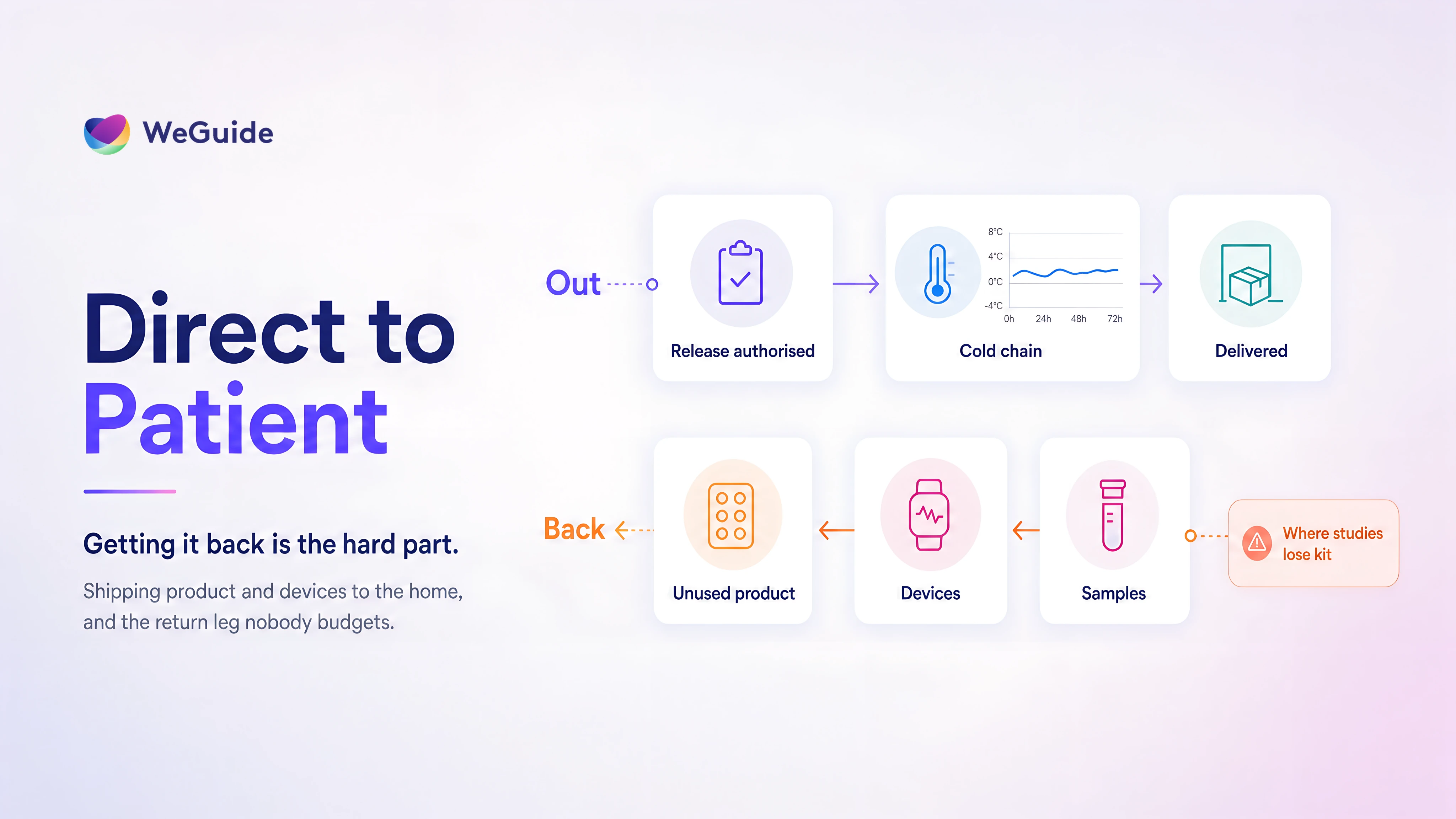


Direct to patient clinical trials ship investigational product, devices or sampling kits from a depot or pharmacy to the participant's address rather than to an investigator site. It is the layer that makes a remote visit schedule physically possible, and it is the one most protocols budget last.
It is also the layer where decentralised studies most often run into friction, and the friction is rarely on the way out. Sending a box is easy. Documenting who authorised it, proving what temperature it travelled at, and getting the device back six months later are the parts that consume the budget.
Key Takeaways
- Shipping to a participant does not change who is accountable. The investigator still authorises release of investigational product, and the chain of custody documentation requirements are the same as they would be at a site.
- Reverse logistics is the real cost. Getting devices and unused product back is harder than sending them out, and it is where studies discover they have no process.
- Temperature and stability decide feasibility before anything else does. A product that cannot survive an uncontrolled courier journey is not a direct to patient candidate, whatever the study design wants.
- The address is protected data, and it changes. Participants move, mistype and go on holiday. Address handling is a privacy question and an operational one at the same time.
- The participant needs to know a box is coming. Most delivery failures are not courier failures. They are nobody being home, because nobody told them.
What Direct to Patient Clinical Trials Actually Cover
Four different things travel to a participant's home in a decentralised study, and they carry very different obligations.
| What ships | Typical origin | The binding constraint |
|---|---|---|
| Investigational product | Depot or investigator site pharmacy | Investigator authorisation, chain of custody, temperature, accountability and return |
| Study devices | Sponsor or vendor stock | Provisioning, configuration, retrieval and refurbishment |
| Sampling kits | Central laboratory | Sample stability from collection to receipt |
| Ancillaries and supplies | Vendor stock | Low risk, but volume and repeat shipping add up |
Only the first carries the full weight of drug accountability regulation. The others are operationally demanding rather than regulatorily heavy, which is why teams often build a good process for medication and an improvised one for everything else.
What the FDA Expects From Direct to Patient Clinical Trials
The FDA's final guidance on conducting clinical trials with decentralised elements, published in September 2024, addresses this directly in its section on packaging and shipping of investigational products. Three expectations matter most in practice.
Release is still authorised by the investigator. Where product reaches participants through a central distribution service, the guidance states that the investigator must authorise the distributor's release of it. It offers no delegated alternative.
Receipt must be ensured, return and disposal must be documented. The guidance keeps three obligations with the investigator: authorise release, ensure the participant or local provider received the product, and document the return or disposal of anything unused. The sponsor separately has to describe in the trial documents how receipt will be tracked. The record requirements sit in the existing regulations, 21 CFR 312.59 to 312.62 for drugs and 21 CFR 812.100 to 812.140 for devices. Nothing about those becomes optional because the destination is a home address.
Shipment conditions have to be planned in the trial documents. The guidance asks sponsors to set out how the physical integrity and stability of the product will be maintained during shipment, including the packaging materials and methods, with temperature control given as the example. It stops there. It does not prescribe a per shipment temperature record, so if your data will need one to survive a query, that requirement has to be written into your own documents.
The guidance is explicit throughout that the sponsor retains responsibility for trial conduct regardless of where activity physically happens. Our guide to decentralized clinical trials covers the wider set of sponsor obligations the same document sets out.
Feasibility: Four Questions Before You Commit
Answer these before the protocol locks, because two of them can kill a direct to patient design outright.
1. Can the product survive the journey? The guidance is direct about this: drugs best suited for direct shipment to the home are those with good stability profiles, and drugs involving specialised handling, shipping and storage conditions may not be suited to it. Work through temperature range, excursion tolerance, total transit time and what happens on a failed delivery attempt.
2. Can the participant handle it? Storage at home, preparation, administration, and disposal of sharps or unused product. A stable oral tablet and a reconstituted injectable are not the same problem.
3. Does the jurisdiction allow it? Rules on shipping medicinal products to a private address vary by country and sometimes by state, and a multi country study multiplies rather than adds these questions. Europe's position on decentralised elements, including direct to participant shipping, is set out in the recommendation paper the European Commission, the Heads of Medicines Agencies and the EMA published in December 2022.
4. What happens when nobody is home? This sounds trivial and it is the single most common cause of a wasted shipment. Decide the redelivery rule, the maximum number of attempts, and what a failed delivery means for the dosing window.
Devices Are a Different Problem
Investigational product mostly goes one way. Devices go out, get worn, and have to come back, which turns a shipping question into a fleet management question.
Provisioning is not one shipment. Some devices need a fitting step before the real one can be sent. The Samsung Galaxy Ring is sized from a kit of nine sample rings with a minimum 24 hour wear test before the participant confirms a size. That is two shipments to the participant and a multi week gap before the first data point, which has to be built into the enrolment timeline rather than discovered in it. Sizing kits are a ring problem specifically, but the pattern generalises: anything that has to fit needs a provisioning step before the real shipment goes out.
Configuration decides how much support you will need. A device that arrives already paired to the study account is a different support burden from one the participant has to set up. Withings Health Solutions, the contracted enterprise arm rather than the consumer product, is the only vendor in the consumer wearable set that publishes a logistics API for this. One server to server call creates the participant account, dropships a preconfigured cellular device and returns the token the sponsor platform uses to pull data, so the participant unboxes it, turns it on and starts. No app, no pairing. The boundary matters: the cellular roster is scales and cuffs, not the wrist. The ScanWatch is not cellular, so a wrist arm puts the phone back in the loop. That model is worked through in our Withings for clinical research guide.
Some devices carry consumables. A Polar H10 is a strap with integrated dry electrodes plus a coin cell, and both are consumed per participant cycle, so a long study needs replacement straps and cells in stock rather than a single issue. The refurbishment loop is longer than it looks too: laundering, an electrode check, a fresh cell, firmware verification and re pairing. Our Polar H10 guide covers where that bites.
Research grade instruments are provisioned by definition. Effectively nobody owns one already, so the entire fleet is yours to distribute, recover and refurbish. See research grade actigraphy for what that looks like in a long observational study.
The wider ownership question, whether you ship devices at all or ask participants to use their own, is covered in BYOD versus provisioned devices. The short version: provisioning solves an access problem and creates a logistics one.
The box arrives. Then what?
WeGuide tells the participant it is coming, walks them through setup, confirms receipt, and keeps the reminders running, alongside consent and outcomes in the same app.
Reverse Logistics: The Part Nobody Budgets
Getting things back is harder than sending them out, for a reason that is behavioural rather than operational. Sending a box to someone who is waiting for it is easy. Asking someone who has finished the study to package a device, print a label and visit a drop off point is a request with no reward attached.
Four things travel back, and each has a different failure profile.
- Unused investigational product, which must be accounted for and either returned or destroyed under a documented process.
- Devices, which represent real capital and are needed for the next participant.
- Samples, which are usually time critical and usually the best handled of the four because a courier collection is built in.
- Packaging and ancillaries, which mostly do not come back and mostly should not need to.
Three design choices materially improve return rates:
- Ship the return with the outbound. The guidance already expects shipping containers to carry instructions for returning unused product, so a prepaid, pre addressed return package inside the original box is the natural way to meet it, and it removes the two steps most likely to stop someone.
- Ask while they are still engaged. A return request that arrives at the final visit, while the participant is still in contact with the study, works far better than one that arrives three weeks after their last interaction.
- Make the reminder specific. "Please return your study equipment" is a weaker instruction than "your device and the prepaid envelope are in the blue box, drop it at any post office by Friday". That is a participant engagement problem, not a courier problem.
Plan the refurbishment loop too. A returned device needs inspection, cleaning, data wipe, charge and reconfiguration before it can go out again. If the study assumes fleet reuse to hit its budget, the turnaround time between participants is a real constraint on enrolment rate.
Where Studies Actually Lose Data
The interesting failures are not lost parcels. They are these.
The gap between shipment and first data. Every day between dispatch and a working device is a day of missing baseline. Sizing kits, address corrections and setup calls all sit in that gap, and none of them appears on the logistics vendor's service level agreement.
Silent non delivery. A device that arrives and is never unboxed produces the same dataset as one that was never sent. Without a confirmation step, the study finds out at the first data review, and the missing baseline is indistinguishable from a device that failed. Our guide to wearable data quality and validation covers how to plan for that.
Address decay in long studies. Participants move. In a multi year cohort, a meaningful share of shipping addresses are stale by the second wave, and the failure surfaces as an undeliverable parcel rather than as a data query. The address is also the most identifying field in the study, and it has to leave the sponsor's system to reach a courier, which makes the shipping file a data sharing decision with a named lawful basis rather than an operational detail. Decide who holds it, who it is passed to, and when it is deleted, before the first shipment.
Equity, hiding inside logistics. A study that can only ship to a residential address during business hours quietly excludes shift workers and people without secure delivery. That exclusion is not random and it points the same way as every other access barrier: older, lower income, more rural.
Where WeGuide Fits, and Where It Does Not
We are not a logistics vendor. We do not run depots, hold investigational product, book couriers or manage a cold chain. Those belong to a specialist supplier and, for investigational product, to the pharmacy and the investigator. We are also not a CRO, a CTMS or an EDC. A direct to patient study still needs all of those, and we are built to run alongside them.
What we do is the participant facing half of the same workflow, and it is the half that determines whether the shipment turns into data. The guidance also expects investigators to ensure participants have appropriate instructions for using a product shipped to them, which is the participant facing half. WeGuide tells the participant a device is coming and when, delivers that instruction as patient education rather than a paper leaflet, captures confirmation that it arrived and works, runs the reminders that keep it worn, and asks for it back at the moment the participant is still engaged. All of that sits in the same branded app as their consent and their outcome questionnaires. Where the device is one we integrate with natively, Garmin, Apple Health or Google Fit, the readings land in the same participant record. Everything else stays in the device vendor's own pipe. Our Integration Engine then connects that record to the systems you already run, your EDC, EHR or CRM.
The logistics vendor gets the box to the door. The participant facing layer decides what happens after it lands. If you are comparing vendors for the whole stack, our decentralized clinical trial platform page sets out what we cover and what we do not.
Direct to Patient Clinical Trial FAQs
What is a direct to patient clinical trial?
It is a trial in which investigational product, devices or sampling kits are shipped from a depot, pharmacy or vendor directly to the participant's address rather than to an investigator site. It is one of the elements that makes a decentralised or hybrid design workable, and it is usually combined with remote visits and electronic outcome collection. The wider set of design choices is covered in the DCT design guide, and the history of the older virtual trial label sits alongside it.
Does the FDA allow shipping investigational product to a participant's home?
Yes. The FDA's September 2024 guidance on conducting clinical trials with decentralised elements addresses direct to participant shipping explicitly. The requirements do not relax. The investigator must still authorise release of the product by the distributor, ensure receipt, and document the return or disposal of anything unused, under the same regulations that apply to site based supply. Separately, the guidance asks sponsors to describe in the trial documents how the product's integrity and stability will be maintained in transit.
What is reverse logistics in a clinical trial?
Everything that travels back: unused investigational product for accountability and destruction, devices for reuse, and samples for analysis. It is consistently underestimated because the outbound journey is to someone who wants the parcel and the return journey is a request to someone who has finished the study.
How do you improve device return rates?
Ship the prepaid return packaging with the outbound parcel, make the request while the participant is still engaged rather than weeks after their final contact, and make the instruction specific about what to return, where and by when. Return rates are an engagement problem more than a courier problem.
Who is responsible for investigational product once it leaves the site?
The sponsor retains responsibility for trial conduct, and the investigator retains responsibility for authorising release and for drug accountability. Shipping to a home address changes the destination, not the accountability chain.
What cannot be shipped direct to patient?
Per the FDA guidance, products involving specialised handling, shipping or storage conditions may not be suited to direct shipment, alongside anything the jurisdiction does not permit to be sent to a private address. Products requiring supervised administration, complex reconstitution or strict cold chain generally stay at the site.
What to Take Into Your Next Protocol
Direct to patient clinical trials rest on the layer that makes the rest of a decentralised design physically possible, and it is the one that will not forgive an optimistic plan. The questions that decide it are all answerable before the protocol locks: can the product travel, can the participant handle it, does the jurisdiction allow it, and what happens on a failed delivery.
Then plan the return before the first shipment leaves. Getting devices back is harder than sending them out, and the study that treats it as an afterthought will pay for it twice, once in lost hardware and once in the data that never arrived.
Talk through the participant side of your supply plan
We will look at what your study ships, what has to come back, and how the participant facing layer turns a delivery into usable data.
Book a demoNo pressure, just a conversation.

