

.svg)


Virtual clinical trials is an older name for studies that move activity away from the investigator site to the participant. The industry used it for roughly a decade, alongside siteless and remote, and has largely replaced it with decentralised, or more precisely with decentralised elements.
That is not a cosmetic change. The old word described a place, or rather the absence of one, and the new one describes a set of choices. This piece is about where the term came from, what happened to it, and what it still costs a team that uses it. If you want the design framework rather than the history, that lives in our guide to decentralized clinical trials.
Key Takeaways
- Virtual, siteless and remote are all older labels for the same family of designs. The current term of art is decentralised, and the FDA's is narrower still: decentralised elements.
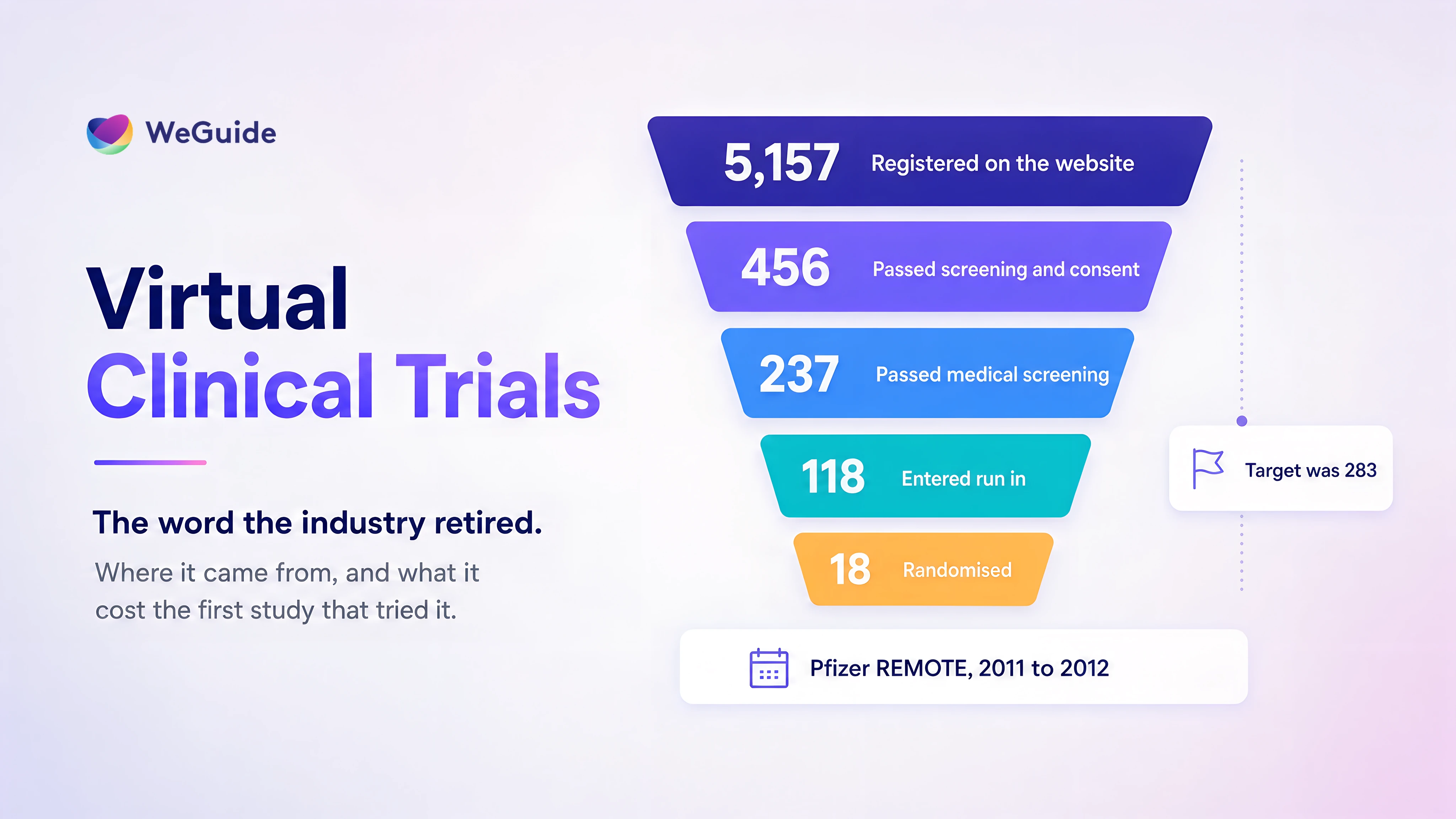
- The first entirely web based drug trial is a cautionary tale, not a success story. Pfizer's REMOTE study opened in 2011, drew 5,157 registrations, randomised 18 participants and was terminated for lack of recruitment.
- The word promises something no study delivers. Almost no protocol is fully virtual, so the label sets an expectation the design cannot meet and invites the wrong questions from reviewers.
- Regulators reframed deliberately. The FDA retitled its guidance between draft and final, from decentralised clinical trials to conducting clinical trials with decentralised elements.
- The search term is contaminated. Most volume around it belongs to market research reports and to people looking to join paid studies, not to sponsors designing one.
Where the Term Came From
The idea predates the vocabulary. Remote data collection existed in research long before anyone called a study virtual. The label arrived with a specific attempt to run an entire trial without a site.
Pfizer's REMOTE study, registered as NCT01302938, opened in March 2011. It was an exploratory, randomised, placebo controlled phase 4 pilot of tolterodine extended release in overactive bladder. Participants were recruited and screened through the website, consented online with a physician countersignature, had their laboratory tests done locally in their own community, and had study medication shipped to their door. The trial ran from a single clinical site overseen by physicians, which is why siteless was always the looser of the two labels. It was published in full (Orri et al., Contemp Clin Trials 2014).
It randomised 18 people and was terminated. The registry gives the reason as recruitment terminated due to lack of recruitment, and the study closed in August 2012 against a target of 283 randomised participants.
The published funnel is the part worth sitting with. 5,157 people registered on the trial website. 456 cleared initial screening, identity verification and consent. 237 passed medical screening, 118 entered the placebo run in, and 18 made it through the e-diary assessment to randomisation. Interest was never the constraint. The study lost more than 99% of its volunteers inside its own onboarding.
That is the lesson the industry eventually drew, and it still holds. Removing travel produces sign ups. What converts a sign up into a randomised participant is how much you ask of someone in the first weeks, before they have any reason to stay. The trial's own authors reached the same conclusion, recommending simplification of the multi step screening and testing chain. It is a design and engagement question rather than a geography one, and the mechanism is worked through in how decentralised trials improve engagement and retention.
What Happened to the Word
Three things, in order.
Between 2011 and 2019 the term stayed niche. Virtual and siteless described an aspiration more than a practice. A handful of studies used remote elements, mostly observational, and the vocabulary stayed loose.
In 2020 the aspiration became compulsory. Sites closed, visits could not happen, and regulators issued emergency guidance so studies could continue. What had been an experiment became a set of tools that stayed in use afterwards. Our COVID era case study shows what that looked like in one study.
Then regulators picked a different word, and picked it carefully. The FDA's draft guidance, issued in May 2023, was titled Decentralized Clinical Trials for Drugs, Biological Products, and Devices. The final version, published in September 2024, is titled Conducting Clinical Trials With Decentralized Elements, and it defines a decentralised clinical trial as "a clinical trial that includes decentralized elements where trial-related activities occur at locations other than traditional clinical trial sites".
Europe made the same move earlier. The recommendation paper published by the European Commission, the Heads of Medicines Agencies and the EMA in December 2022 is on decentralised elements in clinical trials, not on virtual trials.
The direction of travel is consistent across both jurisdictions. The unit of analysis moved from the study to the element.
Why the Word Costs You Something
Three practical costs, in ascending order of seriousness.
1. It describes a design almost nobody runs. Very few studies are fully virtual. Most are hybrid, keeping the visits that need equipment or hands on assessment and moving the rest. Calling a hybrid study virtual overstates it, and the first person to notice will be a reviewer.
2. It invites the wrong question. "Is this trial virtual?" is a yes or no question about the whole study, and it has no useful answer. "Which elements are decentralised, and how is each one justified against the endpoint it supports?" is the question a regulator asks, and the word virtual does not prompt it.
3. It implies the technology is the design. The word points at the delivery mechanism. It says nothing about whether the measure survives the move, which is the part that determines whether the study produces usable evidence. A remotely collected signal does not become an acceptable endpoint because it arrived automatically, a point the FDA's guidance on digital health technologies, finalised in December 2023, makes explicitly and our guide to that framework works through in detail.
None of this means the word is forbidden. It means that if you use it externally, you should be able to say immediately which elements you mean.
What the Virtual Framing Gets Right and Wrong
The word is not empty. It points at three real benefits and it hides three real costs, and the pattern of what it points at versus what it hides is the clearest argument for retiring it.
What it gets right. Reach, retention and measurement frequency are genuine, and the word gestures at all three. Removing a travel requirement does widen the eligible population, does reduce one large source of burden, and does replace four clinic data points a year with a weekly or continuous record. The full case, with the evidence and the trade off attached to each, is in our decentralised clinical trials guide.
What it hides, one. It implies cost savings that do not arrive. Site and monitoring lines fall while technology, logistics and data management lines rise. The reliable return is time to enrolment, not budget, and virtual is the word most often used to promise the opposite.
What it hides, two. It makes completeness sound solved when it is the main open problem. Remote capture fails in ways a clinic visit does not, and the failures are technical rather than behavioural. Across four Samsung Galaxy Watch datasets covering the Watch 3 to Watch 6 generations, two of them produced or funded by Samsung including its own De Novo submission where 205 of 1,229 nights were rejected, between 16% and 26% of overnight recordings or single lead tracings were classed as insufficient or inconclusive. Power on realistic capture rates, not ideal ones. Our guide to wearable data quality and validation covers how to set them.
What it hides, three. It suggests a study can run without anyone, when in practice the work moves rather than disappears. Coordinators spend less time on visits and more on remote monitoring, device support and data chasing. Shipping product and devices to homes and getting them back is the least glamorous constraint and a common source of delay, covered in direct to patient clinical trials. And a design that assumes a smartphone quietly excludes people non randomly, which is worked through in BYOD versus provisioned devices.
The participant facing half, in one place
WeGuide brings eConsent, ePRO, education, reminders and wearable data capture into a single branded app, alongside the systems you already run.
Why This Term Returns Market Reports
If you searched this term and the results felt off, that is not you. The phrase carries three different intents and only one of them belongs to a sponsor.
| Who is searching | What they want | Typical result |
|---|---|---|
| Sponsors and study teams | Design guidance for a protocol | Vendor pages and a handful of guides |
| Market analysts | Industry sizing and forecasts by region | Paid market research reports |
| Members of the public | Paid studies they can join | Recruitment listings |
The second group is much larger than the first, which is why a term that describes a trial design mostly returns pages selling forecasts. It is also a small piece of evidence for the main argument: when a word attracts three audiences that want nothing to do with each other, the field tends to replace it. If you are evaluating suppliers rather than designs, our decentralized clinical trial platform page is the more useful starting point.
What to Say Instead
Replace the label with the specifics. In a protocol, a proposal or a conversation with a reviewer, these carry information the old word does not.
| Instead of | Say |
|---|---|
| "This is a virtual trial" | "Consent, outcome reporting and safety check ins are decentralised. Imaging and dosing stay at the site" |
| "We are running a siteless study" | "There are no required site visits. Local phlebotomy and home nursing cover the physical assessments" |
| "It is a remote trial" | "Follow up is by telehealth, with a wearable supplying the continuous measure" |
| "We virtualised the trial" | "We decentralised four of the six visits, and here is the justification for each" |
Each of these is longer. Each is also answerable, which the original is not.
Virtual Clinical Trial FAQs
What is a virtual clinical trial?
A study in which most or all activity happens away from a traditional investigator site, with consent, outcome reporting, monitoring and sometimes product delivery handled remotely. The term is an older label for what the industry and regulators now call a decentralised clinical trial, or more precisely a trial that includes decentralised elements.
What is the difference between virtual and decentralised clinical trials?
They describe the same family of designs. Decentralised is the current term of art and the one regulators use, and it is more precise because it applies to individual elements rather than to the whole study. Virtual implies an all or nothing design, which very few real protocols are.
Was there ever a fully virtual clinical trial?
Not quite, and the closest attempt is instructive. Pfizer's REMOTE study, which opened in 2011 as a web based phase 4 methodology trial in overactive bladder, is described by its own investigators as the first entirely web based trial conducted under an Investigational New Drug application. Even so it ran from a single clinical site, and participants had their laboratory tests done locally. It drew 5,157 registrations, randomised 18 participants, and was terminated for lack of recruitment in 2012.
What are the benefits of virtual clinical trials?
The same three the industry claims for decentralised designs, because they are the same designs: wider geographic reach, lower travel burden which supports retention, and much higher measurement frequency than periodic clinic visits allow. The difference is that the word virtual also implies cost savings and a study that runs itself, and neither is reliable.
What are the challenges of virtual clinical trials?
The challenges are the same as for any decentralised design, and the label adds one of its own. Because virtual describes the whole study rather than its parts, it encourages teams to plan at the study level when every real constraint sits at the element level: this consent method, this instrument, this device, this shipping route. A reviewer assesses the elements. Planning against the label rather than the elements is how a protocol arrives at review with a remote measure nobody justified.
Is virtual the same as siteless?
Close enough that the two were used interchangeably, though siteless was always the stronger claim: no site involvement at all rather than reduced site involvement. Neither term is in current regulatory use.
Should I still use the term in a protocol?
Use it if your audience does, then immediately name the elements. A reviewer will not ask whether the study is virtual. They will ask which activities were decentralised and how each one was justified against the endpoint it supports.
What to Take From the Virtual Clinical Trials Story
Virtual clinical trials described an ambition rather than a design: a study with no site at all. The ambition turned out to be both harder and less useful than it looked, and the field replaced it with a vocabulary that matches what teams actually do, which is choose elements.
That is the practical takeaway from a terminology question. If you catch yourself asking whether a study is virtual, the more productive version of the question is which parts of it can move, what each move buys, and what each one costs. The element by element version of that question is the whole subject of our DCT design guide, and the visit level decision that follows it is covered in our hybrid trials guide.
Talk through which elements of your protocol can move
We will look at what your endpoints need, what that means for consent, outcomes and device data, and where the completeness risks sit.
Book a demoNo pressure, just a conversation.

