

.svg)
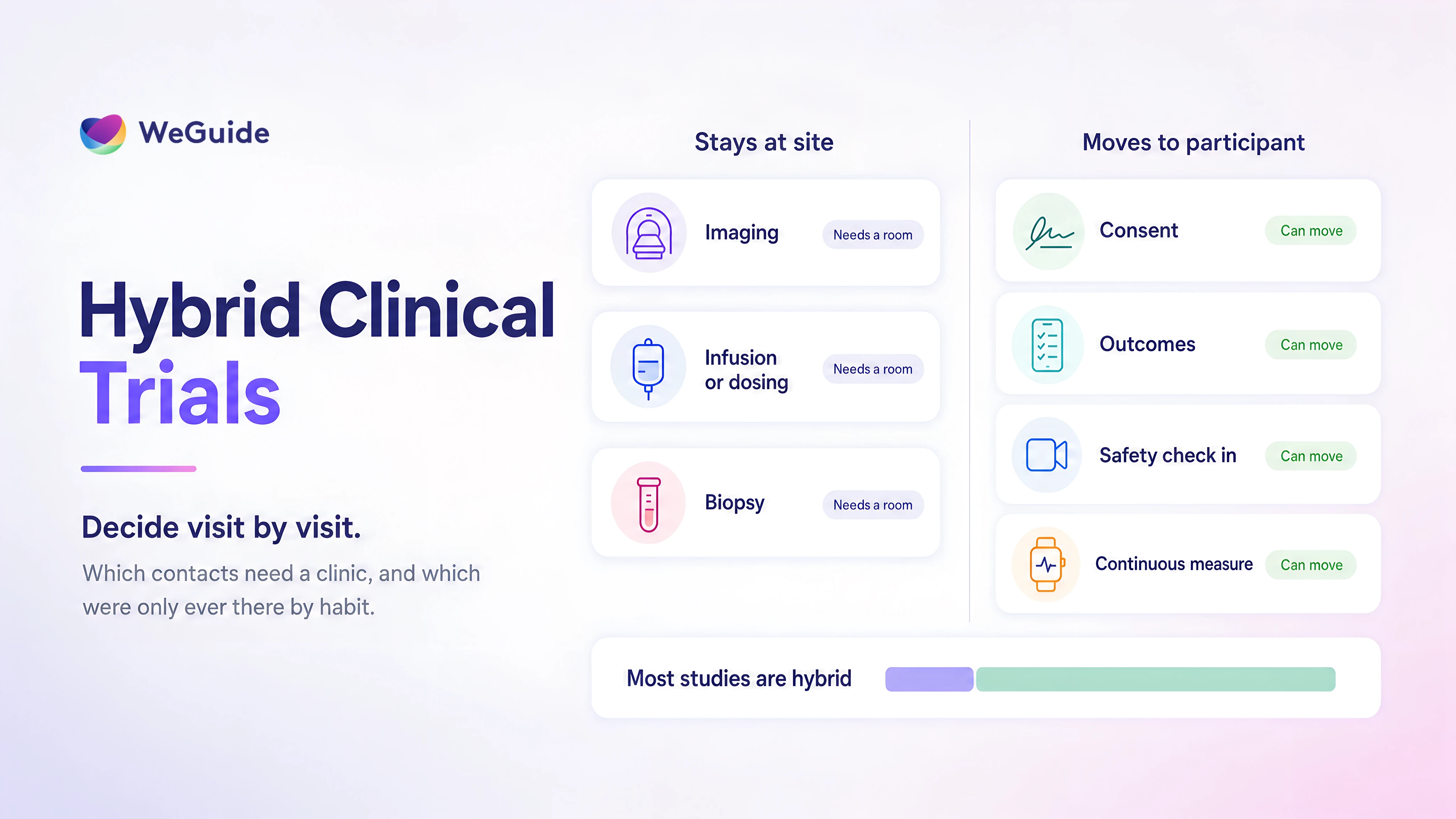


Hybrid clinical trials keep a small number of in person visits and move everything else to the participant. It is the design most real studies land on, because few protocols can move everything and almost none need to. The older labels for the same family, virtual and siteless, have largely fallen out of use for exactly that reason.
That makes the useful question narrower than the label suggests. You are not choosing between hybrid and traditional. You are deciding, visit by visit, which contacts have to happen in a room with a clinician and which do not. That call gets made row by row, and each row has a cost.
Key Takeaways
- Hybrid is the default, not the compromise. Fully remote studies are rare. Regulators assess the elements you decentralise rather than the label you put on the study.
- Decide at the visit level, not the study level. The unit of decision is a single contact in the schedule of assessments, and every visit has a different answer.
- A visit needs a site when it needs hands, equipment, or clinical judgement in the room. Everything else is a candidate to move, subject to whether the measure survives the move.
- Hybrid does not halve the work, it splits it. You now run two operating models at once, and the coordination between them is new work that did not exist before.
- The failure mode is a half migrated schedule. A participant who still has to attend the site will not feel the benefit of the visits you did move, and your retention case evaporates.
What Is a Hybrid Clinical Trial?
A hybrid clinical trial is a study that combines in person site visits with remote or local activity. Consent might be signed at home, symptom diaries might arrive from a phone, a wearable might stream continuously, and the participant still attends the clinic for an infusion, a biopsy, or an imaging appointment.
The term sits in the middle of a spectrum. A fully decentralised trial requires no visit to a traditional investigator site. A site based trial with decentralised elements adds one or two remote components to a conventional design. Hybrid is everything in between, which is where the large majority of real protocols sit.
The label carries no regulatory weight. Regulators assess whether each element produces data fit for its purpose, not what you called the design in the protocol summary. The FDA's final guidance on conducting clinical trials with decentralised elements, published in September 2024, is written around elements rather than trial types, and Europe's recommendation paper on decentralised elements takes the same approach. Our guide to decentralized clinical trials sets out the framework, and the same logic governs a hybrid study.
Hybrid vs Decentralized Clinical Trials: What Actually Differs
The two words describe overlapping things, so the comparison only helps if you make it operational rather than definitional.
| Fully decentralised | Hybrid | Site based with remote elements | |
|---|---|---|---|
| Required site visits | None | Some, defined in the protocol | All, plus remote extras |
| Who owns participant contact | The study platform | Split between site and platform | The site |
| Typical use | Low risk interventions, observational, registries | Most interventional studies | Adding eConsent or diaries to an existing design |
| Main operational risk | No fallback when technology fails | Coordination between two models | Little change, little benefit |
| Main scientific risk | A remote measure cannot support the claim | A measure changes method mid schedule | None |
Operational risk is the row people underestimate. In a fully decentralised study the operating model is at least consistent. In a hybrid study you are running two, and the seam between them is where participants get lost.
How to Decide, Visit by Visit
Take the schedule of assessments and go through it one row at a time. For each contact, ask three questions in order.
1. Does this visit need hands, equipment or a room? A physical examination, an infusion, an imaging appointment, a biopsy, a procedure under supervision. If yes, it stays, and the conversation is over.
2. If not, does the measure survive the move? Collecting a signal remotely does not make it an acceptable endpoint. An instrument validated on paper does not automatically retain its measurement properties on a screen, which is why choosing between eCOA and ePRO is a scientific decision, and why eCOA validation exists as a discipline. If the answer is no, the visit stays.
3. If yes, who is the right person to do it, and where? Not everything that leaves the site has to reach the home. A local pathology collection, a community pharmacy, a visiting nurse and a telehealth call are four different answers, with four different cost and oversight profiles.
Only visits that clear all three move.
The visit types, and where each usually lands
| Visit type | Usually stays | Usually moves | The deciding factor |
|---|---|---|---|
| Screening and eligibility | Sometimes | Often | Whether eligibility depends on a physical finding or a site only test |
| Informed consent | Sometimes | Often | The complexity of the conversation, not the technology |
| Randomisation and first dose | Usually | Rarely | Supervision requirements in the first hours |
| Routine safety review | Sometimes | Often | Whether an adverse event needs same day clinical assessment |
| Patient reported outcomes | Rarely | Almost always | Whether a validated electronic version exists |
| Vital signs and physiological measures | Depends | Depends | Whether the measure is a primary endpoint with a validated remote method |
| Laboratory samples | Often | Sometimes | Sample stability and whether a local provider network covers the catchment |
| Imaging and procedures | Always | Almost never | Equipment |
| End of study | Sometimes | Often | Whether a final physical assessment is required |
Consent moves more easily than people expect, and it is where the ethics concentrate. A participant who signs at home has fewer chances to ask a follow up question, so remote consent needs comprehension checks and a real route back to a person. That is a design problem, not a technology problem, and it is covered in eConsent in clinical trials.
Vital signs are the row that most often gets moved without justification. A remote device is fine for an exploratory or secondary measure where evidence exists in a population like yours. As a primary endpoint with no validated remote method, it is a design error. The FDA's companion guidance on digital health technologies, finalised in December 2023, sets the fit for purpose standard, and our guide to that framework covers what a sponsor has to demonstrate first.
Run both halves of a hybrid study without two participant experiences
WeGuide carries the remote half, consent, outcomes, education, reminders and wearable data, in one branded app that sits alongside the site systems you already run.
What the Remote Half Runs On
The five layer stack behind any remote element, consent, outcomes, sensors, visits and logistics, is set out in the DCT design guide. Hybrid adds one requirement a fully remote design never has: every layer has to reconcile with a site that is still running.
- Two sources of truth per participant. The site holds source documents for the visits that stayed. The remote layer holds everything else. Name which system is authoritative for each field before the protocol locks.
- One consent record, two signing routes. On the same protocol version some participants will sign remotely and some at the site. An electronic informed consent platform has to hold both, and re consent on amendment has to reach both groups.
- A schedule the participant experiences as one study. If the app carries the remote tasks and the site books the in person visits separately, the participant is managing two calendars for one trial.
The BRACE trial is a clean example of the shape. Run with the Murdoch Children's Research Institute across five countries, it kept the parts that needed a clinician, vaccination and blood collection, and moved consent and daily symptom reporting to a phone app for more than 6,000 participants. The BRACE case study sets out how that worked.
WeGuide sits on the participant facing side of that stack. We're the layer the participant touches, and we're not a CRO, a CTMS, an EDC, a telehealth provider or a logistics vendor. A hybrid trial needs all of those alongside us. If you're shortlisting a decentralized clinical trial platform, that page sets out which layers we cover and which we do not.
What Moving Half the Visits Actually Buys
The case for decentralising, wider reach, better retention and far higher measurement frequency, is worked through in the DCT design guide. In a hybrid design you get a fraction of each, and the fraction is not proportional to the number of visits you moved.
Reach is capped by the visits that stay. If one visit needs an infusion suite, your catchment is still the catchment of the sites that have one. Moving five of six visits widens who can stay in the study, not who can join it. Reach only opens up when the remaining visits can be run by a local provider network rather than by your own sites.
Retention scales with burden removed, not visits removed. A participant weighs the visit that costs them a day off work far more heavily than the 20 minute review you moved to video. Work out which visits are expensive for them, then check how many of those you actually moved. The mechanism is worked through in how decentralised trials improve engagement and retention.
Measurement frequency is the one benefit hybrid delivers in full. Continuous or weekly remote capture between the site visits you kept does not depend on how many visits moved. It is available to any design that adds a remote layer at all, which is why it is usually the strongest reason to go hybrid and rarely the reason people give.
Where Hybrid Clinical Trials Go Wrong
Five failure modes recur, and none of them is a technology failure.
1. The half migrated schedule. You move four of six visits and the participant still has to arrange childcare, take a day off and drive two hours for the other two. The burden they actually feel barely changes, so the retention benefit you modelled does not arrive. If the visits that stay are the expensive ones for the participant, moving the cheap ones buys you little.
2. The measure changes method mid schedule. A questionnaire completed on paper at the site in week 1 and on a phone at home in week 4 is not necessarily the same measurement. Decide the mode once, per instrument, and keep it.
3. Site workload goes up, not down. Coordinators now chase remote data, troubleshoot devices, run video visits and reconcile two sources of truth, on top of the visits that stayed. Hybrid removes the waiting room, not the work. Budget the coordinator time honestly.
4. Nobody owns the seam. When a remote reading looks abnormal, who calls the participant, in what window, and is that documented? A hybrid design creates handoffs that a site based study never had. Write them into the protocol rather than discovering them during conduct.
5. Data completeness assumptions are copied from site based studies. They do not transfer. Remote capture introduces technical failure modes a site visit does not have. The best documented case is the Samsung Galaxy Watch. Across four datasets covering the Watch 3 to Watch 6 generations, two of them produced or funded by Samsung including its own De Novo decision summary where 205 of 1,229 nights were rejected, between 16% and 26% of overnight recordings or single lead tracings were classed as insufficient or inconclusive. Assume a loss rate in that region for any consumer device measure until your own pilot says otherwise, and read wearable data quality and validation before you set the target.
A Practical Sequence for a Hybrid Protocol
The general sequence, endpoints first, an owner per element, budget for incompleteness and a fallback for every remote element, is in the DCT design guide. Four steps are specific to hybrid.
- Mark up the schedule of assessments row by row using the three questions above, and record the reason for each decision. Reviewers ask why a visit stayed as often as they ask why one moved.
- Fix the mode per instrument for the whole study, not per visit. If a questionnaire will ever be completed at home, it is an electronic instrument from week 1.
- Write the handoffs between the two halves. Who acts on a remote signal, in what window, with what documentation, and who tells the site.
- Add up the participant's week, not the site's. Include the remote tasks. If total burden went up while visit count went down, the design is not finished.
Hybrid Clinical Trial FAQs
What is a hybrid clinical trial?
A hybrid clinical trial combines in person site visits with remote or local activity. Participants attend the clinic for the procedures that require it and complete the rest, such as consent, outcome reporting and continuous monitoring, from where they are. It is the most common shape a decentralised design takes in practice.
What is the difference between a hybrid and a decentralised clinical trial?
A fully decentralised trial requires no visit to a traditional investigator site. A hybrid trial keeps some, usually for procedures that need equipment or hands on assessment. In regulatory terms the distinction matters less than people expect, because regulators assess the individual elements you decentralise rather than the label on the study.
Why are most clinical trials hybrid rather than fully remote?
Because most interventional protocols contain at least one contact that cannot move: an infusion, a biopsy, an imaging appointment, or a supervised first dose. Once one visit has to stay, the study is hybrid by definition, and the useful work is deciding what to do with the rest.
How do you decide which visits to keep in a hybrid trial?
Go through the schedule of assessments one row at a time and ask whether the visit needs hands, equipment or a room. If it does, it stays. If it does not, ask whether the measure keeps its properties when collected remotely. If it does, ask who should perform it and where, since a local laboratory or a visiting nurse is often a better answer than the participant's kitchen table.
Are hybrid clinical trials cheaper?
Rarely, and hybrid is the design where the cost case is weakest. A fully remote study can close sites. A hybrid study pays for the site network and the remote layer at the same time, so cost per participant can rise even as visit count falls. The return, when it arrives, is faster enrolment and fewer dropouts.
How many visits have to move before a trial counts as hybrid?
One. There is no threshold. A study is hybrid the moment the protocol specifies at least one required site visit and at least one element performed remotely or locally. That is why the label tells a reviewer very little and the schedule of assessments tells them everything.
What is hybrid trial design?
Hybrid trial design is the decision itself: which contacts are specified as in person in the protocol and which are specified as remote or local. It is recorded in the schedule of assessments, not in a separate design document.
Does a hybrid trial reduce site burden?
No, it redistributes it. Coordinators spend less time on in person visits and more on remote monitoring, data chasing and device support, while still running the visits that stayed. Plan coordinator time for both models, not for a reduced version of one.
What to Take Into Your Next Protocol
Hybrid clinical trials are not a halfway house between two better options. It is what a well designed study looks like once you have asked, honestly, which contacts need a clinic and which are there out of habit.
The teams who get the most from it are not the ones who move the most visits. They are the ones who can say, for every row in the schedule of assessments, why that contact is where it is, and who plan for the seam between the two halves rather than discovering it during conduct.
Walk your schedule of assessments with us
We'll go row by row through which visits can move, what that does to consent and outcome data, and where the completeness risk sits.
Book a demoNo pressure, just a conversation.

