

.svg)


ActiGraph is a line of research grade accelerometers that has served as the de facto comparator in wearable validation studies for two decades. The company is now called Ametris and is owned by Signant Health. Its FDA clearances cover accelerometry only, and its flagship device was cleared on a submission whose own summary states that clinical testing was not applicable.
Disclosure. Signant Health sells eCOA, eConsent, EDC, and randomisation software, so Ametris is a WeGuide competitor. This page exists because ActiGraph is the measurement reference behind most of the accuracy claims in our own device write ups, and it is written as a methods reference. It contains no product links.
Key Takeaways
- Actigraphy is a method, ActiGraph is a brand. Conflating them is the most common error in this space, and separating them is the most useful thing this page does.
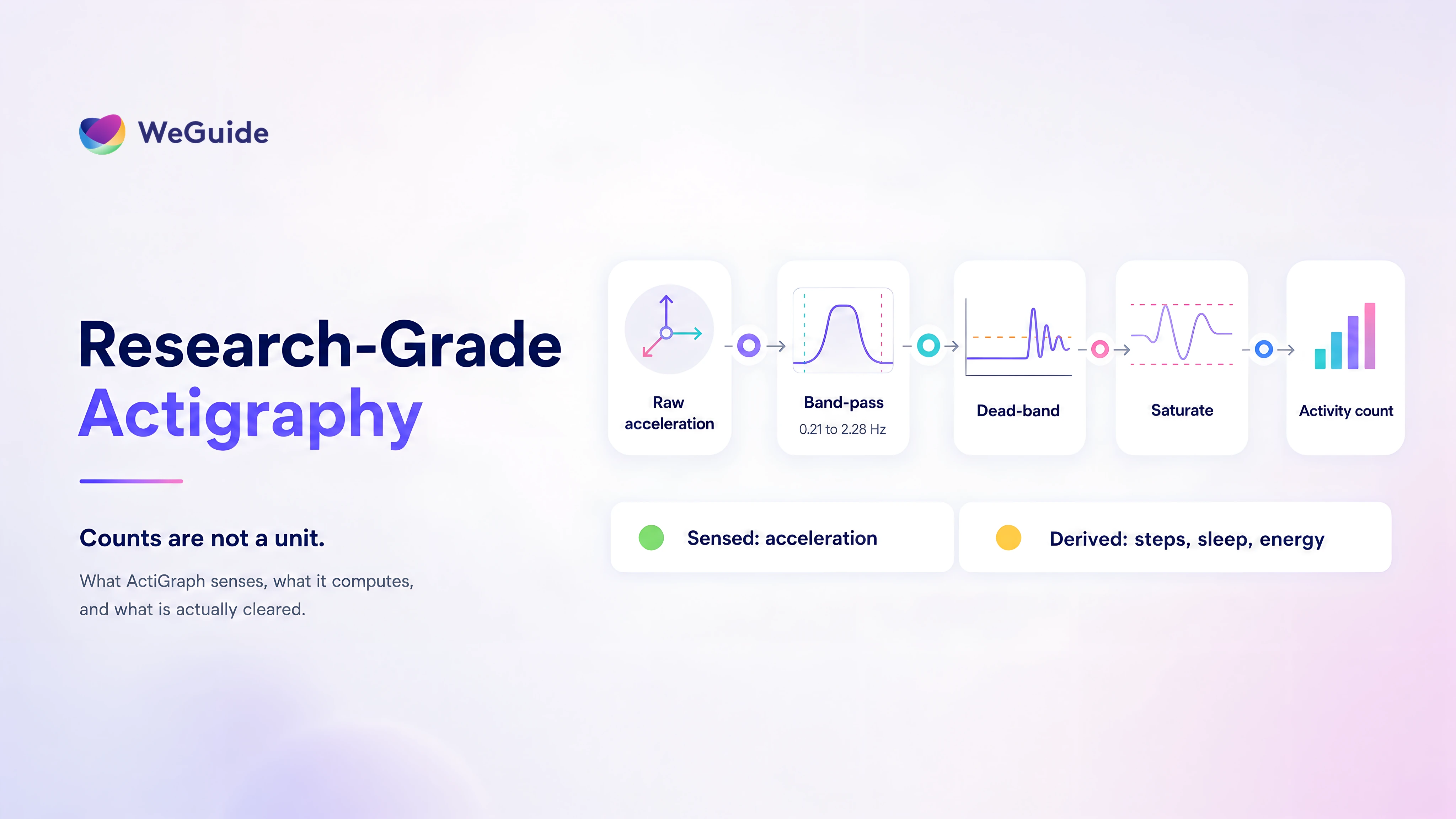
- Activity counts are a proprietary transform, not a physical unit. The algorithm was published and open sourced in 2022, in a vendor authored paper. It band passes roughly 0.21 to 2.28 Hz, applies a dead band and saturates, so it suppresses low amplitude motion by design.
- The flagship LEAP clearance contains no performance data. K231532 is a Special 510(k) whose summary reads "Clinical testing is not applicable to this submission" and lists "The software has not changed" as a same as predicate characteristic.
- The devices the literature validated have no clearance of their own. The wGT3X-BT and GT9X are listed under K080545, a 2008 clearance for a differently named exercise device, in a product code that is currently 510(k) exempt.
- Raw data access is genuinely excellent, and materially better than any consumer wearable. The file format is openly specified under an MIT licence and a sponsor can recompute the vendor's own summary metric from raw signal.
What Is an ActiGraph, and What Is Actigraphy?
Actigraphy is a method: inferring activity, rest, and circadian pattern from body worn accelerometry over days or weeks. It is a category of measurement, and it predates every device discussed here.
ActiGraph is a brand of research grade accelerometers used to do that. An ActiGraph accelerometer is worn on the wrist, hip, or ankle, samples raw triaxial acceleration, and stores or transmits it for downstream processing. Wrist actigraphy is the most common configuration in current trials, though hip placement dominates the older literature.
The distinction matters in a protocol because "the study used actigraphy" and "the study used an ActiGraph" are different statements with different implications for comparability. Two studies can both use actigraphy and be not comparable if they used different devices, different wear locations, different sampling rates or different processing cut points. This is one of the reasons that the data quality questions around wearables are rarely about the sensor.
ActiGraph Is Now Ametris
The corporate chain has moved twice in eighteen months, and study documentation written before 2025 will not match what a reader finds today.
| Date | Event |
|---|---|
| January 2025 | ActiGraph LLC acquires Biofourmis Connect |
| 25 June 2025 | ActiGraph rebrands as Ametris |
| 14 May 2026 | Signant Health announces completion of its acquisition of Ametris |
Both the rebrand and the acquisition are sourced to company press releases, and the transaction terms were not disclosed. "ActiGraph" survives as a device sub-brand: the products are still called the ActiGraph LEAP and the ActiGraph wGT3X-BT. The legacy domains now redirect to ametris.com, though the API and authentication subdomains do not.
Practical consequence for a study team: "ActiGraph LLC" no longer trades under that name. Any protocol, data management plan, or vendor qualification file naming it as the supplier needs updating, since the supplier is now Ametris, a Signant Health company. FDA databases still carry the legacy entity names, so a regulatory records search on "Ametris" or "Signant" returns nothing.
The Current Product Line: ActiGraph LEAP, CentrePoint Insight Watch and wGT3X-BT
| Actigraphy device | Status | Role |
|---|---|---|
| ActiGraph LEAP | Current flagship | Wrist worn, cleared under K231532, carries an optical sensor whose vital sign outputs are labelled investigational use only |
| CentrePoint Insight Watch | Current | Cleared 2018 under K181077, the LEAP's immediate predicate |
| wGT3X-BT | Legacy, still sold | One of the most published research devices, alongside the GT3X and GT3X+. The vendor files it under "Academic Research" as a proven legacy device |
| ActiGraph GT9X Link | Discontinued 23 August 2023 | Heavily represented in the literature, no longer purchasable |
The ActiGraph LEAP battery life discrepancy
The vendor's published battery life for the LEAP (32 days) differs from the figure in the FDA submission (30 days). Where a vendor figure and a regulatory submission figure disagree, cite both and use the lower one for planning.
What ActiGraph Actually Measures
The sensed signal is triaxial acceleration. Everything else is computation.
| Layer | Output | Status |
|---|---|---|
| Sensed | Raw triaxial acceleration, in g, at a configurable sampling rate | The physical measurement |
| Derived, documented | Activity counts | Proprietary transform, algorithm published and open sourced in 2022 in a vendor authored paper |
| Derived, undocumented | Steps | Fully proprietary, no published algorithm |
| Derived, cut point dependent | Sedentary time, moderate to vigorous activity, energy expenditure | Depends entirely on which published cut points the analyst applies |
| Optical, LEAP only | Heart rate, HRV, SpO2, blood pressure, respiratory rate, rhythm | Investigational use only, per the vendor's own brochure footnote |
Activity counts are not a physical unit
This is the single most misunderstood output in the field. A "count" is not acceleration, not energy and not steps. It is the result of a specific filtering and quantisation chain, and since 2022 that chain is public.
The chain runs in seven steps. The raw signal is band passed with half magnitude cutoffs at roughly 0.21 and 2.28 Hz, peak gain near 0.759 Hz (Neishabouri et al. 2022, vendor authored). It is then downsampled to 30 Hz and again to 10 Hz, rectified, and passed through a dead band that zeroes values below a threshold. What survives is saturated above a ceiling, quantised into 256 levels, and summed within the epoch.
Two properties follow directly from that design and both matter for endpoint selection. Counts suppress low amplitude motion, because of the dead band. And counts saturate, so they cannot distinguish vigorous from very vigorous activity. Neither is a defect. Both are consequences of a filter designed in an era of limited on board storage, and both are reasons a count based endpoint needs justification rather than assumption.
The publication of the counts algorithm was a genuine service to the field, and it should be cited with the note that nine of its eleven authors were employed by or consulting for the vendor. Steps, by contrast, remain undocumented, which means a step count endpoint on this hardware rests on an algorithm no one outside the company has seen.
For the broader question of when a derived measure can carry endpoint weight, see our guide to digital biomarkers in clinical trials.
Can You Get the Raw Data Out?
Yes, and this is where ActiGraph is unambiguously better than every consumer wearable in the category.
The .gt3x binary container is publicly specified under an MIT licence, with an open source parser maintained by the vendor. The CentrePoint V3 API is documented and exposes per subject, per day raw sensor files. A sponsor can therefore take raw acceleration, run the open counts algorithm, and reproduce the vendor's own primary summary metric.
That is not possible with Fitbit, Oura or WHOOP, and it is the property that makes ActiGraph defensible as a reference instrument. If an endpoint depends on a derivation, being able to recompute it independently is worth more than any accuracy figure.
Two caveats, both commercial rather than technical. API credentials are issued by support with no self service signup, so access is gated behind a customer relationship. And the other data categories are gated in the documentation with the phrase "subject to contract restrictions", which means the optical outputs may not be available at all depending on what was signed.
A third point is worth stating because it changes provisioning: there is no meaningful bring your own device path here. These are sponsor purchased research instruments that participants are issued, worn for a defined period and returned. That places the whole study in the provisioned column of the BYOD versus provisioned devices trade off, with the reverse logistics burden that implies.
Is ActiGraph a Medical Device?
Partly, narrowly, and less than most people assume.
Exactly three 510(k) clearances list ActiGraph as the applicant, plus one predecessor company clearance. There is no De Novo and no premarket approval anywhere in the portfolio, so nothing ActiGraph makes is FDA approved. The correct verb throughout is cleared. The distinction is not pedantry: clearance rests on substantial equivalence to a predicate, approval on independent evidence of safety and effectiveness.
The cleared indication has not materially changed since 2008. It covers documenting physical movement, monitoring activity associated with movement during sleep, and analysing circadian rhythms. Nothing in any cleared indication mentions sleep staging, sleep efficiency, gait speed, mobility, fall risk, cough, scratch, or any vital sign. All are prescription use.
Three specifics deserve to be stated plainly, because they are verifiable and almost nowhere reported:
1. The LEAP clearance contains no performance data.K231532 is a Special 510(k). Its summary states verbatim that "Clinical testing is not applicable to this submission" and lists "The software has not changed" among the characteristics that are the same as the predicate. The clearance rests on an enclosure dimension change and a materials change, supported by biocompatibility testing. Its predicate chain runs LEAP, to CentrePoint Insight Watch in 2018, to the ActiTrainer in 2008, which was an exercise measuring device.
2. The two most published research devices have no clearance of their own. FDA identifier records list the wGT3X-BT and the GT9X under K080545, the 2008 ActiTrainer clearance for a differently named product. The vendor states this itself on its compliance page. Compounding it, the relevant product code is currently 510(k) exempt, so a new device in that class would not need a clearance at all.
3. CentrePoint the platform is not a cleared device. Only the CentrePoint Data Hub appears in FDA listings, as a Class I Medical Device Data System, exempt, with no premarket submission. By definition a system in that class is not intended for use in active patient monitoring.
None of this makes ActiGraph unsuitable for research. Research grade instruments do not require clearance to be scientifically sound, and the vendor's own framing of the wGT3X-BT as an academic research device is accurate and honest. What it does mean is that a protocol cannot lean on "FDA cleared" as a substitute for fit for purpose justification. The clearance covers movement documentation. It does not cover sleep staging, gait speed, mobility, fall risk, or any vital sign.
Finally: no ActiGraph derived measure holds standalone FDA or EMA endpoint qualification. The device appears as a named instrument inside the EMA qualified PROactive composite for COPD, which is meaningful but is not the same thing. The first regulator qualified wearable derived primary endpoint, stride velocity 95th centile in ambulant Duchenne muscular dystrophy, belongs to a different manufacturer's magneto inertial device.
How Accurate Is It?
Strong in places, weak in others, and generation confounded throughout. The honest summary is that ActiGraph is excellent at what it was designed to do and routinely asked to do things it was not.
| Output | Evidence | Verdict |
|---|---|---|
| Raw acceleration | Absolute error 16.9 mg against a mechanical shaker table reference, the lowest of four devices tested | The strongest result in the category |
| Steps, normal gait | GT9X Link, healthy adults at normal walking speed: acceptable | Usable |
| Steps, slow gait | GT9X Link, treadmill: no study reported acceptable accuracy, defined as a mean absolute percentage error of 3% or less, below 0.88 m/s | A failure mode, and it lands precisely in the populations that matter clinically |
| Sleep and wake, total sleep time | GT3X+, wrist, versus in home polysomnography: accuracy 0.81 to 0.86 | Usable with caveats |
| Wake after sleep onset | GT3X+, wrist: intraclass correlation 0.00 to 0.10 against in home polysomnography | Effectively unmeasured |
| Energy expenditure | GT3X, GT3X+ and wGT3X-BT, hip, versus indirect calorimetry: a near null pooled effect masks severe activity by activity error | Not fit for a primary endpoint |
| Vital signs (LEAP optical) | No peer reviewed validation of LEAP heart rate, HRV, SpO2, blood pressure or rhythm detection was identified in PubMed as of 13 August 2026 | Investigational use only on the vendor's own labelling, and the devices carry no ECG electrode, so ECG based rhythm detection is architecturally out of scope |
Two of these deserve a second look because they are the ones most likely to break a study.
The slow gait step failure is the important one. Below 0.88 metres per second, no treadmill study reported acceptable accuracy, defined in that review as a mean absolute percentage error of 3% or less. That threshold sits inside the gait speeds typical of older adults, people with COPD or heart failure, post surgical recovery and neurological disease. In other words, accuracy is worst exactly where a step count endpoint would be most clinically interesting.
Wake after sleep onset is not measurable with this method. An intraclass correlation between zero and 0.10 against polysomnography is not a weak result, it is an absence of signal. Any protocol naming WASO as an actigraphy derived endpoint should be revisited.
The Generation Confound: The Device Studied Is Not the Device Sold
This is the correction that determines whether a citation to "the ActiGraph literature" holds up under review.
The published evidence base is dominated by the GT3X, GT3X+ and wGT3X-BT, generally hip worn, sampled at 30 to 100 Hz, and processed with published cut points. The GT9X Link, also heavily represented, was withdrawn from sale in August 2023.
The current LEAP has a peer reviewed literature of roughly four records. Its only concurrent validity study enrolled 26 young adults, wrist worn, and compared the LEAP to the discontinued GT9X Link, a device that the same authors state has, to their knowledge, never been compared against a gold standard.
So the chain runs: a device with four papers, validated against a device with no published gold standard comparison, which is no longer sold. A twenty year evidence base does not transfer to the hardware currently shipping, and citing "ActiGraph is the validated reference" without naming the model is not a defensible statement in a protocol. Name the model, the wear location, the sampling rate and the processing, every time.
How ActiGraph Compares to Consumer Wearables
In the cleanest independent cross device benchmark available, a mechanical shaker table gave absolute error against the reference as follows:
| Device | Absolute error |
|---|---|
| ActiGraph | 16.9 mg |
| Apple | 21.6 mg |
| Fitbit | 22.0 mg |
| Garmin | 32.5 mg |
Two findings from the same study are usually dropped when this table is quoted, and both belong. Apple recorded the highest reliability, and no device was statistically equivalent to the mechanical reference. ActiGraph is the most accurate of the four and it is not equivalent to the criterion either.
The more useful comparison is architectural rather than numerical. ActiGraph gives you an open file format, a published summary algorithm and raw signal you can reprocess, with no cleared physiological feature and no consumer wear time advantage. The consumer devices invert every one of those: cleared cardiac features, strong adherence, and derivations you cannot inspect. Our write ups on the Apple Watch, WHOOP, the Oura Ring, the Garmin CIRQA, and the Google Fitbit Air work through each trade off in turn.
Worth noting alongside these: the Polar H10 occupies the same reference instrument position for cardiac timing that ActiGraph occupies for movement, and shares the same paradox of being the field's yardstick while holding no clearance for the purpose.
When ActiGraph Is and Is Not the Right Instrument
| Choose it when | Choose something else when |
|---|---|
| The endpoint is physical activity volume or circadian pattern over days to weeks | The endpoint is step count in a slow gait or clinically impaired population |
| You need to own and reproduce the entire derivation from raw acceleration | The endpoint is wake after sleep onset or sleep staging |
| Comparability with a large existing actigraphy literature matters | You need a cleared physiological feature such as ECG or rhythm detection |
| The study can provision, distribute, and recover hardware | Free living adherence over months is the binding risk |
| An open file format and an inspectable algorithm are procurement requirements | You need vital signs with published validation |
| The wear protocol is supervised or well defined | The study needs a participant owned device with no logistics burden |
What the Study Counts Support
The vendor's CentrePoint page gives more than 600 studies across more than 70 countries. Its own homepage cites 285+ industry sponsored clinical trials across 150+ countries, and its about page gives both "more than 260" and "285+" on a single page. 70+ and 150+ countries cannot both be current, none of the figures carries a definition of "study" or a cut off date, and none is reproducible from any public registry query.
If you need a defensible figure for a protocol or a grant, run the registry query yourself, record the exact search string and the date you ran it, and cite that. A reproducible query with a modest number is worth more to a reviewer than a large marketing figure with no method behind it. The trap runs the other way too. In one large registered heart failure trial, the posted protocol contains dozens of matches for the string "actigraph", and none of them is the brand: the device used was a different manufacturer's monitor, and "actigraphy" was being used as the method noun. Search on the product, not the word.
Actigraphy and ActiGraph FAQs
What does an ActiGraph do?
It records raw triaxial acceleration from the wrist, hip, or ankle and converts it into activity counts, step estimates and rest and activity patterns. Its cleared indication covers documenting physical movement, monitoring activity associated with movement during sleep, and analysing circadian rhythms.
Is ActiGraph a medical device?
Two current devices are FDA cleared as prescription devices for movement documentation. The platform itself is a Class I exempt medical device data system, and the two most published research devices are covered by a 2008 clearance for a differently named product in a code that is now 510(k) exempt. Nothing in the portfolio is FDA approved.
What is the difference between polysomnography and actigraphy?
Polysomnography measures brain activity, eye movement, muscle tone, airflow, and oxygenation in a supervised setting and can stage sleep. Actigraphy infers rest and activity from movement alone, unsupervised, over many nights. Actigraphy is far better at capturing habitual patterns over time, and the American Academy of Sleep Medicine concludes that it is not a substitute for in laboratory polysomnography.
How long do you wear an actigraphy monitor?
Typically seven to fourteen consecutive days, including both weekdays and weekend days, to capture habitual pattern. The exact requirement should be justified against the endpoint and against expected wear time compliance, not adopted by convention.
What is the difference between the wGT3X-BT and the LEAP?
The wGT3X-BT is the legacy device that, with the GT3X and GT3X+, dominates the published literature, and is filed by the vendor under academic research. The LEAP is the current flagship, adds an optical sensor whose vital sign outputs are labelled investigational use only, and has roughly four peer reviewed records. They are not interchangeable in an evidence citation.
What is an activity count?
A proprietary transform of raw acceleration, not a physical unit. The algorithm band passes the signal, applies a dead band that zeroes low amplitude motion, saturates at a ceiling and quantises the result before summing within an epoch. It was published and open sourced in 2022, in a paper written by the vendor's own employees and consultants.
What sampling rate does an ActiGraph GT3X use?
The sampling rate is configurable, and the published literature clusters at 30 to 100 Hz. The choice is not cosmetic: activity counts are computed after the raw signal is downsampled to 30 Hz and then to 10 Hz, so a higher capture rate buys reprocessing headroom rather than a different count. Record the rate in the data management plan, because two studies at different rates are not directly comparable.
Can you export raw ActiGraph data?
Yes. The .gt3x file format is publicly specified under an MIT licence with an open parser, and the CentrePoint API exposes per subject, per day raw sensor files. Credential issuance is manual and other categories may be restricted by contract.
Is ActiGraph the same as Ametris?
Yes. ActiGraph rebranded as Ametris in June 2025, and Ametris was acquired by Signant Health in a transaction announced complete in May 2026. ActiGraph continues as a device sub-brand.
What to Take From This
ActiGraph earns its position as the movement reference. The raw acceleration is the most accurate of the devices tested against a mechanical criterion, the file format is open, and the summary algorithm can be independently reproduced. For physical activity volume and circadian pattern, it remains the right instrument.
The three things worth carrying into a protocol are less flattering and more useful. The clearance covers movement documentation and not the endpoint you are likely planning. The step count accuracy fails below 0.88 metres per second, which is where clinically interesting populations live. And the device the literature validated is largely not the device on sale, so the evidence has to be cited by model rather than by brand.
Read next: our guide to wearables in clinical trials sets out how to choose a measurement instrument against an endpoint, and wearable data quality and validation covers how to read a validation study before you rely on it.

