


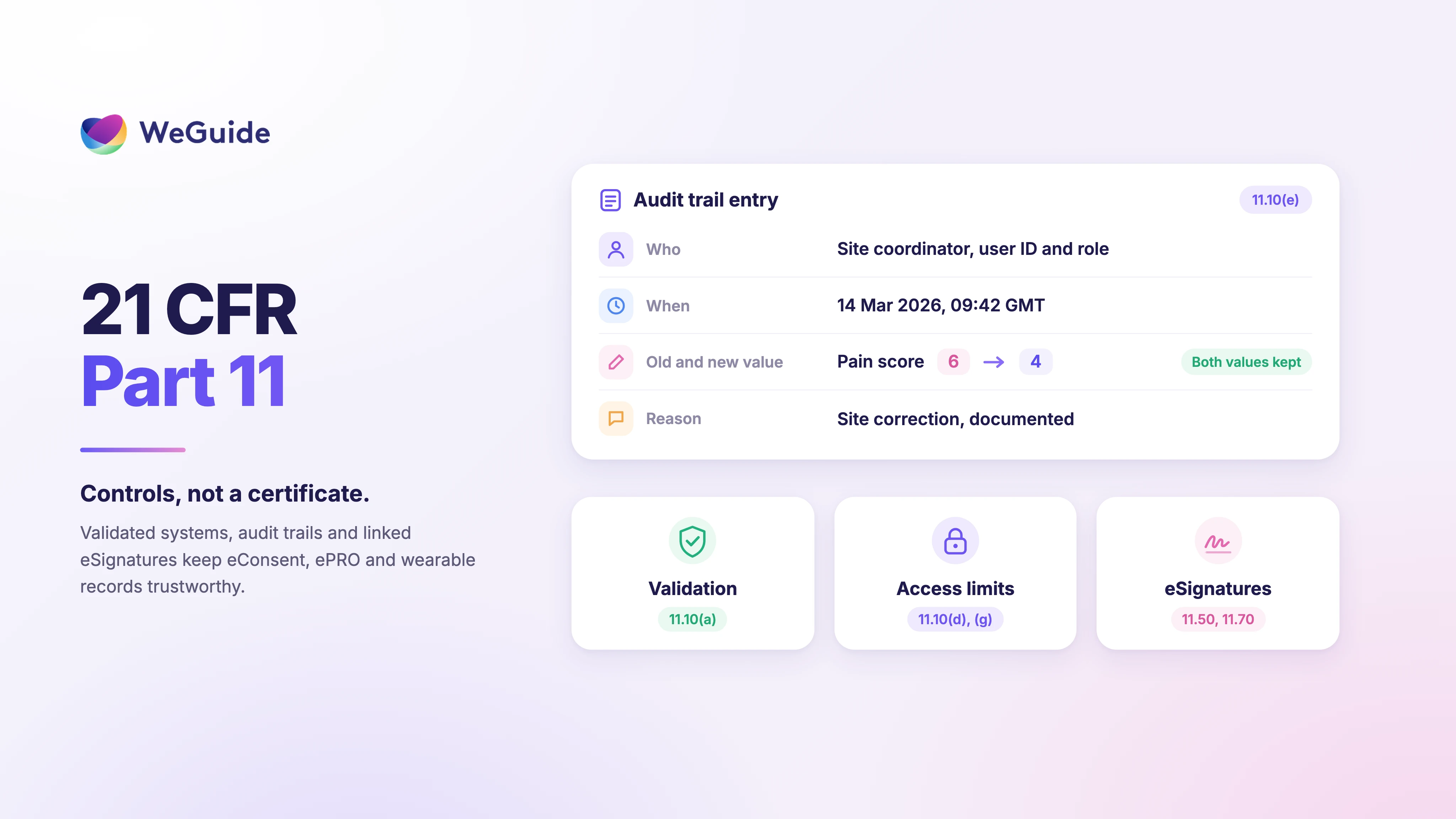


21 CFR Part 11 is the FDA regulation that sets the criteria under which electronic records and electronic signatures are considered trustworthy, reliable and generally equivalent to paper records and handwritten signatures (21 CFR 11.1(a)). In a clinical trial, it applies to the records FDA rules require you to keep or submit, including eConsent records, ePRO entries and wearable data.
21 CFR Part 11 compliance is a set of controls you put in place and can show an inspector. It isn't a certificate, and the FDA doesn't issue one.
This guide is for sponsors, CROs, sites and academic teams choosing eConsent and ePRO systems. It covers each section of the rule, FDA's 2003 and 2024 guidance, and a vendor checklist for your RFP.
Key Takeaways
- Part 11 is controls, not a certificate. The FDA doesn't certify or review systems in advance. The sponsor or site answers for its configured system at inspection.
- Scope follows predicate rules. Part 11 covers records required under FDA rules such as 21 CFR 312, 812, 50 and 56, and records submitted to FDA electronically.
- Audit trails must capture three things, plus a reason. Date and time, who made the change (user ID and role), and the old and new value. FDA adds that the trail should include the reason for a change where applicable (2024 Q&A, Q12).
- Drawn signatures are handwritten signatures. A signature drawn with a finger or stylus is a handwritten signature executed to an electronic record and must be linked to it (Q25, 11.70).
- Wearables count too. A device can be the data originator, and FDA says the transfer to the data repository should use a validated process (Q20, Q22).
What Is 21 CFR Part 11?
21 CFR Part 11, titled Electronic Records; Electronic Signatures, is the part of the US Code of Federal Regulations that covers electronic records and signatures. It defines how they must be controlled so FDA can accept them in place of paper and ink. In clinical research, it reaches sponsors, CROs, investigators and IRBs.
FDA published the final rule on March 20, 1997 (62 FR 13464), and the eCFR holds the current text. It took effect on August 20, 1997, the date FDA's 2003 guidance calls the effective date of Part 11. FDA's 2003 Scope and Application guidance narrowed how it reads the rule, and section 11.100 was last amended in March 2023.
The newest clinical guidance is FDA's Electronic Systems, Electronic Records, and Electronic Signatures in Clinical Investigations: Questions and Answers, final, October 2024 (Revision 1). Here's what each section of the rule asks for in a trial.
| Section | Requirement | What it means in a trial |
|---|---|---|
| 11.1, 11.3 | Scope and definitions | Covers records kept or submitted under FDA rules; defines open, closed and signature types |
| 11.10(a) | Validation | Show the system works as intended and flags altered records |
| 11.10(b), (c) | Copies; record protection | Readable copies for inspectors across the retention period |
| 11.10(d), (g) | Access limits; authority checks | Only authorized users enter, sign or change data |
| 11.10(e) | Audit trails | Every create, modify and delete is recorded; old values stay visible |
| 11.10(f), (h) | Operational and device checks | Enforce step order; confirm valid data sources |
| 11.10(i) to (k) | Training; policies; document control | Trained users, signature accountability, controlled documents |
| 11.30 | Open systems | Extra measures such as encryption |
| 11.50, 11.70 | Signature manifestation and linking | Name, date, time and meaning shown; signatures bound to records |
| 11.100 to 11.300 | Electronic signature controls | Unique signers, identity checks, two components, password controls |
When Does 21 CFR Part 11 Apply in a Clinical Trial?
Part 11 applies to electronic records kept under any FDA records requirement, and to electronic records submitted to FDA (11.1(b)). That covers records created, modified, maintained, archived, retrieved or transmitted electronically. A paper record that has only been faxed isn't in scope.
Those underlying requirements are called predicate rules. Under an IND, they include the recordkeeping rules in 21 CFR 312.57, 312.58 and 312.62. Under an IDE, the main one is 21 CFR 812.140. The 2024 Q&A frames scope as the records FDA needs to reconstruct a study, plus anything submitted electronically.
Records usually in scope:
- eConsent records, form versions and signatures
- ePRO and eCOA entries (see eCOA in clinical trials)
- eCRF and EDC data
- Wearable and other device data
- Signed study documents, and the audit trails behind all of these
- Spreadsheets or shared drive files, if they hold records a predicate rule requires
FDA doesn't intend to assess electronic health record systems for Part 11, but once EHR data enters the sponsor's EDC, FDA assesses that system (Q1). Records from non US sites under an IND or IDE are in scope (Q2). Part 11 doesn't address email or text messages, so judge whether each channel is secure enough for the data you send (Q6).
Part 11 doesn't replace the predicate rules. GCP and informed consent rules still apply.
FDA's 2003 Part 11 Guidance: What FDA Still Enforces
In 2003, FDA said it would interpret Part 11 narrowly and use enforcement discretion for a defined set of requirements (FDA, 2003). The 2024 Q&A confirms FDA still applies that approach.
| FDA uses enforcement discretion | FDA still enforces |
|---|---|
| Validation, 11.10(a) | Limiting access to authorized individuals |
| Audit trails, 11.10(e) and (k)(2) | Operational, authority and device checks |
| Copies of records, 11.10(b) | Training, accountability policies, documentation controls |
| Record retention, 11.10(c) | Open system controls, 11.30 |
| Legacy systems in use before August 20, 1997 | All signature rules: 11.50, 11.70, 11.100, 11.200, 11.300 |
Enforcement discretion isn't an exemption. Records must still meet the predicate rules, and FDA recommends basing validation and audit trail decisions on a documented risk assessment.
For clinical investigations, the 2024 Q&A goes further. It restates audit trail content in "must" language tied to 11.10(e) and expects risk based validation before use. Read the discretion column as a reason to scale effort to risk, not to skip it.
Part 11 Questions and Answers: What FDA's 2024 Clinical Guidance Adds
The October 2024 guidance answers 29 questions across five areas: electronic records, systems deployed by regulated entities, IT service providers, digital health technologies and electronic signatures (FDA, 2024). Its "should" statements are recommendations, while its "must" statements point back to the regulation.
Beyond audit trails, signatures and device data (covered below), these answers change day to day practice:
- Q7, validation: risk based, from design to decommissioning, covering configurations, data transfers and interfaces.
- Q8, documentation: list each study's electronic systems and keep a data flow diagram from creation to final storage.
- Q11, access: keep a dated record of who has access and what changed, and limit login attempts.
- Q16, no advance review: FDA evaluates systems during inspection, not before.
- Q17 to Q19, IT providers: put a written agreement in place, document your oversight, and expect that FDA may inspect the provider.
21 CFR Part 11 Audit Trail Requirements
Section 11.10(e) requires secure, computer generated, time stamped audit trails that record the date and time of actions that create, modify or delete records. In its words: "Record changes shall not obscure previously recorded information." The trail must be kept as long as the records it covers.
The 2024 Q&A (Q12) makes this concrete. Audit trails must capture every change, who made it and when, and should include the reason. They should be protected from modification and from being disabled. FDA recommends a searchable, sortable format. Where that isn't practical, a static format such as PDF is acceptable if it clearly maps to the data elements.
How often should you review it? FDA doesn't set a frequency. Q12 says periodic review "may be helpful" and should rest on a risk assessment of the study.
Q13 says you don't need every keystroke. Record deliberate saves and submits, edits to completed fields, and edit check prompts with the original answer. Q14 asks for controlled clocks and, across time zones, the time zone or GMT.
| Audit trail field | Source | eConsent or ePRO example |
|---|---|---|
| Date and time | 11.10(e), Q12, Q14 | Diary entry saved, with time zone |
| Who made the change | Q12 (user ID and role) | Participant ID, or coordinator ID and role |
| Old and new value | 11.10(e), Q12 | Pain score changed from 6 to 4, both visible |
| Reason for change | Q12, if applicable | Site correction with a documented reason |
| Edit check prompt | Q13 | Original answer, prompt shown, corrected answer |
| Data originator | Q20 | Participant, caregiver with reason, or device ID |
| Transfer time | Q22 | When a wearable record reached the database |
These fields make data attributable and contemporaneous, as our guide to ALCOA+ principles explains.
21 CFR Part 11 Electronic Signature Requirements
Sections 11.50 and 11.70 in Subpart B govern how signatures appear and attach to records. Subpart C governs how electronic signatures are issued and controlled. FDA's 2003 guidance names all of these signature provisions among the requirements it continues to enforce.
Manifestation (11.50). A signed record must show the signer's printed name, the date and time, and the meaning, such as review, approval, responsibility or authorship (11.50). These must appear on screen and on printouts.
Linking (11.70). Signatures must be linked to their records so they can't be excised, copied or transferred by ordinary means (11.70). Changes made after signing must show in the audit trail.
Uniqueness and identity (11.100). Each electronic signature belongs to one person and is never reassigned, and the organization verifies identity before issuing it (11.100). Q26 accepts government issued ID, security questions, or strong credentials with multifactor authentication or video observation. Organizations also certify to FDA that their electronic signatures are intended to be the legally binding equivalent of handwritten signatures (11.100(c)), and one letter of non-repudiation can cover the whole organization (Q29).
Components (11.200). Non biometric signatures need two components, such as an ID code and a password. In one continuous session, the first signing uses both and later ones need at least one (11.200).
Password controls (11.300). The 21 CFR Part 11 password requirements cover unique ID and password pairs, periodic revision, handling of lost tokens, and alerts on misuse (11.300). Part 11 doesn't set a password length or expiry period.
Electronic vs handwritten signatures on a phone
This point matters most for eConsent buyers. FDA's answer to Q25 is direct: signatures drawn with a finger or stylus are handwritten signatures, not electronic signatures. The definition in 11.3(b)(8) already covers a mark applied to "other devices that capture the name or mark."
So a drawn signature doesn't need Subpart C's two components and password controls. It still needs linking under 11.70, and Q25 says it should sit on the document as it would on paper. Ask any vendor which kind of signature each signer gives, and how each is bound to the exact form version.
Part 11 for eConsent, ePRO and Wearables
The rule is technology neutral, but it plays out differently for a consent form, a questionnaire and a sensor.
eConsent
FDA and OHRP's eIC Q&A (December 2016) says electronic signatures documenting consent must meet Part 11. The system must capture the date of consent (21 CFR 50.27(a)), and every IRB approved version should be easy to retrieve. When an amended form could affect willingness to continue, the participant or their legally authorized representative must sign it before continuing. The person signing must also receive a copy of the consent form (21 CFR 50.27(a)), and FDA recommends that it show the signing date.
In practice, that means version control, reconsent tracking, support for legally authorized representatives and multiple signatories, and an audit trail of who signed which version when. Our guides to eConsent in clinical trials and eConsent best practices cover each control, and remote consent is central to decentralized clinical trials.
IRBs, investigators and sponsors may rely on a vendor statement describing how the signature is created and that the system meets Part 11. That's a sensible first document to request.
Consent records with version control and an audit trail
WeGuide eConsent includes version control, reconsent tracking and an audit trail, and supports legally authorized representatives and multiple signatories.
ePRO and eCOA
When a participant types an answer into an ePRO app, they're the data originator (Q20). If a caregiver or site staff member enters it, they become the originator, and the reason should be documented.
Q21 asks for access controls on data entry apps, such as a PIN, biometrics or multifactor authentication. Whether participants use their own phones changes how you meet that, as our guide to BYOD vs provisioned devices explains. For validating and migrating instruments, see eCOA system validation.
Wearables and other digital health technologies
When an activity tracker or glucose sensor sends data without human input, the device is the data originator (Q20). Each data element should carry an identifier recording its origin, date and time and participant ID, which shouldn't be alterable once the system sets it (FDA eSource guidance, 2013).
Data should reach a durable repository by a validated process, as soon as possible, with the transfer time in the audit trail (Q22). FDA doesn't intend to inspect individual devices, because the repository is the source (Q23), as our guide to eSource and source data for wearables explains. Access controls can be hard to apply to some wearables, so Q21 asks sponsors to plan user authentication and attribution, and investigators to tell participants that only they should wear the device and to document that discussion.
FDA's 2023 DHT guidance sets the wider fit for purpose expectations, summarized in our FDA framework for digital health technologies. For how data leaves a device, see wearable APIs for clinical research.
21 CFR Part 11 Validation: CSV vs CSA
Section 11.10(a) requires validation to ensure accuracy, reliability, consistent intended performance and the ability to discern invalid or altered records. Q7 of the 2024 Q&A defines validation, including user acceptance testing, as documenting that requirements are consistently met from design until decommissioning.
Effort scales with the system. A bespoke build needs more than a configurable platform. When the vendor validates, Q7 suggests reviewing its development and validation processes, functional testing and change control logs. FDA may ask for that documentation at inspection, and the regulated entity has to produce it, even when the vendor holds it.
Does computer software assurance (CSA) replace computer system validation (CSV)? For clinical research, not directly.
| Computer system validation (CSV) | Computer software assurance (CSA) | |
|---|---|---|
| Source | 11.10(a); FDA's 2003 guidance and 2024 Q&A (Q7), with FDA's General Principles of Software Validation (2002) as background | FDA CSA guidance, final, February 2026 |
| Scope | Any system holding Part 11 records | Device production and quality management system software (21 CFR 820) |
| Emphasis | Documented evidence that requirements are met | Assurance effort scaled to process risk |
| Testing | Scripted test cases, in common practice | Scripted or unscripted, chosen by risk |
| In clinical research | The working approach for eConsent, ePRO and EDC | Useful risk thinking, not clinical guidance |
For clinical systems, the 2024 Q&A is the source. CSA is still worth reading for how it separates high risk features.
Who Is Responsible for 21 CFR Part 11 Compliance?
There's no 21 CFR Part 11 certification. FDA doesn't certify electronic systems or signature methods (Q28), and it doesn't review systems in advance (Q16). Systems are judged at inspection, in the context of how a sponsor or site configured and used them.
Regulated entities stay responsible for their records when they use an IT service provider. FDA recommends a written agreement covering scope, roles and data access for the full retention period (Q17). Sponsors keep any obligation they haven't specifically and lawfully transferred to the provider (Q17), and they should be able to show FDA their agreements and oversight (Q18).
| Activity | Vendor | Sponsor or CRO | Site |
|---|---|---|---|
| Platform validation evidence | Produces it | Reviews it, adds study testing | Not usually |
| Study configuration and UAT | Builds to spec | Specifies, tests, approves | Checks site workflows |
| SOPs and training, 11.10(i) | Own staff | Study team records | Site staff records |
| Access administration | Provides controls and logs | Approves roles | Reports joiners and leavers |
| Audit trail review | Makes trails available | Reviews by risk | Reviews site data |
| Retention and copies | Per agreement | Access for retention period | Site records |
Academic teams face the same split. A 2026 paper described a shared implementation guide for Part 11 readiness in REDCap. Within six months, 259 people from 164 institutions accessed it, and users reported less vendor reliance and better documentation (Baker 2026). The takeaway for sponsors: Part 11 readiness depends on how a system is configured and documented, not on the software alone.
21 CFR Part 11 vs EU Annex 11, the EMA Guideline and ICH E6(R3)
These frameworks agree on the basics: validation, access control, audit trails and controlled signatures.
| Framework | Issued by | Applies to | Status |
|---|---|---|---|
| 21 CFR Part 11 | FDA | Records under FDA rules | Regulation, 1997 |
| EU GMP Annex 11 | European Commission | Medicines manufacturing | Revision January 2011; revised draft consulted July to October 2025 |
| EMA guideline on computerised systems and electronic data in clinical trials | EMA GCP Inspectors Working Group | Clinical trials, including eCOA | Final, March 2023 |
| ICH E6(R3) | ICH | Good clinical practice | Adopted January 6, 2025 |
For EU or multinational trials, the EMA's 2023 guideline is the closer clinical counterpart, since Annex 11 is written for manufacturing. Our guide to ICH E6(R3) for eCOA and eConsent covers the GCP side.
21 CFR Part 11 Checklist: Questions to Ask an eConsent or ePRO Vendor
These 21 CFR Part 11 software requirements are framed as neutral questions. Ask for evidence, not yes or no answers.
- Validation: What validation documentation can we review, and how is study configuration tested? (11.10(a), Q7)
- Change control: How are releases and patches assessed and logged, and how are we told? (11.10(k), Q7)
- Audit trail fields: Does each entry record date and time, user ID and role, old and new value, and reason? (11.10(e), Q12)
- Audit trail protection: Can any role, including your administrators, edit or disable it? (Q12)
- Audit trail export: Can we export it per participant and per form in a searchable format? (Q12)
- Edit checks: Is the original response kept when an edit check prompts a correction? (Q13)
- Clocks: How are system time and time zones controlled? (Q14)
- Access: Does every user have their own login, how are roles granted and revoked, and is each change logged with a date? (11.10(d), (g), 11.300(a), Q11)
- Participant authentication: What protects entries in the app? (Q21)
- Signature type: Are participant signatures electronic or handwritten signatures executed to the record, and how is each linked to the form version? (11.70, Q25)
- Manifestation: Does each signed record show printed name, date and time, and meaning? (11.50)
- Identity: How is identity verified before an electronic signature is issued? (11.100(b), Q26)
- Copies: Can you produce complete, readable copies with metadata for the full retention period? (11.10(b), (c), Q5)
- Agreement: Will the contract define roles, data access and inspection support? (Q17 to Q19)
- Device data: How is the originator identified, and is the transfer validated and time stamped? (Q20, Q22)
- Exit: At contract end, how do we receive all data with linked audit trails and metadata? (Q5)
For the full RFP and a scoring sheet, see our eCOA and ePRO vendor selection guide.
How WeGuide Supports Part 11 Requirements
WeGuide is a patient engagement and data collection platform for clinical research and care: screening, eConsent, ePRO/PROMs, wearable data and patient registries, on participants' own phones. WeGuide supports 21 CFR Part 11 requirements.
WeGuide eConsent provides version control, reconsent tracking and an audit trail, and supports legally authorized representatives and multiple signatories. Questionnaires are built in the WeGuide Form Builder for ePRO and eCOA. WeGuide is BYOD first, with provisioned devices supported when a protocol needs them, and it integrates with REDCap through the REDCap API.
A vendor can support the requirements and supply evidence, but responsibility for the configured system, SOPs and records sits with the sponsor and site. Bring the checklist above to any evaluation, including ours.
Frequently Asked Questions
Is 21 CFR Part 11 mandatory?
Yes, when it applies. If you keep FDA required records electronically, or submit records to FDA electronically, Part 11 covers them. FDA uses enforcement discretion for validation, audit trails, copies and retention under its 2003 guidance, but predicate rules and all signature requirements are enforced.
What does 21 CFR stand for?
"21 CFR" means Title 21 of the Code of Federal Regulations, the title that holds FDA's food and drug rules. Part 11 is the part of Title 21 that covers electronic records and electronic signatures. Nearby parts used in trials include Part 50 (informed consent), Part 56 (IRBs) and Part 312 (investigational new drugs).
What does 21 CFR Part 11 compliance mean?
It means the electronic records and signatures you rely on for FDA purposes meet Part 11's controls, and you can show the evidence: a validated system, limited access, secure audit trails, signature manifestation and linking, trained users and written procedures. It's judged at inspection for your configured system. FDA doesn't certify software, so a vendor can support the requirements while responsibility stays with the sponsor or site.
When was 21 CFR Part 11 introduced?
FDA published Part 11 as a final rule on March 20, 1997, and it took effect on August 20, 1997. The Scope and Application guidance followed in 2003, and the clinical investigations Q&A (Revision 1) in October 2024.
What records need to meet 21 CFR Part 11?
Electronic records kept under FDA record requirements, plus records submitted to FDA electronically. In trials, that means eConsent records, ePRO and eCOA data, EDC data, device data, signed study documents and the audit trails behind them.
Which records are not covered by 21 CFR Part 11?
Records that no FDA predicate rule requires and that aren't submitted to FDA, and paper records that are only sent electronically, such as by fax. Under the 2003 guidance, if you print an electronic record and rely on the paper copy for regulated activities, FDA generally treats the paper as the record. FDA also doesn't intend to assess site electronic health record systems for Part 11 (2024 Q&A, Q1).
Is there a 21 CFR Part 11 certification for software?
No. FDA doesn't certify electronic systems or signature methods (Q28) or review them in advance (Q16). A vendor that calls its software "certified" means its own or a third party's assessment, not FDA's. What counts is how the sponsor or site configures, validates and uses the system.
How do you comply with 21 CFR Part 11 in a clinical trial?
Identify the records under predicate rules, then control each system holding them: risk based validation, access control, audit trails, signature controls, training and SOPs. Sign a written agreement with each IT provider and keep the documentation ready for inspection.
Is an audit trail mandatory under Part 11, and how often should it be reviewed?
Section 11.10(e) requires audit trails, and the 2024 Q&A restates their content in "must" language, although the 2003 guidance applies enforcement discretion. FDA sets no review frequency. It says periodic review may help and should follow a risk assessment.
Does a signature drawn on a phone count as an electronic signature under Part 11?
No. Q25 of FDA's 2024 Q&A says signatures drawn with a finger or stylus are handwritten signatures executed to an electronic record. They don't need two component controls, but they must be linked to the record so they can't be copied or moved.
What is the difference between 21 CFR Part 11 and EU Annex 11?
Part 11 is a US regulation for any FDA required electronic record. Annex 11 is EU GMP guidance for computerized systems in medicines manufacturing, last revised in 2011, and a revised draft went to public consultation from July to October 2025. For EU clinical trials, the closer counterpart is the EMA's 2023 Guideline on computerised systems and electronic data in clinical trials.
Where can I get the 21 CFR Part 11 text or PDF?
The official text is on the Electronic Code of Federal Regulations. eCFR shows the current text and lets you print or save it as a PDF, and FDA's 2003 Scope and Application guidance is also available as a PDF from FDA. Read the rule with FDA's 2003 and 2024 guidance.
Bring your Part 11 questions to a WeGuide demo
See how eConsent versioning, reconsent tracking and the audit trail work in practice, and walk through this checklist with our team.
Book a demoNo pressure, just a conversation.

