


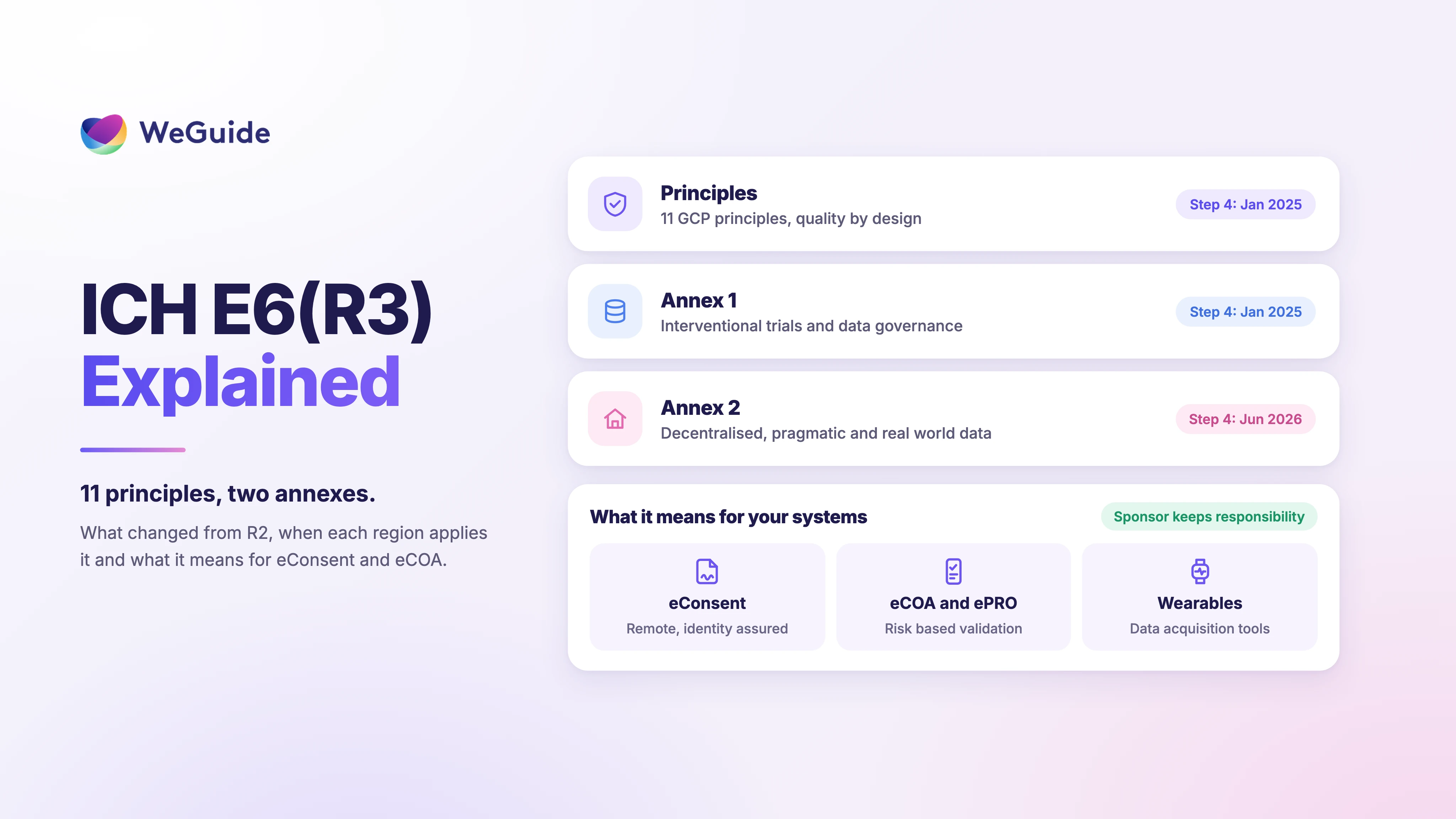


ICH E6(R3) is the current international Good Clinical Practice (GCP) guideline for clinical trials. ICH adopted its Principles and Annex 1 on 6 January 2025, and Annex 2, on decentralised elements, pragmatic elements and real world data, on 3 June 2026. For eConsent, eCOA and wearable data, it brings risk based validation, audit trail and metadata expectations, remote consent rules and documented sponsor oversight of technology vendors.
This guide covers what ICH GCP E6(R3) is, how it's structured, what changed from E6(R2), when each region applies it, and what it asks of the electronic systems in your trial. It finishes with a role split, a 15 question vendor checklist and the SOP updates most teams will need. Regulatory status was checked on 11 November 2026, and every section number below comes from the ICH consolidated guideline of 16 June 2026.
Key Takeaways
- Three layers, 11 principles. E6(R3) has 11 principles (R2 had 13), Annex 1 for interventional trials and Annex 2 for decentralised elements, pragmatic elements and real world data.
- Dates differ by region. The EU applied the Principles and Annex 1 on 23 July 2025 and applies Annex 2 on 15 January 2027. FDA's September 2025 final guidance excludes Annex 2, which is still a draft. Canada applied R3 on 1 April 2026 and Annex 2 on 4 November 2026; the UK and Australia follow their own timelines (see the table).
- Systems face explicit rules. Section 4 of Annex 1 sets out the data life cycle, audit trail content and risk based validation for computerised systems, including eCOA and ePRO apps.
- Electronic and remote consent are named. Consent may be paper or electronic, obtained remotely where appropriate, with identity assured and a paper option offered.
- Vendors don't carry the responsibility. When work moves to a service provider, responsibility for trial conduct and data integrity stays with the sponsor or investigator.
What is ICH E6(R3)?
ICH E6(R3) is the third revision of the International Council for Harmonisation's guideline for Good Clinical Practice. It sets the ethical and scientific quality standard for designing, conducting, recording and reporting clinical trials, and replaces E6(R2) from 2016. It's built around quality by design and risk proportionate oversight.
The scope is narrower than many people assume. The guideline "applies to interventional clinical trials of investigational products that are intended to be submitted to regulatory authorities." Its Principles "may also be applicable to other interventional clinical trials of investigational products" that won't support a marketing application, in line with local rules. A footnote defines investigational products as drugs, medicines, medicinal products, vaccines and biological products.
ICH GCP guidelines aren't law on their own. Each regulator adopts them, and the legal weight differs by region, which is why the effective date question has six answers (see the dates table below).
Two ideas run through the whole text. First, quality should be designed in from the start, with factors critical to quality identified and protected, building on ICH E8(R1). Second, controls should be proportionate to risk.
The introduction also names "digital health technologies, such as wearables and sensors" and says the guideline "is intended to be media neutral to enable the use of different technologies." That one sentence explains why eConsent, eCOA and wearable data now sit inside GCP rather than beside it.
How ICH GCP E6(R3) is structured: Principles, Annex 1 and Annex 2
E6(R2) was one long document. E6(R3) splits into short principles, two annexes, three appendices and a glossary. The annexes give "the basis for the appropriate interpretation and application of the principles", but other approaches are acceptable if they're justified and reach the same intent.
| Part | What it covers | ICH Step 4 date | Why it matters for eConsent, eCOA and DHTs |
|---|---|---|---|
| Principles | 11 GCP principles with sub points | 6 January 2025 | Principle 9.3: computerised systems should be fit for purpose |
| Annex 1 | IRB/IEC, investigator, sponsor, data governance | 6 January 2025 | Consent rules (2.8), data life cycle (4.2), validation (4.3) |
| Annex 2 | Decentralised elements, pragmatic elements, real world data | 3 June 2026 | Remote consent identity (2.2.1), DHTs as data acquisition tools |
| Appendices A, B, C | Investigator's Brochure, protocol, essential records | 6 January 2025 | Appendix C lists the records your systems should keep |
| Glossary | Defined terms | 6 January 2025 | "Data acquisition tool" includes COAs, PROs and wearables |
The consolidated version that combines all parts was published on 16 June 2026.
The 11 principles of ICH GCP E6(R3)
- Trials follow the ethical principles of the Declaration of Helsinki.
- Informed consent is an integral feature of ethical conduct.
- Trials are subject to independent IRB/IEC review.
- Trials are scientifically sound for their intended purpose.
- Trials are designed and conducted by qualified individuals.
- Quality is built into the scientific and operational design.
- Processes and measures are proportionate to the risks to participants and to the reliability of results.
- The protocol is clear, concise, scientifically sound and operationally feasible.
- Trials generate reliable results.
- Roles and responsibilities are clear and documented.
- Investigational products are manufactured to Good Manufacturing Practice (GMP) and managed per protocol.
ICH E6(R3) Annex 1: interventional trials and data governance
Annex 1 holds the operational detail for interventional trials: the IRB/IEC (section 1), the investigator (section 2), the sponsor (section 3) and data governance (section 4). Section 4 is new. It gives investigators and sponsors shared guidance on data integrity, traceability and security, and it's the part eCOA and eConsent vendors get asked about most.
ICH E6(R3) Annex 2: decentralised elements, pragmatic elements and real world data
Annex 2 adds "additional GCP considerations" for trials with decentralised elements, pragmatic elements and/or real world data (RWD). It says it "should not be read as an endorsement of any specific methodologies and should be read in conjunction with the Principles and Annex 1." In plain terms, Annex 2 doesn't create a separate rulebook for decentralized trials. It explains how the same GCP applies when activities move outside the site.
ICH E6(R2) vs E6(R3): the key changes
The main differences between ICH E6(R2) and E6(R3) are a new structure (11 principles, Annex 1 and Annex 2 instead of 13 principles in 8 sections), quality by design and risk proportionality throughout, a new data governance section, media neutral wording that names digital health technologies, explicit electronic and remote consent, and new terms such as "participants" and "essential records".
The biggest change isn't one new rule. It's a shift from a checklist built for paper trials to a principles based text that expects electronic systems, remote activity and proportionate controls. This table compares the E6(R2) text with the R3 consolidated guideline.
| Topic | E6(R2) (2016) | E6(R3) | What changes for electronic systems |
|---|---|---|---|
| Structure | One document, 8 sections, 13 principles | 11 principles, Annex 1, Annex 2, appendices | Requirements are grouped by role and by data life cycle |
| Approach | Quality management added as section 5.0 | Quality by design and proportionality throughout | Validation and review scale with data criticality |
| Terminology | "Subjects", "essential documents" | "Participants", "essential records" | SOPs and system labels need updating |
| Technology | Computerized system validation defined (1.65, 5.5.3) | Media neutral; DHTs named; "data acquisition tool" defined | eCOA, ePRO and wearables are named in the glossary |
| Data | Audit trail defined, data handling in 5.5 | Data governance section 4 with an 8 step data life cycle | Metadata, audit trail review and retention are explicit |
| Computerised systems | Validation addendum in 5.5.3 | 4.3: procedures, training, security, validation, release, failure, support, user management | Vendors get asked about release gating and contingency |
| Consent | Written form, signed and personally dated (4.8.8) | Paper or electronic, remote where appropriate, identity assured | eConsent is described in the text, not just tolerated |
| Service providers | Contract research organization (5.2) | "Service providers", with documented agreements (3.6) | Technology vendors fall under the same oversight |
| Monitoring | On site and/or centralized, risk based (5.18.3) | On site and/or remote, centralized, proportionate | Remote access to system data needs controls |
| Decentralised and pragmatic designs | Not covered | Annex 2 | DHT data, remote consent and home visits get guidance |
Two changes matter most for system buyers. First, R3 treats the computerised system as part of trial quality, not an IT matter: Principle 9.3 says systems "should be fit for purpose (e.g., through risk-based validation, if appropriate)." Second, the glossary's definition of a data acquisition tool covers clinical outcome assessments, patient reported outcomes and wearable devices "irrespective of the media used." Your eCOA app and your wearable feed now carry the same expectations as the eCRF.
A second reading comes from the oncology societies. An ESMO and ASCO consensus paper says R3 clarifies informed consent procedures, reconsent requirements, source documentation and delegation, giving trials room to cut administrative burden without weakening safety or data integrity.
ICH E6(R3) effective dates by region
ICH E6(R3) has no single effective date. ICH adopted the Principles and Annex 1 on 6 January 2025 and Annex 2 on 3 June 2026, and each regulator then sets its own date. The EU applied the Principles and Annex 1 from 23 July 2025 (Annex 2 from 15 January 2027), Canada from 1 April 2026 (Annex 2 from 4 November 2026), in the UK compliance with the Principles became a legal requirement on 28 April 2026, and Australia's transition ends on 13 January 2027.
In the US it's nonbinding FDA guidance. Regulatory status checked on 11 November 2026.
| Region / regulator | Principles and Annex 1 | Annex 2 | Legal status | Source |
|---|---|---|---|---|
| ICH | Step 4: 6 January 2025 | Step 4: 3 June 2026; consolidated 16 June 2026 | Harmonized guideline, applied through each region | ICH |
| EU (EMA) | Effective 23 July 2025 | CHMP adopted 25 June 2026; effective 15 January 2027 | Scientific guideline under EU clinical trial rules | EMA |
| US (FDA) | Final guidance, September 2025 (Federal Register 9 September 2025) | Draft guidance, December 2024; no final version as of November 2026 | Nonbinding guidance, no compliance date | FDA |
| UK (MHRA) | Compliance with the ICH E6 GCP Principles is a legal requirement from 28 April 2026 | No separate date; MHRA says the annexes are relevant guidance that "cannot be ignored" | Principles in law (Regulation 28); annexes are guidance sponsors must have regard to | GOV.UK |
| Canada (Health Canada) | Effective 1 April 2026 (notice of 17 October 2025) | Implemented 4 November 2026 | Guidance; protocols should name critical to quality factors | Health Canada |
| Australia (TGA) | Adopted 16 January 2026; transition ends 13 January 2027 | Not listed on the adoption page | Adopted international scientific guideline | TGA |
The European Commission's clinical trials acceleration page confirms the EU split. In the US, the Federal Register notice says the final guidance covers the Principles and Annex 1 only, and FDA's Annex 2 page still lists it as a draft.
Is ICH E6(R3) mandatory?
It depends on the country. In the UK, the MHRA states that compliance with the ICH E6 GCP Principles, "and not the entirety of the guideline", became a legal requirement on 28 April 2026. In the EU, the guideline applies to trials run under EU clinical trial rules.
In the US, FDA guidance "contains nonbinding recommendations", but FDA's regulations still bind you, including 21 CFR parts 50, 56 and 312 and the electronic records rules in 21 CFR Part 11. If your trial runs in more than one region, it's simpler to design to R3 everywhere, since the EU, UK and Canada already apply it and Australia's transition ends in January 2027.
See how audit trails, version control and reconsent work in practice
WeGuide eConsent keeps version control, reconsent tracking and an audit trail for every consent, on site, remote or hybrid.
What ICH E6(R3) means for eCOA, ePRO and other computerised systems
Under R3, an eCOA or ePRO app is two things at once: a data acquisition tool and a computerised system. Both the data governance rules (Annex 1, section 4.2) and the system rules (section 4.3) apply to it. Responsibility sits with the "responsible party", which means the sponsor or investigator, not the vendor.
Data governance and the data life cycle
Section 4.2 says "procedures should be in place to cover the full data life cycle" and splits that cycle into eight steps:
- 4.2.1 Data capture, including relevant metadata for data captured directly in a system and risk based automated checks at entry
- 4.2.2 Metadata, including audit trails
- 4.2.3 Review of data, audit trails and metadata, planned and risk based
- 4.2.4 Corrections, attributed, justified and timely
- 4.2.5 Transfer, exchange and migration, through validated or reconciled processes
- 4.2.6 Finalisation of data sets before analysis
- 4.2.7 Retention and access
- 4.2.8 Destruction
Section 4.2.2 is the part to test vendors on. For data of higher criticality, systems should log user account creation, changes to roles and permissions, and user access. They should document the initial entry and every later change or deletion, "including, where appropriate, the reason for the change", and record workflow actions, not only data entries.
Audit trails shouldn't be disabled, should be interpretable, and should timestamp entries unambiguously, for example in UTC.
The glossary defines data integrity as data that are attributable, legible, contemporaneous, original, accurate, complete, secure and reliable. Those criteria map closely to the ALCOA+ data integrity attributes. Annex 1 2.12.2 also asks the investigator to define what counts as a source record before the trial starts and to avoid "unnecessary transcription steps", which is the core argument for eSource and direct data capture.
Risk based validation of eCOA systems
Section 4.3.4 makes the responsible party "responsible for the validation status of the system throughout its life cycle." The approach should rest on a risk assessment of the system's intended use, the importance of its data and its potential to affect participants and results.
Three points catch eCOA teams out. Validation has to cover "both standard system functionality and protocol-specific configurations and customisations, including automated data entry checks and calculations", so your scoring rules and edit checks need testing, not just the vendor's core product.
"Interfaces between systems should also be defined and validated", which covers the eCOA to EDC link and any wearable feed. And the responsible party should ensure systems are validated "including those developed by other parties", with validation documentation kept. Section 4.3.4(h) names "collection of endpoint data" as critical functionality. Our guide to eCOA validation walks through the system, equivalence, linguistic and psychometric layers.
For context on how one platform fits these rules, WeGuide is a patient engagement and data collection platform for clinical research and care, covering screening, eConsent, ePRO/PROMs, wearable data and patient registries on participants' own phones. It's ISO 27001:2022 certified and supports 21 CFR Part 11 requirements. Validation of the configured study stays with the sponsor, as R3 says.
Release, failure, support and user management
The rest of section 4.3 reads like a vendor service agreement:
- Release (4.3.5). Trial systems, including updates from protocol amendments, go live at a site only after that site has all necessary approvals.
- Failure (4.3.6). Contingency procedures should be in place to prevent loss of, or lost access to, data essential to participant safety, trial decisions or outcomes.
- Support (4.3.7). A help desk or similar should log issues, with periodic review to spot repeated or systemic problems.
- User management (4.3.8). Access controls should ensure attributability to an individual, permissions should match duties and blinding arrangements, and access should be revoked when no longer needed.
Blinding gets its own subsection (4.1). Sponsor staff and service providers who deal with sites shouldn't see unblinding information unless the design justifies it.
Investigator access to ePRO data
Annex 1 2.12.3 says the investigator should get timely access to data and review it, including, "if appropriate, electronic patient-reported outcome (ePRO) data." The protocol may restrict access, for instance to protect blinding. If your ePRO captures safety relevant symptoms, plan who sees what and when.
Informed consent under ICH E6(R3): eConsent, remote consent and identity
Yes, ICH E6(R3) explicitly allows electronic and remote consent. Annex 1 2.8.1 describes a consent process that can use "text, images, videos and other interactive methods", may be obtained remotely "where appropriate", and may involve "a physical or an electronic signature" (2.8.7). R2 assumed a written form, signed and personally dated.
What 2.8.1 asks of the process:
- (b) Clear, concise information. Simple language, "avoid unnecessary volume and complexity." A consent readability checker is a quick first test.
- (c) Varied media, with a paper option. Consider whether the population is familiar with computerised systems. When systems are used, participants "may be given the option to use a paper-based approach as an alternative."
- (d) Remote consent. "Obtaining consent remotely may be considered where appropriate."
- (e) Identity. In person or remote, the investigator "should assure themselves of the identity of the participant (or legally acceptable representative)."
Annex 2 goes further. Section 2.2.1 gives an example of remote identity checks, "verification of an official identification document via a video call", and says the method and the privacy safeguards "should be pre-specified." Section 2.2.2 repeats the paper and/or in person option "should they prefer this." Section 2.2.3 asks consent materials to state what data will be collected, how they'll be used and who can see personal information such as health records and home address, including "when data are collected remotely via DHTs."
Reconsent is tighter too. Under 2.8.2, participants should be informed "in a timely manner" about new information relevant to continuing, and revised materials need IRB/IEC approval before use. That makes version control and a record of who signed which version a practical necessity.
The evidence supports the electronic route. A 2023 systematic review of 35 studies with 13,281 participants found that no study reported better comprehension, acceptability or usability with paper than with eConsent. Consent took longer with eConsent, which the authors suggest may reflect greater engagement with the content. Three of the five authors were employees of AstraZeneca or Signant Health.
Regional rules still apply alongside R3. In the US, FDA's eConsent questions and answers (December 2016) cover identity, signatures and Part 11. In the UK, the HRA and MHRA joint statement allows electronic methods for seeking, confirming and documenting consent. For the basics, read our guides to eConsent in clinical trials and eConsent best practices.
WeGuide offers eConsent with version control, reconsent tracking and an audit trail, and supports legally authorized representatives and multiple signatories.
Annex 2: decentralised elements, DHTs and wearables as data acquisition tools
Annex 2 defines decentralised elements as "trial-related activities conducted outside the investigator's location." These include visits or procedures at the participant's home, local healthcare centers or mobile medical units, plus remote interactions such as video calls or the use of DHTs. Pragmatic elements bring usual clinical practice into the trial, and RWD is health data collected outside the trial, for example from electronic health records (EHRs), registries or claims databases.
The sentence that matters most for wearables is short: "Where a DHT is used to acquire participant data for a clinical trial, it is considered a data acquisition tool." So the wearable feed carries the same expectations as your eCOA: fit for purpose, relevant metadata with every data point (4.2.1(b)), defined and validated interfaces (4.3.4(e)), and security. Annex 2 3.5.2 adds that remote data collection "requires special attention to be paid to data security vulnerabilities", including cybersecurity and data privacy.
Oversight scales with risk. Annex 2 2.4 says investigator oversight should be "proportionate to the importance of the data being collected" and the risk to participants, and may run from direct supervision to remote contact to review of records. Sponsors should describe and justify the methods in the protocol, including their "rationale, fitness for purpose and feasibility" (3.2.1). Involving patients early can help check that DHTs suit the population (3.1.1).
In the US, FDA's Annex 2 is still a draft. Until it's final, FDA's guidance on DHTs for remote data acquisition (December 2023) and its guidance on trials with decentralized elements (September 2024) set the US expectations. Regulators from FDA, the MHRA and Health Canada wrote jointly about the same themes: quality by design, risk proportionality, decentralized elements and DHTs. Our overview of decentralized clinical trials covers the design side, and our guide to digital health technologies in clinical trials goes deeper on DHTs.
A real example of remote capture: in the BRACE trial led by Murdoch Children's Research Institute (6,800+ healthcare workers, five countries), participants logged daily symptoms in the WeGuide app, with data flowing into REDCap. Adherence was above 90%.
On the device side, WeGuide has a native Garmin integration, which collects raw accelerometer and gyroscope data at 25 Hz on supported models. It reads Apple Health (HealthKit) and Health Connect, and through them gets data from devices such as Apple Watch, Fitbit, Oura and Withings. It's BYOD first; provisioned devices are supported when a protocol needs them. Our guide to wearable APIs explains how each route affects metadata and provenance, and the decentralised trial platform page shows how the pieces fit.
Who owns what under ICH E6(R3): sponsor, investigator and technology vendor
R3 is blunt about delegation. Principle 10.2 says that where activities are transferred or delegated to service providers, "the responsibility for the conduct of the trial, including quality and integrity of the trial data, resides with the sponsor or investigator, respectively." Section 3.6.4 adds that anything not specifically transferred in a written agreement stays with the sponsor.
| Activity | Sponsor | Investigator / site | eCOA or eConsent vendor (service provider) |
|---|---|---|---|
| Select fit for purpose systems | Decides and documents (9.3, 4.3) | Uses as the protocol specifies (2.12.4) | Describes intended use and limits |
| Validation | Responsible for validation status, including third party systems (4.3.4(a), (g)) | Not usually | Performs and documents the work it's contracted for |
| Audit trail and metadata | Ensures logs exist and are reviewed (4.2.2, 4.2.3) | Reviews its own data and corrections | Builds and maintains audit trails |
| Informed consent process | Provides approved materials and systems | Owns the process and identity check (2.8) | Delivers the eConsent tool and records |
| Hosting, security, incidents | Ensures controls, backup and contingency (4.3.3, 4.3.6) | Protects site access | Operates security controls and reports issues |
| Agreements and oversight | Documents agreements and oversees (3.6, 3.9) | Oversees delegated staff and providers (2.3) | Accepts monitoring, audit and inspection access (3.6.3(d)) |
Read the last row carefully. Under 3.6.3(d), service providers agree to direct access to their records and facilities for monitoring, audits and inspections. A vendor that won't agree to that access is a poor fit for a GCP trial.
The third role, the IRB/IEC, sits in Annex 1 section 1. Under 1.2.2 it reviews the consent materials, the process for obtaining consent and "a description of the media" used to inform participants, so an eConsent build goes through the same review as a paper form.
A 15 question checklist for your eConsent and eCOA vendor under E6(R3)
These questions are neutral and work for any vendor. Each one is tied to the section it comes from.
- Can you export the audit trail with its metadata, including user account creation, role changes and access logs? [4.2.2(a)(i)]
- Does every data change keep the original entry, the new value, who made it and, where appropriate, the reason? [4.2.2(a)(ii), 4.2.4]
- What's your validation approach, and which documents do you share with sponsors? [4.3.4]
- How do you validate protocol specific configuration, scoring and edit checks for each study? [4.3.4(e)]
- Are interfaces to EDC and wearable sources specified and validated? [4.3.4(e)]
- How do you control mid study changes, and how is reconsent triggered and tracked? [4.3.4(c), 2.8.2]
- Can you gate the release of each study version per site until approvals are in place? [4.3.5]
- What happens to data and access if the system fails? [4.3.6]
- How do you log, classify and trend support issues? [4.3.7]
- How do roles and permissions protect blinding and attributability? [4.3.8, 4.1]
- Which identity verification options exist for remote consent? [2.8.1(e), Annex 2 2.2.1]
- Is there a paper or in person fallback for consent and questionnaires? [2.8.1(c), Annex 2 2.2.2]
- Do you support BYOD and provisioned devices, and does device data arrive with metadata such as source and timestamps? [4.2.1(b)]
- Where is data hosted, how is it encrypted, which security certification do you hold, and how is privacy handled? [4.3.3, Annex 2 3.5.2]
- How are retention, sponsor access and destruction handled at study end? [4.2.7, 4.2.8]
If your trial runs in more than one language, add a question on how translated consent and eCOA versions were produced through linguistic validation. For pricing, references and the full request for proposal, see our eCOA vendor selection guide.
For reference, WeGuide's answers to a few of these: eConsent with version control and an audit trail, ISO 27001:2022 certified, participant data hosted in Australian data centers and encrypted, on premises deployment available if required, and BYOD first.
What to update in your SOPs and vendor contracts
Most of R3's impact lands in documents, not code. A short list to work through:
- Terminology. Replace "subjects" with "participants" and "essential documents" with "essential records".
- Critical to quality factors. Name them in protocols with their risks and mitigations. Health Canada's notice says it expects this.
- Data governance plan. Cover all eight life cycle steps in 4.2, with a planned audit trail review.
- Vendor agreements. Document every transferred activity (3.6.4), access for audits and inspections, and system failure procedures.
- Consent SOP. Add remote and electronic routes, the identity check method, the paper alternative and reconsent triggers.
- DHT data flows. Document source, metadata, interfaces and security for every device feed.
- Annex 2 readiness. EU trials need it in place by 15 January 2027; Health Canada already implemented it on 4 November 2026.
This article is general information, not regulatory advice. Check the current text with your regulator and quality team.
Frequently asked questions
When did ICH E6(R3) go into effect?
ICH adopted the Principles and Annex 1 on 6 January 2025 and Annex 2 on 3 June 2026. Regions apply it separately: the EU from 23 July 2025 (Annex 2 from 15 January 2027) and Canada from 1 April 2026 (Annex 2 from 4 November 2026). In the UK, compliance with the Principles became a legal requirement on 28 April 2026, and Australia's transition ends 13 January 2027. See the dates table above.
Has FDA adopted ICH E6(R3), and is it mandatory in the US?
FDA published the Principles and Annex 1 as final guidance in September 2025. Guidance contains nonbinding recommendations, so the guideline itself isn't legally required in the US, but FDA regulations such as 21 CFR parts 50, 56, 312 and Part 11 remain binding. FDA's version of Annex 2 is still a draft from December 2024.
What does ICH E6(R3) apply to?
It applies to interventional clinical trials of investigational products intended for submission to regulatory authorities, and its Principles may apply to other interventional trials. Investigational products are defined as drugs, medicines, vaccines and biologics. Device investigations usually follow ISO 14155 and device rules, such as post market clinical follow up.
How many principles are in ICH E6(R3)?
Eleven, down from 13 in E6(R2). They cover ethics, informed consent, IRB/IEC review, scientific soundness, qualified people, quality by design, proportionality, a clear protocol, reliable results, clear roles and GMP for investigational products.
What is the difference between ICH E6(R2) and E6(R3)?
E6(R2), from 2016, was one document with 13 principles written around paper processes. E6(R3) has 11 principles, Annex 1 for interventional trials and Annex 2 for decentralised elements, pragmatic elements and real world data. It adds a data governance section, risk based validation of computerised systems and explicit electronic and remote consent. See the comparison table above.
What changed for ICH E6(R3) in 2026?
ICH adopted Annex 2 on 3 June 2026 and published the consolidated guideline on 16 June 2026. Australia adopted the Principles and Annex 1 on 16 January 2026 and Canada applied them from 1 April 2026. In the UK, compliance with the Principles became a legal requirement on 28 April 2026. EMA's CHMP adopted Annex 2 on 25 June 2026 for use in the EU from 15 January 2027, and Health Canada implemented Annex 2 on 4 November 2026.
What is Annex 2 of ICH E6(R3)?
Annex 2 adds GCP considerations for trials with decentralised elements, pragmatic elements and real world data. ICH adopted it on 3 June 2026. It covers remote consent, home visits, DHTs and RWD, and should be read with the Principles and Annex 1, not as a separate standard.
Does ICH E6(R3) allow electronic and remote informed consent?
Yes. Annex 1 2.8.1 allows consent in paper or electronic format, obtained remotely where appropriate, with a physical or electronic signature. The investigator should assure the participant's identity, and participants may be offered a paper option. Annex 2 2.2.1 gives an ID check via video call as one example.
Does ICH E6(R3) replace 21 CFR Part 11?
No. Part 11 is a binding US regulation on electronic records and electronic signatures. E6(R3) is GCP guidance. A US trial using eConsent or eCOA has to meet Part 11 and should follow E6(R3) as FDA's current GCP guidance, and FDA's October 2024 questions and answers explain how Part 11 applies to clinical investigations.
Is a technology vendor responsible for GCP compliance under E6(R3)?
No. Principle 10.2 keeps responsibility for trial conduct and data integrity with the sponsor or investigator, even when work is transferred to a service provider. Vendors support compliance through validated systems, documented agreements and access for audits and inspections.
Book a demo of WeGuide for your next trial
See eConsent, ePRO and wearable data collection on participants' own phones, with version control, audit trails and ISO 27001:2022 certified security.
Book a demoNo pressure, just a conversation.

