


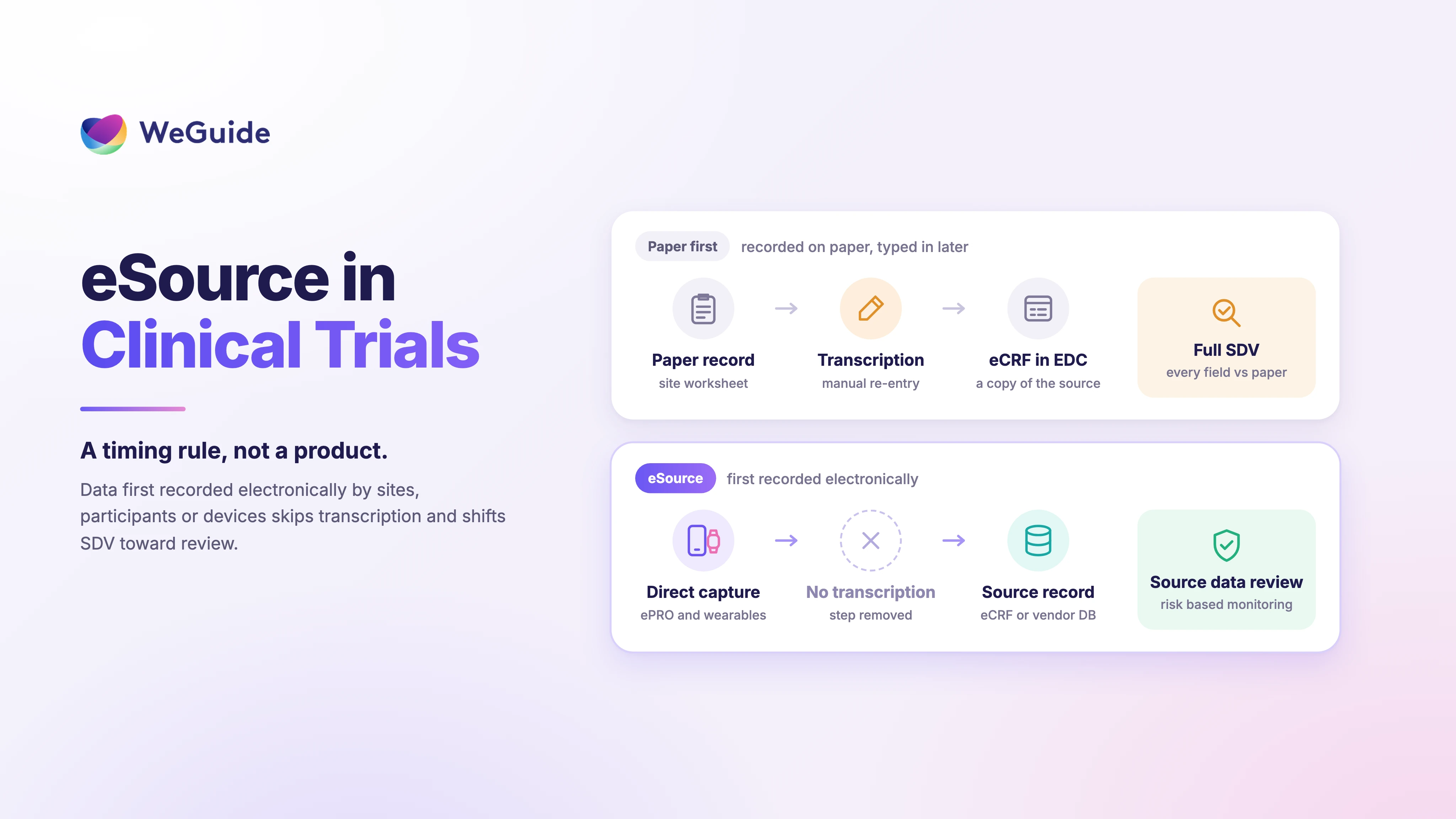


eSource in clinical trials is trial data that is first recorded in electronic form instead of on paper. The FDA defines electronic source data as "data initially recorded in electronic format" (FDA eSource guidance, 2013).
Sponsors are paying closer attention for two reasons. ICH E6(R3) now says "unnecessary transcription steps between the source record and the data acquisition tool should be avoided", and risk based monitoring has moved monitors away from checking every eCRF field against paper.
The term covers three layers that get mixed up. Site eSource and eISF tools digitize the site's own source documents and binders. The EDC holds the eCRF and runs queries through to database lock. Participant capture tools (ePRO, eCOA, eConsent and wearable connectors) collect data directly from participants, and that's where most open regulatory questions sit.
Below: the types of eSource, where the source lives for participant and device data, and what direct capture changes about source data verification (SDV).
Key Takeaways
- eSource is a timing rule, not a product. Data counts as eSource when it's first recorded electronically (FDA, 2013).
- Participants and devices are data originators. For ePRO the participant is the originator, and for wearable data the FDA (2023) puts the source in the first durable electronic data repository.
- Direct capture removes transcription SDV, not monitoring. Source data review, edit checks and validation of systems and transfers still apply.
- The evidence for 100% SDV is weak. In the I-SPY COVID trial, retrospective SDV of 23% of eCRFs changed 0.36% of data fields, changed no outcome type and cost $6.1M.
What Is eSource in Clinical Trials?
eSource (electronic source data) is clinical trial data that is first recorded in electronic form, such as a measurement typed straight into an eCRF, a participant's ePRO entry, or a reading sent by a device, rather than written on paper and transcribed later. The FDA defines it as data initially recorded in electronic format.
Source data itself is broad. Section II of the 2013 guidance defines it as "all information in original records and certified copies of original records of clinical findings, observations, or other activities" in a clinical investigation "used for reconstructing and evaluating the investigation."
A data element is a single item in the eCRF, and each one has an authorized data originator: the person, system or device that entered or generated it. The FDA's list includes investigators and delegated staff, "clinical investigation subjects or their legally authorized representatives", medical devices, EHRs and automated laboratory systems. For electronic patient reported outcomes, the subject "should be listed as the originator."
What eSource does is remove the paper step. The FDA's stated goals include to "reduce the possibility for transcription errors", "eliminate transcription of source data prior to entry into an eCRF" and "promote real-time access for data review", which also makes remote monitoring practical.
The Four Types of eSource, Plus Participant Data
TransCelerate's eSource Initiative groups eSource into four modalities: Direct Data Capture, Non-CRF, Devices & Apps, and EHR (Jennings et al., 2020). The same initiative found that "transcription between electronic systems continues to be the norm" (Kellar et al., 2016), so having an EDC doesn't mean a trial runs on eSource. A later TransCelerate paper describes the goal as source data from any actor, including the "healthcare professional, patient, caregiver", being completely electronic, and notes that "eSource adoption is fragmented and slow" (Parab et al., 2020).
Participant ePRO, eCOA and eConsent sit inside "Devices & Apps" and "Direct Data Capture", but they behave differently because the participant, not the site, is the originator. The data arrive without a site visit, and the investigator doesn't manage the system that holds them.
| eSource type | Data originator | Transcription step? | What monitoring looks like |
|---|---|---|---|
| Site direct data capture | Investigator or delegated staff | None (eCRF is the source) | Source data review; FDA can still ask for corroborating records |
| Non-CRF data (central labs, imaging reads) | Lab system, central reader | None if automated | Transfer validation and reconciliation |
| EHR to EDC | EHR (intervening selection logic) | None if automated, but the EHR stays the source | Review of the EHR record; FDA does not assess EHRs for Part 11 |
| Participant ePRO and eCOA | Participant (unique subject ID) | None | Review of trends, timeliness and safety signals; no transcription SDV |
| eConsent | Participant or legally authorized representative, plus investigator | None | Consent verification and version checks through the audit trail |
| Wearables and other DHTs | The device (identified by model and version) | None, but derived metrics involve processing | Data flow validation and metadata completeness |
The eConsent row reflects monitoring practice. The FDA's eSource guidance doesn't cover consent.
Where eSource Data Lives for Participant and Device Data
For ePRO, the FDA treats the participant as the originator and the eCRF, or the service provider database the entry is sent to, as the source. The EMA treats the entry saved on the device as the original record and the server copy as a certified copy. The EMA and ICH E6(R3) both expect the source location to be defined before the trial starts.
- FDA 2013, section III.A.2.e: "When a PRO instrument is used by a subject to transmit data elements directly to the eCRF, the subject is the data originator and the eCRF is the source. If a process is used by which the subject uses the instrument to transmit data to a technology service provider database, the service provider database is the source." Section III.A.2.b applies the same rule to devices.
- FDA digital health technologies guidance (December 2023): "For data collected directly from study participants through DHTs, FDA considers electronic data that are located in the first durable electronic data repository to which the data are transferred to be the source data." That repository is "an enduring database that is electronically protected from alterations and is maintained until the end of the record retention period." The FDA "does not intend to inspect individual DHTs for source data" when the data and all associated metadata are securely transferred to and retained in that repository "according to the sponsor's prespecified plan."
- EMA guideline on computerised systems and electronic data in clinical trials (2023), Annex A5.1.1.2: "Data saved on the device is the original record created by the trial participant." After a validated transfer, "the data on the server are considered certified copies."
- ICH E6(R3), 2.12.2: the investigator "should define what is considered to be a source record(s), the methods of data capture and their location prior to starting the trial."
| Data path | FDA view | EMA view | What the protocol or DMP must state |
|---|---|---|---|
| ePRO entered straight into the eCRF | Participant is the originator; the eCRF is the source | Device entry is the original; the server copy is a certified copy | Originator ID, entry device, transfer method |
| ePRO into a vendor database, then synced to the EDC | The vendor database is the source; the EDC holds a copy | Device entry is the original; the vendor server holds certified copies | Which database is the source, sync schedule, investigator access, transfer validation |
| Wearable via the maker's cloud, then the study platform | The first durable electronic data repository is the source, with its metadata | The first obtainable permanent data are the source, with device metadata | Which repository counts as first durable, device model and version, which metric is the endpoint |
| Device to EHR, then the eCRF | The EHR is the source | Source location and every transfer identified and validated | The EHR as source and monitor access to it |
When ePRO data live in a vendor database and sync to REDCap or another EDC, the vendor database is the FDA source, not the EDC. The EMA adds that ePRO data "are not managed (although available for review) by the investigator and are often hosted by a service provider", so they "should consequently be made available to the investigator in a timely manner" (A5.1.1.3).
For wearables, whether a consumer maker's cloud meets the FDA's definition of a durable repository is something to settle and document, not assume.
eSource vs EDC vs eCRF
eSource describes when and where data are first recorded. The EDC is the system that holds the eCRF. An eCRF can itself be the source (direct entry) or a copy of a source held elsewhere.
Most eSource ends up in an EDC by one of three paths:
- Direct entry. Site staff type into the eCRF, and the eCRF is the source.
- Transfer from a capture platform. ePRO, eConsent or device data move into the EDC through an API, and the capture platform's database stays the source.
- EHR to EDC. Data move from the hospital record into the eCRF, a route the FDA covers in Use of Electronic Health Record Data in Clinical Investigations (July 2018). Because EHRs "can use intervening processes", the EHR remains the source (FDA 2013, III.A.2.d).
Wearable data rarely fit the EDC itself. Jennings and colleagues explain that digital data outside Direct Data Capture "does not conform to EDC architectural principles": it can be continuous time series, "un-mappable to CRF fields" when it's a raw signal, and large enough to exceed EDC storage capacity. That's why wearable data live in a separate platform and only derived values go into the eCRF.
For the operational split, here's how a CTMS and an EDC differ. WeGuide sits in the participant capture layer, not the EDC layer. It integrates with REDCap through the REDCap API and also connects to Castor and Medidata Rave through its Integration Engine.
What Regulators Expect From eSource
- FDA 2013: keep a list of all authorized data originators, and attach data element identifiers (originator, date and time, subject) as each element enters the eCRF. Changes "must not obscure the original entry, and must record who made the change, when, and why." Describe edit checks in the data management plan, and include "a description or diagram of the electronic data flow" in the protocol or plan.
- ICH E6(R3), 2.12.2: "Unnecessary transcription steps between the source record and the data acquisition tool should be avoided." Our guide to ICH E6(R3) covers what else changed for eCOA and eConsent.
- EMA 2023: the guideline (EMA/INS/GCP/112288/2023) replaced the 2010 eSource reflection paper (EMA/INS/GCP/454280/2010). It says "the first obtainable permanent data from an electronic data generation/capture should be considered and defined as the electronic source data."
- Data integrity attributes: the FDA's 2013 guidance says source data should meet ALCOA, and the EMA guideline builds on ALCOA++. Our guide to ALCOA, ALCOA+ and ALCOA++ explains each attribute for electronic data.
- Electronic records and signatures: investigators' electronic signatures on the eCRF "must comply with part 11", while the FDA "does not intend to assess the compliance of EHRs with part 11." Our guide to 21 CFR Part 11 audit trails and electronic signatures covers the rest.
Capture participant data at the source
Build ePRO and eCOA forms that participants complete on their own phones, with data synced to REDCap, Castor or Medidata Rave.
Source Data Verification vs Source Data Review (SDV vs SDR)
Source data verification (SDV) in clinical trials checks that data in the eCRF match the source record, field by field. Source data review (SDR) checks the source itself for protocol compliance, eligibility, safety events and quality of trial conduct, including things that never become an eCRF field.
The FDA defines SDV as "the process of confirming that study data included in efficacy/effectiveness and safety analyses reflect source data obtained during the clinical investigation" (FDA risk based monitoring Q&A, 2023, footnote 13). ICH E6(R3) 3.11.4 lists "source data review, source data verification, data analytics" among monitoring approaches.
| Activity | What it checks | Question it answers | Needs a transcription step to add value? | Still needed with direct capture? |
|---|---|---|---|---|
| Source data verification (SDV) | eCRF fields against the source record | Was the value copied correctly? | Yes | Only where transcription remains |
| Source data review (SDR) | The source record itself | Was the trial run as the protocol says, and are participants safe? | No | Yes |
| Centralized monitoring | Aggregated data across sites and participants | Are there outliers, gaps or unusual patterns? | No | Yes, and it grows in scope |
Risk based monitoring and targeted SDV
The FDA's 2013 monitoring guidance says frequent site visits "with 100% verification of all data" became the norm partly "because of the perception" that the FDA preferred it. The 2023 Q&A says "the extent to which SDV is used should be guided by the sponsor's risk assessment process and focused on critical study data and processes", so sponsors can meet their obligations "without necessarily having to conduct frequent routine visits to all clinical sites and extensive SDV."
Targeted source data verification (targeted SDV) verifies a defined subset of fields, such as primary endpoint data, eligibility and serious adverse events. Remote source data verification (remote SDV) does the comparison through secure remote access to source records.
What SDV Costs and What the Evidence Says
As summarized in a 2024 scoping review by Hamidi et al., an estimated 46% of on site monitoring time has been attributed to SDV, and estimates of the share of trial costs attributable to SDV "range from 25% to 40%." Both figures come from earlier literature the review summarizes.
The same review found that "no absolute measures of SDV accuracy were identified," and it warns that reducing SDV without knowing its sensitivity "is counter to recommendations in Good Clinical Practice." Less SDV needs a reason grounded in the data.
Three studies give that reason.
- A TransCelerate analysis by Sheetz et al. (2014) found results that "support the hypothesis that generalized SDV has limited value as a quality control measure."
- Tantsyura et al. (2016) modeled an on demand, query driven SDV approach. In a budget simulation (not a trial result), it "could result in cost savings from 3% to 14% for smaller studies to 25% to 35% or more for large studies."
- In the I-SPY COVID trial, retrospective SDV changed 0.36% of data fields (1,234 of 340,532), changed no outcome type, added 2 adverse events, and cost 61,073 person hours, or $6.1M (Abbasi et al., 2025, with an author correction that fixes an author name only). The platform trial enrolled 1,111 patients and used systematic data capture and centralized monitoring "in lieu of SDV." After the arms closed, the team ran retrospective SDV on 10,101 of 44,486 eCRFs (23%).
SDV mainly catches transcription and entry errors, so its value falls as those steps disappear.
How Direct Data Capture Changes SDV
Data a participant enters directly into ePRO has no transcription step, so transcription SDV does not apply to those fields. Source data review, edit checks, and validation of the system and the data transfer still do.
Four checks still apply:
- Source data review for safety signals, eligibility and protocol deviations.
- Edit checks at capture. E6(R3) 4.2.1(c) says "automated data validation checks to raise data queries should be considered as required based on risk."
- Validation of the system and every transfer. The EMA says "all transfers that are needed during the conduct of a clinical trial need to be pre-specified."
- Reconciliation between the capture platform and the EDC, so the copy matches the source.
What changes is the monitor's day: less matching of paper diaries to eCRF pages, more centralized review of completeness, timeliness and outliers. Our comparison of ePRO versus paper covers the paper diary problem.
Designing for eSource: Moving Participant Reported Fields Out of the Site eCRF
Move the fields the participant knows first (symptoms, diaries, patient reported outcomes, quality of life, adherence logs) into a participant facing capture tool. Values the site measures stay in the eCRF.
Annex A5.1.1 of the EMA guideline sets out the design requirements for ePRO:
- Record the time of entry. "The timestamp should record the time of the data entry and not only the time of the data submission/transmission."
- Block implausible dates. Logical checks should prevent unreasonable changes such as "time travel" into the past or future.
- Document corrections. If participants can correct data, corrections should be documented and audit trailed, with a procedure for someone who submitted something wrong.
- Plan for interruptions. Procedures should prevent data loss during "server outage, device battery drained, loss of or unstable internet connection."
- Give the investigator timely access to participant data and metadata.
When an instrument changes mid study, the record has to show which version each participant answered, as our guide to eCOA in clinical trials explains.
WeGuide is a patient engagement and data collection platform for clinical research and care: screening, eConsent, ePRO/PROMs, wearable data and patient registries, on participants' own phones. It's BYOD first, with provisioned devices supported when a protocol needs them. Researchers build ePRO and eCOA forms in the form builder, and the platform offers eConsent with version control, reconsent tracking and an audit trail. WeGuide is ISO 27001 certified and supports 21 CFR Part 11 requirements.
For entry timestamps, offline handling, corrections and edit checks, ask any vendor to demonstrate its system, using our questions to ask an eCOA vendor.
In the BRACE trial led by Murdoch Children's Research Institute (6,800+ healthcare workers, five countries), participants logged daily symptoms in the WeGuide app, with data flowing into REDCap.
Wearables as eSource: Raw Versus Derived Data
The FDA's 2023 DHT guidance puts the wearable source in the first durable repository, together with "all relevant associated metadata." The FDA generally "does not intend to request machine or raw data that require electronic processing to be understood (e.g., voltages) during an inspection." DHT data can be "discrete clinical events measured using built-in analytics or algorithms (e.g., heart beats, breaths, steps)" or continuous recordings.
Device identity matters too. The FDA asks sponsors to identify a specific product, "e.g., model and/or version", and to plan for "trial participants upgrading or updating a DHT" mid study. The EMA (section 6.1.3) says wearable data "should be accompanied by metadata concerning the device used (e.g. device version, device identifiers, firmware version, last calibration, data originator, timestamp of events)."
Consumer wearables mostly expose derived metrics such as steps, sleep stages and resting heart rate. The maker's algorithm sits between the observation and the stored value, so the protocol has to say which value is the endpoint source. A firmware or algorithm update can change a derived value such as a step count without any change in behavior, which is why the FDA wants those updates planned for and why some studies collect raw sensor data. Our guide to raw accelerometer data versus activity counts explains the tradeoff.
Device and firmware versioning, sync metadata and the first durable repository are protocol decisions the sponsor makes. Our guides to wearable APIs and wearable data quality cover the technical side.
On the WeGuide side, the native Garmin integration collects raw accelerometer and gyroscope data at 25 Hz on supported models. WeGuide also reads Apple Health (HealthKit) and Health Connect, and through them gets data from devices such as Apple Watch, Fitbit, Oura and Withings.
eSource Implementation Checklist for Sponsors, CROs and Academic Trial Units
- List the authorized data originators: people, participants, systems and devices (FDA 2013).
- Define the source record and its location for every data stream before enrollment (E6(R3) 2.12.2).
- Draw the electronic data flow and put it in the protocol or data management plan (FDA 2013).
- Remove transcription steps that aren't needed (E6(R3) 2.12.2).
- Specify edit checks and describe them in the data management plan (FDA 2013, III.A.5).
- Specify and validate every transfer in advance (EMA 2023).
- Confirm the investigator has timely access to ePRO and DHT data (EMA A5.1.1.3, E6(R3) 2.12.3).
- Fix DHT model, version and metadata requirements, plus a plan for updates (FDA DHT 2023, EMA 6.1.3).
- Build the monitoring plan around critical data: SDR plus centralized review, with targeted SDV only where transcription remains (FDA 2023 Q&A).
- Plan site startup. In 2023 workshops with sponsors, sites and an eSource vendor, the top two challenges were having no site eSource champion and no agreed eSource approach (Cramer et al., 2024).
eSource in Clinical Trials: FAQs
What does eSource do in clinical trials?
eSource removes the paper step between an observation and the trial database. When data are recorded electronically from the start, nobody transcribes them, so transcription errors disappear and monitors can review data remotely and close to real time.
What is considered source data in a clinical trial?
Source data are all information in original records, and certified copies of them, of clinical findings, observations or other activities needed to reconstruct and evaluate the trial. For DHT data, the FDA treats the first durable electronic data repository as the source.
Is ePRO data considered eSource?
Yes. ePRO data are entered electronically by the participant, who is listed as the data originator. If the entry goes straight to the eCRF, the eCRF is the source. If it goes to a vendor database first, that database is the source (FDA). The EMA treats the device entry as the original and the server copy as a certified copy.
Does eSource eliminate source data verification?
Not entirely. Data a participant enters directly into ePRO has no transcription step, so transcription SDV doesn't apply to those fields. Source data review, edit checks, system and transfer validation, and reconciliation with the EDC still apply. Targeted SDV stays useful wherever a site still transcribes.
What is the difference between SDV and SDR?
SDV compares eCRF values with the source record to confirm they were copied correctly. SDR looks at the source record itself for protocol compliance, eligibility, safety events and the quality of trial conduct. SDV only adds value when there's a transcription step, while SDR stays relevant either way.
Is EHR data considered eSource?
It can be. Data recorded first in a hospital's electronic health record are electronic source data, and when they move into the eCRF the FDA treats the EHR as the source, because EHRs "can use intervening processes" before data reach the trial (FDA 2013). The FDA "does not intend to assess the compliance of EHRs with part 11", but the pertinent EHR data should be available for review during an FDA inspection.
Is eSource the same as EDC?
No. eSource describes when and where data are first recorded, while the EDC is the system that holds the eCRF, runs queries and supports database lock. An eCRF can be the source when staff enter data directly, or hold a copy of a source that lives in an ePRO database, a device platform or the EHR.
What is remote source data verification?
Remote source data verification is SDV done away from the site. The monitor gets secure, read only access to source records, such as the EHR or a site eSource system, and compares them with eCRF values without traveling.
What does SDV stand for in clinical research?
SDV stands for source data verification. It's the monitoring step that confirms data in the eCRF match the original source record.
Plan participant data capture with your EDC in mind
See how WeGuide collects ePRO, eConsent and wearable data from participants and connects it to REDCap, Castor or Medidata Rave.
Book a demoNo pressure, just a conversation.

