


The IQCODE: Informant Questionnaire on Cognitive Decline
The IQCODE asks caregivers to rate changes in an older person's memory and thinking over ten years. It helps doctors screen for dementia without relying on direct patient testing.


Informant Questionnaire on Cognitive Decline in the Elderly (IQCODE)
The Informant Questionnaire on Cognitive Decline in the Elderly (IQCODE) screens for dementia by asking a relative to rate changes in a patient's everyday memory. By comparing current function to ten years ago, it helps clinicians identify decline independent of a person's education or intelligence.
Category
Disease
Source
What is Informant Questionnaire on Cognitive Decline in the Elderly (IQCODE)

The Informant Questionnaire on Cognitive Decline in the Elderly (IQCODE) is a trusted instrument for tracking mental changes in older adults. Unlike standard tests that just measure current ability, this screening tool relies on a close friend or relative to report on everyday memory and thinking skills. Informants rate changes over a ten-year period across 16 or 26 specific items. They look at practical things like remembering family birthdays or handling money, scoring from "much improved" to "much worse" to highlight actual shifts in daily ability. This approach is really helpful because it isn't affected by a person's education level or previous intelligence. It works well in multicultural settings where language barriers might skew other test results. Clinicians use it to get a fair picture of dementia risk and plan better support strategies.
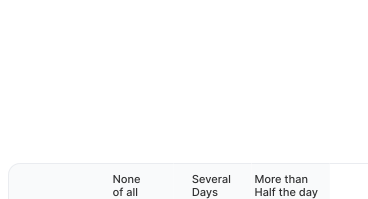
The IQCODE can be scored using one main approach that tracks cognitive changes over a ten year period. Whether you use the short 16 item or long 26 item version, the method stays the same. An informant rates everyday memory and function on a scale from 1, meaning much improved, to 5, meaning much worse. To get the total, simply add up the ratings and divide by the number of questions. A score of 3 means no change, while anything above 3.3 usually suggests cognitive decline or dementia risks. It is a practical way to check for issues without testing the patient directly.
Advantages

Enables precise identification of patient health status.
.svg)
Monitors clinical data throughout extended study periods.
.svg)
Serves diverse clinical needs effectively.
.svg)
Enables remote healthcare assessment capabilities.
.png)

Related Instruments

Digital counterpart
Digital biomarkers that measure the same thing with sensors rather than a questionnaire.
Collect IQCODE data with WeGuide, the all in one patient engagement platform
.jpg)

Support Your patient in no time - all under your own brand
Our platform combines the knowledge of 100+ digital health solutions built, letting you easily build your patient engagement app for research or clinical use. Collect PROMs, support patients on waiting lists, or gather vital signs data. This is how:
Learn More.png)
Program Builder
.png)
.png)
Whitelabelling
.svg)
.svg)
.png)
Turn on components, dependent on your usecase
.svg)
.png)
Support The Full Journey
.png)
.png)
%20(1).png)
.png)
It’s your turn
Every WeGuide project, saves researchers and clinicians - 9 months and $450,000 - creating impactful digital health solutions.
