


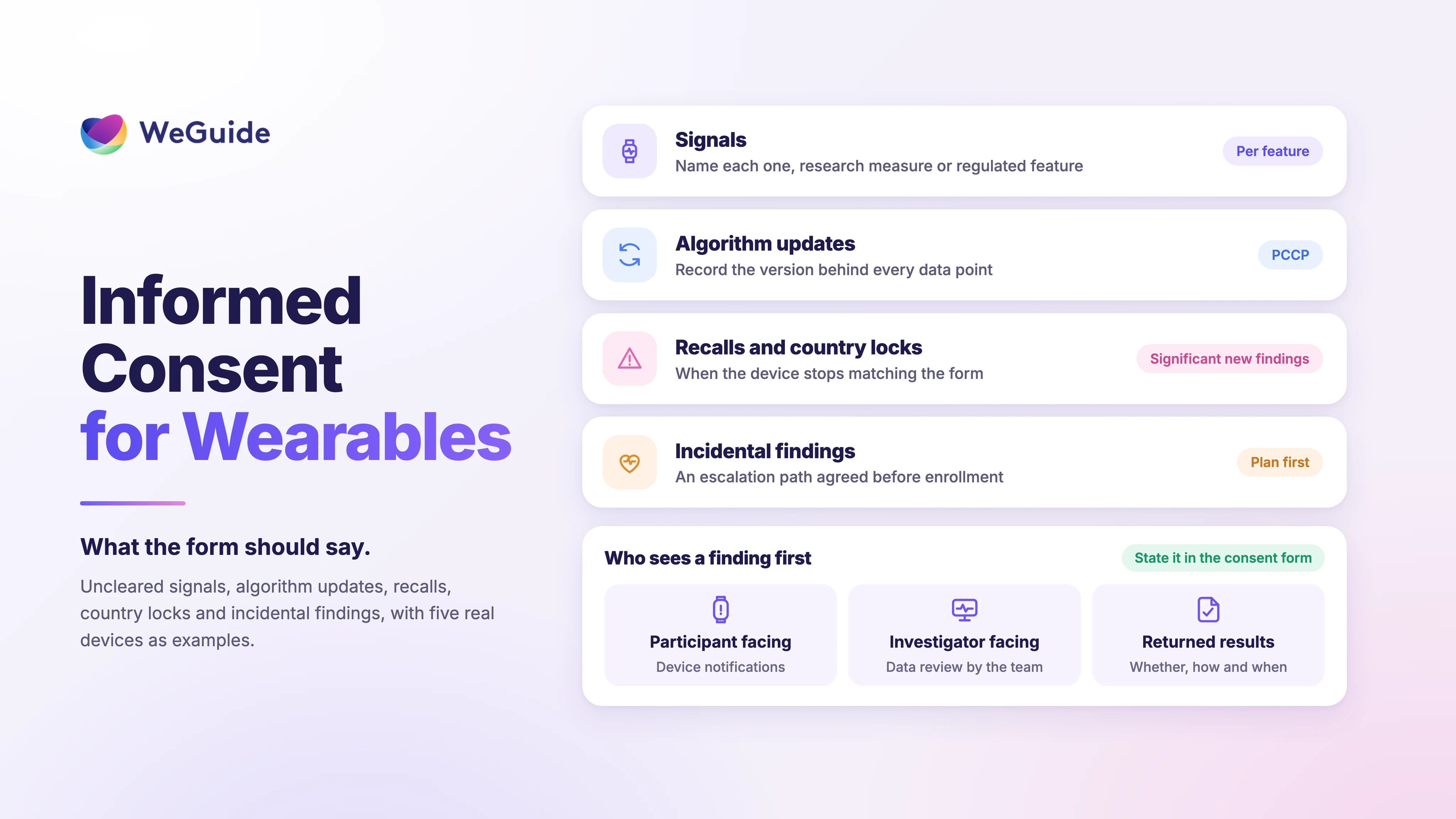


Informed consent for wearable devices has to say more than "we will collect activity data." The consent form should name each signal and say whether the device is cleared to produce it, record which algorithm version produced a participant's data, explain what happens if a feature is updated or recalled mid study, and set out who acts on incidental findings, such as a watch telling a participant they may have atrial fibrillation, sleep apnea or hypertension.
This guide turns those four problems into clauses for the participant information sheet and consent form. It uses five real devices and the FDA and Common Rule text behind each one, so a study team can take the points straight to its IRB or ethics committee.
This article is general information, not legal or regulatory advice. Your IRB or ethics committee decides what your consent form needs.
Key Takeaways
- Clearance is per feature, not per device. Name each signal and say plainly which outputs are research measures and which, if any, are regulated features.
- Algorithms can change mid study. Samsung's July 2026 sleep apnea clearance and Apple's September 2025 hypertension clearance both carry a predetermined change control plan, so record the app and firmware version behind every data point and decide in advance when an update triggers new information for participants.
- Recalls and country locks change what participants see. A Withings software bug removed the physician step before ECG activation and review on 38,886 US watches, and Samsung's Health Monitor app (ECG and blood pressure) only works on devices bought in a supported country.
- Plan incidental findings before enrollment. FDA's DHT guidance says participants should be told what to do if a device detects something like an abnormal cardiac rhythm. In the Apple Heart Study, 57% of notified participants who answered the 90 day survey contacted a provider outside the study.
- Split participant facing and investigator facing findings. What the device shows the participant and what your team sees in the data need different clauses and different escalation paths.
What Informed Consent for Wearable Devices Has to Cover
Informed consent for research that uses a wearable must still meet the standard consent elements. A wearable changes how three of them play out: foreseeable risks now include unexpected health notifications, confidentiality now includes the device maker, and significant new findings now include software updates and recalls. FDA guidance adds a fourth point: what the device collects and how it's monitored.
The regulations didn't change for wearables. US federal regulations still set the same required content for a consent form for research, and our guide to all required elements of informed consent walks through the full list. What changes is the practical meaning of a handful of those elements once a device on the participant's wrist can generate clinical information by itself.
Here are the requirements a wearable touches, and what each one means in practice.
| Requirement | Source | What it means for a wearable |
|---|---|---|
| Reasonably foreseeable risks | 21 CFR 50.25(a)(2) | Skin irritation, but also the risk of receiving an unexpected health notification |
| Confidentiality, and the possibility that FDA may inspect records | 21 CFR 50.25(a)(5); FDA DHT guidance IV.F.3 | Name the manufacturer and its terms of service as a party that may access data |
| Significant new findings | 21 CFR 50.25(b)(5) and 45 CFR 46.116(c)(5) (additional elements, when appropriate) | A feature update, recall or safety notice may be new information |
| Return of clinically relevant results | 45 CFR 46.116(c)(8) (Common Rule research, additional element when appropriate) | State whether, how and when individual results are returned |
| What the DHT collects, how it's monitored, what to do on an abnormal event | FDA DHT guidance (December 2023) IV.F.3 | State whether monitoring is real time |
| Data collected remotely and who can see it | ICH E6(R3) Annex 2, 2.2.3 | Describe remote data collection in the consent materials |
The 21 CFR 50.25 elements are binding for FDA regulated clinical investigations. FDA's Digital Health Technologies for Remote Data Acquisition in Clinical Investigations guidance, finalized in December 2023, is nonbinding, but it's the clearest statement of what FDA expects a DHT consent to explain. It says consent "should explain the type of information that will be collected by the DHT and how that information will be used and monitored." FDA's broader Informed Consent guidance (August 2023) is useful background.
The ICH E6(R3) guideline points the same way. Annex 2, section 2.2.3 asks that consent materials describe the data collected, including data collected remotely through DHTs, and who can see participants' personal information. Our explainer on ICH E6(R3) Annex 2 covers the rest of that wording.
One gap is worth knowing. FDA's Part 50 has no element on returning individual research results. The Common Rule does, at 46.116(c)(8), as an additional element to include when appropriate, but it applies to research covered by the Common Rule, which mainly means federally funded studies. Many industry sponsored device and drug trials sit under Part 50 only. That doesn't remove the question. It just means the answer comes from your protocol and IRB rather than a regulation.
Five Wearable Devices, Five Informed Consent Problems
The consent problem isn't "wearables" in general. It's a specific regulatory fact about a specific device and feature. These five devices are common in research, and each one creates a different gap between what the consent form says and what the participant experiences.
Device records checked on 2026-11-28.
| Device and feature | Regulatory record | What can reach the participant | The consent problem |
|---|---|---|---|
| Samsung Galaxy Watch, Sleep Apnea Feature v2.0 | 510(k) K261011, cleared July 2026, with a PCCP | A sleep apnea risk notification | The cleared algorithm can step versions mid study. Separately, Samsung's ECG and blood pressure app only works on devices bought in a supported country |
| Apple Watch, Hypertension Notification and AFib History | K250507 (September 2025, with a PCCP); K213971 (2022, diagnosed AFib only) | A possible hypertension notification and, for diagnosed users, an AFib burden estimate | A participant consented for activity can receive a hypertension flag, and no flag doesn't mean no hypertension |
| Withings ScanWatch (HWA09) | K201456, AFib detection under a physician's care; recall Z-1280-2023 | An AFib classification that should have been physician gated | A software bug removed the physician step without any protocol change |
| Polar H10, through the Polar SDK | No 510(k) found in openFDA. SDK licence says not intended for medical purpose | Continuous ECG to the study, and to the participant's own app depending on setup | Research grade signal with no clinical claim, but a reviewer may still see an arrhythmia |
| ActiGraph LEAP | K231532, cleared June 2023 | Nothing about the measures | Every finding is investigator facing, so the plan is about what the team does |
The rest of this guide turns each row into consent language. The Samsung and Apple rows drive the algorithm update section, Withings and Samsung drive the recall and country lock section, and Polar and ActiGraph frame the incidental findings section.
Uncleared Signals: Say What Each Measure Is, and What It Isn't
A smartwatch isn't a medical device as a whole. Individual features are. Apple Watch, for example, has several separately cleared Apple Watch features, each with its own indications for use and intended population. Step counts, sleep stages and most heart rate outputs on the same watch carry no clearance at all.
That matters for consent because participants (and some study staff) tend to treat everything a watch shows as medically meaningful. The consent form is where the study draws the line.
The Polar H10 shows the extreme case. Researchers value its chest strap ECG and RR intervals, and our Polar H10 guide covers why. Yet the Polar BLE SDK licence, clause 3.2, states: "Licensed Materials and Polar's devices are not intended to be used in life critical, life supporting or medical purpose." A study can collect a high quality ECG stream from a device whose maker explicitly disclaims any medical use.
The consent language should do four things:
- List signals by name. Write "accelerometry, optical heart rate (PPG), skin temperature and on demand ECG, collected 24 hours a day including sleep," not "activity data." Our Samsung guide makes the same case to name the actual signals.
- State the purpose. Say the signals are collected for research.
- State the review status. Say they won't be reviewed for clinical care unless the protocol says otherwise.
- State the limit. Say the device and its outputs are not a substitute for seeing a doctor.
If the protocol uses a cleared feature as part of the study, say which feature and that it's used within its cleared indications. If it doesn't, don't imply that it does. A consent form that calls a consumer sleep score a "medical measurement" sets an expectation the study can't meet.
This section stays on the consent side: what the participant is told. Whether a cleared feature is fit to serve as an endpoint is a separate question for your protocol and statistical plan.
When the Algorithm Changes Mid Study
A regulated wearable algorithm can now change between app releases without a new 510(k). FDA can authorize a predetermined change control plan (PCCP) as part of a clearance, which lets the manufacturer make the modifications agreed in that plan later. For a study, that means the feature a participant consented to in month one may run a different validated version in month six.
Two recent wearable clearances carry a PCCP.
Samsung Sleep Apnea Feature v2.0 (K261011, July 2026). The 510(k) summary says the PCCP "complies with Section 3308 of the Food and Drug Omnibus Reform Act (FDORA) of 2022." It also limits what can change: "No modifications described in the PCCP allow adaptive learning of algorithms in the field. Modifications to all algorithms, including neural networks, will be verified and validated and then locked prior to release." These are changes agreed in advance, locked and released as new versions, not an algorithm that drifts on its own. They're still changes.
Apple Hypertension Notification Feature (K250507, September 2025). This clearance also includes a PCCP, with "a procedure ... for updating the Instructions for Use in order to inform users about the changes." So the instructions a participant reads at enrollment can be updated during the study.
FDA's DHT guidance anticipates this. Section IV.H.4, "DHT Updates and Other Changes," says: "Sponsors should keep a record of the timing and nature of any updates for each DHT." Recording versions is the data management side, and version drift in wearable data can bias an analysis on its own. The consent side is what participants are told.
Two consent implications follow:
- Tell participants software may update. The consent form should say the device and its apps may receive software updates during the study, and that the study records which version produced their data. If participants are asked not to update, or to update only when told, say that too.
- Decide in advance what counts as new information. Under 21 CFR 50.25(b)(5), an additional element to include when appropriate, the consent form says that "significant new findings developed during the course of the research which may relate to the subject's willingness to continue participation" will be provided to the subject. Not every update meets that bar. A change that alters what participants are shown, or the risks they face, is more likely to. A change that only affects how data are processed may be a data management event. Agree the rule with your IRB in the protocol, before the first update arrives, rather than debating each release.
There's no regulatory threshold to quote here. The point is that the decision is made once, written down, and applied the same way to every update.
Keep every consent version matched to the device it describes
WeGuide eConsent keeps version control, re-consent tracking and an audit trail for every participant, on site, remote or hybrid.
Recalls and Country Locks: When the Device Stops Matching the Consent Form
A consent form describes a device at one point in time. Two things can make that description wrong without anyone touching the protocol: a recall, and a feature that doesn't work where the participant bought the device.
A recall that removed physician review
The Withings ScanWatch (HWA09) was cleared under K201456 to detect AFib "when the monitor is prescribed or used under the care of a physician." FDA recall Z-1280-2023, initiated on December 19, 2022 and covering 38,886 US units, gives the reason: "A software bug eliminated the initial ECG activation and review of the ECG under a physician. However, the device is only cleared for use under the care of a physician." The openFDA record still lists the recall as "Open, Classified."
Withings told users by push notification on December 19, 2022 to update the app and activate the ECG feature under a physician, then followed up with recall letters on February 10, 2023. This was a software design failure that removed a step required by the cleared indication, not a hardware fault. For affected users, what they could see on their wrist didn't match the cleared conditions of use, and no protocol amendment would have caught it.
The record kept moving afterward. Withings later received K240795 (June 2025), a separate over the counter clearance for the Withings ECG App on ScanWatch model HWA10, not the recalled HWA09. A protocol written in 2024 may describe a different access model from the one participants have today. Our guide to Withings in clinical research covers the device side.
Consent implication: say who will tell participants about manufacturer safety notices or recalls that affect the study device, and that the study may ask them to update the device, stop using a feature, or stop wearing it. In practice, the manufacturer's notice reaches the participant first, so the study's role is to confirm what it means for the study.
Features that only work where the device was bought
Samsung's Australian page for Samsung Health Monitor, the app that runs Samsung's regulated watch features such as ECG and blood pressure, says: "Due to country/region restrictions in obtaining approval/registration as a medical device, Samsung Health Monitor app only works on watches and smartphones purchased in the country/region where the service is currently available."
That's Samsung's own wording about its own regulatory status in each market. For a bring your own device study, it means two participants with the same watch model may have different features, depending on where each one bought it.
Consent implication for multinational studies: use country specific consent versions that state which features are available in that country, and add a purchase country check at enrollment for participants who use their own device. If a feature matters to the protocol, the consent form shouldn't promise it to a participant whose device can't run it.
Incidental Findings in Research With Wearables: Who Is on the Escalation Path
An incidental finding is health information a study didn't set out to find. With wearables it arrives by two routes: a cleared consumer feature can deliver it straight to the participant, or the study team can spot it in the data. Each route needs its own consent clause and its own plan, agreed before enrollment.
The scale isn't hypothetical. The Apple Heart Study (Perez et al., NEJM 2019, sponsored by Apple with Stanford investigators) enrolled 419,297 participants. Over a median of 117 days, 2,161 (0.52%) received an irregular pulse notification. Of the 1,376 notified participants who returned the 90 day survey, 57% contacted health care providers outside the study. In a large study, a small notification rate can still mean hundreds of people seeking care because of a device.
Absence of a notification is information too, and it can mislead. Apple's hypertension clearance (K250507) is for "adults age 22 and over who have not been previously diagnosed with hypertension," is "not intended to replace traditional methods of diagnosis," and states: "The absence of a notification does not indicate the absence of hypertension." Its reported sensitivity was 41.2% (specificity 92.3%). A participant who never receives a flag shouldn't read that as a clean bill of health, and the consent form can say so.
Eligibility for a feature can also depend on a diagnosis. Apple's AFib History feature (K213971) is for users "22 years of age and over who have a diagnosis of atrial fibrillation" and is "not intended to provide individual irregular rhythm notifications." A consent form for a mixed population may need different wording for participants with and without that diagnosis.
The ethics literature has said the same thing for years. Wolf and colleagues (J Law Med Ethics 2008) concluded that researchers should address possible incidental findings in the protocol, in communications with the IRB, and in consent forms, and should set up a pathway for handling them. The US Presidential Commission for the Study of Bioethical Issues put it in two words in its December 2013 report title: Anticipate and Communicate. It recommends that practitioners "anticipate and plan for incidental findings and communicate that plan to patients, research participants, and consumers so they are informed ahead of time about what to expect."
Participant facing findings
These come from the device to the participant: an Apple hypertension or irregular rhythm notification, a Samsung sleep apnea notification, a Withings AFib classification. The study team usually doesn't see them as they happen.
FDA's DHT guidance is direct about this: "When relevant, participants should be informed of what action to take in case of any concerning sign, symptom, or abnormal clinical event (e.g., hypoglycemia or abnormal cardiac rhythm) detected by a DHT, such as seeking emergency medical attention, if appropriate." The clause should cover:
- that the device's own features may give health notifications
- that the study team doesn't monitor those notifications in real time (if that's true for your protocol)
- what to do: contact their doctor, and when to contact the study team for advice
- whether to tell the study about a notification, and whether that report becomes study data
Investigator facing findings
These come from the data to the study team. A coordinator reviewing a Polar ECG stream, or any study that ingests ECG classifications from Apple HealthKit, can see something nobody planned for.
ActiGraph LEAP is the contrast case. Its clearance (K231532) states: "The display does not provide feedback to the wearer/patient regarding data measures." With a device like that, findings can only surface on the study side, and the whole plan is about what the team does. Our guide to actigraphy in clinical research covers the device itself.
The clause should cover whether data are reviewed at all, by whom and how often, and whether clinically relevant individual results will be returned. For Common Rule research, 46.116(c)(8) lists, among the additional elements to include when appropriate, "a statement regarding whether clinically relevant research results, including individual research results, will be disclosed to subjects, and if so, under what conditions." Whether participants can choose to be told or not told about incidental findings is a protocol question worth raising with your IRB.
An escalation path in four steps
- Define the signals. In the protocol, list which signals could produce a finding and who reviews them.
- Tier by urgency.Leonard-Corzo and colleagues (Front Digit Health 2025, authors employed by VivoSense) summarize the MRCT Center of Brigham and Women's Hospital and Harvard categories: urgent results and urgent incidental findings, routine results and incidental findings that aren't urgent, end of study individual results, and exploratory results. The MRCT Center recommends that at minimum the urgent and end of study categories are returned.
- Name the decision maker. Name the qualified person who decides whether a finding is clinically relevant, and the timeframe for acting.
- Document it. Record the participant's choice and any disclosure in the consent record and source documents.
WeGuide reads ECG data through Apple HealthKit, so a study that ingests those records holds clinical information. Agree this path before the first participant enrolls.
Informed Consent for Wearable Devices: A Clause Checklist
This isn't a template. It's a list of points to check your own informed consent form for wearable data against, each tied to its source.
- Each device and each signal named, with collection times (for example, 24 hours a day including sleep) [FDA DHT guidance IV.F.3 (type of information collected)]
- Which outputs are research measures and which are regulated features, without implying the study provides diagnosis [510(k) indications for use]
- Whether the participant will see their own data or notifications, and how that could affect them [FDA DHT guidance]
- What to do if the device shows a health notification, and whom to contact [FDA DHT guidance IV.F.3]
- Whether the study team reviews data, how often, and that monitoring isn't real time (if so) [FDA DHT guidance IV.F.3]
- Whether clinically relevant individual results will be returned, and under what conditions [45 CFR 46.116(c)(8)]
- That device software may update during the study and that versions are recorded [FDA DHT guidance IV.H.4]
- That significant new findings, including recalls or safety notices about the study device, will be shared [21 CFR 50.25(b)(5)]
- Who can access device data, including the manufacturer under its terms of service, and for how long [FDA DHT guidance IV.F.3; 21 CFR 50.25(a)(5)]
- Which features are available in each country, for multinational studies [Samsung Health Monitor availability]
- Any data costs or charging burden for the participant [21 CFR 50.25(b)(3)]
- What withdrawal means for data already on the device, the phone and the study systems (see our Samsung Galaxy Watch guide)
Point 9 deserves a closer look. FDA's DHT guidance says consent "should specify who may have access to data collected through the DHT," naming "sponsors, investigators, participants, DHT manufacturers, other specified third parties," and "during what time frame." It also notes that end user license agreements and terms of service may let manufacturers "gain access to personal information." Most participants won't read the device's terms, so the consent form is the place to summarize them.
Point 3 matters for study design as well as consent. The DHT guidance notes that "If participants are able to view data or results from the DHT, it may impact their behavior or evaluation of the investigational product." If the protocol blinds participants to their own data, the consent form should say so and explain why.
Once the wording is drafted, run it through our consent readability checker, and see our eConsent best practices for layered and multimedia consent that keeps a long device section readable.
Keeping Consent Current When the Device Changes
Paper consent struggles to keep up with a device that changes under a PCCP, gets recalled, or behaves differently by country. Each of those events can mean a new consent version, a new information sheet, or a re-consent for some participants. That's a versioning and tracking problem as much as a wording problem.
WeGuide provides eConsent with version control and re-consent tracking, plus an audit trail, and supports legally authorized representatives and multiple signatories. For background on the format itself, see how eConsent works in clinical trials.
On the data side, WeGuide reads Apple Health (HealthKit) and Health Connect, and through them gets data from devices such as Apple Watch, Fitbit, Oura and Withings. It also has a native Garmin integration, which collects raw accelerometer and gyroscope data at 25 Hz on supported models. Our page on wearable device studies shows how the pieces fit together.
WeGuide is TGA registered Class I medical device software (ARTG 355337) and ISO/IEC 27001:2022 certified.
Frequently Asked Questions
Does an FDA cleared wearable feature make the data clinical grade?
No. A 510(k) clearance covers a specific feature, its indications for use and its intended population. Apple's hypertension feature, for example, is cleared for adults 22 and over without a prior hypertension diagnosis. Other outputs on the same device are wellness outputs. See our guide to digital health technologies in clinical trials for how FDA frames DHT data.
Do you have to tell participants about incidental findings from a wearable?
US regulations require consent forms to describe reasonably foreseeable risks, and, when appropriate, to say that significant new findings will be provided to participants. For Common Rule research, the additional elements include a statement on whether clinically relevant individual results will be returned. How you handle incidental findings is a protocol and IRB decision, but it has to be made, and stated in the consent form, before enrollment.
Is a wearable software update a reason to re-consent?
Not automatically. Record the software version behind every data point, as FDA's DHT guidance recommends. If an update changes the risks or what participants are shown, treat it as possible new information under 21 CFR 50.25(b)(5) and agree the route with your IRB. Setting that rule in the protocol avoids debating each release.
Should participants see their own wearable data during a trial?
It depends on the design. FDA's DHT guidance notes that viewing data or results may affect participant behavior or the evaluation of the investigational product. Some protocols blind participants to study measures, others return data to support engagement. Whichever you choose, state it in the consent form and explain what participants will and won't see.
What are the risks of wearable devices in a research study?
Beyond skin irritation, the consent risks are an unexpected health notification from a cleared feature, access to participant data by the device maker under its terms of service, and a feature that is updated, recalled or unavailable in the participant's country mid study. List each under foreseeable risks and confidentiality in the consent form, and say who the participant should contact if the device shows a notification.
What does the Common Rule say about returning individual research results?
45 CFR 46.116(c)(8) lists, among additional elements to include when appropriate, "a statement regarding whether clinically relevant research results, including individual research results, will be disclosed to subjects, and if so, under what conditions." It applies to research covered by the Common Rule. FDA's 21 CFR Part 50 has no equivalent element, so for FDA only trials the answer comes from the protocol and IRB.
What is the difference between an incidental finding and a secondary finding?
The Presidential Commission for the Study of Bioethical Issues (2013) defines a secondary finding as one "actively sought by a practitioner that is not the primary target." An incidental finding isn't sought. It can be anticipatable, meaning known to be associated with a test, or unanticipatable. A wearable AFib notification in a sleep study is a good example of an anticipatable incidental finding, because the device is known to produce that kind of output.
Book a demo of WeGuide for your next wearable study
See eConsent, ePRO and wearable data capture on participants' own phones, with version control, re-consent tracking and ISO/IEC 27001:2022 certified security.
Book a demoNo pressure, just a conversation.

