


Morningness-Eveningness Questionnaire: Measuring Chronotype
The Morningness-Eveningness Questionnaire measures chronotype: whether a person is naturally a morning type, an evening type or somewhere in between.

Morningness-Eveningness Questionnaire (MEQ)
The Morningness-Eveningness Questionnaire, developed by Horne and Östberg, is a 19 item self-report measure of circadian preference. It asks when a person would choose to sleep, wake and perform at their best, producing a score from 16 to 86 that places them on a spectrum from definite evening type to definite morning type.
Category
Disease
Source
What is the Morningness-Eveningness Questionnaire

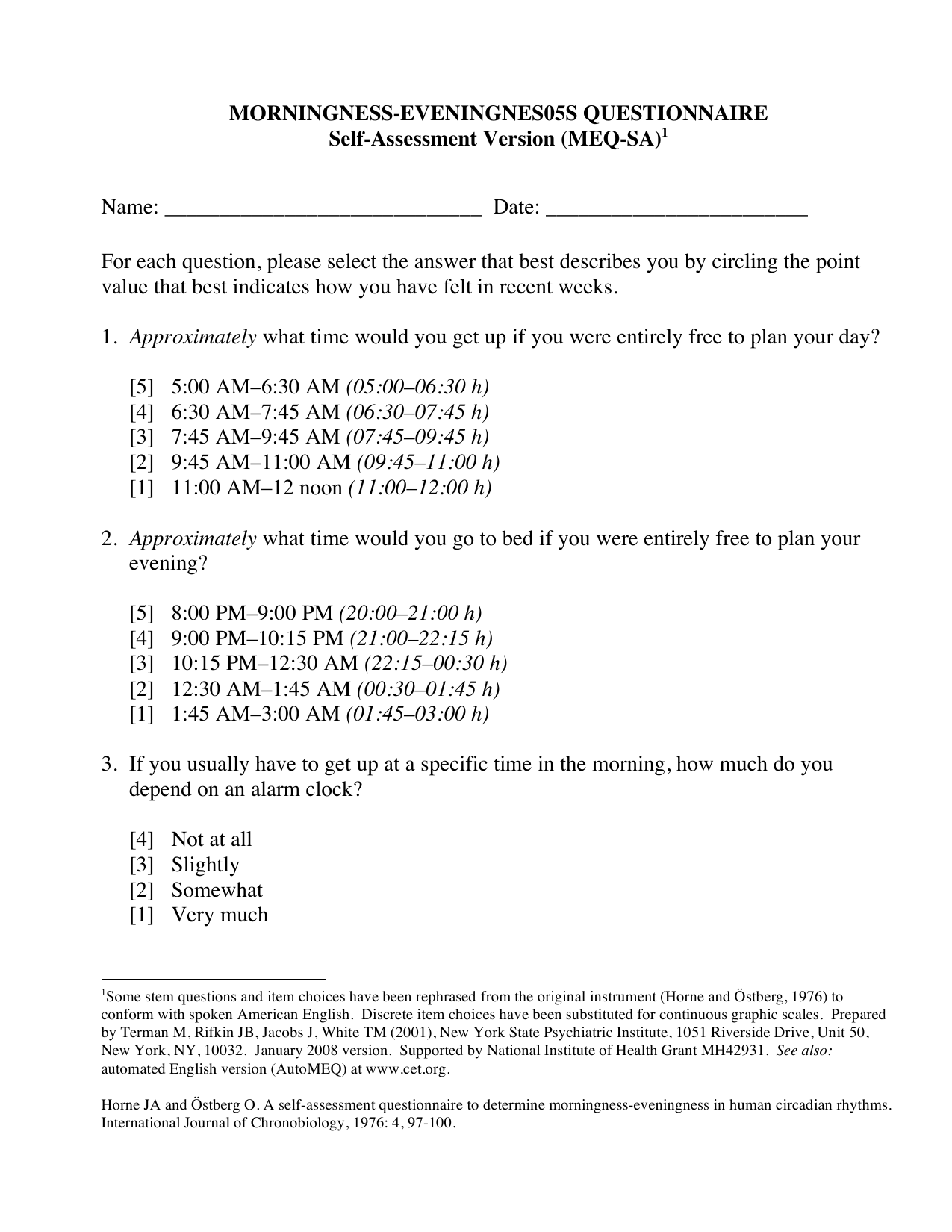
The questions ask about preferred rather than actual timing: what time the person would get up and go to bed if entirely free to plan their day, how alert they feel in the first half hour after waking, when they would choose to do hard physical work or sit a demanding exam, and how they would describe themselves overall. Responses carry weighted points that sum to a single score.
Horne and Östberg published it in 1976 and linked scores to the timing of the daily peak in body temperature, which is why it is treated as a behavioural marker of the internal clock rather than a personality measure. Chronotype matters in research because it modifies how people respond to shift schedules, when they sleep best, and how strongly social timing conflicts with biological timing. It is also used to time light therapy, which is the purpose of the self-assessment version published by the Center for Environmental Therapeutics.
Scores range from 16 to 86. Scores of 41 and below indicate evening types, 42 to 58 intermediate types, and 59 and above morning types, with the outer bands further split into moderate and definite. Most people fall in the intermediate range.
The cut-offs were derived in young adults, and chronotype shifts with age: adolescents and young adults drift later, older adults earlier. Applying the original bands unchanged to other age groups will misclassify people, so studies spanning a wide age range should analyse the continuous score rather than the categories. The questionnaire measures preference, not a disorder, and an evening score is not a diagnosis of delayed sleep phase. Where actual sleep timing is the outcome, the Munich ChronoType Questionnaire or actigraphy measures behaviour more directly.
Advantages
.svg)
Strengthens evidence through systematic measurement approaches.

Develops personalised strategies based on assessment data.
.svg)
Simple to understand and complete for patients.
.svg)
Analyzes outcomes across diverse patient groups.
.png)

Related Instruments

Digital counterpart
Digital biomarkers that measure the same thing with sensors rather than a questionnaire.
Collect Morningness-Eveningness Questionnaire data with WeGuide, the all in one patient engagement platform
.jpg)

Support Your patient in no time - all under your own brand
Our platform combines the knowledge of 100+ digital health solutions built, letting you easily build your patient engagement app for research or clinical use. Collect PROMs, support patients on waiting lists, or gather vital signs data. This is how:
Learn More.png)
Program Builder
.png)
.png)
Whitelabelling
.svg)
.svg)
.png)
Turn on components, dependent on your usecase
.svg)
.png)
Support The Full Journey
.png)
.png)
%20(1).png)
.png)
It’s your turn
Every WeGuide project, saves researchers and clinicians - 9 months and $450,000 - creating impactful digital health solutions.
