


Berlin Questionnaire: Screening for Obstructive Sleep Apnoea
The Berlin Questionnaire sorts people into high or low risk of obstructive sleep apnoea from snoring, daytime sleepiness, blood pressure and body mass index.

Berlin Questionnaire
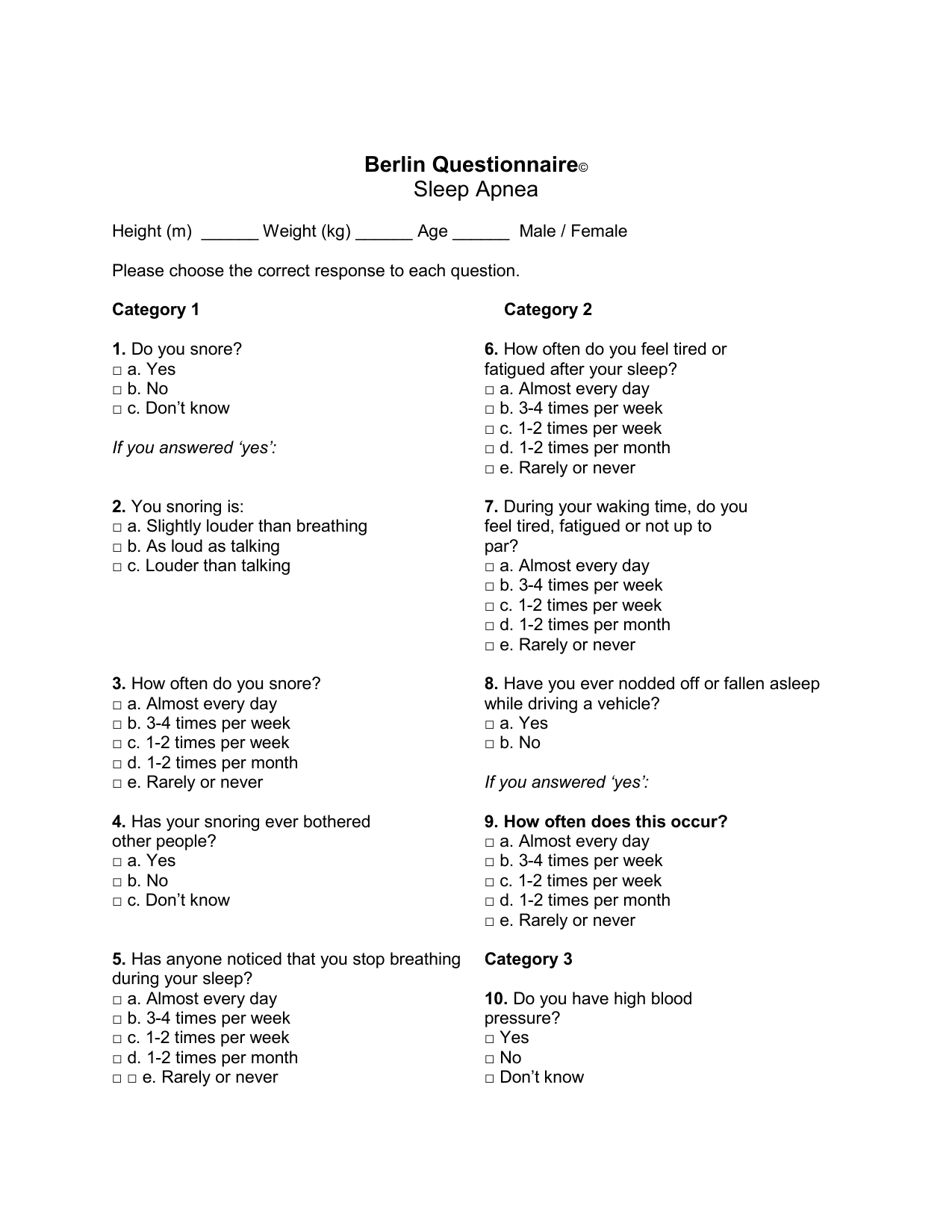
The Berlin Questionnaire is a self-report screening tool for obstructive sleep apnoea. Ten questions across three categories cover snoring and witnessed breathing pauses, daytime sleepiness and fatigue, and high blood pressure or obesity. Two positive categories classify a person as high risk, which is a reason for a sleep study rather than a diagnosis.
Category
Disease
Source
What is the Berlin Questionnaire

The questionnaire opens with height, weight, age and sex, then asks ten questions grouped into three categories. The first covers snoring: whether the person snores, how loudly, how often, whether it bothers others and whether anyone has noticed them stop breathing during sleep. The second covers daytime sleepiness and fatigue, including whether they have nodded off while driving. The third is met by a history of high blood pressure or a body mass index above 30.
Netzer and colleagues developed it at a 1996 conference in Berlin and validated it in primary care, where most people with sleep apnoea are never identified. Its purpose is triage: to decide who should go on to polysomnography or home sleep apnoea testing, in settings where testing everyone is impossible. It asks about symptoms a bed partner often notices first, which is a strength when the partner helps complete it and a blind spot when the person sleeps alone.
Each category is scored as positive or negative. Categories one and two are positive when their item responses reach two or more points; category three is positive when the person reports high blood pressure or has a body mass index above 30. Two or more positive categories classify the person as high risk of sleep apnoea, and zero or one as low risk.
Performance depends heavily on the population. In the original primary care validation, high risk status predicted a respiratory disturbance index above five with a sensitivity of 86 percent and a specificity of 77 percent. In sleep clinic and surgical populations, where the prevalence and severity of sleep apnoea are different, accuracy is lower and STOP-Bang is often preferred. A low risk result lowers the probability without excluding the condition, and a high risk result is a referral decision, not a diagnosis.

Advantages
.svg)
Identifies health issues during initial stages.
.svg)
Quick completion with minimal burden.
.svg)
Streamlines research data gathering process.
.svg)
Serves diverse clinical needs effectively.
.png)

Related Instruments

Digital counterpart
Digital biomarkers that measure the same thing with sensors rather than a questionnaire.
Collect Berlin Questionnaire data with WeGuide, the all in one patient engagement platform
.jpg)

Support Your patient in no time - all under your own brand
Our platform combines the knowledge of 100+ digital health solutions built, letting you easily build your patient engagement app for research or clinical use. Collect PROMs, support patients on waiting lists, or gather vital signs data. This is how:
Learn More.png)
Program Builder
.png)
.png)
Whitelabelling
.svg)
.svg)
.png)
Turn on components, dependent on your usecase
.svg)
.png)
Support The Full Journey
.png)
.png)
%20(1).png)
.png)
It’s your turn
Every WeGuide project, saves researchers and clinicians - 9 months and $450,000 - creating impactful digital health solutions.
