


Karolinska Sleepiness Scale: Rating Sleepiness in the Moment
The Karolinska Sleepiness Scale rates how sleepy a person feels right now on a nine point scale. It measures a state that changes by the hour, not a trait.

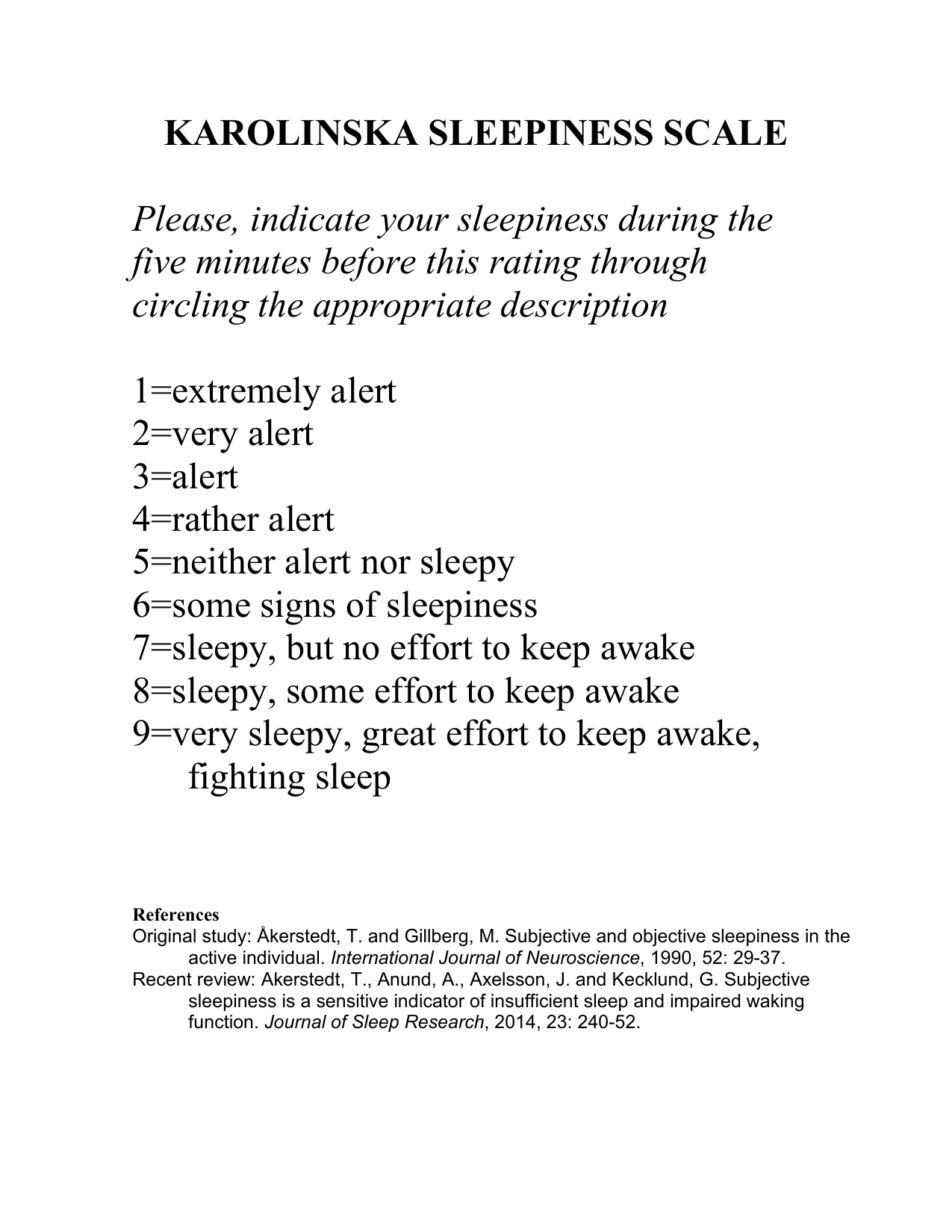
Karolinska Sleepiness Scale (KSS)
The Karolinska Sleepiness Scale is a single item, nine point self-rating of sleepiness over the preceding few minutes, from extremely alert to fighting sleep. Because it captures momentary state, it is repeated through a shift, a drive or a study session, and it tracks physiological signs of sleepiness closely.
Category
Disease
Source
What is the Karolinska Sleepiness Scale

The person chooses the description that best matches how they have felt over the last five to ten minutes, on a scale from 1, extremely alert, through 5, neither alert nor sleepy, to 9, very sleepy, great effort to keep awake, fighting sleep. The original version labels the odd numbered steps only; a version with every step labelled is also widely used, and the two should not be mixed within a study.
The scale answers a different question from the Epworth Sleepiness Scale. The Epworth asks how likely a person is to doze in everyday situations in general, which is a trait. The Karolinska asks how sleepy they are at this moment, which rises and falls with time awake, time of day, sleep loss and medication. That is why it is the usual choice in shift work, driving and sleep deprivation research, where the question is when sleepiness becomes dangerous rather than who is sleepy in general.
The rating is recorded as a single number from 1 to 9 with the time it was taken. There is no total and no single normal range, because the value is expected to change: the analysis is of the pattern across repeated ratings within a person.
In the original work, higher ratings were accompanied by increases in EEG alpha and theta activity and slow eye movements, and ratings of 7 and above are where physiological signs of sleepiness and performance lapses become common. That relationship is the scale's main strength, but it does not make a single rating a safety test. People underestimate their own impairment after prolonged sleep loss, so studies with safety outcomes pair it with an objective measure such as the psychomotor vigilance task.
Advantages
.svg)
Tracks patient condition changes systematically.
.svg)
Quick completion with minimal burden.
.svg)
Simple to understand and complete for patients.
.svg)
Monitors clinical data throughout extended study periods.
.png)

Related Instruments

Digital counterpart
Digital biomarkers that measure the same thing with sensors rather than a questionnaire.
Collect Karolinska Sleepiness Scale data with WeGuide, the all in one patient engagement platform
.jpg)

Support Your patient in no time - all under your own brand
Our platform combines the knowledge of 100+ digital health solutions built, letting you easily build your patient engagement app for research or clinical use. Collect PROMs, support patients on waiting lists, or gather vital signs data. This is how:
Learn More.png)
Program Builder
.png)
.png)
Whitelabelling
.svg)
.svg)
.png)
Turn on components, dependent on your usecase
.svg)
.png)
Support The Full Journey
.png)
.png)
%20(1).png)
.png)
It’s your turn
Every WeGuide project, saves researchers and clinicians - 9 months and $450,000 - creating impactful digital health solutions.
