


Medical Outcomes Study Social Support Survey (MOS-SSS)
This self-report tool assesses social support for patients with chronic conditions. It helps clinicians understand the emotional and practical help available to an individual.

Medical Outcomes Study Social Support Survey (MOS-SSS)
The Medical Outcomes Study Social Support Survey (MOS-SSS) is a brief self-report tool that measures available social support. It assesses emotional and tangible dimensions, helping clinicians evaluate a patient's network. This insight is essential for managing chronic illness and improving health outcomes.
Category
Disease
Source
What is Medical Outcomes Study Social Support Survey (MOS-SSS)

The Medical Outcomes Study Social Support Survey (MOS-SSS) is a reliable tool for measuring the social support available to patients with chronic health issues. This brief self report survey uses nineteen items to look at different types of functional support, focusing on perceived availability rather than just received help. It covers four main areas including emotional and informational backing, tangible help, affectionate support, and positive social interaction. Patients rate how often support is available on a simple five point scale ranging from none of the time to all of the time. Clinicians find it easy to use because it takes only a few minutes to complete. It is reliable for spotting gaps in a patient's support network which helps in planning better care. The survey works well in both research settings and clinical practice to improve health outcomes over the long term.
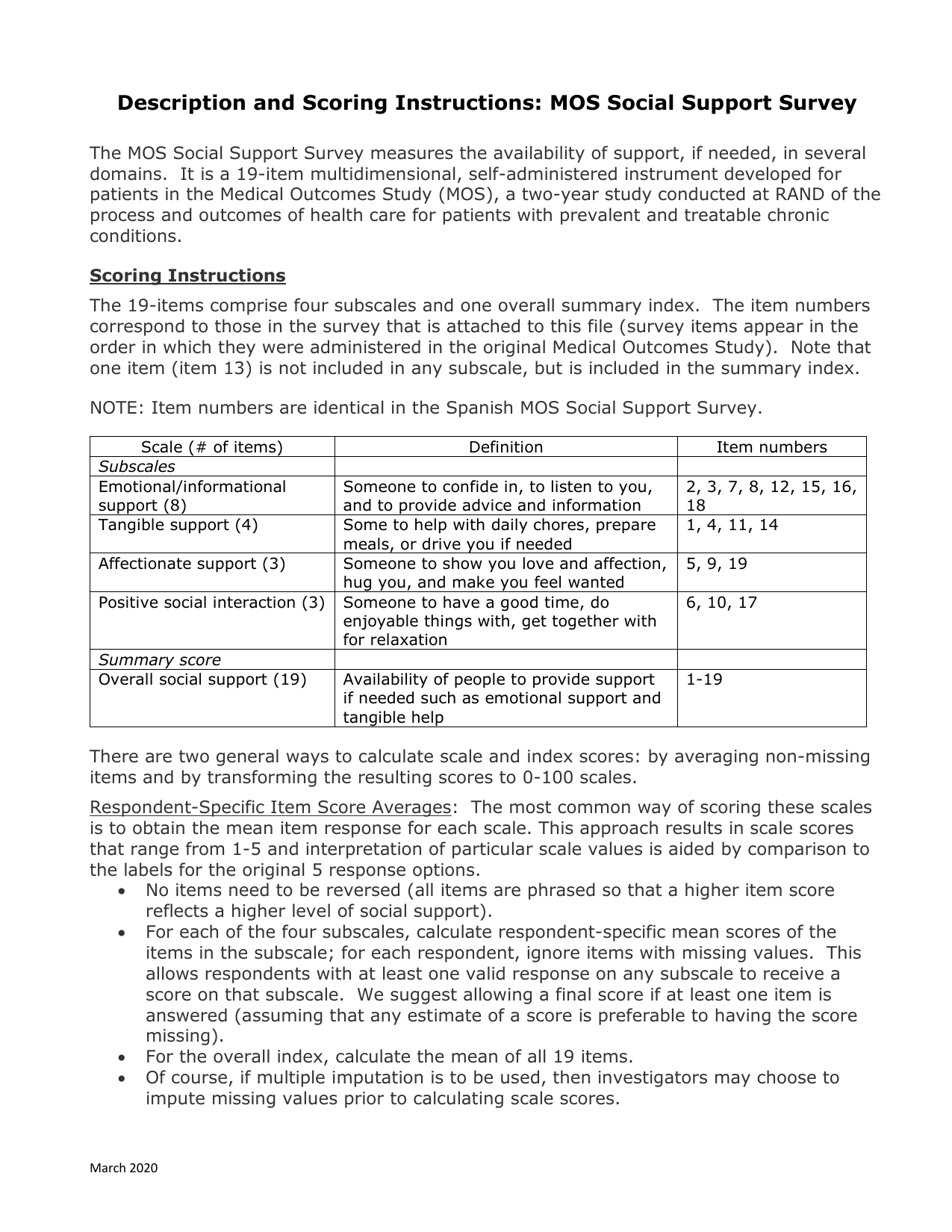
The MOS-SSS can be scored using two main approaches: calculating subscales and determining an overall support index. 1. Subscale Scoring: You will group items into four dimensions like emotional or tangible support. Simply average the responses in each group and transform them to a 0 to 100 scale using a standard formula. 2. Overall Support Index: This gives a big picture view by averaging all 19 functional items together. Once transformed to that 0 to 100 range, a higher score means the patient has better social backing. It is a handy way to spot who needs a bit of extra help.
Advantages
.svg)
Provides consistent measurements for clinical research.
.svg)
Serves diverse clinical needs effectively.
.svg)
Streamlines research data gathering process.

Develops personalised strategies based on assessment data.
.png)

Related Instruments

Digital counterpart
Digital biomarkers that measure the same thing with sensors rather than a questionnaire.
Streamline Medical Outcomes Study Social Support Survey collection with WeGuide
.jpg)

Support Your patient in no time - all under your own brand
Our platform combines the knowledge of 100+ digital health solutions built, letting you easily build your patient engagement app for research or clinical use. Collect PROMs, support patients on waiting lists, or gather vital signs data. This is how:
Learn More.png)
Program Builder
.png)
.png)
Whitelabelling
.svg)
.svg)
.png)
Turn on components, dependent on your usecase
.svg)
.png)
Support The Full Journey
.png)
.png)
%20(1).png)
.png)
It’s your turn
Every WeGuide project, saves researchers and clinicians - 9 months and $450,000 - creating impactful digital health solutions.
