


The Obsessive-Compulsive Inventory - Revised (OCI-R)
The OCI-R helps clinicians measure the severity of obsessive compulsive disorder symptoms. This self-report tool tracks behaviours like checking and washing to support treatment planning.

Obsessive-Compulsive Inventory - Revised (OCI-R)
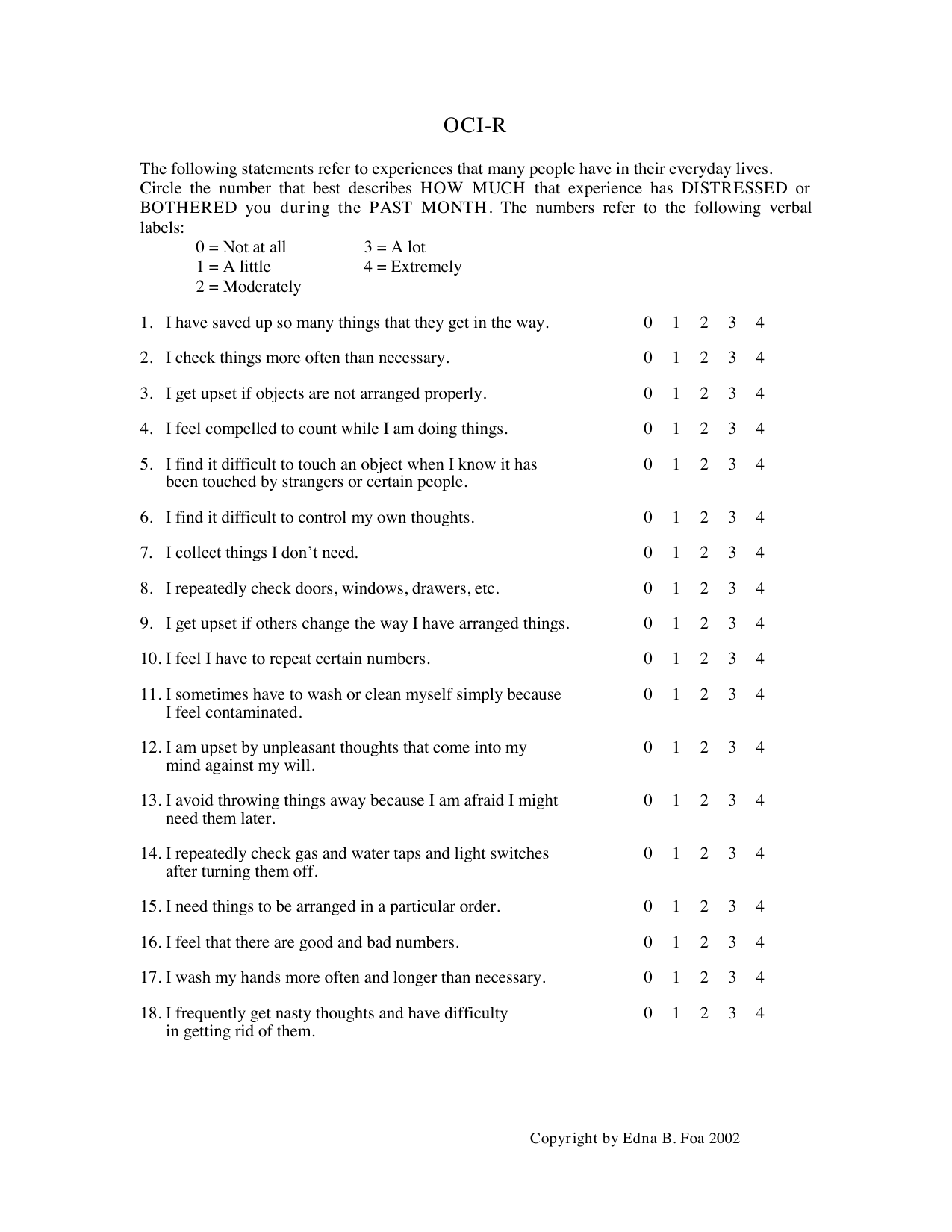
The Obsessive-Compulsive Inventory - Revised (OCI-R) is a short self-report scale for assessing OCD symptom severity. With just 18 items, it evaluates distress across areas like washing and checking. It's a reliable tool that helps clinicians screen patients and track their progress during therapy.
Category
Disease
Source
What is Obsessive-Compulsive Inventory - Revised (OCI-R)

The Obsessive-Compulsive Inventory - Revised (OCI-R) is a reliable tool for measuring OCD symptoms. It helps clinicians spot symptom severity quickly. This concise 18-item self-report scale streamlines the assessment process. It focuses on common experiences of distress linked to obsessive-compulsive disorder in daily life. The inventory covers six distinct subscales like washing, checking, ordering, obsessing, hoarding and neutralising. Patients rate how much they are bothered by these issues on a clear 0 to 4 scale, which makes it easy to track specific problem areas accurately. Clinicians love that it takes only about five minutes to finish. It is fantastic for initial screening and checking how well treatment is working over time. The OCI-R offers strong reliability and works well in clinical or research settings to guide therapy decisions effectively for better outcomes.
The Obsessive-Compulsive Inventory - Revised can be scored using two main approaches: the Total Score and Subscale Scores. 1. Total Score: You simply add up ratings from all 18 items, where answers range from 0 for not at all to 4 for extremely. This gives a global measure of symptom severity between 0 and 72. A total of 21 or higher usually suggests the likely presence of OCD. 2. Subscale Scores: This method breaks things down into six specific symptom types including washing, checking, ordering, obsessing, hoarding, and neutralising. You sum the three items in each group to get a score between 0 and 12 per domain, helping clinicians spot specific trouble areas.
Advantages

Enables precise identification of patient health status.
.svg)
Streamlines research data gathering process.

Develops personalised strategies based on assessment data.
.svg)
Measures healthcare intervention results systematically.
.png)

Related Instruments

Digital counterpart
Digital biomarkers that measure the same thing with sensors rather than a questionnaire.
Collect Obsessive-Compulsive Inventory - Revised (OCI-R) data with WeGuide
.jpg)

Support Your patient in no time - all under your own brand
Our platform combines the knowledge of 100+ digital health solutions built, letting you easily build your patient engagement app for research or clinical use. Collect PROMs, support patients on waiting lists, or gather vital signs data. This is how:
Learn More.png)
Program Builder
.png)
.png)
Whitelabelling
.svg)
.svg)
.png)
Turn on components, dependent on your usecase
.svg)
.png)
Support The Full Journey
.png)
.png)
%20(1).png)
.png)
It’s your turn
Every WeGuide project, saves researchers and clinicians - 9 months and $450,000 - creating impactful digital health solutions.
