


McGill Pain Questionnaire (MPQ): Measuring Pain Quality
The McGill Pain Questionnaire helps patients describe the quality and intensity of their pain. Doctors use this self-report tool to assess pain levels and monitor treatment progress.

McGill Pain Questionnaire (MPQ)
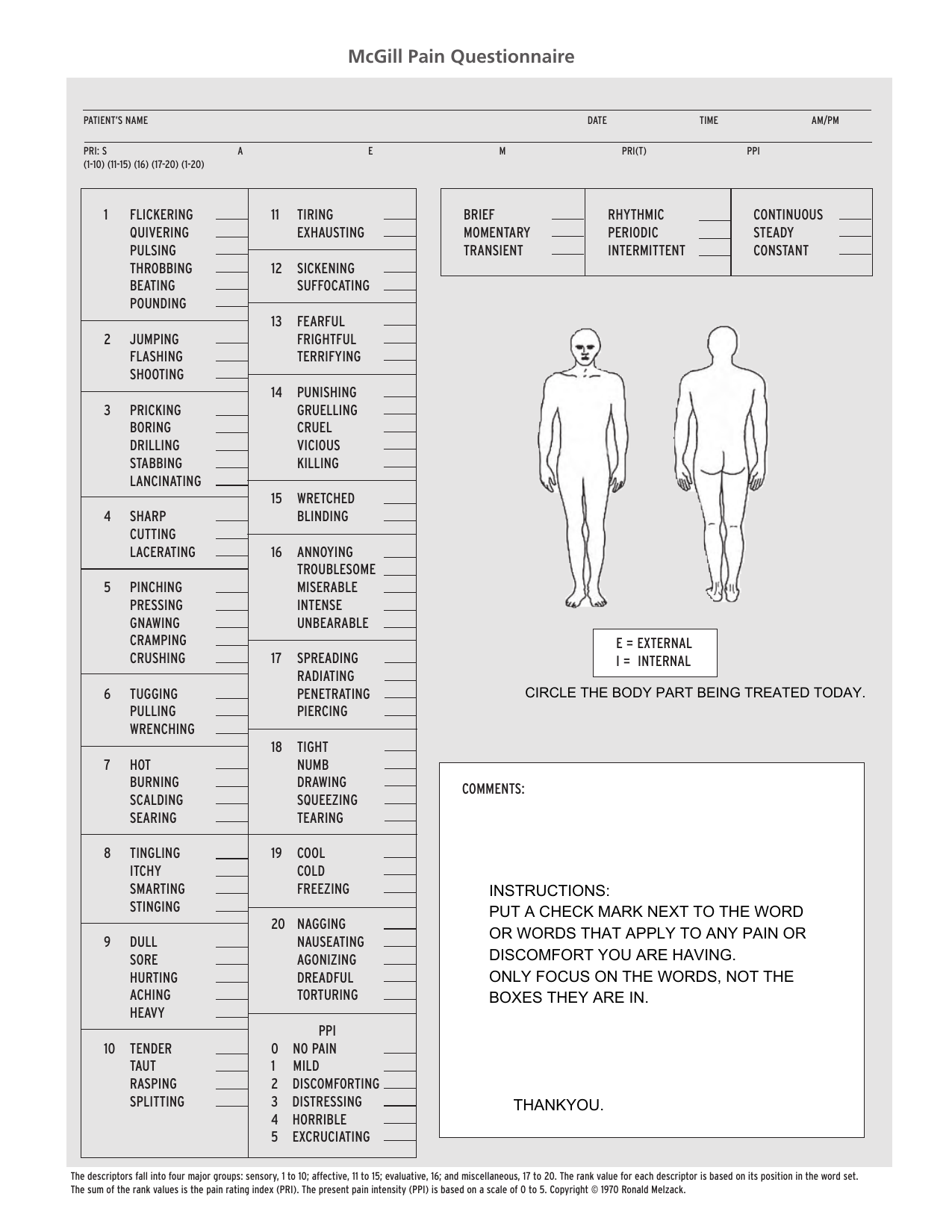
The McGill Pain Questionnaire (MPQ) is a key tool for assessing pain quality and intensity. It lets patients select words that describe their sensory and emotional experiences. This helps clinicians understand the nature of the pain, supporting accurate diagnosis and treatment planning.
Category
Disease
Source
What is McGill Pain Questionnaire (MPQ)

The McGill Pain Questionnaire (MPQ) is a trusted tool for assessing pain. It helps clinicians grasp the quality plus intensity of a patient's discomfort effectively. This scale uses three main parts to build a full picture. It features a body chart to locate hurt, a list of descriptive words, and a simple intensity score to measure severity. Patients pick from 78 words grouped into twenty sets. These cover sensory, affective, and evaluative feelings like throbbing or fearful. The choices calculate a Pain Rating Index to show exactly how the pain impacts their daily life. Doctors use it for chronic issues like arthritis or back pain. It is easy to fill out and gives reliable data for tracking changes over time. Since it is self-reported, it gives patients a real voice. This makes it handy for planning treatments that truly hit the mark in busy clinical settings.
The McGill Pain Questionnaire can be scored using three main approaches to measure pain experience. 1. Pain Rating Index (PRI): You calculate this by summing rank values of selected words across sensory, affective, and evaluative categories. It gives a solid look at pain quality. 2. Number of Words Chosen (NWC): This is a simple count of all descriptors selected by the patient to show symptom burden. 3. Present Pain Intensity (PPI): This uses a 0 to 5 scale, ranging from no pain to excruciating, to capture current pain levels. These metrics help clinicians track patient progress.

Advantages

Enables precise identification of patient health status.
.svg)
Measures healthcare intervention results systematically.
.svg)
Promotes active participation in healthcare assessment.
.svg)
Strengthens evidence through systematic measurement approaches.
.png)

Related Instruments

Digital counterpart
Digital biomarkers that measure the same thing with sensors rather than a questionnaire.
Collect McGill Pain Questionnaire data with WeGuide, the all in one patient engagement platform
.jpg)

Support Your patient in no time - all under your own brand
Our platform combines the knowledge of 100+ digital health solutions built, letting you easily build your patient engagement app for research or clinical use. Collect PROMs, support patients on waiting lists, or gather vital signs data. This is how:
Learn More.png)
Program Builder
.png)
.png)
Whitelabelling
.svg)
.svg)
.png)
Turn on components, dependent on your usecase
.svg)
.png)
Support The Full Journey
.png)
.png)
%20(1).png)
.png)
It’s your turn
Every WeGuide project, saves researchers and clinicians - 9 months and $450,000 - creating impactful digital health solutions.
