


Marx Activity Rating Scale: Measuring Knee Activity
The Marx Activity Rating Scale measures physical activity levels in patients with knee injuries. This self-report tool tracks movements like running and pivoting to help doctors monitor recovery.

Marx Activity Rating Scale
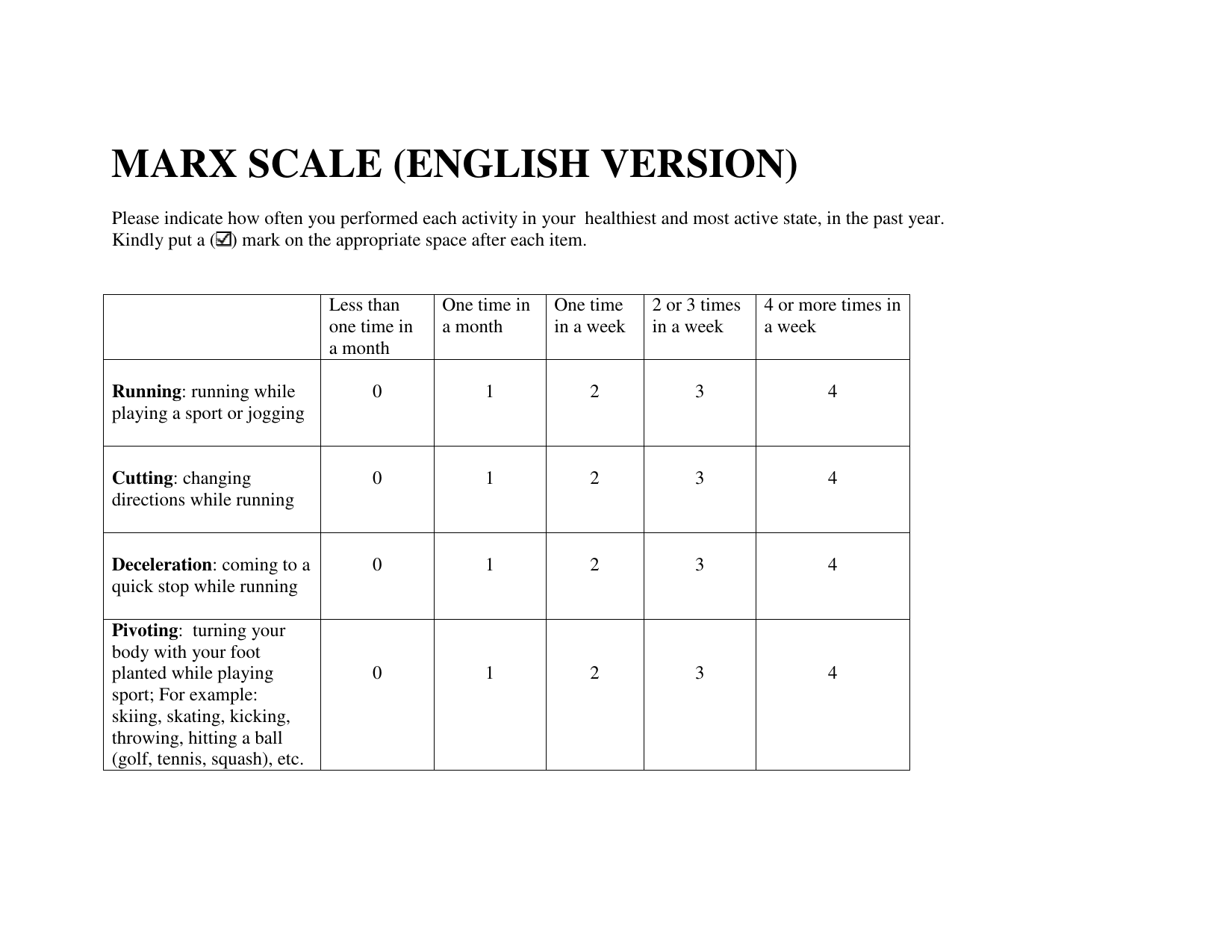
Used to assess knee function, the Marx Activity Rating Scale evaluates a patient's ability to perform high-level physical tasks. It focuses on the frequency of running, cutting, decelerating, and pivoting. This questionnaire helps clinicians monitor activity levels after knee injuries.
Category
Disease
Source
What is Marx Activity Rating Scale

The Marx Activity Rating Scale is a top choice for checking knee function. It helps clinicians track high-level activity levels in patients with knee issues. This short survey focuses on four specific movements that put stress on the joint. It looks closely at running, cutting, decelerating, and pivoting actions during sport. Patients rate how often they perform these tasks on a simple frequency scale. Scores range from zero to four for each item based on weekly or monthly habits. The total score goes up to sixteen, where higher numbers show the person is very active and physically fit. It is really quick to finish so it fits well in busy clinics. Doctors use it often for ACL injuries to see if treatments worked well. It helps physios plan rehab and get athletes back to sport safely. This tool is a reliable way to measure progress and guide future recovery choices effectively.
The Marx Activity Rating Scale can be scored using one main approach that focuses on physical frequency. You look at four specific movements: running, cutting, decelerating, and pivoting. Patients rate how often they do these things on a scale from 0 to 4. A 0 means less than once a month, while a 4 stands for four or more times a week. To get the final result, you simply add up the points for a total score between 0 and 16. Higher numbers mean the patient is more active, which is helpful for tracking recovery after knee surgery.
Advantages
.svg)
Measures treatment effectiveness through standardised tools.
.svg)
Streamlines research data gathering process.
.svg)
Provides consistent measurements for clinical research.
.svg)
Strengthens evidence through systematic measurement approaches.
.png)

Related Instruments

Digital counterpart
Digital biomarkers that measure the same thing with sensors rather than a questionnaire.
Streamline your Marx Activity Rating Scale data collection with WeGuide
.jpg)

Support Your patient in no time - all under your own brand
Our platform combines the knowledge of 100+ digital health solutions built, letting you easily build your patient engagement app for research or clinical use. Collect PROMs, support patients on waiting lists, or gather vital signs data. This is how:
Learn More.png)
Program Builder
.png)
.png)
Whitelabelling
.svg)
.svg)
.png)
Turn on components, dependent on your usecase
.svg)
.png)
Support The Full Journey
.png)
.png)
%20(1).png)
.png)
It’s your turn
Every WeGuide project, saves researchers and clinicians - 9 months and $450,000 - creating impactful digital health solutions.
