


The Fugl-Meyer Assessment - Lower Extremity (FMA-LE)
The FMA-LE evaluates lower limb movement and balance in stroke survivors. Therapists use this physical test to track motor recovery and guide rehabilitation plans.

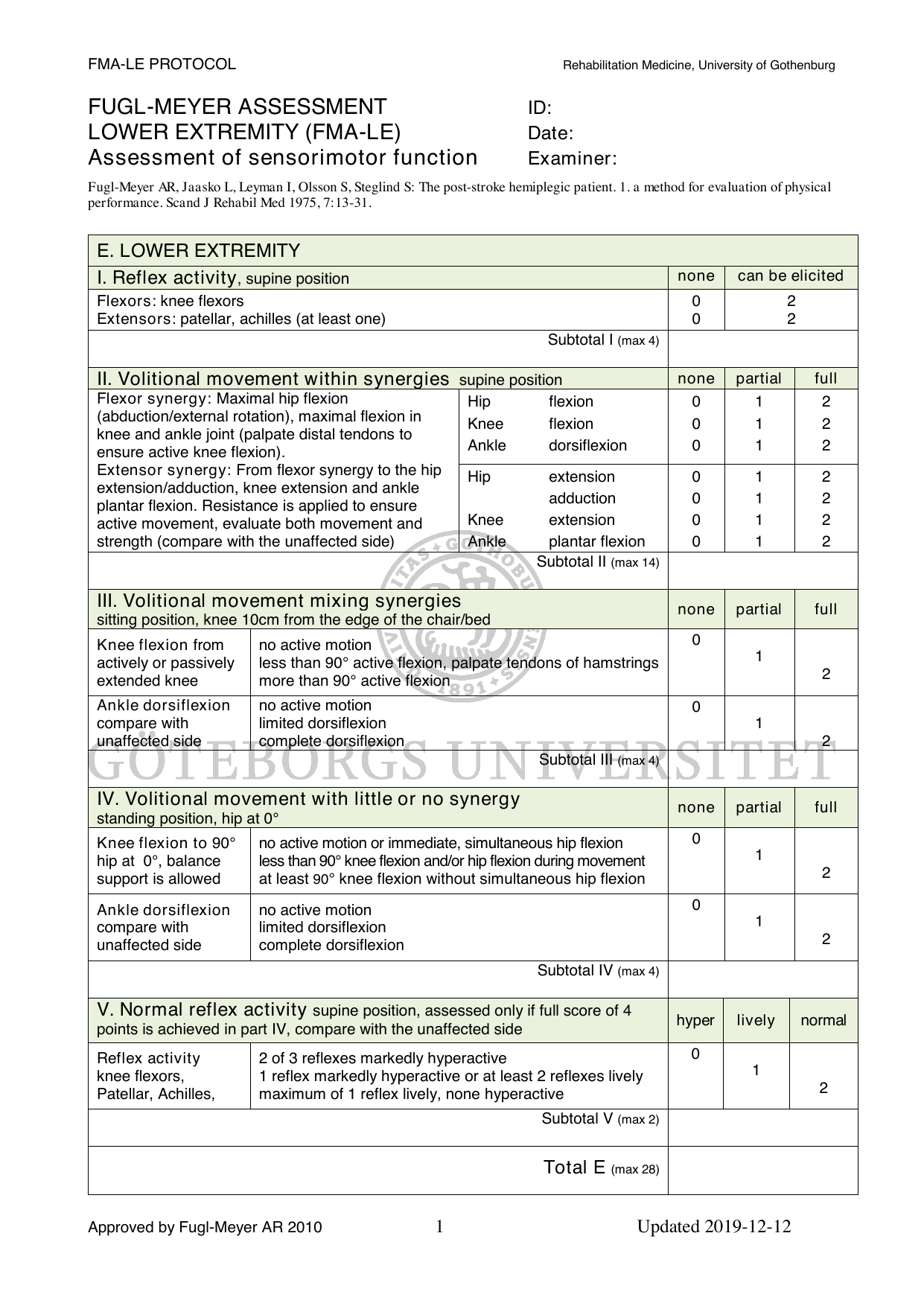
Fugl-Meyer Assessment - Lower Extremity (FMA-LE)
The Fugl-Meyer Assessment - Lower Extremity (FMA-LE) is a standard scale used to evaluate motor recovery following a stroke. It measures movement, coordination, and reflexes in the legs to help clinicians track progress. This tool is essential for planning effective rehabilitation.
Category
Disease
Source
What is Fugl-Meyer Assessment - Lower Extremity (FMA-LE)

The Fugl-Meyer Assessment - Lower Extremity (FMA-LE) is a top tool for checking leg movement after a stroke. It helps clinicians track recovery progress. This scale looks closely at hip, knee, and ankle function. It breaks down complex movements into smaller steps to see how well muscles work together or apart during rehab. Therapists score items on a simple three-point scale from zero to two. A zero means the action cannot be done at all, while a two shows full movement. It covers reflexes and coordination to give a clear picture of motor control plus balance issues. It takes roughly 20 minutes to finish and is widely used in hospitals plus research settings. The results help physios plan specific exercises to improve walking and stability. It is highly reliable for measuring changes over time, making it a smart choice for tracking stroke outcomes in daily practice.
The Fugl-Meyer Assessment - Lower Extremity (FMA-LE) can be scored using one main cumulative approach:1. Cumulative Scoring: Clinicians rate items on a three point ordinal scale, where 0 means the patient cannot do the task, 1 indicates partial completion, and 2 shows full performance. You add these values to get a total motor score ranging from 0 to 34. This covers reflexes, movement synergies, and coordination speed. Higher totals suggest better motor recovery following a stroke, making it a reliable way for physios to track rehabilitation progress in a clinical setting.

Advantages
.svg)
Provides consistent measurements for clinical research.
.svg)
Measures healthcare intervention results systematically.
.svg)
Meets international clinical assessment requirements.

Develops personalised strategies based on assessment data.
.png)

Related Instruments

Digital counterpart
Digital biomarkers that measure the same thing with sensors rather than a questionnaire.
Collect Fugl-Meyer LE data with WeGuide, the all in one patient engagement platform
.jpg)

Support Your patient in no time - all under your own brand
Our platform combines the knowledge of 100+ digital health solutions built, letting you easily build your patient engagement app for research or clinical use. Collect PROMs, support patients on waiting lists, or gather vital signs data. This is how:
Learn More.png)
Program Builder
.png)
.png)
Whitelabelling
.svg)
.svg)
.png)
Turn on components, dependent on your usecase
.svg)
.png)
Support The Full Journey
.png)
.png)
%20(1).png)
.png)
It’s your turn
Every WeGuide project, saves researchers and clinicians - 9 months and $450,000 - creating impactful digital health solutions.
