



Cumberland Ankle Instability Tool (CAIT): Ankle Assessment
The Cumberland Ankle Instability Tool measures ankle stability during daily activities and sport. This questionnaire helps clinicians identify functional instability and track patient recovery.

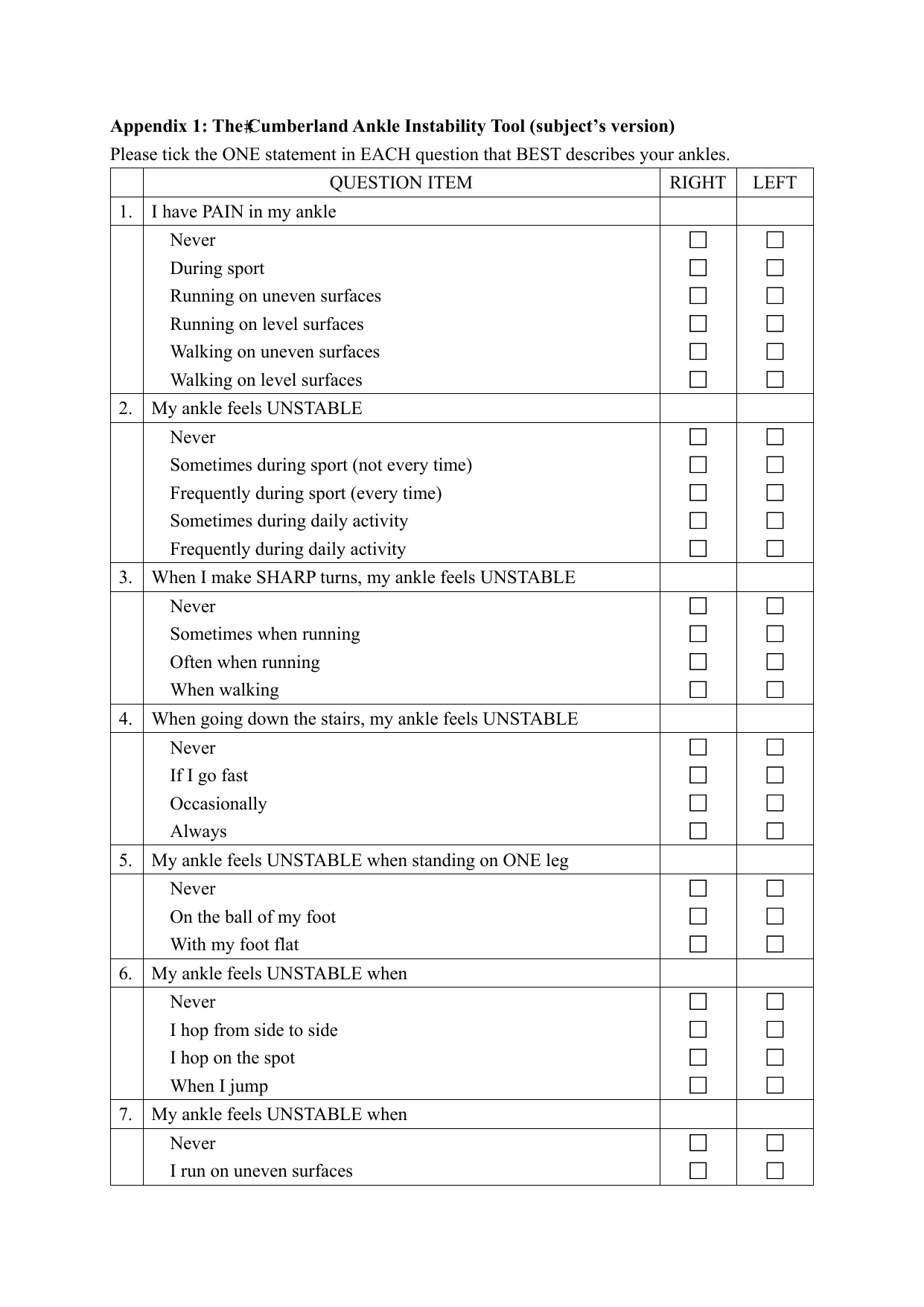
Cumberland Ankle Instability Tool (CAIT)
The Cumberland Ankle Instability Tool (CAIT) is a nine-item questionnaire used to measure the severity of functional ankle instability. Scored out of 30, it helps clinicians evaluate a patient's perception of stability during daily activities. It's a reliable way to identify chronic ankle issues and effectively monitor rehabilitation progress.
Category
Disease
Source
What is Cumberland Ankle Instability Tool (CAIT)

The Cumberland Ankle Instability Tool (CAIT) is a reliable questionnaire for measuring the severity of functional ankle instability in patients. It helps clinicians spot how bad an ankle problem really is. This nine item survey focuses on specific feelings of giving way and rolling over during daily movement. Patients answer questions about pain and stability while walking, running, or hopping. The scoring ranges from 0 to 30, where lower numbers mean the ankle is much less stable. It is simple to score and covers both left and right sides separately to ensure accuracy. You can use this tool in clinics or sports settings to track recovery over time. It is great for sorting out who needs rehab and checking if treatment works well. Since it is self reported, patients give their own view on how their ankle holds up during tricky tasks like turning or jumping.

The Cumberland Ankle Instability Tool can be scored using one main approach based on item summation. You simply tally up responses from nine questions covering daily activities and sport. Each answer gets a specific point value, and you add them all up to get a final total between 0 and 30. Higher numbers mean your ankle is stable, while lower ones suggest functional instability. Most clinicians reckon a score of 27 or less points to a wobbly ankle that needs looking at. It is a top way to track how well an ankle holds up over time.

Advantages

Enables precise identification of patient health status.
.svg)
Provides consistent measurements for clinical research.
.svg)
Measures healthcare intervention results systematically.
.svg)
Streamlines research data gathering process.
.png)

Related Instruments

Digital counterpart
Digital biomarkers that measure the same thing with sensors rather than a questionnaire.
Streamline Cumberland Ankle Instability Tool assessments with WeGuide
.jpg)

Support Your patient in no time - all under your own brand
Our platform combines the knowledge of 100+ digital health solutions built, letting you easily build your patient engagement app for research or clinical use. Collect PROMs, support patients on waiting lists, or gather vital signs data. This is how:
Learn More.png)
Program Builder
.png)
.png)
Whitelabelling
.svg)
.svg)
.png)
Turn on components, dependent on your usecase
.svg)
.png)
Support The Full Journey
.png)
.png)
%20(1).png)
.png)
It’s your turn
Every WeGuide project, saves researchers and clinicians - 9 months and $450,000 - creating impactful digital health solutions.
