


Knee Outcome Survey (KOS): Assessing Knee Function
The Knee Outcome Survey allows patients to rate knee symptoms and their ability to manage daily tasks. This questionnaire helps clinicians track recovery and guide treatment for knee injuries.

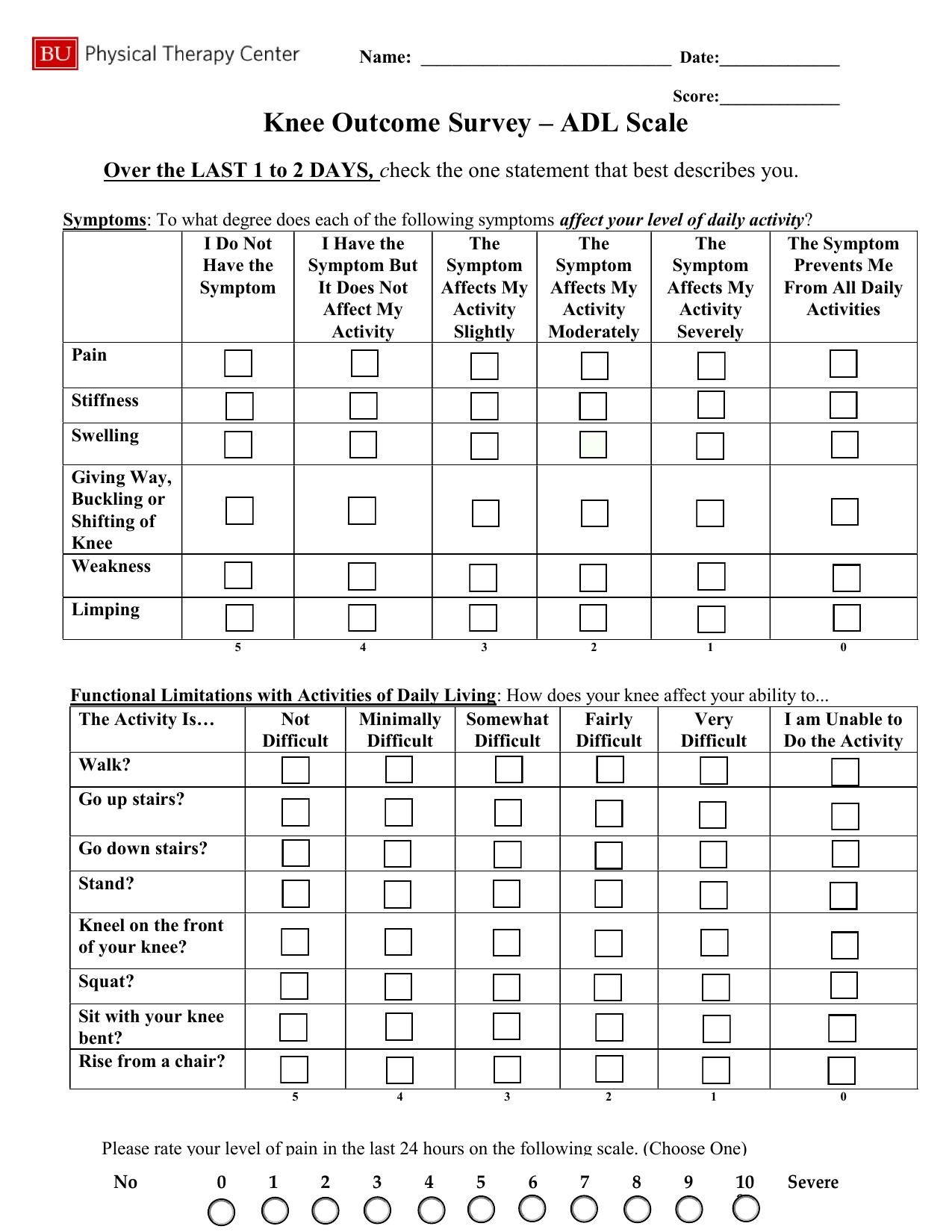
Knee Outcome Survey (KOS)
The Knee Outcome Survey (KOS) evaluates symptoms and functional limits caused by knee disorders. This patient-reported tool assesses how injuries impact daily living and sports. It helps clinicians monitor rehabilitation progress, ensuring treatment plans effectively support a patient's full recovery.
Category
Disease
Source
What is Knee Outcome Survey (KOS)

The Knee Outcome Survey (KOS) is a trusted tool for tracking knee health. It helps clinicians see how knee issues affect a patient's daily life. This questionnaire focuses on specific symptoms and functional limits. It mainly uses the Activities of Daily Living Scale to check regular daily movement. Patients rate how hard it is to walk, climb stairs, or squat. They answer questions about pain, stiffness, and swelling using a simple graded scale. The scores range from zero to 100, where higher numbers mean better function and less disability for the user. It is easy to use in busy clinics and works well for different knee problems like ligament tears or osteoarthritis. Physios love it because it is quick to score and gives clear data to guide treatment plans. This makes it easier to spot progress during rehab and get people back on their feet sooner.
The Knee Outcome Survey can be scored using one main approach: the percentage calculation method. 1. Percentage Calculation: You'll start by assigning points to items on the Activities of Daily Living Scale, rating them 0 to 5. Here, 5 means no drama at all and 0 means you simply can't do the task. Add these up for a raw total, then divide by the maximum possible score and multiply by 100. This gives a final rating between 0 and 100 percent. Higher scores show better knee function, helping physios track how well a patient is tracking with their rehab.
Advantages
.svg)
Measures healthcare intervention results systematically.
.svg)
Provides consistent measurements for clinical research.

Develops personalised strategies based on assessment data.
.svg)
Simple to understand and complete for patients.
.png)

Related Instruments

Digital counterpart
Digital biomarkers that measure the same thing with sensors rather than a questionnaire.
Collect Knee Outcome Survey data with WeGuide, the all in one patient engagement platform
.jpg)

Support Your patient in no time - all under your own brand
Our platform combines the knowledge of 100+ digital health solutions built, letting you easily build your patient engagement app for research or clinical use. Collect PROMs, support patients on waiting lists, or gather vital signs data. This is how:
Learn More.png)
Program Builder
.png)
.png)
Whitelabelling
.svg)
.svg)
.png)
Turn on components, dependent on your usecase
.svg)
.png)
Support The Full Journey
.png)
.png)
%20(1).png)
.png)
It’s your turn
Every WeGuide project, saves researchers and clinicians - 9 months and $450,000 - creating impactful digital health solutions.
